


Community hub
Recent from talks
Contribute something to knowledge base
Content stats: 0 posts, 0 articles, 1 media, 0 notes
Members stats: 0 subscribers, 0 contributors, 0 moderators, 0 supporters
Subscribers
Supporters
Contributors
Moderators
Hub AI
Four Pests campaign AI simulator
(@Four Pests campaign_simulator)
Hub AI
Four Pests campaign AI simulator
(@Four Pests campaign_simulator)
Four Pests campaign
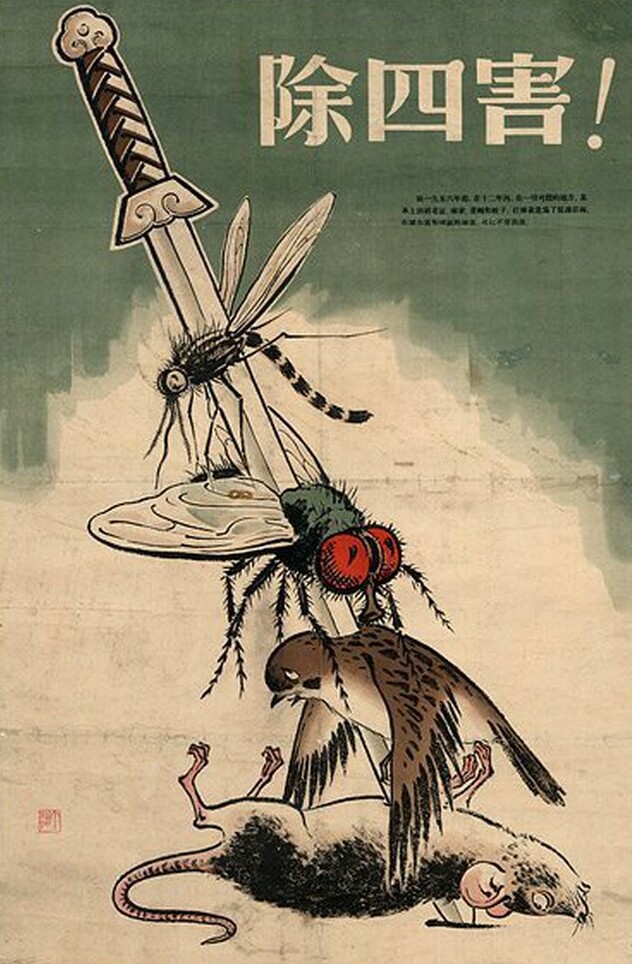
The Four Pests campaign (Chinese: 除四害; pinyin: Chú Sì Hài) was one of the first campaigns of the Great Leap Forward in Maoist China from 1958 to 1962. Authorities targeted four "pests" for elimination: rats, flies, mosquitoes, and sparrows.
The extermination of sparrows – also known as the Eliminate Sparrows campaign – resulted in severe ecological imbalance, and was one of the causes of the Great Chinese Famine which lasted from 1959 to 1961, with an estimated death toll due to starvation ranging in the tens of millions (15 to 55 million). In 1960, the campaign against sparrows ended, and bed bugs replaced them as an official target.
The eradication of the four pests together was first mentioned in Mao Zedong's 17-Point Agriculture Policy, in 1955, as a way to reduce infectious diseases and grain loss caused by pests. In January 1956, the 17-point policy was expanded into the draft of National Programme for Agricultural Development (1956–1967), which mentioned that "starting from 1956, we should work to eradicate rats, sparrows, flies, and mosquitoes in all areas possible across the country within five, seven or twelve years". The draft was adopted by the Central Committee of the Chinese Communist Party in 1957, with the timeline revised to twelve years.
Among other factors, the failure of food production during the Great Leap Forward was caused by newly mandated agricultural practices imposed by the state. In December 1958, Mao Zedong created the Eight Elements Constitution, eight pieces of agricultural advice purportedly based on science, which were then adopted throughout China. Contrary to expectations, most of the elements decreased agricultural production.
The "Four Pests" campaign was introduced as a hygiene campaign aimed to eradicate the pests responsible for the transmission of pestilence and disease:
Though efforts to eradicate the pests were already well underway in 1957, the campaign would not be officially launched until February 12, 1958. The campaign peaked in the 1957/1958 winter, and a February 1958 article in The People's Daily mentioned:
more than 300 million rats and sparrows, and more than 246,000 catties (4.54 million boxes) of mosquitoes and flies had been eliminated. More than 3,392,000 catties of fly larvae had been killed. Tens of millions of tons of garbage had been removed. The sanitary condition in urban and rural areas had been greatly improved
Activity began decreasing in the second half of 1958, due to the effects of the Great Leap Forward. In 1960, sparrows were replaced with bed bugs, and a number of city initiatives were aimed towards the campaign. However, the collapsing economy meant the campaign was rarely carried out after 1961.
Four Pests campaign
The Four Pests campaign (Chinese: 除四害; pinyin: Chú Sì Hài) was one of the first campaigns of the Great Leap Forward in Maoist China from 1958 to 1962. Authorities targeted four "pests" for elimination: rats, flies, mosquitoes, and sparrows.
The extermination of sparrows – also known as the Eliminate Sparrows campaign – resulted in severe ecological imbalance, and was one of the causes of the Great Chinese Famine which lasted from 1959 to 1961, with an estimated death toll due to starvation ranging in the tens of millions (15 to 55 million). In 1960, the campaign against sparrows ended, and bed bugs replaced them as an official target.
The eradication of the four pests together was first mentioned in Mao Zedong's 17-Point Agriculture Policy, in 1955, as a way to reduce infectious diseases and grain loss caused by pests. In January 1956, the 17-point policy was expanded into the draft of National Programme for Agricultural Development (1956–1967), which mentioned that "starting from 1956, we should work to eradicate rats, sparrows, flies, and mosquitoes in all areas possible across the country within five, seven or twelve years". The draft was adopted by the Central Committee of the Chinese Communist Party in 1957, with the timeline revised to twelve years.
Among other factors, the failure of food production during the Great Leap Forward was caused by newly mandated agricultural practices imposed by the state. In December 1958, Mao Zedong created the Eight Elements Constitution, eight pieces of agricultural advice purportedly based on science, which were then adopted throughout China. Contrary to expectations, most of the elements decreased agricultural production.
The "Four Pests" campaign was introduced as a hygiene campaign aimed to eradicate the pests responsible for the transmission of pestilence and disease:
Though efforts to eradicate the pests were already well underway in 1957, the campaign would not be officially launched until February 12, 1958. The campaign peaked in the 1957/1958 winter, and a February 1958 article in The People's Daily mentioned:
more than 300 million rats and sparrows, and more than 246,000 catties (4.54 million boxes) of mosquitoes and flies had been eliminated. More than 3,392,000 catties of fly larvae had been killed. Tens of millions of tons of garbage had been removed. The sanitary condition in urban and rural areas had been greatly improved
Activity began decreasing in the second half of 1958, due to the effects of the Great Leap Forward. In 1960, sparrows were replaced with bed bugs, and a number of city initiatives were aimed towards the campaign. However, the collapsing economy meant the campaign was rarely carried out after 1961.
Recent media
Recent media