



Community hub
Recent from talks
Contribute something to knowledge base
Content stats: 0 posts, 0 articles, 1 media, 0 notes
Members stats: 0 subscribers, 0 contributors, 0 moderators, 0 supporters
Subscribers
Supporters
Contributors
Moderators
Hub AI
American handball AI simulator
(@American handball_simulator)
Hub AI
American handball AI simulator
(@American handball_simulator)
American handball
American handball, known as handball in the United States and sometimes referred to as wallball (although the term "one-wall handball" is being adopted to avoid confusion), is a sport in which players use their hands to hit a small, rubber ball against a wall such that their opponent(s) cannot do the same without the ball touching the ground twice or hitting out of bounds. The three versions are four-wall, three-wall and one-wall (sometimes known as wallball or international fronton). Each version can be played either by two players (singles), three players (cutthroat) or four players (doubles), but in official tournaments, singles and doubles are the only versions played.
Games in which a ball is hit or thrown have been referenced as far back as Homer and ancient Egypt. A game similar to handball was played by Northern and Central Americans from 1500 BC, most famously by the Aztecs as the Mesoamerican ballgame, but no references to a rebound game using a wall survive. It is thought that these ancient games more closely resembled a form of hand tennis. Further examples of similar games include the European-originated games of Basque pelota (or Jai-alai), Gaelic handball, Valencian frontó,[citation needed] International fronton[citation needed] and Eton fives.[citation needed]
References to similar games (then referred to as either "hand-tennis" and "hand-ball") have been found as early as 1287, when the Synod of Exeter banned the game due to the damage it caused to church buildings. Other notable examples of wall ball games being banned include Robert Braybrooke, Bishop of London, who in 1385 prohibited the game. Another recorded game of striking a ball against a wall using a hand was in Scotland in 1427, when King James I ordered a cellar window in his palace courtyard to be blocked up, as it was interfering with his game. In Ireland, the earliest written record of a similar game is in the 1527 town statutes of Galway, which forbade the playing of ball games against the walls of the town. The first depiction of an Irish form of handball does not appear until 1785. The sport of handball in Ireland was eventually standardized as Gaelic handball. By the mid-19th century, Australians were playing a similar game, which developed into the modern sport of Australian handball.
In Treacherous Beauty, by Mark Jacob and Stephen H. Case, about the Arnold-Andre conspiracy, Major John André and General Sir Henry Clinton are said to have played a game called handball during the American Revolution. The earliest record of the modern game in the United States mentions two handball courts in San Francisco in 1873. The sport grew over the next few decades. By the early 1900s, four-wall handball was well established and a one-wall game was developed in New York City by beach-goers who hit bald tennis balls with their hands against the sides of the wooden jetties that lined beaches. This led to a rise in one-wall handball at New York beaches and by the 1930s, thousands of indoor and outdoor one-wall courts had been built throughout the city. American handball is seen predominantly in parks, beaches, and high school yards in New York City, Lynbrook, New York, Philadelphia, Chicago and other large urban areas.
National championships in handball have been held annually in the United States since 1919. These championships were organized by the Amateur Athletic Union (AAU) until 1950, when their control was transferred to the newly formed United States Handball Association (USHA).
The sports of racquetball, squash, fives, four-wall and one-wall paddleball were heavily influenced by handball. Four-wall and one-wall paddleball were created when people took up wooden paddles to play on handball courts. Four-wall paddleball was invented in 1930 by Earl Riskey, a physical-education instructor at the University of Michigan, when he came up with the idea of using paddles to play on the school's handball courts. Racquetball was invented in 1949 by Joseph Sobek in Greenwich, Connecticut, when he played handball using a strung racquet.
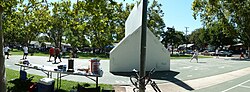
American handball is played on a walled court, with either a single (front) wall, three walls, or in a fully enclosed four-wall court; four-wall courts typically have a ceiling while three-wall courts may or may not. The four-wall court is a rectangular box. The front wall is 20 feet (6.1 m) square, and the side walls are 40 feet (12.2 m) long and 20 feet (6.1 m) high.
In the middle of the floor lies a short line, dividing the floor into two 20 feet (6.1 m) squares. Also along the floor is the service line, which is 5 feet (1.5 m) in front of the short line. The service zone is the area between these two lines. The back wall of the court is usually 12 feet (3.7 m) high, with an above gallery for the referee, scorekeeper and spectators. Some courts have a glass back wall and glass side walls to allow for better viewing. In three-wall court handball, the court often has a front wall and two full side walls, or the front wall is flanked by two triangular wings.
American handball
American handball, known as handball in the United States and sometimes referred to as wallball (although the term "one-wall handball" is being adopted to avoid confusion), is a sport in which players use their hands to hit a small, rubber ball against a wall such that their opponent(s) cannot do the same without the ball touching the ground twice or hitting out of bounds. The three versions are four-wall, three-wall and one-wall (sometimes known as wallball or international fronton). Each version can be played either by two players (singles), three players (cutthroat) or four players (doubles), but in official tournaments, singles and doubles are the only versions played.
Games in which a ball is hit or thrown have been referenced as far back as Homer and ancient Egypt. A game similar to handball was played by Northern and Central Americans from 1500 BC, most famously by the Aztecs as the Mesoamerican ballgame, but no references to a rebound game using a wall survive. It is thought that these ancient games more closely resembled a form of hand tennis. Further examples of similar games include the European-originated games of Basque pelota (or Jai-alai), Gaelic handball, Valencian frontó,[citation needed] International fronton[citation needed] and Eton fives.[citation needed]
References to similar games (then referred to as either "hand-tennis" and "hand-ball") have been found as early as 1287, when the Synod of Exeter banned the game due to the damage it caused to church buildings. Other notable examples of wall ball games being banned include Robert Braybrooke, Bishop of London, who in 1385 prohibited the game. Another recorded game of striking a ball against a wall using a hand was in Scotland in 1427, when King James I ordered a cellar window in his palace courtyard to be blocked up, as it was interfering with his game. In Ireland, the earliest written record of a similar game is in the 1527 town statutes of Galway, which forbade the playing of ball games against the walls of the town. The first depiction of an Irish form of handball does not appear until 1785. The sport of handball in Ireland was eventually standardized as Gaelic handball. By the mid-19th century, Australians were playing a similar game, which developed into the modern sport of Australian handball.
In Treacherous Beauty, by Mark Jacob and Stephen H. Case, about the Arnold-Andre conspiracy, Major John André and General Sir Henry Clinton are said to have played a game called handball during the American Revolution. The earliest record of the modern game in the United States mentions two handball courts in San Francisco in 1873. The sport grew over the next few decades. By the early 1900s, four-wall handball was well established and a one-wall game was developed in New York City by beach-goers who hit bald tennis balls with their hands against the sides of the wooden jetties that lined beaches. This led to a rise in one-wall handball at New York beaches and by the 1930s, thousands of indoor and outdoor one-wall courts had been built throughout the city. American handball is seen predominantly in parks, beaches, and high school yards in New York City, Lynbrook, New York, Philadelphia, Chicago and other large urban areas.
National championships in handball have been held annually in the United States since 1919. These championships were organized by the Amateur Athletic Union (AAU) until 1950, when their control was transferred to the newly formed United States Handball Association (USHA).
The sports of racquetball, squash, fives, four-wall and one-wall paddleball were heavily influenced by handball. Four-wall and one-wall paddleball were created when people took up wooden paddles to play on handball courts. Four-wall paddleball was invented in 1930 by Earl Riskey, a physical-education instructor at the University of Michigan, when he came up with the idea of using paddles to play on the school's handball courts. Racquetball was invented in 1949 by Joseph Sobek in Greenwich, Connecticut, when he played handball using a strung racquet.
American handball is played on a walled court, with either a single (front) wall, three walls, or in a fully enclosed four-wall court; four-wall courts typically have a ceiling while three-wall courts may or may not. The four-wall court is a rectangular box. The front wall is 20 feet (6.1 m) square, and the side walls are 40 feet (12.2 m) long and 20 feet (6.1 m) high.
In the middle of the floor lies a short line, dividing the floor into two 20 feet (6.1 m) squares. Also along the floor is the service line, which is 5 feet (1.5 m) in front of the short line. The service zone is the area between these two lines. The back wall of the court is usually 12 feet (3.7 m) high, with an above gallery for the referee, scorekeeper and spectators. Some courts have a glass back wall and glass side walls to allow for better viewing. In three-wall court handball, the court often has a front wall and two full side walls, or the front wall is flanked by two triangular wings.
Recent media
Recent media