Hubbry Logo
FivesFivesMain
Open search
Fives
Community hub
Fives
logo
8 pages, 0 posts
0 subscribers
Be the first to start a discussion here.
Contribute something
Fives
Fives
from Wikipedia

Fives (historically known as hand-tennis) is an English handball sport derived from jeu de paume, similar to the games of handball, Basque pelota, and squash. The game is played in both singles and doubles teams, in an either three- or four-sided court.

Key Information

Etymology

[edit]

The origin of the name "fives" for the game is uncertain, but two main theories are commonly presented. The first is that it is derived from the slang expression "a bunch of fives" (meaning a fist);[1] the other that an earlier form of the game, as described by Nichols, used five-a-side teams.[2]

History

[edit]

Fives is generally considered to have originated from early forms of the French Jeu de paume. Games were most often played against the walls of the north ends of churchyards,[3] or against the walls of belltowers.[4] This often damaged window glazing, so many churches adapted their exteriors to protect against the game. This often came in the form of shutters and pintles inserted into walls, as well as latticework over the windows themselves. The sport also influenced the layout of several churches; at some churches, saplings were planted where Fives would have been played,[5] at the Church of St James, Ashwick, a cross was moved "to the Vifes place... to prevent the Young People from spending so much idle time in that sort of exercise."[6]

As such, many of the earliest written testaments of the game are directives by clergy taken to prevent playing of the game. Actions against the game (then referred to as either "hand-tennis" and "hand-ball")[7] have been found as early as 1287, when the Synod of Exeter banned the game due to the damage it caused to church buildings.[8] Other notable examples of wall ball games being banned include Robert Braybrooke, Bishop of London, who in 1385 prohibited the game "Necnon ad pilam infra et extra ecclesiam ludunt." (English: Let them play ball neither inside nor outside the church.)[9]

The name "fives" was applied to the game by 1591, as when Elizabeth I visited the village of Elvetham in Hampshire, she was entertained by the Marquess of Hertford by a game played by his servants:

"about three o'clock, ten of his lordship's servants, all Somersetshire men, in a square greene court before her majesties windowe, did hang up lines, squaring out the forme of a tennis-court, and making a cross line in the middle; in this square they (being stript out of their dublets) played five to five with hand-ball at bord and cord as they tearme it, to the great liking of her highness" – John Nichols, The Progresses and Public Processions of Queen Elizabeth, Volume II.[10]

Fives wall in South Petherton, Somerset

The version of fives played here is an example of Wessex fives, the common ancestor to all modern fives games. The first known fives court was built at the base of the church tower in West Pennard, Somerset, in 1813. By this time, fives had achieved some popularity in Wales, where it was referred to as "Ffeifs" – many courts and matches were referred to as "fives courts",[5] although whether these were for playing Welsh handball is unclear.[citation needed]

In the beginning of the 19th century, fives was played as a pub game especially in Somerset, and many courts were built alongside pubs, attracting large numbers of spectators. Gambling was often present at these matches. The courts at these pubs were different from those used later in the century, consisting of a free standing wall (which were, as such, referred to as either "fives walls" or "fives towers"), occasionally with a buttress attached.[11]

During this period, John Cavanagh, reputed to be the greatest fives player of all time, gained popularity.[5] However, after around 1855, the sport experienced a serious loss of players, due to the prominence of other "more sophisticated" sports, such as squash, and was seen as old-fashioned due to its agrarian roots.[12] As described the Badminton Library:

The number of those who continue fives players after the age of twenty-five is very small; and, for obvious reasons, these veterans are usually schoolmasters. Again, fives is entirely a game for amateurs. It has no professors who make their living and their renown as its teachers or exponents. It has no matches to be reported in newspapers with a minuteness of detail suitable to events of international importance. No fives player, as such, has ever had his portrait published in an illustrated journal, or has had the meanest article of dress in the hosiers' shops named after him. Indeed, the game is not one that tends to exalt the individual player.

Fives courts at Eton

At the end of the 19th century, fives was gentrified from its origins as a rural sport to an elitist sport at public schools; codified forms of the game such as Eton fives and Rugby fives were introduced in the 1870s, which spread to schools such as Highgate, Westminster, Charterhouse and Harrow.[13] By the end of the 19th Century, fives had become a well-established sport for British public schools.[5] In the 1920s, the sport began to be played at Cambridge University. The first recorded fives match was played between Eton and Harrow in 1885 (F. Thomas and C. Barclay of Eton beat E.M. Butler and B. R. Warren of Harrow).[citation needed]

Fives continued to be played through the 20th century, but failed to develop a large nation standing. This was because it had a tradition of being a recreational sport played in free time, the large number of varieties of the game in play, and because the "more sophisticated" game of rackets was already established.[14]

Variants

[edit]
Fives court at Abingdon School

Several regional varieties of fives exist; however, most games played are either Rugby fives or Eton fives. Of the two, Etonian fives is the older, being played since the 17th century.[15] The two major variants of the game differ primarily in the construction of the court, with Eton fives including a buttress and inside the court, and an open back wall.[16]

Other variants of the game include Warminster and Winchester fives; Winchester fives has similarities to both Rugby and Etonian fives in regards to court construction, while Warminster fives dates to the late 18th century, and uses a specialised set of rules.[17] The majority of fives-playing schools have only one type of court, although three schools have historically had both Eton and Rugby courts: Cheltenham, Dover, and Marlborough.[citation needed]

Eton fives

[edit]
A buttress at the High Elms Country Park Eton fives courts

Eton fives is a form of the game which, unlike Rugby fives, is played only in doubles form. The sport was first created at Eton College (hence the name) by boys playing handball between two buttresses of the school chapel[18] with rules for the game being created in 1877 under the title "Rules of the Game of Fives as played at Eton".[citation needed]

Eton fives is played in three-sided courts around the size of a squash court[19] mimicking the sides of the school chapel, with a buttress (referred to as a "pepper-box"[20]) on the left-hand wall, and a raised step at the front of the court, extending around 80 cm into the court, at a height of 15 cm,[21] creating the "upper" and "lower" parts of the court.[22] A sloping ledge runs around the walls of the court, roughly four and a half feet from the floor, of which the bottom line is dubbed the "playline", above which shots have to be played. The upper limit of the court is the "coping" – stonework that lines the top of the walls.[23]

The first purpose-built fives courts were built at Eton College in 1840, by then headmaster Edward Craven Hawtrey, who constructed four courts mimicking the sides of the school chapel. These courts varied in a few specifications; the distance between the front wall and the buttress was increased, and the floor's slope was reduced, which quickened play speed. The courts were built of sandstone, to reproduce the effect's of the chapel's walls,[24] which are made of Taynton stone.[25]

The first Eton fives match was played on 12 February 1885, between Eton and Harrow School, playing at Harrow's fives courts.[24] Eton fives began to be played at the University of Cambridge in 1920, with varsity matches beginning in 1927.[26] The sport is regulated by the Eton Fives Association, which promotes the sport and runs tournaments annually. While Eton fives has historically been a male-dominated game, due to the public schools it was played in being single-sex, in recent years, women have begun to take a larger role in the sport, accounting for approximately 20% of games played as of 2016.[27]

Rugby fives

[edit]
Rugby fives court in Retford, Nottinghamshire (Grade II listed)

Rugby fives, nominally developed at Rugby School in Rugby is the most common variant of the sport,[28] played in both singles and doubles. The variant is derived from Wessex fives, and was brought to Rugby in the 19th century by Thomas Arnold, the then headmaster of Rugby School, who had learnt the game playing at Warminster School.[citation needed] Rugby fives is attested to in Thomas Hughes' 1857 Tom Brown's School Days, centered on the author's own experiences at Rugby, which align with the period in with Arnolds was headmaster. The sport is governed by the Rugby Fives Association, which stages multiple tournaments for the sport annually.[citation needed]

Rugby fives uses an enclosed court free from "hazards", with a hollow board running across the front wall, similar to that of squash.[29] The court has a width of 18 feet and a length of 28 feet, with the front wall having a height of 15 feet. The Rugby fives court uses a shortened back wall, which has a height of 4'10''.[30] Rugby fives is most commonly played in gloves, using a leather-clad ball with a rubber core.[31] This ball is harder than that used in Eton fives, which increases the speed of play in the game.[27]

Fives is played at several public schools throughout England, including Rugby School, Bedford School, and St Paul's School (London), as well as by the universities of Oxford[32] and Cambridge, which participate in an annual varsity match in the sport.[33] As of 2022, Rugby fives is played in two state schools, namely Stoke Newington School[34][35] (whose courts were renovated by The National Lottery in 2007[36]) and Derby Moor Academy.[37]

Winchester fives

[edit]

Winchester fives is a version of fives very similar to Rugby fives,[38] played originally at Westminster School [citation needed]. The sport has been played at Westminster since July 1886, when two courts were opened at the site.[39] The court used is almost identical to that used in Rugby fives,[40] except for a 45° change in wall direction for almost 10 inches on the left wall.[30] This makes the back of the court narrower, and creates a very small buttress similarly to that of Eton fives. This buttress also serves to diversify gameplay by allowing winning shots to be made more easily: sharp changes in direction are created by bouncing the ball off the buttress.[41] The game is played in doubles, with matches being played to either 11 or 15 points.[42]

The sport has no organisation of its own, but The Schools' Winchester Fives Doubles tournament is run yearly by the Rugby Fives Association.[43]

Warminster fives

[edit]
Fives court at Warminster School

Warminster fives, also known as West Country fives, is played at Lord Weymouth School, now Warminster School. An 1860 fives court still stands at the school and was in regular use until the 1970s.[44] The court used in Warminster fives is unique in its construction: the court is similar to a fives wall, except for two small walls jutting from the front wall at 45° angles.[17] The court itself is a grade II listed building, first being listed in 1978.[45]

Warminster fives is likely to have inspired Rugby fives: Thomas Arnold, headmaster at Rugby responsible for the introduction of the sport at the school was previously a teacher at Warminster before joining Rugby.[46]

The Warminster variety of fives also differs greatly in its rules: teams play three-a-side; one on the left, center and right sides of the court (referred to as "squif", "centre" and "skunk"). The court has dimensions of roughly 8 metres in width and depth.[46]

Bat fives

[edit]
External image
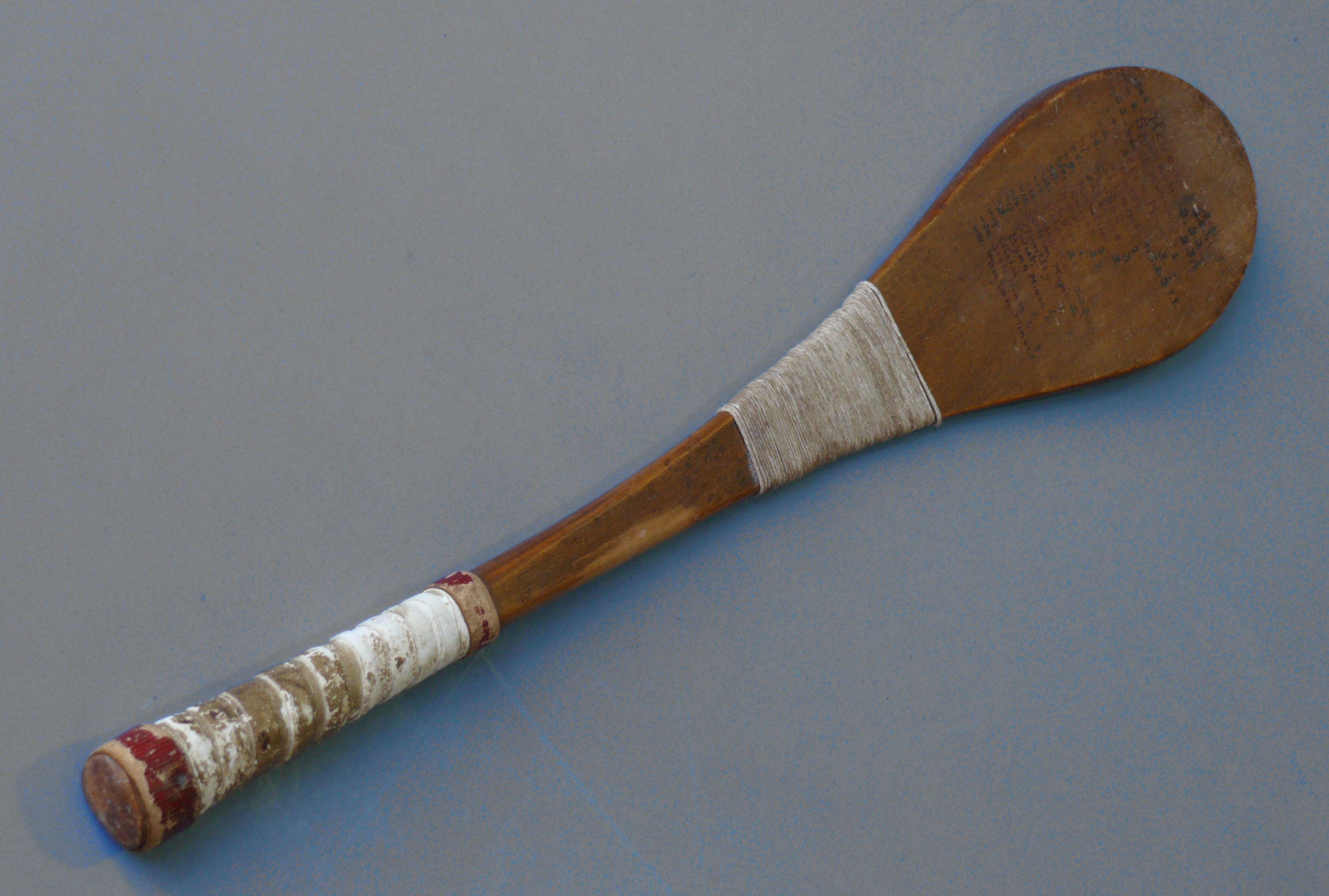
image icon Fives-bat used to play Bat fives. Held at the Radley School Archives.

Bat fives is a form of fives predating Rugby, Eton, and Westminster forms of the game.[47] It is very similar to the game of rackets, and can even be considered an early form of the game, differing in the shape of the bat used, and the slightly smaller ball used in rackets.[48] The game was played using a willow bat with a curved bowl,[49] measuring around 21 inches by 4 inches,[50] with the end wrapped in leather.[51]

Bat fives was played mostly at Radley and Westminster, but was also played at Rugby, Cheltenham, and Aldenham.[52] It used courts similar in size to squash courts,[53] with an open back, and with no buttress, step or hazards.[54] The sport ceased to be played around 1903,[55] in favour of Eton fives,[53] and most courts were demolished in the 1920s.[54]

When playing, a line was drawn on the ground around 10 feet in front of the front wall. Games were then played to either fifteen or twenty-five points. The 1914 book Three Hundred Things a Bright Boy Can Do describes gameplay as:

The first player takes the ball, and strikes it against the wall with his bat above the line on the wall, and so that it may fall outside of the line on the ground. The other then strikes it, and the players then continue to hit it against the wall, either before it comes to the ground or at the first rebound, until one of them missing it, or driving it out of bounds, or beneath the wall-line, loses or goes out. The ball may fall anywhere within the side boundaries, after once being struck up by the player who is in.[49]

Courts and equipment

[edit]
A woodcut lithograph of a game of Fives in progress found in A Little Pretty Children's Book
A modern pair of Fives Gloves with standard leather match ball

Fives is generally played wearing leather gloves.[56] The practice of which dates from the 18th Century – in John Newbery's 1744 children's book A Little Pretty Pocket-Book, two fives players can be seen wearing white gloves on their right hands.[57] The balls used in fives generally weigh around an ounce and a quarter, and vary in material – leather and rubber are most commonly used.[58]

As shown before, court dimensions vary greatly between different versions of Fives; however, modern day court construction is relatively uniform. Two main types of courts exist; traditional ones, and pre-cast courts. Traditional courts are built by bricklaying a form, which is then coated in a cement render,[59] which consists of concrete and sharp sand (alternatively grus), which is then coated in Keene's cement plaster.[30] Precast concrete courts are also available,[60] which are more cost-effective, and faster to build (traditional courts take 4–5 months, concrete courts can be erected in weeks) than traditional courts.[61]

Players

[edit]

Europe

[edit]

There are some well-established clubs overseas, such as the Zuoz Fives Club in Zürich, Switzerland.[62]

Africa

[edit]

Eton fives is the only version of Fives played in the north of Nigeria,[63] and is especially popular in Katsina State, being more popular in Nigeria than in England itself.[64] The sport was introduced in 1928 by former Eton pupil J. S. Hogden, who was teaching in the state of Katsina (in the Provincial Secondary School) and in Birnin Kebbi.[65] The version of the game in Nigeria is played using a tennis ball, as traditional balls "take chunks out of the mud walls of the courts",[65] and gloves are not used. In Nigeria, fives is popular; the Emir of Katsina, Abdulmumini Kabir Usman plays, and has a court inside the Gidan Korau [ha] Katsina Royal Palace.[66]

Fives in Nigeria is regulated by the Fives Federation of Nigeria[67] Several inter-state tournaments are run, which include the Sardauna cup and Dan-Iyan Zazzau Super Cup.[68] The organisation also works to popularise the sport in Southern Nigeria.[69]

The Eton Fives Association has run multiple tours in conjunction with the Nigerian Fives Association to Nigeria to play the sport: one in 1965,[70] and a second in December 1984 (after which the Nigerian Fives Association visited England),[71] and most recently, a second tour by Nigerian players in 2019.[72]

Oceania

[edit]

Fives was played in schools and universities in Australia in the nineteenth century. A court was opened at the Hutchins School in Hobart, Tasmania, in November 1877,[73] The court was described as "the only one, we believe, in the colony", and its dimensions as: "Length of floor, 21 ft.; height and width of court 14 ft. each. The court will be an open one, with a flagged floor, the walls will be built of brick, and cemented on the inside."[74]

The erection of a fives court on the Recreation Ground of the University of Melbourne is noted in the Council minutes of Trinity College in 1873,[75] and there were newspaper reports of an "annual tournament in connexion with the University Fives Club" in 1881, when Professor Herbert Strong acted as judge.[76] A double-handed tournament and a single-handed handicap tournament were played there in August 1883.[77]

Fives is played in some secondary schools in New Zealand, for example Nelson College, New Zealand's oldest state school.[78]

Asia

[edit]

Eton fives is played in Malaysia,[79] being introduced to Malay College Kuala Kangsar by Charles Ernest Bazell, the school's Oxfordian fourth headmaster, in 1923.[80] Two Eton fives courts exist, reopened in 2014, after 50 years of disuse.[81] These courts are speculated to have been the first in the country; however, a report by The Straits Times from 30 April 1920 references fives courts at the Padang Polo (polo ground) in Penang.[82][original research?] Eton Fives teams from Malaysia have been entered into tournaments – in March 2015, two teams were sent to the UK National Eton Fives Schools Championship at Eton College, reaching the Plate Quarter Finals.[83]

In India, Eton fives is played only at St. Paul's School, Darjeeling, where there exist two courts built in 1899 by the brother of one of the school's former rectors as a gift to the school.[84] Courts also exist in Kodaikanal,[85] as well as at the Laxmi Vilas Palace, but these are not in use.[86]

Americas

[edit]

Fives has been played in the United States since the 18th century, first attested to in a by-law in Pittsfield, Massachusetts in 1791, where several forms of ball games were prohibited from being played within eighty yards of the town hall to protect its windows.[87]

The Racquet Club of Philadelphia built a set of Fives Courts in 1900, but these were quickly used for playing squash.[88][89] Fives courts also existed at the old location of the Racquet and Tennis Club in New York City before it relocated in 1918, as well as at the Chicago Athletic Association.[90] Fives has received little attention in America since the early 20th century; however, American handball players such as Timothy Gonzalez[91] and Mathieu Pelletier[92][93] have brought attention to fives by playing it.[citation needed]

Like in England, fives was also played in prestigious preparatory schools, most notably Groton School and St. Mark's School, Massachusetts. Of these, only Groton still plays, where three Rugby fives courts, built in 1884 by Endicott Peabody, are in use as of 2016. Until 2001, eight courts had existed at St. Mark's School, Massachusetts, built by William Greenough Thayer, and an annual competition between the two schools was held until at least the 1980s.[94] In March 1979, a tour of England was made by players from St. Mark's School, the first ever by American players.[95] Several other courts exist scattered throughout the country, for example one near Kezar Lake, and another at the Union Boat Club in Boston.[96]

In 2021, Mexico's first Eton Fives court was built in Oaxaca by Emilian Ruiz Ayala, a player who learnt the sport at the Lyceum Alpinum Zuoz.[97][98] Fives also has a history in Brazil, several fives courts were built by the Western and Brazilian Telegraph Company, although these were closed in the late 1920s. Courts also existed at the São Paulo Athletic Club, which were eventually converted into a swimming pool. Finally, a set of fives courts were built at St Paul's School in São Paulo in 1934.[99]

Bat fives was played in Uruguay at the Montevideo Cricket Club,[100] where there were two courts.[101]

See also

[edit]

References

[edit]

Literature

[edit]
[edit]
Revisions and contributorsEdit on WikipediaRead on Wikipedia
from Grokipedia
Fives is an English sport in which players strike a small, hard —typically made of rubber and cork—with gloved hands against the walls of an enclosed court, emphasizing agility, strategy, and precision in a manner akin to squash but without racquets. It is played as singles or doubles in variants like Rugby Fives, and exclusively as doubles in , by two or four participants, with matches decided by reaching a set number of points, often 11 or 15, through rallies where the ball is returned before its second bounce and must strike the front wall above a designated line. The sport demands protective padded leather gloves due to the ball's firmness, comparable to a in size and hardness, and it promotes as players must volley from both sides of the court. Originating from informal games played against church walls or other structures dating back several centuries, Fives evolved into structured forms in the at British public schools, where dedicated courts were constructed to formalize the rules and gameplay. The sport's development is closely tied to institutions like , which gave rise to Rugby Fives in a four-walled court resembling a simplified squash setup, and , which inspired with its distinctive three-sided court featuring a central and a dividing step for added tactical complexity. A third variant, Winchester Fives, incorporates elements of both but remains less widespread. Today, Fives is governed by associations such as the Rugby Fives Association and the Eton Fives Association, which oversee competitions, court maintenance, and promotion, though its popularity has waned since its peak in the early due to the loss of courts during wars and urban redevelopment. Despite this, it endures in schools, universities, and dedicated clubs across the , with recent efforts including new court constructions, such as three glass-backed facilities built in 2013 at University, and ongoing promotion with a revival of competitive play in the United States in 2024. The game's intellectual and physical demands have historically appealed to elite education settings, fostering skills in hand-eye coordination and quick decision-making.

Etymology and Origins

Etymology

The etymology of the term "fives" as applied to the remains uncertain, with several competing theories proposed by historians of British games. One widely circulated explanation links it to the phrase "a bunch of fives," referring to a clenched or the five fingers of the hand used to strike the ball, though this is considered unlikely by experts due to the phrase's later emergence in common parlance. Another theory attributes the name to early team formats involving five players per side, drawing on descriptions of handball-like games played in such configurations. A third suggestion ties it to the game's scoring systems, often structured in increments of five (such as sets to 15), reflected in historical grouped accordingly. The earliest recorded uses of "fives" appear in English texts from the early , denoting games played against walls. For instance, Joseph Strutt's 1801 historical survey references a 1591 at Elvetham where Queen Elizabeth observed ten players divided into teams of five engaging in a bounded match, suggesting the term may have crystallized around such play by the late 16th or early . Over time, "fives" evolved to distinguish the British variant of wall-based from broader terms like "" or the French precursor , particularly as the game became embedded in the traditions of English public schools where informal rules and courts developed. This school-centric terminology emphasized the sport's adaptation for enclosed play with gloved hands, setting it apart from open-field or racquet-assisted forms. Fives shares roots with as a hand-propelled ball game against walls.

Historical Origins

The origins of fives trace back to ancient wall-based games practiced in and , where participants struck balls against stone walls or courts using their hands, as referenced in classical texts. These early forms evolved into the French game of by the 11th and 12th centuries, a palm-based ball sport played in monastic and against building walls, which directly influenced the development of fives as a continental European tradition. By the late , the game had spread to , where it was popularly played as an informal folk activity against church walls and buttresses, particularly in rural villages. This medieval proliferation led to ecclesiastical interventions, such as the 1287 Synod of , which prohibited and similar sports in churchyards to prevent damage to sacred structures like windows and masonry. In its earliest iterations, fives was played bare-handed, though simple leather gloves occasionally provided protection, with balls crafted from stitched leather filled with sheep's fleece or similar materials for durability. The play style featured loose, unwritten rules adapted to local environments, fostering its widespread adoption in both rural fields and urban alleys across medieval Europe.

Historical Development

Early History in Europe

The sport of fives, an English handball variant derived from the French jeu de paume, evolved informally across from the 16th to the 18th centuries, with play centered on striking a ball against walls using the gloved or bare hand. In France, jeu de paume flourished during this period, boasting around 250 courts in and 40 in by the end of the , though the game increasingly incorporated rackets while retaining hand-play elements in informal settings. Continental variants persisted in various regions of , echoing paume traditions. Despite medieval prohibitions by church authorities against disruptive ball games, such practices continued unabated, integrating into daily life across borders. In Britain, documentation from the 17th and 18th centuries highlights fives' spread, with the term "fives"—likely alluding to the five fingers of the hand—appearing by the mid-17th century to describe informal wall play. accounts in , such as those from Martock in 1740, 1754, and 1758, record complaints about players damaging church towers during games, prompting measures like digging defensive ditches to curb the activity. Personal records, including Edward Phelips V's autobiography and his 1784 diary, describe casual matches at , underscoring the game's role in social gatherings among locals and visitors. Socially, fives transcended class boundaries, engaging peasants, , and youth in communal settings like public houses and markets, where it served as accessible amid rural and urban life. By the , the gained traction in English towns, with purpose-built walls emerging near inns—such as the 18th-century fives court behind the in Stoke sub Hamdon, —facilitating informal matches that built community ties without formal rules. This period marked fives' establishment as a versatile pursuit, increasingly linked to youthful vigor and physical conditioning across , before its later institutionalization.

Codification in British Public Schools

Fives transitioned from informal folk games in to a structured activity within British public schools during the 18th and 19th centuries, with early adoptions at key institutions shaping its variants. At , the game was first mentioned in an informal school publication in 1765, where boys played against the buttresses of the college chapel, marking its introduction in the 1760s. adopted fives in the early 1800s under headmaster , who had encountered a similar game as a pupil at and promoted it as part of his educational reforms. introduced its variant around the 1820s, developing a distinct style that incorporated unique court features like a back wall slope. The construction of dedicated courts formalized play and accelerated its institutionalization. In 1840, Eton headmaster Dr. Edward Hawtrey built the first purpose-built block of four courts along Eton Wick Road, replicating the chapel's irregular architecture to preserve the game's challenging dynamics. This development shifted fives from wall-based games to organized , influencing other schools to follow suit. Rule development marked a key evolution from unstructured play to codified standards; for instance, received its first formal rules in 1877, authored by A.C. Ainger, which standardized scoring, faults, and court boundaries while accommodating the variant's hazards like the "pepper" ledge. At Rugby, Arnold's influence emphasized supervised, moral play, laying groundwork for later standardization, though full codification of Rugby Fives rules occurred in the late 1920s via the Rugby Fives Association. Public school headmasters, exemplified by Arnold at Rugby from 1828 to 1842, championed fives as a character-building exercise that instilled discipline, teamwork, and resilience—core tenets of Victorian educational philosophy. This promotion elevated fives from a casual pursuit to an integral part of the , fostering physical and among elite youth. By the 1880s, the sport had spread to additional institutions, with the first inter-school match between Eton and Harrow held on February 12, 1885, and adoption at schools like Charterhouse by the mid-1880s, solidifying its place in British public school culture.

Decline and Modern Revival

The sport of fives faced substantial challenges throughout the , exacerbated by the rising popularity of racquet-based alternatives like squash, which emerged from fives traditions in the mid-19th century and attracted broader participation due to standardized equipment and courts. High construction and maintenance costs for fives courts, combined with the closure of over 60 grammar schools that once hosted them, contributed to widespread demolitions and disuse, particularly in the post-World War II era when resources were scarce and redevelopment priorities shifted. By the 1950s, many school courts had been dismantled or neglected, as seen at institutions like Ipswich School, where the last Rugby Fives courts were removed in the early part of the decade, and Lincoln Christ's Hospital School, where facilities operated intermittently before full decline in the 1950s to 1970s. Efforts to revive fives gained momentum in the with the establishment of dedicated governing bodies. The Rugby Fives Association was founded in 1927 to standardize rules, organize competitions, and promote the game amid waning school interest. Similarly, the Eton Fives Association formed in 1924 following an initial meeting in late 1923, aiming to popularize through club matches and old boys' fixtures, which helped sustain play post-World War I. From the 1970s onward, women's involvement expanded notably, with female students increasingly accessing courts in co-educational settings like St. Mark's School in the United States, where they quickly adopted the sport and contributed to its local resurgence. Recent research in 2025 has highlighted efforts to further increase girls' participation in fives. In recent decades, revival initiatives have emphasized internationalization and infrastructure development. A landmark event was the 2019 tour by Nigerian players to the , the first such exchange in 30 years, fostering cross-cultural matches and renewed enthusiasm in . In 2021, opened its inaugural Eton Fives court in , built by alumnus Emiliano Ruiz Ayala to introduce the sport to . New courts continued to emerge, including six at in 2024 (four for Winchester Fives and two for Rugby Fives) and four at Holyport College, a , contributing to a surge in popularity reported in 2024. Globally, fives remains niche, with an estimated 6,000 active players as of 2023, concentrated in the but growing through school programs and overseas outposts.

Gameplay Fundamentals

Objective and Basic Rules

While sharing core principles, specific rules such as serving and interactions vary by variant (Eton, Rugby, and Fives); see the Variants section for details. The primary objective in Fives is to win points by striking a against the front wall of the using only the hand or , in a manner that prevents the opponent from making a legal return before the ball's second bounce. This requires players to leverage the 's walls for rebounds, exploiting angles and speed to make the ball unreachable while adhering to strict striking protocols. The game emphasizes precision and anticipation, as successful play depends on controlling the ball's trajectory off multiple surfaces to force errors. Fives is played in either singles (one player per side) or doubles (two players per side) formats, though some variants like Eton Fives are exclusively doubles. Serving rules differ by variant; for example, in Rugby Fives, the server hits the ball to strike the front wall above a designated board, followed by contact with a side wall, ensuring it bounces once before the receiver's turn, while in Eton Fives, the server strikes the front wall above the line followed by the right-hand wall, landing in the lower court. The ball must then be returned to the front wall above the required marker before its second bounce. Players alternate hits in sequence, with the ball permitted to rebound off side walls (or other permitted surfaces in four-walled variants) en route to the front wall, but it must be struck with a single blow of the hand or wrist—any contact with other body parts results in loss of the point. No catching, throwing, or deliberate obstruction of the opponent is allowed, promoting fair play through direct hand-ball interaction. Faults occur if the ball fails to reach the front wall above the required height, bounces twice before being struck, goes out of bounds beyond court lines, or if the server commits a foot fault by stepping over the service line. Lets are called for neutral interruptions, such as the ball lodging on a feature, accidental obstruction by a player, or external distractions, allowing the rally to be replayed without penalty. These rules underscore the game's reliance on hand-eye coordination, as players must react swiftly to erratic rebounds while maintaining positional awareness within the enclosed .

Scoring Systems

In fives, the core scoring mechanism employs a point-a-rally system, where the winner of each exchange is awarded a point, though the eligibility to score depends on whether a side is serving or receiving. Games are typically played to 11, 12, or 15 points depending on , with a match consisting of the best of three or five games to determine the overall winner. Service rules govern the alternation of serves between opponents or partners, ensuring balanced opportunities; a valid serve must strike the front wall above a designated line before contacting a side wall and landing in the appropriate court area. In hand-out scoring traditions, prevalent in Rugby Fives, only the receiving side can score points upon winning a rally, with the server gaining the right to receive only after winning a rally without scoring. Conversely, hand-in scoring, as in , allows only the serving side to score, with a lost rally transferring the serve to the opponents. Tie-breaks address deuces, such as scores of 10-all, 11-all, or 14-all, by requiring a side to win by two points or, in some cases, continuing to a set higher score like 3 or 5 additional points as agreed by the receiving side. In doubles, scoring incorporates partner rotation, where players alternate serving and receiving duties after each point or fault to maintain equity, with the first receiver typically scoring until their side loses a rally, at which point the second partner assumes the receiving role.

Techniques and Strategies

In fives, fundamental techniques revolve around precise hand positioning and glove usage to strike the ball effectively while minimizing injury risk. Players typically employ padded leather gloves to protect the hands, which allow for controlled contact with the hard rubber-and-cork ball without direct skin impact. Basic shots include the drive, a straight, powerful hit aimed low against the front wall to force opponents into defensive positions; the drop shot, executed gently to land near the front wall and die quickly due to the ball's construction; and, in , the cut, a sliced stroke imparting spin to alter the ball's path off the or side walls for deception. These shots demand wrist suppleness and quick footwork, with volleys preferred for easy balls to maintain momentum, while underhand volleys are reserved for defensive retrievals. Advanced strategies emphasize tactical positioning and exploitation of court geometry, particularly in doubles play where one partner covers the front court—focusing on short angles and, in , the —and the other guards the back court for longer rallies. Effective play involves varying shot pace to disrupt rhythm, such as using defensive lobs to high side walls for retrieval time or attacking boasts that rebound sharply off the side wall before the front to wrong-foot opponents. Players must maintain central court control, always tracking the ball to anticipate deflections from hazards like the buttress in , and shift quickly to cover angles that exploit the court's irregular features for unreturnable shots into niches or low corners. Training in fives prioritizes drills to build reflexes, , and shot consistency, such as repeated left-hand volley practice to handle off-side plays and spin-infused cut drills for precision under pressure. Sessions often include warm-ups to prepare hands and muscles, followed by progressive rallies that simulate match scenarios to enhance stamina for prolonged exchanges. Common injuries include hand strains from repetitive impacts or awkward deflections, which can be prevented through mandatory use, proper warm-ups and cool-downs, and avoiding play on slippery surfaces.

Courts and Equipment

Court Variations

Fives courts exhibit variations in design to accommodate different playing styles, primarily differing in the number of enclosing walls—three-walled or four-walled configurations—and subtle architectural elements that influence ball behavior. For Rugby and Fives, standard dimensions measure 28 feet in length and 18 feet in width, with the front wall rising to 15 feet in height. For , the court is approximately 28 feet 6 inches long, 16 feet wide at the front widening to 18 feet at the back, with a front wall typically around 30 feet high; slight deviations occur across installations due to historical construction practices. Three-walled courts, as in , remain open at the rear, allowing balls to exit during play, while four-walled versions, as in Rugby and Fives, fully enclose the space for contained rallies. Traditional courts are built using or cement-rendered walls, often over a floor with a granolithic or resin-modified topping to ensure a firm, consistent playing surface. These materials provide durability against the impact of hand-struck balls but require periodic maintenance, such as mortar joints to prevent cracking and water ingress. Architectural features vary, with some courts incorporating plain walls for predictable bounces and others including protrusions like ledges or steps that create irregular rebounds, adding strategic depth. Modern adaptations have introduced panels for court construction, enabling faster assembly—often in weeks rather than months—and higher quality control in dimensions and surface finish compared to on-site bricklaying. These prefabricated systems reduce overall costs and allow integration into existing structures, such as sports halls, while maintaining compatibility with standard gloves and balls used in play.

Required Equipment

The primary equipment required for playing fives consists of specialized gloves and a , designed to facilitate hand striking while ensuring player safety and optimal performance on the . Gloves are mandatory in most variants and are constructed from padded to cushion impacts from the hard and enhance grip during play. The is typically concentrated in the palm and fingers, protecting against abrasions and bruises from repeated contact with walls and the itself. In Eton Fives, where the features an asymmetric buttress on the left side, gloves often vary between left and right hands, with the left-hand glove reinforced for handling shots near the obstruction to maintain control and reduce risk. Sizes for gloves range from small to large, accommodating different hand measurements, and are available in colors such as white, blue, or red for visibility and team identification. Balls differ by variant to suit the court's dimensions and bounce characteristics. For , the standard ball is a leather-covered composition of rubber and cork, weighing approximately 1.25 ounces and measuring 1.6 to 1.7 inches in , providing a firm, predictable bounce on the irregular surfaces. In Rugby Fives, the ball features a softer rubber core encased in , offering greater control and less intensity on the uniform four-walled court, though it remains harder overall than casual handballs. These specifications ensure consistent , with balls sourced from official suppliers like or Wiseman for match standards. Optional items include , such as clear , to guard against errant balls in fast-paced rallies, particularly recommended for beginners. Supportive athletic shoes with non-marking soles are advised for traction on the court's floor, preventing slips during lateral movements. Unlike some racket sports, fives does not use bats or rackets in its standard forms, though a discontinued variant known as bat fives briefly employed short paddles before fading from practice.

Variants

Eton Fives

Eton Fives originated in the 17th century at , where students adapted earlier medieval games by striking a ball against the irregular walls and es of the school's chapel. The name "fives" refers to the use of the five fingers of the hand to propel the ball, a practice documented in school records from that era. By the early , the game had evolved into a structured activity, with the first purpose-built courts constructed in 1840 under the direction of headmaster Dr. Edward Hawtrey to standardize play. These courts closely replicated the chapel's architecture, incorporating slanted roofs, a central , and a dividing step, which introduced unique challenges absent in more uniform variants. The rules were formally codified in 1877 by Arthur C. Ainger, an Eton master, marking the transition from informal play to a regulated . Distinct from other fives variants, is played exclusively as doubles, with teams of two players per side positioned strategically across the court's upper and lower sections. The court itself is asymmetric and enclosed on three sides, featuring a prominent —often called the "pepper-box"—protruding from the front wall, a horizontal step separating the upper and lower areas, and additional ledges along the side and back walls that affect trajectory. A key rule requires the to be struck against the front wall on or above a horizontal line at 4 feet 6 inches (approximately 1.37 meters), ensuring plays remain high and dynamic. These irregularities demand precise control and adaptability, as the can unpredictably off the or step, where striking the step's face followed by the floor counts as a single bounce. Gameplay emphasizes serving and volleying, with service delivered from the upper court near the right-hand wall, with the server standing in the back while the cutter positions in the . The server must hit the ball above the 4-foot-6-inch line on the front wall, followed by the right-hand wall, landing in the opponent's ; faults occur if it misses these targets or lands short. Only the serving side can score points, with games played to 12, requiring a win by at least two points—escalating to set limits like 5 or 3 at 10-all, or sudden death at 11-all. The first return, or "cut," must strike the front wall above the 4-foot-6-inch line, optionally after first striking the right-hand wall. A "blackguard" cut grazes the or hits left of the 3-foot-8-inch vertical line on the front wall, adding layers of tactical depth. Special provisions, such as "blackguard" shots that graze the , allow for clever angles but risk faults if mishandled. These rules, revised in 1931 and 1981, are overseen by the Eton Fives Association, established to promote and standardize the sport. Culturally, remains tied to British public school traditions, peaking in popularity between 1890 and 1900 before a post-World War I revival through old boys' clubs and community leagues introduced in 1971. The first inter-school match, between Eton and Harrow, occurred in 1885, fostering rivalries that endure today. Women's involvement has grown significantly since the inaugural Ladies Championship in 1984 and in 1985, expanding participation beyond its historical male-dominated roots and attracting players through local clubs across the and internationally in places like and . The Eton Fives Association continues to govern, emphasizing accessibility while preserving the game's heritage.

Rugby Fives

Rugby Fives is played on a symmetric four-walled measuring 28 feet (8.534 meters) in length by 18 feet (5.486 meters) in width, featuring plain composition walls without any hazards or irregularities. The front wall stands 15 feet (4.572 meters) high with a 2 feet 6 inches (0.762 meters) board at its base, while the side walls taper to a rear wall height of 4 feet 10 inches (1.473 meters), creating an enclosed space that supports dynamic rallies. This balanced design allows the game to be contested in both singles and doubles formats, emphasizing direct hand-to-ball contact and full-court movement. Key rules highlight the game's intensity, with service permitted from either the left or right side of the court; the server must strike the to hit the front wall above the board before it contacts the side wall and bounces on the floor. After service, players alternate striking the before its second bounce to return it above the board to the front wall, fostering an emphasis on power shots enabled by the harder Rugby Fives used on courts. Scoring operates on a "no-ace" system where only the receiver can earn points, with games standardly to 15 points (or 11 by mutual agreement), and special rules at deuce such as first to 16 from 14-all or first to 12 from 10-all. Players utilize padded gloves to mitigate the impact of the firmer . The variant originated and was codified at in the , evolving from earlier traditions into a structured . It has since achieved international prominence through annual varsity matches between the universities of and , awarding Half Blues to participants. By 2022, Rugby Fives had expanded modestly beyond elite institutions, with active programs in two state schools: Derby Moor in and in .

Fives

Winchester Fives is a variant of the handball sport fives that closely resembles Rugby Fives in its gameplay and court structure, but features a distinctive architectural modification on the left-hand wall, primarily played in doubles format at a limited number of British schools. The game emphasizes quick reflexes and strategic positioning, with players using gloved hands to strike a solid rubber ball against the walls, adapting readily to Rugby Fives courts while facing challenges due to the unique court narrowing. The court measures 28 feet in length by 18 feet in width, with a front rising to 15 feet and side walls sloping down to 4 feet 10 inches at the rear, identical to Rugby Fives specifications except for a on the left wall located 9 feet 10 inches from the front. This projects at a 135-degree angle for 9.75 inches, causing the court to narrow slightly toward the back and altering shot trajectories, which demands specialized adaptation from players accustomed to standard four-walled enclosures. The playing surface is typically composition or stone, enclosed on four sides, promoting fast-paced rallies similar to squash but without rackets. Rules follow Rugby Fives conventions, with points scored only by the receiving side upon winning a rally, and no faults for certain wall contacts unique to other variants. Games are typically to 11 or 15 points, contested as best-of-three sets, though scoring can vary by school or event. Unlike singles-focused formats in Rugby Fives, Winchester Fives is predominantly doubles, fostering teamwork in defensive coverage and offensive volleys. Lacking a dedicated governing body, Winchester Fives falls under the oversight of the Rugby Fives Association (RFA), which coordinates its limited activities despite the variant's confinement to a handful of elite institutions such as , St Paul's School, and the Pilgrims' School. Play remains niche, with only about a dozen courts in active use across the , supporting occasional inter-school matches rather than widespread leagues. The RFA organizes small-scale national championships for doubles, , and women's events, held annually at venues like and , but no large international tournaments exist. This restricted scope underscores its status as a school-specific tradition, with recent developments including new courts at in 2024 to sustain participation.

Other Variants

Warminster Fives, a historical variant originating in the late at (formerly Lord Weymouth's Grammar School), was played three-a-side on a court featuring side walls angled at 45 degrees. The game utilized positions designated as "squi" on the left, "centre," and "skunk" on the right, with teams competing to 21 points where only the serving side could score; the serving team initially conceded three points to opponents. Unique elements included a serving ritual called "dapping," where the ball was bounced three times before delivery, and specific rally rules requiring the ball to rebound off the middle wall. The sport, likely influenced by earlier Fives traditions, saw its last regular play in the , though revival efforts began in the with court repairs and advisory visits to the Grade II-listed facility. Bat Fives, an early form employing short bats rather than hands, was widespread in English schools during the and served as a precursor to modern hand-play variants. Bats, often standardized by the 1890s and treated with for durability, measured approximately 21 inches by 4 inches and were used on three-walled courts typically 20 feet square. The game resembled a blend of and emerging racket sports, appealing particularly to cricketers during winter months. It was largely discontinued by the early , with many dedicated courts converted to hand Fives or squash facilities by the 1930s, though informal revivals have occurred on existing courts since 2008. Regional adaptations of Fives, such as informal American basement or wall play, emerged without codified rules, evolving from 19th-century immigrant traditions including Irish influences. These versions, often played against brick walls or in courtyards as early as the —exemplified by Abraham Lincoln's participation in —involved basic hand propulsion of a ball in singles or doubles to 21 points, adapting locally to available spaces like basements. Today, such play persists sporadically in informal settings across the , with no organized governing structure.

Governing Bodies and Organizations

United Kingdom Associations

The Rugby Fives Association (RFA), established in 1928, serves as the primary for Rugby Fives in the , focusing on the promotion, organization, and development of the sport across schools, universities, and community clubs. The RFA oversees national tournaments, provides coaching resources and training programs, and supports the preservation and regeneration of courts through advisory services and financial grants. As a registered charity, it emphasizes accessibility and heritage, maintaining an of historical documents and memorabilia to document the sport's evolution. The Association (EFA), founded in 1923 and formalized in 1924, acts as the specifically for Eton Fives, prioritizing the organization of doubles competitions and outreach to educational institutions. It coordinates events such as the Kinnaird Cup and Public Schools' Handicaps, while fostering growth through school partnerships and facility development initiatives. In recent years, the EFA has advanced female inclusion by partnering with organizations like the Youth Action Alliance and the Advanta Foundation to increase participation among women and girls, including funding research on best practices for girls' programs. Other notable bodies include school-specific clubs, such as those at , where Winchester Fives—a variant with unique court features—is preserved and played almost exclusively within the institution's program. These clubs maintain local traditions without a separate national association. Joint efforts across variants are coordinated by the Fives Federation, established in 2005, which unites the EFA, RFA, and UK Wallball to standardize equipment specifications and support broader development initiatives in the UK.

International and Regional Bodies

The of fives relies on informal collaborations rather than a centralized global body, with cross-variant events often coordinated through committees involving representatives from national associations to facilitate tournaments that blend Eton, Rugby, and other forms. These efforts draw historical parallels to related racquet sports, where fives courts have been adapted for squash and . In Africa, the Fives Federation of Nigeria serves as a key regional organization promoting fives nationwide through youth competitions and national championships, following the sport's introduction in 1928 by British educator S.J. Hogben at . The federation, affiliated with the Nigeria Olympic Committee, organizes events like the National Youth Games and aims to expand participation beyond its northern strongholds. Europe's primary hub outside the is the Zuoz Club in , an alumni network of the boarding school, which maintains fives courts and hosts regular tournaments such as the Challenge and Benny Oei Fives Tournament to encourage European tours and international play. This group facilitates cross-border exchanges, including the annual tournament on unique blue courts, drawing players from multiple . Emerging regional initiatives include Mexico's first Eton fives court, built in in 2021 through international support, marking the sport's foothold in the with plans for local development programs. In , fives persists in select schools like , where informal clubs promote the game, though no dedicated national body exists as of 2025. A major challenge to fives' global expansion remains the absence of a unified international federation, limiting recognition by bodies like the and hindering coordinated funding. Efforts thus prioritize development aid, such as constructing new courts in regions like and supporting tours modeled after associations, to build infrastructure and participation.

Competitions and Tournaments

Major National Events

The Eton Fives Championships, encompassing the Kinnaird Cup as the premier open doubles event, trace their origins to the sport's early competitive era, with the first inter-school match between and Harrow occurring on February 12, 1885. The Kinnaird Cup itself was established in 1931 as , donated by Lord Kinnaird for old boys' clubs, and has been held annually since its post-World War II revival in 1948, typically featuring best-of-five sets to 12 points. Formats include open divisions for adults, alongside dedicated schools and veterans categories, with the Public Schools Handicaps serving as a precursor to modern schools championships since 1929 at venues like . Finals and later stages are often hosted at historic sites such as or . In 2025, Riki Houlden and Hugo Young retained the Kinnaird Cup with a 3-1 win over Tom Dunbar and Seb Wanzel at . In Rugby Fives, the National Singles Championship, known as the Jesters Club Cup since the 1931-32 season, stands as a cornerstone event, featuring a knockout format that evolved in 1989 to include regional qualifiers leading to a finals weekend for the top 16 players. This annual competition, interrupted only during (1940-1947) and the (2020), emphasizes individual skill in an enclosed four-walled court, with sets played to 15 points. Open singles dominate, but parallel events exist for doubles, schools, and veterans, often culminating at schools like St Paul's or Alleyn's. Prize structures typically include trophies and modest awards, supported by the Rugby Fives Association. Ed Kay won the 2024 National Singles title, defeating Dan Tristao in the final. The Oxford versus Cambridge Varsity Matches represent another pivotal national tradition, contested annually in both Eton and Rugby Fives variants since the early 20th century. These matches, played across multiple rubbers in doubles and singles formats, alternate venues between the universities' courts and emphasize inter-university rivalry, often drawing top amateur talent. In Eton Fives, Oxford has maintained dominance with consecutive wins, including their sixth in 2020 and continuing the streak through a 13-2 victory in 2025.; In Rugby Fives, Oxford extended a winning streak to six in the men's event in 2023 (279-245), followed by a seventh in 2024, before Cambridge prevailed 288-281 in 2025. Recent years have seen robust recovery in participation following the disruptions, with the 2022 National Schools' Championships in marking a full return after cancellations in 2020 and 2021, featuring extensive qualifiers and competitions across age groups at . Women's divisions, introduced in for and expanding with mixed doubles in 1985, have continued to grow, reflecting increased female involvement in national events through dedicated categories and rising entries. Venues like host key tournaments, such as the annual Aldenham Tournament, which resumed post-2019 with strong fields in open and veterans play.

International and School Competitions

International competitions in Fives have historically been limited but include notable invitational events that brought together players from multiple countries. The International Championships in , organized by the Eton Fives Association, were held irregularly during the 1980s, featuring teams from , , , , and . The inaugural event in 1980/81 at saw emerge victorious, followed by wins for Edgbaston () in 1982/83 and () in 1983/84 and 1984/85. Subsequent championships included an Under-21 victory over the senior team in 1986/87 at and a Welsh triumph at in 1987/88. No further editions have been recorded since 1988, reflecting the sport's niche status and logistical challenges in sustaining global participation beyond . In Rugby Fives, international engagement has grown through regional tournaments, particularly the Basque Rugby Fives Doubles Championship in , which has fostered cross-border competition since its inception. The fourth edition in 2025, held in the Basque region on , drew players from and the , with Egoitz Campo and Daniel Barrientos claiming the title after defeating Joseba Fernández and Lander Campo in the final. This annual event highlights the sport's expansion into , emphasizing doubles play in a format adapted from traditional Basque influences. African tours have also played a key role in global outreach, exemplified by the 2019 Nigerian tour organized by the Association, marking the first such visit by Nigerian players to the in 30 years. Over five days, the touring squad participated in matches and social events across , strengthening ties between the Nigerian Fives Federation and British associations. School-level competitions extend internationally through youth exchanges and tours, promoting Fives among young players outside the . Inter-public school knockouts remain primarily domestic, but collaborative initiatives like the Association's exchanges with schools have introduced the sport to African youth. The 2019 tour included matches involving Nigerian school-aged players, building on earlier efforts such as the 1965 Association visit to Northern Nigeria, which sparked grassroots interest. These exchanges emphasize skill-sharing and cultural connections, with Nigerian participants often representing local academies in informal youth fixtures against British school teams. Emerging trends in international Fives include sustained European events like the Basque championship, which in 2025 incorporated junior categories to nurture talent from schools in and neighboring regions. While development cups in and remain nascent, historical play in underscores potential for future youth-focused tournaments.

Notable Players

Pioneers and British Icons

One of the earliest pioneers in the development of was Edward Craven Hawtrey, who served as Headmaster of from 1834 to 1853. In 1840, Hawtrey oversaw the construction of the first purpose-built block of four courts along Eton Wick Road, marking a significant advancement from the informal play against the chapel walls that had characterized the game since the early . This initiative standardized the court design, incorporating elements like the sloping walls and buttresses inspired by the , and helped formalize as a structured sport. Hawtrey's contributions extended the game's reach within Eton and influenced its adoption at other institutions, laying the groundwork for inter-school competitions. In the realm of Rugby Fives, , Headmaster of from 1828 to 1842, played a pivotal role in codifying and popularizing the game during the 1820s and 1830s. Arnold, who had enjoyed Wessex Fives—a regional variant—during his youth, introduced it to , where it evolved into the distinct form of Rugby Fives played in enclosed courts. His emphasis on and character-building through sports integrated Fives into the school's curriculum, contributing to rule refinements that emphasized fair play and strategic depth. Arnold's legacy endures through Rugby Fives' origins as one of the school's enduring contributions to British sports, alongside itself. The standardization of rules in the late owed much to Arthur Campbell Ainger, an Eton master who, in 1877, collaborated with colleagues to publish the "Rules of the Game of Fives as played at Eton." This document clarified gameplay mechanics, such as serving and scoring to 11 or 12 points, resolving ambiguities from earlier informal versions and enabling consistent inter-school matches, including the first Eton versus Harrow contest in 1885. Ainger's work facilitated the game's growth beyond Eton, influencing its spread to other public schools. Twentieth-century British icons further elevated Fives' status through competitive dominance and organizational efforts. In Rugby Fives, John Howe emerged as a legendary figure, securing 7 singles and 15 doubles titles between the 1950s and 1980s, while Edward Marsh claimed 10 singles and 4 doubles victories in the 1950s and 1960s, both exemplifying the sport's technical mastery. These players, along with John Pretlove (4 singles, 7 doubles) and John Watkinson (4 singles, 4 doubles), amassed records that highlighted the game's post-war resurgence. In , the formation of the Eton Fives Association in 1923, led by pioneers like Sir Lionel Alexander and C.M.W. Prior, professionalized competitions; Lord Kinnaird, serving as Patron from 1934 to 1971, donated the prestigious Kinnaird Cup in 1924, fostering old boys' clubs and international links until his death in 1972, after which tributes underscored his role in the sport's revival. Female trailblazers began shaping Fives in the mid-20th century, though formal championships emerged later. Early efforts in the focused on introducing women's play at schools and clubs, paving the way for the inaugural Ladies Eton Fives Championship in 1984. These pioneers advocated for inclusive access, contributing to rule adaptations for mixed and women's doubles that emphasized agility and teamwork, ensuring the sport's evolution as a gender-diverse activity. Their legacies include expanded participation and memorials in association records honoring initial organizers.

Contemporary and International Figures

In the , has seen continued prominence among British players who have dominated national competitions. Ed Wass, a veteran competitor, has remained active into the , with earlier successes including reaching the 2002 Kinnaird Cup final with partner Jamie Halstead. Recent champions include Riki Houlden and Hugo Young, who won the Kinnaird Cup in 2024 with a 3-1 victory over former winners at and retained it in September 2025. Female participation has grown, with standout duos achieving sustained excellence in the Ladies Championship. Karen Hird and Charlotta Cooley secured their tenth consecutive title in 2022, defeating Emily Scoones and her partner in the final at , highlighting the rise of competitive women's play since the early . Internationally, the sport has expanded beyond its British roots, fostering notable figures from emerging regions. In , a 2019 tour marked the first visit by Nigerian players in 30 years, featuring athletes such as Ademisoro Oluwasegun Bode and Dangaladima Abubakar Aliyu, who competed in matches across courts and strengthened ties with the Eton Fives Association. In , Emiliano Ruiz Ayala emerged as a pioneer by constructing the country's first Eton Fives court in in 2021, having learned the game at the Lyceum Alpinum Zuoz in ; this development introduced the sport to beyond existing pockets. These contemporary figures underscore Fives' evolving global appeal, with achievements like the 2025 Kinnaird retention by Houlden and Young exemplifying high-level doubles play, while international efforts promote broader accessibility and diversity in participation. The Eton Fives Association's diversity statement emphasizes ongoing commitments to inclusivity, noting girls comprise about one-third of the school-age playing but under a quarter of national competition entries as of 2025.

Global Presence

Europe

In continental Europe, Eton fives maintains a niche but enduring presence, primarily in , where it was introduced in the early as an export from British public schools. The sport arrived via English educators at international boarding institutions, fostering dedicated courts and clubs that host regular international matches with teams. This Swiss foothold has sustained cross-border exchanges, including annual tournaments that draw players from across and beyond. Switzerland hosts the most established European fives community outside the , centered at the Lyceum Alpinum in Zuoz, where the first courts were constructed in 1924. The school now features six courts, supporting a vibrant student and alumni program that culminates in the annual Engadin Challenge tournament. Held each June, this event attracts over 60 participants, including British teams from clubs like the Old Citizens Eton Fives Club, and features competitive ladders for doubles play. In 2024, the tournament marked the centenary of Zuoz's courts with special matches and celebrations, underscoring the site's role as a European hub for the sport. In September 2025, the Benny Oei Fives Tournament was held at Zuoz, continuing these traditions. Additional Swiss venues bolster this activity, including the Geneva Fives Club at the David Lloyd Club, which boasts the world's only blue courts. Established as a key international site, hosts an annual September tournament that in 2024 drew 40 players from multiple countries, emphasizing the sport's cosmopolitan appeal through doubles competitions on its outdoor facilities. Nearby, the Zuoz Fives Club in , founded around 1965 by alumni of the Zuoz school, maintains two courts and organizes autumn events, further linking Swiss play to British traditions via visiting teams. These locations collectively enable regular internationals, with UK clubs like the Eton Fives Association supporting travel and fixtures to promote growth. Beyond , fives has a limited footprint influenced by historical ties to , the French precursor from which the evolved. In , two Eton fives courts exist in Grillon, , built in the early by British expatriate Nigel Cox, who hosted opening matches with players in the 2000s. teams have visited for tours, playing exhibition games and fostering informal exchanges, though organized clubs remain scarce. Small pockets of play occur in and , with isolated courts dating to the mid-20th century , often at or private estates, but without dedicated associations or large-scale events. In Ireland, historical references to handball variants akin to fives appear in 19th-century accounts, yet the never gained widespread traction, limited to occasional school-based play without formal clubs today. Overall, European fives outside the involves fewer than a few hundred active players, concentrated in Switzerland's school and club networks, with challenges stemming from court scarcity—most venues are private and not publicly accessible. Efforts to address this include international tours and shared maintenance by bodies like the , which advocates for preservation amid declining facilities in non-Swiss sites.

Africa and Americas

In Africa, Eton Fives has established a notable presence primarily in , where the sport was introduced in 1928 by J.S. Hogben, an Old Etonian teacher in , northern Nigeria. This colonial legacy has fostered a strong tradition, with the game played using balls on improvised courts to accommodate local resources, drawing crowds in resource-limited communities despite its British origins. The Fives Federation of Nigeria has maintained ties with the Association, culminating in a successful 2019 tour by Nigerian players to the —the first in 30 years—which involved matches across the country and strengthened international connections. The federation reports thousands of active players, with ongoing national events such as the inaugural National Interstates Open Fives Championship held in January 2025 in Sokoto, where teams from multiple states competed. The sport's growth in Nigeria emphasizes school-based play, particularly in northern regions, where it promotes physical activity among youth without requiring expensive equipment. Its endurance over nearly a century underscores its cultural integration, supported by occasional visits from UK associations to sustain enthusiasm. In the Americas, Fives traces back to the 18th century in the United States, where it was a popular handball variant played in Britain, Canada, and early American settlements, often against walls in urban and rural settings. Historical accounts note its recreational appeal among colonists, though it later declined in favor of emerging sports like baseball and American handball. Recent efforts signal revival potential; in October 2024, an invitational Rugby Fives tournament was held in Maine to celebrate 100 years of courts at Westways, Lake Kezar, marking the return of competitive play after decades. In 2021, a new Eton Fives court was constructed in Oaxaca, Mexico, spearheaded by former Eton player Emiliano Ruiz Ayala, marking the first dedicated facility in the country and aiming to introduce the sport to local communities. Presence elsewhere in the Americas remains limited, with introductions in linked to British communities but lacking widespread adoption or formal structures. In , early 19th-century play mirrored U.S. patterns but has not sustained organized growth. By 2025, informal ties to broader circuits in the U.S. offer opportunities for expansion, with Fives-specific programs showing signs of revival.

Asia and Oceania

In Asia, Eton Fives has a niche presence primarily in former British colonial educational institutions, with historical roots dating back to the late 19th and early 20th centuries. In , the sport was introduced at St. Paul's School in in 1899 by a British rector, leading to the construction of two courts that were refurbished in 2008 with added lighting and an enclosed structure. Approximately 15 senior boys played regularly in the late 1980s, while earlier records from 1983 noted around 40 participants, including competitive pairs, though play remains limited by equipment shortages and lack of opposition. Additional courts exist at Laxmi Vilas Palace in , , built in 1890 by Maharaja , featuring unique marble-facing and buttresses, now integrated into a and event venue but potentially playable. In , Eton Fives arrived at (MCKK) in 1928 under Headmaster C. Bazell, an alumnus, with two courts constructed that year— the only known in . The game lay dormant from the late 1960s until a 2014 revival supported by the Eton Fives Association (EFA) in the , culminating in MCKK teams competing in the 2015 UK National Eton Fives Schools Championship, reaching quarter-finals in under-15 and under-17 categories. has no documented dedicated courts or formal clubs, though informal interest persists among communities tied to British schooling traditions. Across these sites, active players number roughly 100, concentrated in school settings with occasional international ties. In , Fives maintains a historical footprint in select schools, influenced by British educational exports, but lacks widespread infrastructure or organized leagues. boasts the region's most established legacy, with courts emerging around 1880, primarily three-walled designs at secondary institutions. Active venues as of 2014 include (three courts), Waimate High School (four courts), and St. Kevin’s College (adapted handball courts), while others like Auckland Grammar School's 15 courts have been redeveloped. The sport is played at schools such as , 's oldest state institution, though participation remains sporadic and tied to curricula rather than competitive circuits. In , is confined to , where two courts were built in 1914 and upgraded with donor funding; a 2019 visit confirmed it as the nation's sole facility, supporting occasional school play. No dedicated Rugby Fives courts are recorded in , and overall, has no purpose-built venues beyond these school sites, with play historically peaking in the 19th to mid-20th centuries before declining due to facility losses. The sport's expansion in and faces barriers rooted in cultural preferences for more popular racquet games like squash and , alongside the scarcity of courts and equipment, which limits accessibility outside elite or circles. Prospects for growth by 2025 hinge on leveraging Fives' shared mechanics with squash—its direct descendant—for initiatives, potentially drawing from global revival trends in programs.

References

Add your contribution
Related Hubs
Contribute something
User Avatar
No comments yet.