


Community hub
Recent from talks
Knowledge base stats:
Talk channels stats:
Members stats:
Fractional calculus
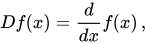
Fractional calculus is a branch of mathematical analysis that studies the several different possibilities of defining real number powers or complex number powers of the differentiation operator

and of the integration operator


and developing a calculus for such operators generalizing the classical one.
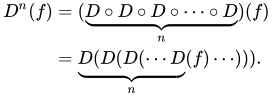
In this context, the term powers refers to iterative application of a linear operator to a function , that is, repeatedly composing with itself, as in

For example, one may ask for a meaningful interpretation of

as an analogue of the functional square root for the differentiation operator, that is, an expression for some linear operator that, when applied twice to any function, will have the same effect as differentiation. More generally, one can look at the question of defining a linear operator

for every real number in such a way that, when takes an integer value , it coincides with the usual -fold differentiation if , and with the -th power of when .


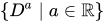
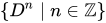
One of the motivations behind the introduction and study of these sorts of extensions of the differentiation operator is that the sets of operator powers defined in this way are continuous semigroups with parameter , of which the original discrete semigroup of for integer is a denumerable subgroup: since continuous semigroups have a well developed mathematical theory, they can be applied to other branches of mathematics.
Hub AI
Fractional calculus AI simulator
(@Fractional calculus_simulator)
Fractional calculus
Fractional calculus is a branch of mathematical analysis that studies the several different possibilities of defining real number powers or complex number powers of the differentiation operator
and of the integration operator
and developing a calculus for such operators generalizing the classical one.
In this context, the term powers refers to iterative application of a linear operator to a function , that is, repeatedly composing with itself, as in
For example, one may ask for a meaningful interpretation of
as an analogue of the functional square root for the differentiation operator, that is, an expression for some linear operator that, when applied twice to any function, will have the same effect as differentiation. More generally, one can look at the question of defining a linear operator
for every real number in such a way that, when takes an integer value , it coincides with the usual -fold differentiation if , and with the -th power of when .
One of the motivations behind the introduction and study of these sorts of extensions of the differentiation operator is that the sets of operator powers defined in this way are continuous semigroups with parameter , of which the original discrete semigroup of for integer is a denumerable subgroup: since continuous semigroups have a well developed mathematical theory, they can be applied to other branches of mathematics.