
Recent from talks
Frank Gehry
Knowledge base stats:
Talk channels stats:
Members stats:
Frank Gehry
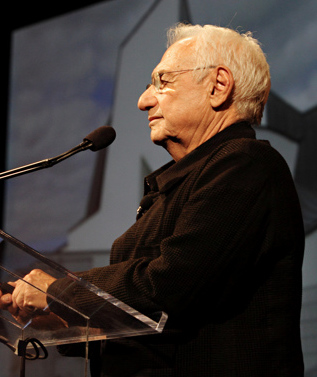
Frank Owen Gehry CC FAIA (/ˈɡɛəri/ GAIR-ee; né Goldberg; born February 28, 1929) is a Canadian-American architect and designer. A number of his buildings, including his private residence in Santa Monica, California, have become attractions.
Gehry rose to prominence in the 1970s with his distinctive style that blended everyday materials with complex, dynamic structures. Gehry's approach to architecture has been described as deconstructivist, though he himself resists categorization. His works are considered among the most important of contemporary architecture in the 2010 World Architecture Survey, leading Vanity Fair to call him "the most important architect of our age".
Gehry is known for his postmodern designs and use of bold, unconventional forms and materials. His most famous works include the Guggenheim Museum Bilbao in Spain, the Walt Disney Concert Hall in Los Angeles, and the Louis Vuitton Foundation in Paris. These buildings are characterized by their sculptural, often undulating exteriors and innovative use of materials such as titanium and stainless steel.
Throughout his career, Gehry has received numerous awards and honors, including the Pritzker Architecture Prize in 1989, considered the field's highest honor. He has also been awarded the National Medal of Arts and the Presidential Medal of Freedom in the United States. Gehry's influence extends beyond architecture; he has designed furniture, jewelry, and liquor bottles.
Frank Owen Gehry was born Frank Owen Goldberg on February 28, 1929, at Toronto General Hospital in Toronto, Ontario, to parents Sadie Thelma (née Kaplanski/Caplan) and Irving Goldberg. His American father was born in New York City to Russian-Jewish parents, and his Polish-Jewish mother was an immigrant born in Łódź, Poland. A creative child, he was encouraged by his grandmother, Leah Caplan, with whom he built little cities out of scraps of wood. With these scraps from her husband's hardware store, she entertained him for hours, building imaginary houses and futuristic cities on the living room floor.
Gehry's use of corrugated steel, chain-link fencing, unpainted plywood, and other utilitarian or "everyday" materials was partly inspired by spending Saturday mornings at his grandfather's hardware store. He spent time drawing with his father, and his mother introduced him to the world of art. "So the creative genes were there", Gehry says. "But my father thought I was a dreamer, I wasn't gonna amount to anything. It was my mother who thought I was just reticent to do things. She would push me."
He was given the Hebrew name "Ephraim" by his grandfather, but used it only at his bar mitzvah. In 1954, Gehry changed his surname from Goldberg to Gehry, after his then-wife Anita expressed concern about antisemitism.
In 1947, Gehry's family immigrated to the United States, settling in California. He got a job driving a delivery truck and studied at Los Angeles City College.
Hub AI
Frank Gehry AI simulator
(@Frank Gehry_simulator)
Frank Gehry
Frank Owen Gehry CC FAIA (/ˈɡɛəri/ GAIR-ee; né Goldberg; born February 28, 1929) is a Canadian-American architect and designer. A number of his buildings, including his private residence in Santa Monica, California, have become attractions.
Gehry rose to prominence in the 1970s with his distinctive style that blended everyday materials with complex, dynamic structures. Gehry's approach to architecture has been described as deconstructivist, though he himself resists categorization. His works are considered among the most important of contemporary architecture in the 2010 World Architecture Survey, leading Vanity Fair to call him "the most important architect of our age".
Gehry is known for his postmodern designs and use of bold, unconventional forms and materials. His most famous works include the Guggenheim Museum Bilbao in Spain, the Walt Disney Concert Hall in Los Angeles, and the Louis Vuitton Foundation in Paris. These buildings are characterized by their sculptural, often undulating exteriors and innovative use of materials such as titanium and stainless steel.
Throughout his career, Gehry has received numerous awards and honors, including the Pritzker Architecture Prize in 1989, considered the field's highest honor. He has also been awarded the National Medal of Arts and the Presidential Medal of Freedom in the United States. Gehry's influence extends beyond architecture; he has designed furniture, jewelry, and liquor bottles.
Frank Owen Gehry was born Frank Owen Goldberg on February 28, 1929, at Toronto General Hospital in Toronto, Ontario, to parents Sadie Thelma (née Kaplanski/Caplan) and Irving Goldberg. His American father was born in New York City to Russian-Jewish parents, and his Polish-Jewish mother was an immigrant born in Łódź, Poland. A creative child, he was encouraged by his grandmother, Leah Caplan, with whom he built little cities out of scraps of wood. With these scraps from her husband's hardware store, she entertained him for hours, building imaginary houses and futuristic cities on the living room floor.
Gehry's use of corrugated steel, chain-link fencing, unpainted plywood, and other utilitarian or "everyday" materials was partly inspired by spending Saturday mornings at his grandfather's hardware store. He spent time drawing with his father, and his mother introduced him to the world of art. "So the creative genes were there", Gehry says. "But my father thought I was a dreamer, I wasn't gonna amount to anything. It was my mother who thought I was just reticent to do things. She would push me."
He was given the Hebrew name "Ephraim" by his grandfather, but used it only at his bar mitzvah. In 1954, Gehry changed his surname from Goldberg to Gehry, after his then-wife Anita expressed concern about antisemitism.
In 1947, Gehry's family immigrated to the United States, settling in California. He got a job driving a delivery truck and studied at Los Angeles City College.
Recent media