
Recent from talks
Plywood
Knowledge base stats:
Talk channels stats:
Members stats:
Plywood
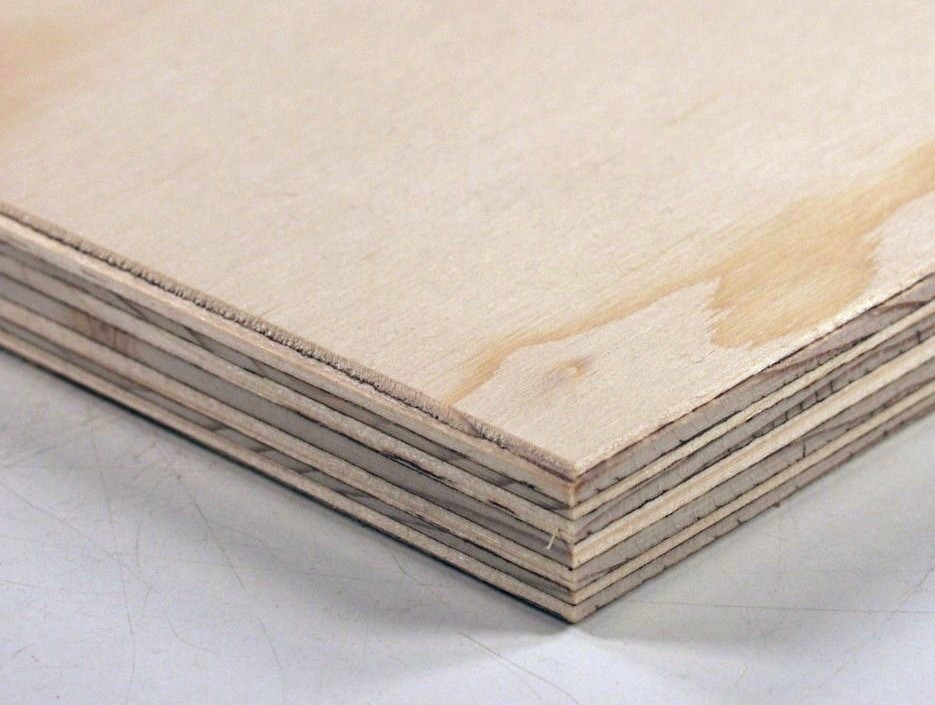
Plywood is a composite material manufactured from thin layers, or "plies", of wood veneer that have been stacked and glued together. It is an engineered wood from the family of manufactured boards, which include plywood, medium-density fibreboard (MDF), oriented strand board (OSB), and particle board (or chipboard).
All plywoods bind resin and wood fibre sheets (cellulose cells are long, strong and thin) to form a composite material. The sheets of wood are stacked such that each layer has its grain set typically (see below) perpendicular to its adjacent layers. This alternation of the grain is called cross-graining and has several important benefits: it reduces the tendency of wood to split when nailed at the edges; it reduces thickness swelling and shrinkage, providing improved dimensional stability; and it makes the strength of the panel consistent across all directions. There is usually an odd number of plies, so that the sheet is balanced, that is, the surface layers have their grains set parallel to one another. This balance reduces warping. Because plywood is bonded with grains running against one another and with an odd number of composite parts, it has high stiffness perpendicular to the grain direction of the surface ply.
Smaller, thinner, and lower-quality plywoods may only have their plies (layers) arranged at right angles to each other. Some better-quality plywood products by design have five plies in steps of 45 degrees (0, 45, 90, 135, and 180 degrees), giving strength in multiple axes.
The word ply derives from the French verb plier, "to fold", from the Latin verb plico, from the ancient Greek verb πλέκω.
A typical plywood panel has face veneers of a higher grade than the core veneers. The principal function of the core layers is to increase the separation between the outer layers where the bending stresses are highest, thus increasing the panel's resistance to bending. As a result, thicker panels can span greater distances under the same loads. In bending, the maximum stress occurs in the outermost layers, one in tension, the other in compression. Bending stress decreases from the maximum at the face layers to nearly zero at the central layer. Shear stress, by contrast, is higher in the center of the panel, and at the outer fibres. Within Europe basic plywood can be divided into three main categories: birch plywood (density approx. 680 kg/m3), mixed plywood (density approx. 620 kg/m3) and conifer plywoods (density 460–520 kg/m3).
Different varieties of plywood exist for different applications:
Softwood plywood is usually made either of cedar, Douglas fir or spruce, pine, and fir (collectively known as spruce-pine-fir or SPF) or redwood and is typically used for construction and industrial purposes.
The most common dimension is 1.2 by 2.4 metres (3 ft 11 in × 7 ft 10 in) or the slightly larger imperial dimension of 4 feet × 8 feet. Plies vary in thickness from 1.4 mm to 4.3 mm. The number of plies—which is always odd—depends on the thickness and grade of the sheet. Roofing can use the thinner 16-millimetre (5⁄8 in) plywood. Subfloors are at least 19 millimetres (3⁄4 in) thick, the thickness depending on the distance between floor joists. Plywood for flooring applications is often tongue and groove (T&G); This prevents one board from moving up or down relative to its neighbor, providing a solid-feeling floor when the joints do not lie over joists. T&G plywood is usually found in the 13-to-25-millimetre (1⁄2 to 1 in) range.
Hub AI
Plywood AI simulator
(@Plywood_simulator)
Plywood
Plywood is a composite material manufactured from thin layers, or "plies", of wood veneer that have been stacked and glued together. It is an engineered wood from the family of manufactured boards, which include plywood, medium-density fibreboard (MDF), oriented strand board (OSB), and particle board (or chipboard).
All plywoods bind resin and wood fibre sheets (cellulose cells are long, strong and thin) to form a composite material. The sheets of wood are stacked such that each layer has its grain set typically (see below) perpendicular to its adjacent layers. This alternation of the grain is called cross-graining and has several important benefits: it reduces the tendency of wood to split when nailed at the edges; it reduces thickness swelling and shrinkage, providing improved dimensional stability; and it makes the strength of the panel consistent across all directions. There is usually an odd number of plies, so that the sheet is balanced, that is, the surface layers have their grains set parallel to one another. This balance reduces warping. Because plywood is bonded with grains running against one another and with an odd number of composite parts, it has high stiffness perpendicular to the grain direction of the surface ply.
Smaller, thinner, and lower-quality plywoods may only have their plies (layers) arranged at right angles to each other. Some better-quality plywood products by design have five plies in steps of 45 degrees (0, 45, 90, 135, and 180 degrees), giving strength in multiple axes.
The word ply derives from the French verb plier, "to fold", from the Latin verb plico, from the ancient Greek verb πλέκω.
A typical plywood panel has face veneers of a higher grade than the core veneers. The principal function of the core layers is to increase the separation between the outer layers where the bending stresses are highest, thus increasing the panel's resistance to bending. As a result, thicker panels can span greater distances under the same loads. In bending, the maximum stress occurs in the outermost layers, one in tension, the other in compression. Bending stress decreases from the maximum at the face layers to nearly zero at the central layer. Shear stress, by contrast, is higher in the center of the panel, and at the outer fibres. Within Europe basic plywood can be divided into three main categories: birch plywood (density approx. 680 kg/m3), mixed plywood (density approx. 620 kg/m3) and conifer plywoods (density 460–520 kg/m3).
Different varieties of plywood exist for different applications:
Softwood plywood is usually made either of cedar, Douglas fir or spruce, pine, and fir (collectively known as spruce-pine-fir or SPF) or redwood and is typically used for construction and industrial purposes.
The most common dimension is 1.2 by 2.4 metres (3 ft 11 in × 7 ft 10 in) or the slightly larger imperial dimension of 4 feet × 8 feet. Plies vary in thickness from 1.4 mm to 4.3 mm. The number of plies—which is always odd—depends on the thickness and grade of the sheet. Roofing can use the thinner 16-millimetre (5⁄8 in) plywood. Subfloors are at least 19 millimetres (3⁄4 in) thick, the thickness depending on the distance between floor joists. Plywood for flooring applications is often tongue and groove (T&G); This prevents one board from moving up or down relative to its neighbor, providing a solid-feeling floor when the joints do not lie over joists. T&G plywood is usually found in the 13-to-25-millimetre (1⁄2 to 1 in) range.
Recent media