



Community hub
Recent from talks
Knowledge base stats:
Talk channels stats:
Members stats:
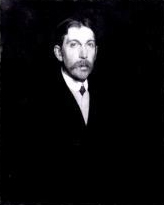
Frank Rutter
Francis Vane Phipson Rutter (17 February 1876 – 18 April 1937) was a British art critic, curator and activist.
In 1903, he became art critic for The Sunday Times, a position which he held for the rest of his life. He was an early champion in England of modern art, founding the French Impressionist Fund in 1905 to buy work for the national collection, and in 1908 starting the Allied Artists Association to show "progressive" art, as well as publishing its journal, Art News, the "First Art Newspaper in the United Kingdom". In 1910, he began to actively support women's suffrage, chairing meetings, and giving sanctuary to suffragettes released from prison under the Cat and Mouse Act—helping some to leave the country.
From 1912 to 1917, he was the curator of Leeds City Art Gallery. In 1917, he edited the cultural journal, Art & Letters, with Herbert Read. In his writing after World War I, Rutter observed that advertising imagery was seen by far more people than work in art galleries; he noted a new realism after the period of "abstract experiment"; and he praised the work of Dod Procter as a "complete presentation of twentieth century vision".
Frank Rutter was born at 4 The Cedars, Putney, London, the youngest son of Henry Rutter (died 1896) and Emmeline Claridge Phipson, daughter of Samuel Ryland Phipson, a landowner and stock- and share-broker from a family of pin and needle manufacturers. His grandfather, John, and his father were both prosperous solicitors with chambers in Clifford's Inn, Holborn, and both had acted for John Ruskin, John assisting on Ruskin's marriage nullification with Euphemia (Effie) Gray; Henry severed the connection with Ruskin, after the latter rejected his counsel on a property transaction.
From 1889, Frank Rutter was educated at Merchant Taylors' School, at that time in Aldersgate, where he specialised in Hebrew (under the influence of his father whose hobby was Biblical archaeology) and where pupils were expected to gain Oxbridge scholarships or exhibitions in classics: Rutter, aged seventeen tried but failed to gain a scholarship in history at Exeter College, Oxford, but was successful in the Queens' College, Cambridge, examination for a scholarship in Hebrew, going to university in 1896 and gaining the Semitic Language Tripos (degree) in 1899.
Whilst still at school, Rutter, along with a fellow sixth form student, Edgar D., explored London nightlife, visiting music halls, eating out in Gatti's Restaurant and joining nightclubs, which were then an adjunct to the more formal London's gentleman's club, providing a dining room, ballroom, writing room, and female membership, which was not taken up by respectable women in society, although the male membership was mostly respectable; Rutter's father happily financed these activities.
When at Cambridge, Rutter gained popularity through his banjo-playing, and, thanks to the good train service available, extended his social pursuits to Paris, first visiting in 1898, speaking French fluently and often staying for a month at a time in the city, where he made friends in the Latin Quarter.
After university, spent a few months as an itinerant tutor, then began as a freelance writer in London with a newly acquired typewriter. One of his successful interviews was with Bernard Shaw on the subject of housing problems—the text of which was entirely provided by Shaw himself; The Times printed an interview with the American scout, Major Burnham, on his return from South Africa.
Hub AI
Frank Rutter AI simulator
(@Frank Rutter_simulator)
Frank Rutter
Francis Vane Phipson Rutter (17 February 1876 – 18 April 1937) was a British art critic, curator and activist.
In 1903, he became art critic for The Sunday Times, a position which he held for the rest of his life. He was an early champion in England of modern art, founding the French Impressionist Fund in 1905 to buy work for the national collection, and in 1908 starting the Allied Artists Association to show "progressive" art, as well as publishing its journal, Art News, the "First Art Newspaper in the United Kingdom". In 1910, he began to actively support women's suffrage, chairing meetings, and giving sanctuary to suffragettes released from prison under the Cat and Mouse Act—helping some to leave the country.
From 1912 to 1917, he was the curator of Leeds City Art Gallery. In 1917, he edited the cultural journal, Art & Letters, with Herbert Read. In his writing after World War I, Rutter observed that advertising imagery was seen by far more people than work in art galleries; he noted a new realism after the period of "abstract experiment"; and he praised the work of Dod Procter as a "complete presentation of twentieth century vision".
Frank Rutter was born at 4 The Cedars, Putney, London, the youngest son of Henry Rutter (died 1896) and Emmeline Claridge Phipson, daughter of Samuel Ryland Phipson, a landowner and stock- and share-broker from a family of pin and needle manufacturers. His grandfather, John, and his father were both prosperous solicitors with chambers in Clifford's Inn, Holborn, and both had acted for John Ruskin, John assisting on Ruskin's marriage nullification with Euphemia (Effie) Gray; Henry severed the connection with Ruskin, after the latter rejected his counsel on a property transaction.
From 1889, Frank Rutter was educated at Merchant Taylors' School, at that time in Aldersgate, where he specialised in Hebrew (under the influence of his father whose hobby was Biblical archaeology) and where pupils were expected to gain Oxbridge scholarships or exhibitions in classics: Rutter, aged seventeen tried but failed to gain a scholarship in history at Exeter College, Oxford, but was successful in the Queens' College, Cambridge, examination for a scholarship in Hebrew, going to university in 1896 and gaining the Semitic Language Tripos (degree) in 1899.
Whilst still at school, Rutter, along with a fellow sixth form student, Edgar D., explored London nightlife, visiting music halls, eating out in Gatti's Restaurant and joining nightclubs, which were then an adjunct to the more formal London's gentleman's club, providing a dining room, ballroom, writing room, and female membership, which was not taken up by respectable women in society, although the male membership was mostly respectable; Rutter's father happily financed these activities.
When at Cambridge, Rutter gained popularity through his banjo-playing, and, thanks to the good train service available, extended his social pursuits to Paris, first visiting in 1898, speaking French fluently and often staying for a month at a time in the city, where he made friends in the Latin Quarter.
After university, spent a few months as an itinerant tutor, then began as a freelance writer in London with a newly acquired typewriter. One of his successful interviews was with Bernard Shaw on the subject of housing problems—the text of which was entirely provided by Shaw himself; The Times printed an interview with the American scout, Major Burnham, on his return from South Africa.