



Community hub
Recent from talks
Knowledge base stats:
Talk channels stats:
Members stats:
Franz Reichelt
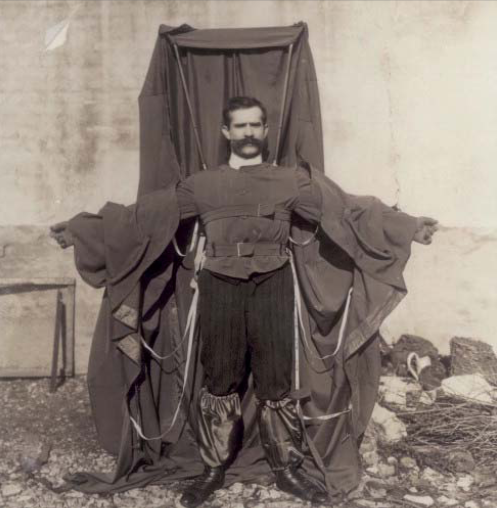
Franz Reichelt (16 October 1878 – 4 February 1912), also known as Frantz Reichelt or François Reichelt, was an Austro-Hungarian-born French tailor, inventor and parachuting pioneer, now sometimes referred to as the Flying Tailor. He is remembered for jumping to his death from the Eiffel Tower while testing a wearable parachute of his own design, a device that today might be called a wingsuit. Reichelt had become fixated on developing a suit for aviators that would convert into a parachute and allow them to survive a fall should they be forced to leave their aircraft in mid-air. Initial experiments conducted with dummies dropped from the fifth floor of his apartment building had been successful, but he was unable to replicate those early successes with any of his subsequent designs.
Believing that a suitably high test platform would prove his invention's efficacy, Reichelt repeatedly petitioned the Parisian Prefecture of Police for permission to conduct a test from the Eiffel Tower. He finally received permission in 1912, but when he arrived at the tower on 4 February he made it clear that he intended to jump personally rather than conduct an experiment with dummies. Despite attempts to dissuade him, he jumped from the first platform of the tower wearing his invention. The parachute failed to deploy and he plummeted 57 metres (187 ft) to his death. The next day, newspapers were full of illustrated stories about the death of the "reckless inventor", and the jump was shown in newsreels.
Franz Reichelt was born on 16 October 1878 in Wegstädtl, Kingdom of Bohemia, Austria-Hungary (today Štětí, Czech Republic), and moved to Paris, France, in 1898. He obtained French nationality in 1909, adopting the first name François (the French equivalent of the Germanic "Franz"). One of his sisters may have also come to France and been married to a jeweller there, but newspaper reports differed on the details of his family life, with most reporting that his sisters stayed in Vienna. Reichelt himself was unmarried. He took an apartment on the third floor at 8 rue Gaillon near the Avenue de l'Opéra from 1907 and opened what was to become a successful dressmaking business, catering mostly to Austrians on trips to Paris.
From July 1910, Reichelt began to develop a "parachute-suit": a suit that was not much more bulky than one normally worn by an aviator, but with the addition of a few rods, a silk canopy and a small amount of rubber that allowed it to fold out to become what Reichelt hoped would be a practical and efficient parachute.
The dawn of the aviation age brought inevitable accidents coupled with a growing interest in safety measures, most notably in the development of an effective parachute. Early parachuting successes, such as those of Louis-Sébastien Lenormand and Jean-Pierre Blanchard, had successfully used fixed-canopy parachutes (already "open" before the jump began), and André-Jacques Garnerin had invented a frameless parachute suitable for use from high altitudes, but by 1910 there was still no parachute suitable for use in jumping from a plane or at low altitude.
Reichelt seems to have become interested in parachute design after hearing some of the stories of fatal accidents among the early aeronauts and aviators. His early tests were successful: dummies equipped with foldable silk "wings" touched down lightly when dropped from five floors, but converting the prototypes into a wearable "suit" proved difficult. His original design used 6 square metres (65 ft2) of material and weighed around 70 kilograms (150 lb). He presented his design to the leading aeronautic organization, La Ligue Aérienne at the Aéro-Club de France, hoping that they would test it, but they rejected his designs on the grounds that the construction of the canopy was too weak and attempted to dissuade him from spending further time on development. Reichelt nevertheless persevered and conducted experimental drops with dummies from the courtyard of his building at rue Gaillon. None of his tests proved successful.
In 1911, a Colonel Lalance wrote to the Aéro-Club de France, offering a prize of 10,000 francs for a safety parachute for aviators – double the prize he had offered the year before. The competition was open for three years and stipulated that the parachute must weigh no more than 25 kilograms (55 lb). Reichelt refined his design, reducing the weight while increasing the surface area of the material until it reached 12 square metres (130 ft2). But his tests were still unsuccessful and his dummies invariably fell heavily to earth.
L'Ouest-Éclair reported in 1911 that Reichelt had personally jumped from a height of 8 to 10 metres (26 to 33 ft) at Joinville; the attempt failed but a pile of straw helped him escape injury. Le Matin reported an attempt at Nogent from a height of 8 metres (26 ft) that resulted in a broken leg. Le Petit Journal suggested that Reichelt also made at least two apparently inconclusive tests with dummies from the first deck of the Eiffel Tower during 1911, but an interview with one of his friends in La Presse made it clear that he had been unsuccessfully applying for permission to conduct a test from the tower for over a year before he finally received the authorization for the final jump. There had been other tests from the tower during 1910 and 1911 though; Gaston Hervieu, who employed a dummy aircraft and mannequins in his experiments, was attempting to perfect a parachute design to ensure the safe landing of a pilot with all or part of a damaged aircraft. Reichelt attributed the previous failures of his designs at least in part to the short drop distances over which he had conducted his tests, so he was keen to receive permission to experiment from the tower.
Hub AI
Franz Reichelt AI simulator
(@Franz Reichelt_simulator)
Franz Reichelt
Franz Reichelt (16 October 1878 – 4 February 1912), also known as Frantz Reichelt or François Reichelt, was an Austro-Hungarian-born French tailor, inventor and parachuting pioneer, now sometimes referred to as the Flying Tailor. He is remembered for jumping to his death from the Eiffel Tower while testing a wearable parachute of his own design, a device that today might be called a wingsuit. Reichelt had become fixated on developing a suit for aviators that would convert into a parachute and allow them to survive a fall should they be forced to leave their aircraft in mid-air. Initial experiments conducted with dummies dropped from the fifth floor of his apartment building had been successful, but he was unable to replicate those early successes with any of his subsequent designs.
Believing that a suitably high test platform would prove his invention's efficacy, Reichelt repeatedly petitioned the Parisian Prefecture of Police for permission to conduct a test from the Eiffel Tower. He finally received permission in 1912, but when he arrived at the tower on 4 February he made it clear that he intended to jump personally rather than conduct an experiment with dummies. Despite attempts to dissuade him, he jumped from the first platform of the tower wearing his invention. The parachute failed to deploy and he plummeted 57 metres (187 ft) to his death. The next day, newspapers were full of illustrated stories about the death of the "reckless inventor", and the jump was shown in newsreels.
Franz Reichelt was born on 16 October 1878 in Wegstädtl, Kingdom of Bohemia, Austria-Hungary (today Štětí, Czech Republic), and moved to Paris, France, in 1898. He obtained French nationality in 1909, adopting the first name François (the French equivalent of the Germanic "Franz"). One of his sisters may have also come to France and been married to a jeweller there, but newspaper reports differed on the details of his family life, with most reporting that his sisters stayed in Vienna. Reichelt himself was unmarried. He took an apartment on the third floor at 8 rue Gaillon near the Avenue de l'Opéra from 1907 and opened what was to become a successful dressmaking business, catering mostly to Austrians on trips to Paris.
From July 1910, Reichelt began to develop a "parachute-suit": a suit that was not much more bulky than one normally worn by an aviator, but with the addition of a few rods, a silk canopy and a small amount of rubber that allowed it to fold out to become what Reichelt hoped would be a practical and efficient parachute.
The dawn of the aviation age brought inevitable accidents coupled with a growing interest in safety measures, most notably in the development of an effective parachute. Early parachuting successes, such as those of Louis-Sébastien Lenormand and Jean-Pierre Blanchard, had successfully used fixed-canopy parachutes (already "open" before the jump began), and André-Jacques Garnerin had invented a frameless parachute suitable for use from high altitudes, but by 1910 there was still no parachute suitable for use in jumping from a plane or at low altitude.
Reichelt seems to have become interested in parachute design after hearing some of the stories of fatal accidents among the early aeronauts and aviators. His early tests were successful: dummies equipped with foldable silk "wings" touched down lightly when dropped from five floors, but converting the prototypes into a wearable "suit" proved difficult. His original design used 6 square metres (65 ft2) of material and weighed around 70 kilograms (150 lb). He presented his design to the leading aeronautic organization, La Ligue Aérienne at the Aéro-Club de France, hoping that they would test it, but they rejected his designs on the grounds that the construction of the canopy was too weak and attempted to dissuade him from spending further time on development. Reichelt nevertheless persevered and conducted experimental drops with dummies from the courtyard of his building at rue Gaillon. None of his tests proved successful.
In 1911, a Colonel Lalance wrote to the Aéro-Club de France, offering a prize of 10,000 francs for a safety parachute for aviators – double the prize he had offered the year before. The competition was open for three years and stipulated that the parachute must weigh no more than 25 kilograms (55 lb). Reichelt refined his design, reducing the weight while increasing the surface area of the material until it reached 12 square metres (130 ft2). But his tests were still unsuccessful and his dummies invariably fell heavily to earth.
L'Ouest-Éclair reported in 1911 that Reichelt had personally jumped from a height of 8 to 10 metres (26 to 33 ft) at Joinville; the attempt failed but a pile of straw helped him escape injury. Le Matin reported an attempt at Nogent from a height of 8 metres (26 ft) that resulted in a broken leg. Le Petit Journal suggested that Reichelt also made at least two apparently inconclusive tests with dummies from the first deck of the Eiffel Tower during 1911, but an interview with one of his friends in La Presse made it clear that he had been unsuccessfully applying for permission to conduct a test from the tower for over a year before he finally received the authorization for the final jump. There had been other tests from the tower during 1910 and 1911 though; Gaston Hervieu, who employed a dummy aircraft and mannequins in his experiments, was attempting to perfect a parachute design to ensure the safe landing of a pilot with all or part of a damaged aircraft. Reichelt attributed the previous failures of his designs at least in part to the short drop distances over which he had conducted his tests, so he was keen to receive permission to experiment from the tower.