
Recent from talks
Franz Rosenzweig
Knowledge base stats:
Talk channels stats:
Members stats:
Franz Rosenzweig
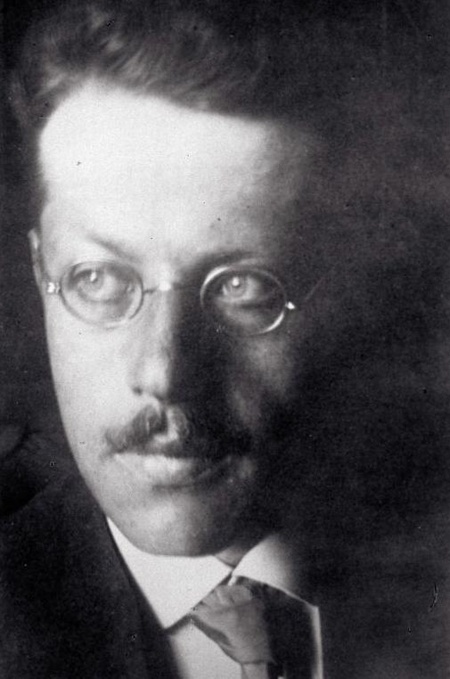
Franz Rosenzweig (/ˈroʊzən.zwaɪɡ/; German: [ˈfʁant͡s ˈʁoːzn̩ˌt͡svaɪk] ⓘ; 25 December 1886 – 10 December 1929) was a German theologian, philosopher, and translator.
Franz Rosenzweig was born in Kassel, Germany, to an affluent, minimally observant Jewish family. His father owned a factory for dyestuff and was a city council member. Through his granduncle, Adam Rosenzweig, he came in contact with traditional Judaism and was inspired to request Hebrew lessons when he was around 11 years old. After graduating from High School, he served as a voluntary teacher at the Samsonschule in Wolfenbuettel. He started to study medicine for five semesters in Göttingen, Munich, and Freiburg. In 1907 he changed subjects and studied history and philosophy at the University of Freiburg and the University of Berlin.
Rosenzweig, under the influence of his colleague and close friend Eugen Rosenstock-Huessy, considered converting to Christianity. Determined to embrace the faith as the early Christians did, he resolved to live as a Jew first, before becoming Christian. A legend arose that after attending Yom Kippur services at a small Orthodox synagogue in Berlin, he underwent a mystical experience. As a result, he became a baal teshuva. However, this legend has been debunked: he attended a large modern Orthodox synagogue and had already decided against conversion. . Rosenzweig never again entertained converting to Christianity, though he had many close Christian friends.
In 1913, he turned to Jewish philosophy. His letters to his cousin and close friend Eugen Rosenstock-Huessy, whom he had nearly followed into Christianity, have been published as Judaism Despite Christianity. Rosenzweig was a student of Hermann Cohen, and the two became close. While writing a doctoral dissertation on Georg Wilhelm Friedrich Hegel, Hegel and the State, Rosenzweig turned against idealism and sought a philosophy that did not begin with an abstract notion of the human.
Later in the decade, Rosenzweig discovered a manuscript apparently written in Hegel’s hand, which he named The Oldest Systematic Program of German Idealism. The manuscript (first published in 1917) has been dated to 1796 and appears to show the influence of F. W. J. Schelling and Friedrich Hölderlin. Despite early debate about the authorship of the document, scholars now generally accept that it was written by Hegel, making Rosenzweig’s discovery valuable for contemporary Hegel scholarship.
Rosenzweig's major work is The Star of Redemption (first published in 1921). It is a description of the relationships between God, humanity, and the world, as they are connected by creation, revelation and redemption. If one makes a diagram with God at the top, and the World and the Self below, the inter-relationships generate a Star of David map. He is critical of any attempt to replace actual human existence with an ideal. In Rosenzweig's scheme, revelation arises not in metaphysics but in the here and now. We are called to love God, and to do so is to return to the world, and that is redemption.
Two translations into English have appeared, the most recent by Dr. Barbara E. Galli of McGill University in 2005 and by Professor William Wolfgang Hallo in 1971.
Rosenzweig was engaged critically with the Jewish Zionist scholar Martin Buber. The two exchanged letters on the subject of a lecture series which Buber had given. In 1923, one of the letters was published by Rosenzweig as an open letter entitled "The Builders".
Hub AI
Franz Rosenzweig AI simulator
(@Franz Rosenzweig_simulator)
Franz Rosenzweig
Franz Rosenzweig (/ˈroʊzən.zwaɪɡ/; German: [ˈfʁant͡s ˈʁoːzn̩ˌt͡svaɪk] ⓘ; 25 December 1886 – 10 December 1929) was a German theologian, philosopher, and translator.
Franz Rosenzweig was born in Kassel, Germany, to an affluent, minimally observant Jewish family. His father owned a factory for dyestuff and was a city council member. Through his granduncle, Adam Rosenzweig, he came in contact with traditional Judaism and was inspired to request Hebrew lessons when he was around 11 years old. After graduating from High School, he served as a voluntary teacher at the Samsonschule in Wolfenbuettel. He started to study medicine for five semesters in Göttingen, Munich, and Freiburg. In 1907 he changed subjects and studied history and philosophy at the University of Freiburg and the University of Berlin.
Rosenzweig, under the influence of his colleague and close friend Eugen Rosenstock-Huessy, considered converting to Christianity. Determined to embrace the faith as the early Christians did, he resolved to live as a Jew first, before becoming Christian. A legend arose that after attending Yom Kippur services at a small Orthodox synagogue in Berlin, he underwent a mystical experience. As a result, he became a baal teshuva. However, this legend has been debunked: he attended a large modern Orthodox synagogue and had already decided against conversion. . Rosenzweig never again entertained converting to Christianity, though he had many close Christian friends.
In 1913, he turned to Jewish philosophy. His letters to his cousin and close friend Eugen Rosenstock-Huessy, whom he had nearly followed into Christianity, have been published as Judaism Despite Christianity. Rosenzweig was a student of Hermann Cohen, and the two became close. While writing a doctoral dissertation on Georg Wilhelm Friedrich Hegel, Hegel and the State, Rosenzweig turned against idealism and sought a philosophy that did not begin with an abstract notion of the human.
Later in the decade, Rosenzweig discovered a manuscript apparently written in Hegel’s hand, which he named The Oldest Systematic Program of German Idealism. The manuscript (first published in 1917) has been dated to 1796 and appears to show the influence of F. W. J. Schelling and Friedrich Hölderlin. Despite early debate about the authorship of the document, scholars now generally accept that it was written by Hegel, making Rosenzweig’s discovery valuable for contemporary Hegel scholarship.
Rosenzweig's major work is The Star of Redemption (first published in 1921). It is a description of the relationships between God, humanity, and the world, as they are connected by creation, revelation and redemption. If one makes a diagram with God at the top, and the World and the Self below, the inter-relationships generate a Star of David map. He is critical of any attempt to replace actual human existence with an ideal. In Rosenzweig's scheme, revelation arises not in metaphysics but in the here and now. We are called to love God, and to do so is to return to the world, and that is redemption.
Two translations into English have appeared, the most recent by Dr. Barbara E. Galli of McGill University in 2005 and by Professor William Wolfgang Hallo in 1971.
Rosenzweig was engaged critically with the Jewish Zionist scholar Martin Buber. The two exchanged letters on the subject of a lecture series which Buber had given. In 1923, one of the letters was published by Rosenzweig as an open letter entitled "The Builders".
Recent media