Hubbry Logo
Franz RothFranz RothMain
Open search
Franz Roth
Community hub
Franz Roth
logo
8 pages, 0 posts
0 subscribers
Be the first to start a discussion here.
Franz Roth
Franz Roth
from Wikipedia

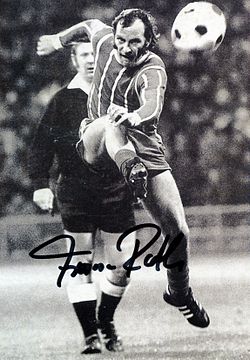
Franz "Bulle" Roth (born 27 April 1946 in Memmingen) is a former German footballer. He earned four caps for the Germany national football team[2] and was nicknamed "the Bull" due to his physical playing style.

Key Information

Career

[edit]

Roth was a big game player and had a knack of scoring important goals in massive games for Bayern Munich. He scored the only goal of the 1967 European Cup Winners' Cup Final against Rangers in extra time, which was enough to give Bayern victory, and their first triumph in European competition.[3] He opened the scoring in the 1975 European Cup Final win over Leeds United, a game in which Roth won the midfield battle against Billy Bremner. Roth scored for the third time in the final of a European competition, with his 57th-minute strike against AS Saint-Étienne 1976 European Cup Final enough to give Bayern a 1–0 victory, and retain the European Cup for the third straight season.[4]

On the domestic scene he scored 72 goals in 322 West German top-flight matches.[5] With Roth FC Bayern won 4 Bundesliga titles.

Roth is one of the most decorated players in Bayern's history and has been voted into their Hall of Fame.[6]

Honours

[edit]

References

[edit]
[edit]
Revisions and contributorsEdit on WikipediaRead on Wikipedia
from Grokipedia
Franz Roth (born 27 April 1946 in ) is a retired German professional footballer who played primarily as a defensive and attacking for during a 12-year tenure from 1966 to 1978. Known by the nickname "Bulle" (Bull) for his aggressive style and powerful shots, Roth appeared in 322 matches for Bayern, scoring 72 goals and ranking among the club's all-time top 15 scorers. He earned four caps for the national team between 1970 and 1973. Roth's career is defined by his clutch performances in major finals, where he scored decisive goals across three European competitions. In the 1967 European Cup Winners' Cup final, he netted the only goal in Bayern's 1–0 victory over at the Nürnberg Arena, securing the club's first European trophy. He repeated this feat in the 1975 European Cup final against Leeds United, scoring the opener in a 2–0 win (with adding the second) to claim Bayern's second continental title. In the , Roth's 57th-minute strike from a delivered a 1–0 triumph over , completing Bayern's of consecutive European Cup wins. Domestically, he contributed to four titles (1968–69, 1971–72, 1972–73, 1973–74) and three victories (1966–67, 1968–69, 1969–70). After leaving Bayern, Roth briefly played for in during the 1978–79 season before ending his professional career as an amateur with . Post-retirement, he operated two sports shops in his hometown of and remained a lifelong Bayern supporter, rejecting lucrative offers from clubs like during his playing days. Roth's legacy endures as one of Bayern's most reliable big-game players, inducted into the club's Hall of Fame for his role in establishing its European dominance.

Early life

Birth and upbringing

Franz Roth was born on 27 April 1946 in , , , at a time when the region was under Allied occupation in the immediate . He grew up as the youngest of six children in a working-class family with modest means, the son of a farmer in the rural village of Bertoldshofen near , part of the Swabian region that was slowly rebuilding amid economic hardship. After completing an agricultural apprenticeship, Roth helped on the family dairy farm, which built his physical strength through manual labor. Roth's early years were shaped by the agricultural lifestyle of his family's surroundings and the resilient community spirit of rural during the . As a child in this football-enthusiastic part of , Roth experienced basic schooling and local traditions, fostering an initial interest in sports that later drew him toward organized youth football.

Youth football career

Roth began his organized football involvement in the youth ranks of TSV Bertoldshofen, a local village club in Hausen, where he grew up, playing as a versatile multi-position player during his early teens. His family supported this initial engagement, providing encouragement amid his rural upbringing on a farm. In 1964, at age 18, Roth transferred to SpVgg , a regional team competing in the Amateurliga Schwaben, where he developed as an emerging in their A-youth . During his two seasons there (1964–1966), he contributed to the team's promotion to the , the third tier of German football, through strong performances in key qualification matches that showcased his physical robustness and tactical awareness gained from late-teen development on the farm and in training. Initially preferring winger roles for his speed and , Roth began shifting toward central midfield duties, adapting to higher competition levels with intensive weekly sessions that built his endurance and ball-winning skills. At age 20, Roth caught the attention of Bayern Munich scouts in while playing for ; club official and barber Alexander Kotter, a devoted Bayern supporter, recommended him to the team, leading to observations by manager Walter Fembeck. Impressed by his quick acceleration—capable of running 100 meters in 11 seconds—and defensive tenacity, Bayern's general manager Robert Schwan signed him directly to a professional contract for the season without a trial period, marking the end of his youth phase and his transition to senior football.

Club career

Bayern Munich

Franz Roth joined FC Bayern Munich in 1966 at the age of 20, marking his entry into professional football during the early years of the era, where the club was establishing itself as a dominant force following promotion in 1965. In his debut season of 1966–67, Roth quickly adapted to the role of a versatile , capable of both defensive duties and attacking contributions, earning him the nickname "Bulle" (Bull) from coach due to his physical presence and aggressive style. His breakthrough moment came in the 1967 European Cup Winners' Cup final against in Nürnberg, where he scored the decisive goal in the 109th minute of extra time, securing a 1–0 victory and Bayern's first major European trophy. Over the next few seasons through 1970, Roth solidified his position in the squad, contributing to Bayern's growing success in domestic competitions while honing his ability to neutralize opponents' playmakers through hard tackles and tactical awareness. Roth's peak years from 1971 to 1975 saw him become a cornerstone of Bayern's golden era, playing a pivotal role in the club's three consecutive European Cup triumphs between 1974 and 1976. He was instrumental in securing four Bundesliga titles—in the 1968–69, 1971–72, 1972–73, and 1973–74 seasons—often providing midfield stability and powerful long-range shots that complemented the attacking prowess of teammates like Franz Beckenbauer and Gerd Müller. In the 1975 European Cup final against Leeds United at Parc des Princes, Roth opened the scoring in the 71st minute with a clinical finish, paving the way for Müller's second goal in a 2–0 win that marked Bayern's second straight European title. The following year, in the 1976 final versus Saint-Étienne at Hampden Park, Roth again proved decisive, scoring the only goal from a free kick in the 57th minute of regular time, clinching a 1–0 victory and completing Bayern's hat-trick of European Cups. His tactical contributions during this era were marked by a robust physicality in midfield, where he effectively disrupted opposition builds while launching counter-attacks with his renowned shooting accuracy from distance. From 1976 to 1978, Roth's role within the Bayern squad began to diminish as younger players emerged and persistent physical demands took a toll, leading to his departure from the club after 12 years. Despite reduced starts, he remained a valuable squad member, drawing on his experience alongside stars like Beckenbauer and Müller to mentor the team during transitional phases. Over his entire Bayern career, Roth made 322 appearances in the , scoring 72 goals, figures that underscore his longevity and impact as a reliable midfield engine in one of the club's most successful periods.

Later clubs

After departing Bayern Munich in 1978 at the age of 32, Roth signed with SV Casino Salzburg for the 1978–79 season in the Austrian Bundesliga. In his single campaign there, he featured in 31 league matches, scoring once, as the team competed in the top flight of Austrian football. This international move marked a shift to a new league environment following his long tenure in Germany. Returning to his home country in 1980, Roth joined for a short spell in the , where he made 8 appearances without finding the net. The stint was limited, reflecting the later stages of his professional career amid increasing physical demands. Roth concluded his playing days with TSV Mindelheim, a club in the Bavarian Oberliga near his hometown of , from 1980 to 1985. There, he contributed to the side in the regional third tier, gradually reducing his involvement before retiring at age 39. Across all clubs, Roth amassed 371 senior appearances and 73 goals in his career.

International career

Senior appearances

Roth earned four caps for the senior national team between 1967 and 1970, during which he scored no goals. His international debut occurred on 7 October 1967, starting in a 3–1 home win against in the Group 4, where he played the full 90 minutes as a defensive . This selection coincided with Bayern Munich's emerging prominence, following their victory in the 1966–67 European Cup Winners' Cup. Roth's subsequent appearances were all in friendlies. On 8 1970, he substituted in for the second half during a 1–1 draw with in . Later that year, on 18 November, he started and completed the full match in a 2–0 defeat to in . His final cap came four days later, on 22 November 1970, entering as a substitute in the 35th minute during a 3–1 victory over in , where he played 55 minutes. Despite his solid performances at club level, Roth's international opportunities were limited by intense competition for midfield places from established stars such as and , as well as his commitments to Bayern's domestic and European campaigns. He did not feature in major tournaments, including the finals, though his national team exposure underscored his value as a reliable squad option and enhanced his standing in German football.

Youth international

Roth earned his sole cap for the U-23 team on 7 May 1969, starting as an attacking in a 2–1 victory over U-23 in a friendly in . The match, played shortly after his continued establishment in Bayern Munich's first team following his debut, offered valuable experience in bridging his youth club background to higher international levels. His physical playing style, characterized by robust tackling and stamina that later earned him the nickname "Bulle" (Bull), aligned well with the intense demands of U-23 fixtures. Roth did not score in the encounter and had no further involvement with the U-23 squad, marking a swift transition toward senior opportunities.

Playing style and legacy

Characteristics and nickname

Franz Roth, standing at 179 cm and weighing 82 kg, possessed a robust physique that underpinned his reputation as a formidable presence on the pitch. His nickname "," meaning "the " in German, originated in the mid-1960s during his early training sessions with Bayern under coach , who initially likened Roth's powerful build and shots to a "muh" (cow in Croatian); teammate famously corrected this to "bull," cementing the moniker that reflected Roth's aggressive, tenacious tackling and unyielding strength. As a versatile capable of shifting between defensive and attacking roles, Roth exemplified endurance and tenacity, often neutralizing opponents through relentless coverage of the pitch and physical duels. His style was marked by powerful long-range shots that became a hallmark, delivering blistering strikes with exceptional force, while his ability to fight for every ball made him a tough but fair competitor who avoided unnecessary fouls. Roth's contributions extended to big-game scenarios, where his scoring prowess in high-stakes matches underscored his reliability under pressure. His playing approach drew comparisons to modern box-to-box midfielders, blending defensive steel with offensive threat in a way that covered extensive ground and adapted to tactical demands. Over his career, Roth's style evolved from the versatile, all-around role he honed in youth setups to a more specialized fit within Bayern's systems under coaches like , where his physicality and shooting integrated seamlessly into pressing and counter-attacking strategies.

Achievements and recognition

Franz Roth's club career with Bayern Munich was marked by significant domestic success, including four titles during the late 1960s and early 1970s. These victories came in the 1968–69, 1971–72, 1972–73, and 1973–74 seasons, establishing Bayern as a dominant force in German football. Additionally, Roth contributed to three triumphs in the 1966–67, 1968–69, and 1969–70 seasons, showcasing his role in the club's early cup successes. On the European stage, Roth played a pivotal part in Bayern's international breakthroughs. He scored the decisive goal in the 1967 European Cup Winners' Cup final, securing a 1–0 extra-time victory over and delivering Bayern's first major European trophy. Roth was instrumental in the club's historic three consecutive European Cup wins from 1974 to 1976, a feat achieved by no other team until 2017; he netted crucial goals in the 1975 final against Leeds United (opening the scoring in a 2–0 win) and the 1976 final against (the lone goal in a 1–0 triumph), marking his third goal in a European final overall. These achievements formed part of Bayern's "golden era" trebles, combining European dominance with domestic prowess. Following his professional retirement in 1979, Roth received formal recognition for his contributions. He was inducted into the FC Bayern Hall of Fame in 2012 as part of the museum's inaugural class of 16 players, honoring his status among the club's most decorated figures. Media tributes continued to highlight his legacy, such as FC Bayern's official celebration of his 75th birthday in 2021, which emphasized his enduring impact on the club's history. Roth remains a symbol of Bayern Munich's golden era, embodying the tenacity and big-game reliability that defined the team's success alongside legends like and . His influence persists in the club's culture as a homegrown hero from the region, though he pursued no major coaching or administrative roles post-retirement, instead maintaining a low-profile connection to the club through occasional appearances at the . While his international career yielded only four caps for with limited honors, Roth's club-centric legacy underscores Bayern's transformation into a European powerhouse.

References

Add your contribution
Related Hubs
User Avatar
No comments yet.