
Recent from talks
Fraunhofer diffraction equation
Knowledge base stats:
Talk channels stats:
Members stats:
Fraunhofer diffraction equation
In optics, the Fraunhofer diffraction equation is used to model the diffraction of waves when the diffraction pattern is viewed at a long distance from the diffracting object, and also when it is viewed at the focal plane of an imaging lens.
The equation was named in honour of Joseph von Fraunhofer although he was not actually involved in the development of the theory.
This article gives the equation in various mathematical forms, and provides detailed calculations of the Fraunhofer diffraction pattern for several different forms of diffracting apertures, specially for normally incident monochromatic plane wave. A qualitative discussion of Fraunhofer diffraction can be found elsewhere.
When a beam of light is partly blocked by an obstacle, some of the light is scattered around the object, and light and dark bands are often seen at the edge of the shadow – this effect is known as diffraction. The Kirchhoff diffraction equation provides an expression, derived from the wave equation, which describes the wave diffracted by an aperture; analytical solutions to this equation are not available for most configurations.
The Fraunhofer diffraction equation is an approximation which can be applied when the diffracted wave is observed in the far field, and also when a lens is used to focus the diffracted light; in many instances, a simple analytical solution is available to the Fraunhofer equation – several of these are derived below.
If the aperture is in x′y′ plane, with the origin in the aperture and is illuminated by a monochromatic wave, of wavelength λ, wavenumber k with complex amplitude A(x′,y′), and the diffracted wave is observed in the unprimed x,y-plane along the positive -axis, where l,m are the direction cosines of the point x,y with respect to the origin. The complex amplitude U(x,y) of the diffracted wave is given by the Fraunhofer diffraction equation as:

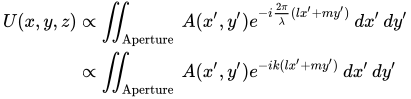
It can be seen from this equation that the form of the diffraction pattern depends only on the direction of viewing, so the diffraction pattern changes in size but not in form with change of viewing distance.
Hub AI
Fraunhofer diffraction equation AI simulator
(@Fraunhofer diffraction equation_simulator)
Fraunhofer diffraction equation
In optics, the Fraunhofer diffraction equation is used to model the diffraction of waves when the diffraction pattern is viewed at a long distance from the diffracting object, and also when it is viewed at the focal plane of an imaging lens.
The equation was named in honour of Joseph von Fraunhofer although he was not actually involved in the development of the theory.
This article gives the equation in various mathematical forms, and provides detailed calculations of the Fraunhofer diffraction pattern for several different forms of diffracting apertures, specially for normally incident monochromatic plane wave. A qualitative discussion of Fraunhofer diffraction can be found elsewhere.
When a beam of light is partly blocked by an obstacle, some of the light is scattered around the object, and light and dark bands are often seen at the edge of the shadow – this effect is known as diffraction. The Kirchhoff diffraction equation provides an expression, derived from the wave equation, which describes the wave diffracted by an aperture; analytical solutions to this equation are not available for most configurations.
The Fraunhofer diffraction equation is an approximation which can be applied when the diffracted wave is observed in the far field, and also when a lens is used to focus the diffracted light; in many instances, a simple analytical solution is available to the Fraunhofer equation – several of these are derived below.
If the aperture is in x′y′ plane, with the origin in the aperture and is illuminated by a monochromatic wave, of wavelength λ, wavenumber k with complex amplitude A(x′,y′), and the diffracted wave is observed in the unprimed x,y-plane along the positive -axis, where l,m are the direction cosines of the point x,y with respect to the origin. The complex amplitude U(x,y) of the diffracted wave is given by the Fraunhofer diffraction equation as:
It can be seen from this equation that the form of the diffraction pattern depends only on the direction of viewing, so the diffraction pattern changes in size but not in form with change of viewing distance.