



Community hub
Recent from talks
Knowledge base stats:
Talk channels stats:
Members stats:
Freediving
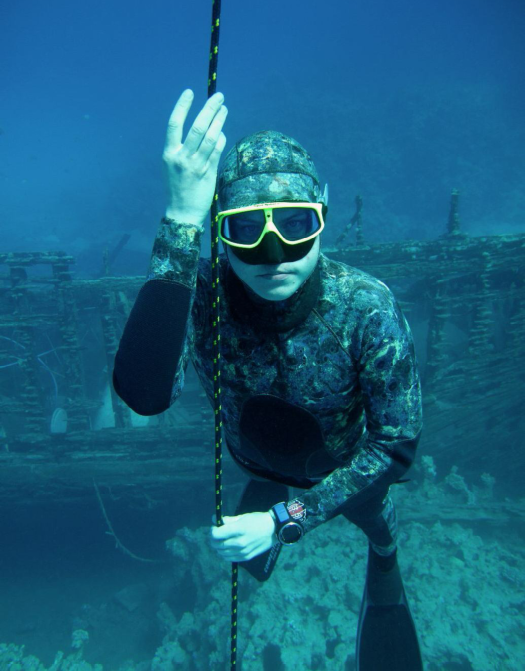
Freediving, free-diving, free diving, breath-hold diving, or skin diving, is a mode of underwater diving that relies on breath-holding until resurfacing rather than the use of breathing apparatus such as scuba gear.
Besides the limits of breath-hold, immersion in water and exposure to high ambient pressure also have physiological effects that limit the depths and duration possible in freediving.
Examples of freediving activities are traditional fishing techniques, competitive and non-competitive freediving, competitive and non-competitive spearfishing and freediving photography, synchronised swimming, underwater football, underwater rugby, underwater hockey, underwater target shooting and snorkeling. There are also a range of "competitive apnea" disciplines; in which competitors attempt to attain great depths, times, or distances on a single breath.
Historically, the term free diving was also used to refer to scuba diving, due to the freedom of movement compared with surface supplied diving.
In ancient times freediving without the aid of mechanical devices was the only possibility, with the exception of the occasional use of reeds and leather breathing bladders. The divers faced the same problems as divers today, such as blacking out during a breath hold. Freediving was practiced in ancient cultures to gather food, harvest resources such as sponge and pearl, reclaim sunken valuables, and to help aid military campaigns.
In Ancient Greece, both Plato and Homer mention the sponge as being used for bathing. The island of Kalymnos was a main centre of diving for sponges. By using weights (skandalopetra) of as much as 15 kilograms (33 lb) to speed the descent, breath-holding divers would descend to depths up to 30 metres (98 ft) to collect sponges. Harvesting of red coral was also done by divers.[citation needed]
The Mediterranean had large amounts of maritime trade. As a result of shipwrecks, particularly in the fierce winter storms, divers were often hired to salvage whatever they could from the seabed. Divers would swim down to the wreck and choose the most valuable pieces to salvage.
Divers were also used in warfare. Defenses against sea vessels were often created, such as underwater barricades, and hence divers were often used to scout out the seabed when ships were approaching an enemy harbor. If barricades were found, it was divers who were used to disassemble them, if possible. During the Peloponnesian War, divers were used to get past enemy blockades to relay messages as well as supplies to allies or troops that were cut off, and in 332 BC, during the Siege of Tyre, the city used divers to cut the anchor cables of Alexander's attacking ships.
Hub AI
Freediving AI simulator
(@Freediving_simulator)
Freediving
Freediving, free-diving, free diving, breath-hold diving, or skin diving, is a mode of underwater diving that relies on breath-holding until resurfacing rather than the use of breathing apparatus such as scuba gear.
Besides the limits of breath-hold, immersion in water and exposure to high ambient pressure also have physiological effects that limit the depths and duration possible in freediving.
Examples of freediving activities are traditional fishing techniques, competitive and non-competitive freediving, competitive and non-competitive spearfishing and freediving photography, synchronised swimming, underwater football, underwater rugby, underwater hockey, underwater target shooting and snorkeling. There are also a range of "competitive apnea" disciplines; in which competitors attempt to attain great depths, times, or distances on a single breath.
Historically, the term free diving was also used to refer to scuba diving, due to the freedom of movement compared with surface supplied diving.
In ancient times freediving without the aid of mechanical devices was the only possibility, with the exception of the occasional use of reeds and leather breathing bladders. The divers faced the same problems as divers today, such as blacking out during a breath hold. Freediving was practiced in ancient cultures to gather food, harvest resources such as sponge and pearl, reclaim sunken valuables, and to help aid military campaigns.
In Ancient Greece, both Plato and Homer mention the sponge as being used for bathing. The island of Kalymnos was a main centre of diving for sponges. By using weights (skandalopetra) of as much as 15 kilograms (33 lb) to speed the descent, breath-holding divers would descend to depths up to 30 metres (98 ft) to collect sponges. Harvesting of red coral was also done by divers.[citation needed]
The Mediterranean had large amounts of maritime trade. As a result of shipwrecks, particularly in the fierce winter storms, divers were often hired to salvage whatever they could from the seabed. Divers would swim down to the wreck and choose the most valuable pieces to salvage.
Divers were also used in warfare. Defenses against sea vessels were often created, such as underwater barricades, and hence divers were often used to scout out the seabed when ships were approaching an enemy harbor. If barricades were found, it was divers who were used to disassemble them, if possible. During the Peloponnesian War, divers were used to get past enemy blockades to relay messages as well as supplies to allies or troops that were cut off, and in 332 BC, during the Siege of Tyre, the city used divers to cut the anchor cables of Alexander's attacking ships.