Hubbry Logo
Free Soil PartyFree Soil PartyMain
Open search
Free Soil Party
Community hub
Free Soil Party
logo
8 pages, 0 posts
0 subscribers
Be the first to start a discussion here.
Free Soil Party
Free Soil Party
from Wikipedia

The Free Soil Party, also called the Free Democratic Party or the Free Democracy,[4] was a political party in the United States from 1848 to 1854, when it merged into the Republican Party. The party was focused on opposing the expansion of slavery into the western territories of the United States. The 1848 presidential election took place in the aftermath of the Mexican–American War and debates over the extension of slavery into the Mexican Cession. After the Whig Party and the Democratic Party nominated presidential candidates who were unwilling to rule out the extension of slavery into the Mexican Cession, anti-slavery Democrats and Whigs joined with members of the Liberty Party (an abolitionist political party) to form the new Free Soil Party. Running as the Free Soil presidential candidate, former President Martin Van Buren won 10.1 percent of the popular vote, the strongest popular vote performance by a third party up to that point in U.S. history.

Key Information

Though Van Buren and many other Free Soil supporters rejoined the Democrats or the Whigs after the 1848 election, Free Soilers retained a presence in Congress over the next six years. Led by Salmon P. Chase of Ohio, John P. Hale of New Hampshire, and Charles Sumner of Massachusetts, the Free Soilers strongly opposed the Compromise of 1850, which temporarily settled the issue of slavery in the Mexican Cession. Hale ran as the party's presidential candidate in the 1852 presidential election, taking just under five percent of the vote. The 1854 Kansas–Nebraska Act repealed the long-standing Missouri Compromise and outraged many Northerners, contributing to the collapse of the Whigs and spurring the creation of a new, broad-based anti-slavery Republican Party. Most Free Soilers joined the Republican Party, which emerged as the dominant political party in the United States in the Third Party System (1856–1894).

History

[edit]

Background

[edit]
James G. Birney was the two-time presidential nominee of the Liberty Party, a forerunner of the Free Soil Party.

Though William Lloyd Garrison and most other abolitionists of the 1830s had generally shunned the political system, a small group of abolitionists founded the Liberty Party in 1840. The Liberty Party was a third party dedicated to the immediate abolition of slavery. The Liberty Party nominated James G. Birney for president and Thomas Earle for vice president in the 1840 presidential election.[5] Months after the 1840 election, the party re-nominated Birney for president, established a national party committee, and began to organize at the state and local level.[6] Support for the party grew in the North, especially among evangelical former Whigs in New England, upstate New York, Michigan, and Ohio's Western Reserve.[7] Other anti-slavery Whigs like John Quincy Adams remained within the Whig Party, but increasingly supported anti-slavery policies like the repeal of the gag rule, which prevented the House of Representatives from considering abolitionist petitions.[8] Meanwhile, long-time abolitionist leaders like Lewis Tappan became increasingly open to working within the political system.[9] In a reflection of the rise of anti-slavery sentiment, several Northern states passed personal liberty laws that forbid state authorities from cooperating in the capture and return of fugitive slaves.[10]

Beginning in May 1843, President John Tyler made the annexation of Texas his key priority. Most leaders of both parties opposed opening the question of annexation in 1843 due to their fear of stoking the debate over slavery; the annexation of Texas was widely viewed as a pro-slavery initiative because it would add another slave state to the union.[11] Nonetheless, in April 1844, Secretary of State John C. Calhoun reached a treaty with Texas providing for the annexation of that country.[12] Henry Clay and Martin Van Buren, the two front-runners for the major party presidential nominations in the 1844 presidential election, both announced their opposition to annexation, and the Senate blocked the treaty.[13] To the surprise of Clay and other Whigs, the 1844 Democratic National Convention rejected Van Buren in favor of James K. Polk, and approved a platform calling for the acquisition of both Texas and Oregon Country.[14] Polk went on to defeat Clay in a close election, taking 49.5 of the popular vote and a majority of the electoral vote. The number of voters casting a ballot for Birney increased tenfold from 6,200 in 1840 (0.3 percent of popular vote) to 62,000 (2.3 percent of the popular vote) in 1844.[15]

Formation of the Free Soil Party

[edit]

Wilmot Proviso

[edit]
Free Soilers sought to exclude slavery from the Mexican Cession (red), which was acquired from Mexico in the 1848 Treaty of Guadalupe Hidalgo.

Following the annexation of Texas in 1845, President Polk began preparations for a potential war with Mexico, which still regarded Texas as a part of its republic.[16] After a skirmish known as the Thornton Affair broke out on the northern side of the Rio Grande,[17] Polk convinced Congress to declare war against Mexico.[18] Though most Democrats and Whigs initially supported the war, Adams and some other anti-slavery Whigs attacked the war as a "Slave Power" plot designed to expand slavery across North America.[19] Meanwhile, former Democratic Representative John P. Hale had defied party leaders by denouncing the annexation of Texas, causing him to lose re-election in 1845. Hale joined with anti-slavery Whigs and the Liberty Party to create a new party in New Hampshire, and he won election to the Senate in early 1847.[20] In New York, tensions between the anti-slavery Barnburner and the conservative Hunker factions of the Democratic Party rose, as the Hunkers allied with the Whigs to defeat the re-election campaign of Democratic Governor Silas Wright.[21]

In August 1846, Polk asked Congress to appropriate $2 million (~$62.3 million in 2024) in hopes of using that money as a down payment for the purchase of Alta California in a treaty with Mexico.[22] During the debate over the appropriations bill, Democratic Representative David Wilmot of Pennsylvania offered an amendment known as the Wilmot Proviso, which would ban slavery in any newly acquired lands.[23] Though broadly supportive of the war, Wilmot and some other anti-slavery Northern Democrats had increasingly come to view Polk as unduly favorable to Southern interests, partly due to Polk's decision to compromise with Britain over the partition of Oregon.[24] Unlike some Northern Whigs, Wilmot and other anti-slavery Democrats were largely unconcerned by the issue of racial equality, and instead opposed the expansion of slavery because they believed the institution was detrimental to the "laboring white man."[25] The Wilmot Proviso passed the House with the support of both Northern Whigs and Northern Democrats, breaking the normal pattern of partisan division in congressional votes, but it was defeated in the Senate, where Southerners controlled a proportionally higher share of seats.[26] Several Northern congressmen subsequently defeated an attempt by President Polk and Senator Lewis Cass to extend the Missouri Compromise line to the Pacific.[27]

In February 1848, Mexican and U.S. negotiators reached the Treaty of Guadalupe Hidalgo, which provided for the cession of Alta California and New Mexico.[28] Though many senators had reservations about the treaty, the Senate approved it in a 38-to-14 vote in February 1848.[29] Senator John M. Clayton's effort to reach a compromise over the status of slavery in the territories was defeated in the House, ensuring that slavery would be an important issue in the 1848 election.[30]

Election of 1848

[edit]
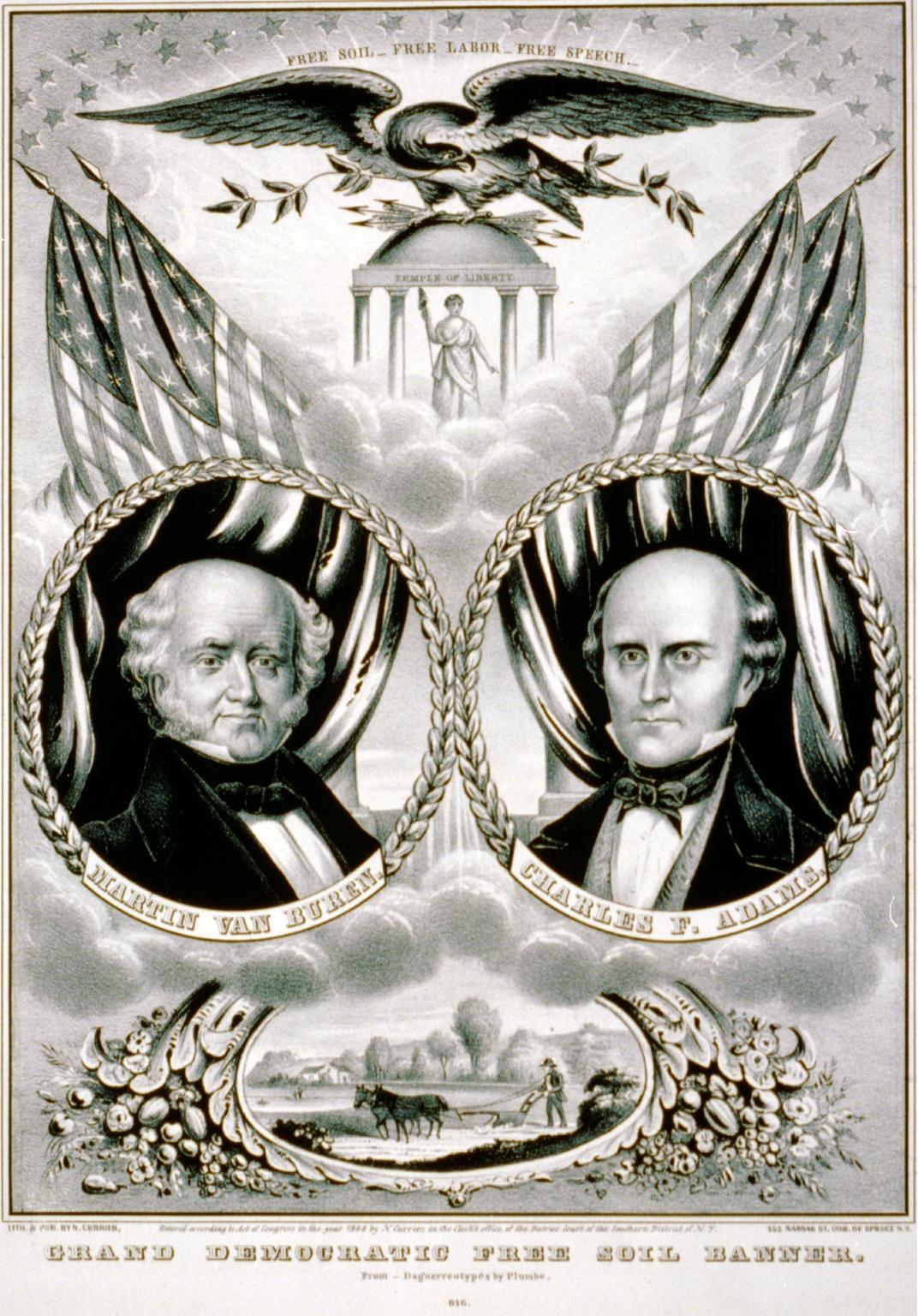
The party nominated former President Martin Van Buren for president in the 1848 presidential election
1848 cartoon for Van Buren

Led by John Van Buren, the Barnburners bolted from the 1848 Democratic National Convention after the party nominated a ticket consisting of Senator Lewis Cass of Michigan and former Representative William O. Butler of Kentucky; Cass and Butler had both opposed the Wilmot Proviso.[31] Shortly after the Democrats nominated Cass, a group of Whigs made plans for a convention of anti-slavery politicians and activists in case the 1848 Whig National Convention nominated General Zachary Taylor of Louisiana for president.[32] With the strong backing of slave state delegates, Taylor defeated Henry Clay to win the Whig presidential nomination.[33] For vice president, the Whigs nominated Millard Fillmore of New York, a conservative Northerner.[34] The nomination of Taylor, a slaveholder without any history in the Whig Party, spurred anti-slavery Whigs to go through with their convention, which would meet in Buffalo, New York, in August.[35] A faction of the Liberty Party led by Salmon P. Chase agreed to attend the convention, though another faction of the party, led by Gerrit Smith, refused to consider merging with another party.[36]

Meanwhile, Barnburners convened in Utica, New York, on June 22; they were joined by a smaller number of Whigs and Democrats from outside New York. Though initially reluctant to accept to run for president, former President Van Buren accepted the group's presidential nomination. Van Buren endorsed the position that slavery should be excluded from the territories acquired from Mexico, further declaring his belief that slavery was inconsistent with the "principles of the Revolution". Because Van Buren had favored the gag rule and had generally accommodated pro-slavery leaders during his presidency, many Liberty Party leaders and anti-slavery Whigs were unconvinced as to the sincerity of Van Buren's anti-slavery beliefs.[37] Historian A. James Reichley writes that, while resentment stemming from his defeat at the 1844 Democratic National Convention may have played a role in his candidacy, Van Buren ran on the grounds that "the long-term welfare of [the Democratic Party], and the nation, required that the [Democratic Party] shed its Calhounite influence, even at the cost of losing an election or two."[38]

With mix of Democratic, Whig, and Liberty Party attendees, the National Free Soil Convention convened in Buffalo early August. Anti-slavery leaders made up a majority of the attendees, but the convention also attracted some Democrats and Whigs who were indifferent on the issue of slavery but disliked the nominee of their respective party.[39] Salmon Chase, Preston King, and Benjamin Franklin Butler led the drafting of a platform that not only endorsed the Wilmot Proviso but also called for the abolition of slavery in Washington, D.C., and all U.S. territories. With the backing of most Democratic delegates, about half of the Whig delegates, and a small number of Liberty Party leaders, Van Buren defeated John P. Hale to win the fledgling party's presidential nomination. For vice president, the Free Soil Party nominated Charles Francis Adams Sr., the youngest son of the recently deceased John Quincy Adams.[40]

Some Free Soil leaders were initially optimistic that Van Buren could carry a handful of Northern states and force a contingent election in the House of Representatives, but Van Buren did not win a single electoral vote.[41] However, the nomination of Van Buren alienated many Whigs; except in northern Ohio, most Whig leaders and newspapers rallied around Taylor's candidacy.[42] Ultimately, Taylor won the election with a majority of the electoral vote and a plurality of the popular vote, improving on Clay's 1844 performance in the South and benefiting from the defection of many Democrats to Van Buren in the North.[43] Van Buren won ten percent of the national popular vote and fifteen percent of the popular vote in the Northern states; he received a popular vote total five times greater than that of Birney's 1844 candidacy.[44] Van Buren was the first third-party candidate in U.S. history to win at least ten percent of the national popular vote.[45] In concurrent congressional elections, Salmon Chase won election to the Senate and about a dozen Free Soil candidates won election to the House of Representatives.[46]

Between elections, 1849–1852

[edit]
Salmon P. Chase of Ohio was one of the most prominent leaders of the Free Soil Party
In this 1850 political cartoon, the artist attacks abolitionist, Free Soil and other sectionalist interests of 1850 as dangers to the Union

The Free Soil Party continued to exist after 1848, fielding candidates for various offices. At the state level, Free Soilers often entered into coalition with either of the major parties to elect anti-slavery officeholders.[47] To sidestep the issue of the Wilmot Proviso, the Taylor administration proposed that the lands of the Mexican Cession be admitted as states without first organizing territorial governments; thus, slavery in the area would be left to the discretion of state governments rather than the federal government.[48] In January 1850, Senator Clay introduced a separate proposal which included the admission of California as a free state, the cession by Texas of some of its northern and western territorial claims in return for debt relief, the establishment of New Mexico and Utah territories, a ban on the importation of slaves into the District of Columbia for sale, and a more stringent fugitive slave law.[49] Free Soilers strongly opposed this proposal, focusing especially on the fugitive slave law.[50]

Taylor died in July 1850 and was succeeded by Vice President Fillmore.[51] Fillmore and Democrat Stephen A. Douglas led the passage of the Compromise of 1850, which was based on Clay's earlier proposal.[52] The Whig Party became badly split between pro-Compromise Whigs like Fillmore and Webster and anti-Compromise Whigs like William Seward, who demanded the repeal of the Fugitive Slave Act.[53] The first of several prominent episodes concerning the enforcement of the Fugitive Slave Law occurred in late 1850, when Boston abolitionists helped Ellen and William Craft, two fugitive slaves, escape to Canada.[54]

Though the fugitive slave act and its enforcement outraged anti-slavery activists, most Northerners viewed it as a necessary trade-off for sectional peace with the South, and there was a backlash in the North against the anti-slavery agitation.[55] The Free Soil Party suffered from this backlash, as well as the desertion of many anti-slavery Democrats (including Van Buren himself), many of whom believed that sectional balance had been restored following Van Buren's candidacy and the Compromise of 1850. Charles Sumner won election to the 32nd Congress, but Free Soilers lost a net of five seats in the 1850 and 1851 House of Representatives elections.[56] As the 1852 presidential election approached, Free Soilers cast about for a candidate. Potential candidates with national stature like Van Buren and Senator Thomas Hart Benton declined to run, while Supreme Court Justice Levi Woodbury, another subject of speculation as a potential Free Soil candidate, died in 1851.[56]

1852 presidential election

[edit]

Enforcement of the Fugitive Slave Act damaged Fillmore's standing among Northerners and, with the backing of Senator Seward, General Winfield Scott won the presidential nomination at the 1852 Whig National Convention.[57] The Whig national convention also adopted a platform that endorsed the Compromise of 1850 and the Fugitive Slave Act. Scott and his advisers had initially hoped to avoid openly endorsing the Compromise of 1850 in order to court Free Soil support, but, as a concession to Southern Whigs, Scott agreed to support the Whig platform.[58] The 1852 Democratic National Convention, meanwhile, nominated former New Hampshire senator Franklin Pierce, a Northerner sympathetic to the Southern view on slavery.[59] Free Soil leaders had initially considered supporting Scott, but they organized a national convention after Scott accepted the pro-Compromise Whig platform.[60]

At the August 1852 Free Soil Convention, held in Pittsburgh, the party nominated a ticket consisting of Senator John P. Hale of New Hampshire and former Representative George Washington Julian of Indiana. The party adopted a platform that called for the repeal of the Fugitive Slave Act and described slavery as "a sin against God and a crime against man."[61] Free Soil leaders strongly preferred Scott to Pierce, and Hale focused his campaign on winning over anti-slavery Democratic voters.[62] The elections proved to be disastrous for the Whig Party, as Scott was defeated by a wide margin and the Whigs lost several congressional and state elections.[63] Hale won just under five percent of the vote, performing most strongly in Massachusetts, Vermont, and Wisconsin.[64] Though much of this drop in support was caused by the return of Barnburners to the Democratic Party, many individuals who had voted for Van Buren in 1848 sat out the 1852 election.[65] In the aftermath of the decisive defeat of the Whigs, many Free Soil leaders predicted an impending realignment that would result in the formation of a larger anti-slavery party that would unite Free Soilers with anti-slavery Whigs and Democrats.[66]

Formation of the Republican Party

[edit]
After the passage of the Kansas–Nebraska Act in 1854, Free Soilers joined with other groups to form the Republican Party, which nominated political neophyte John C. Frémont for president in 1856.

Hoping to spur the creation of a transcontinental railroad, in 1853 Senator Douglas proposed a bill to create an organized territorial government in a portion of the Louisiana Purchase that was north of the 36°30′ parallel, and thus excluded slavery under the terms of the Missouri Compromise. After pro-slavery Southern senators blocked the passage of the proposal, Douglas and other Democratic leaders agreed to a bill that would repeal the Missouri Compromise and allow the inhabitants of the territories to determine the status of slavery.[67] In response, Free Soilers issued the Appeal of the Independent Democrats, a manifesto that attacked the bill as the work of the Slave Power.[68] Overcoming the opposition of Free Soilers, Northern Whigs, and many Democrats, the Kansas–Nebraska Act was passed into law in May 1854.[69] The act deeply angered many Northerners, including anti-slavery Democrats and conservative Whigs who were largely apathetic towards slavery but were upset by the repeal of a thirty-year-old compromise. Pierce's forceful response to protests stemming from the capture of escaped slave Anthony Burns further alienated many Northerners.[70]

Throughout 1854, Democrats, Whigs, and Free Soilers held state and local conventions, where they denounced the Kansas–Nebraska Act. Many of the larger conventions agreed to nominate a fusion ticket of candidate opposed to the Kansas–Nebraska Act, and some adopted portions of the Free Soil platform from 1848 and 1852. One of these groups met in Ripon, Wisconsin, and agreed to establish a new party known as the Republican Party if the Kansas–Nebraska Act passed. Though many Democrats and Whigs involved in the anti-Nebraska movement still clung to their partisan affiliation, others began to label themselves as Republicans.[71] Another political coalition appeared in the form of the nativist and anti-Catholic Know Nothing movement, which formed the American Party.[72] While the Republican Party almost exclusively appealed to Northerners, the Know Nothings gathered many adherents in both the North and South; some individuals joined both groups even while they remained part of the Whig Party or the Democratic Party.[73]

Congressional Democrats suffered huge losses in the mid-term elections of 1854, as voters provided support to a wide array of new parties opposed to the Democratic Party.[74] Most victorious congressional candidates who were not affiliated with the Democratic Party had campaigned either independently of the Whig Party or in fusion with another party.[75] "Bleeding Kansas", a struggle between anti-slavery and pro-slavery settlers for control of Kansas Territory, escalated in 1855 and 1856, pushing many moderate Northerners to join the nascent Republican Party.[76] As cooperation between Northern and Southern Whigs appeared to be increasingly impossible, leaders from both sections continued to abandon the party.[77] In September 1855, Seward led his faction of Whigs into the Republican Party, effectively marking the end of the Whig Party as an independent and significant political force.[78] In May 1856, after denouncing the Slave Power in a speech on the Senate floor, Senator Sumner was attacked by Congressman Preston Brooks, outraging Northerners.[79] Meanwhile, the 1856 American National Convention nominated former President Fillmore for president, but many Northerners deserted the American Party after the party platform failed to denounce the Kansas–Nebraska Act.[80]

The 1856 Republican National Convention convened in Philadelphia in June 1856. A committee chaired by David Wilmot produced a platform that denounced slavery, the Kansas–Nebraska Act, and the Pierce administration. Though Chase and Seward were the two most prominent members of the nascent party, the Republicans instead nominated John C. Frémont, the son-in-law of Thomas Hart Benton and a political neophyte. The party campaigned on a new version of an old Free Soil slogan: "Free Speech, Free Press, Free Men, Free Labor, Free Territory, and Frémont".[81] With the collapse of the Whig Party, the 1856 presidential election became a three-sided contest between Democrats, Know Nothings, and Republicans.[82] During his campaign, Fillmore minimized the issue of nativism, instead attempting to use his campaign as a platform for unionism and a revival of the Whig Party.[83] Ultimately, Democrat James Buchanan won the election with a majority of the electoral vote and 45 percent of the popular vote; Frémont won most of the remaining electoral votes and took 33 percent of the popular vote, while Fillmore won 21.6 percent of the popular vote and just eight electoral votes.[84] Frémont carried New England, New York, and parts of the Midwest, but Buchanan nearly swept the South and won several Northern states.[85]

Ideology and positions

[edit]

The 1848 Free Soil platform openly denounced the institution of slavery, demanding that the federal government "relieve itself of all responsibility for the existence and continuance of slavery" by abolishing slavery in all federal districts and territories. The platform declared: "[W]e inscribe on our banner, 'Free Soil, Free Speech, Free Labor, and Free Men,' and under it we will fight on, and fight forever, until a triumphant victory shall reward our exertions". Unlike the Liberty Party, the 1848 Free Soil Party platform did not address fugitive slaves or racial discrimination, nor did it call for the abolition of slavery in the states. The party nonetheless earned the support of many former Liberty Party leaders by calling for abolition wherever possible, the chief goal of the Liberty Party. The Free Soil platform also called for lower tariffs, reduced postal rates, and improvements to harbors.[86] The 1852 party platform more overtly denounced slavery, and also called for the diplomatic recognition of Haiti.[61] Many Free Soilers also supported the temperance movement.[87]

Base of support

[edit]
Free Soil performance in the 1848 election; darker shades of green indicate greater support

During the 1848 election, the Free Soil Party fared best in New York, Vermont, and Massachusetts.[88] Though some anti-slavery Democrats found Cass acceptable or refused to vote for a ticket featuring Charles Francis Adams, about three-fifths of the support for Van Buren's candidacy came from Democrats. About one-fifth of those who voted for Van Buren were former members of the Liberty Party, though a small number of Liberty Party members voted for Gerrit Smith instead. Except in New Hampshire and Ohio, relatively few Whigs voted for Van Buren,[89] as slavery-averse Whigs like Abraham Lincoln, Thaddeus Stevens, and Horace Greeley largely backed Taylor.[44]

In New England, many trade unionists and land reformers supported the Free Soil Party, though others viewed slavery as a secondary issue or were hostile to the anti-slavery movement.[90] Other Free Soil Party supporters were active in the women's rights movement, and a disproportionate number of those who attended the Seneca Falls Convention were associated with party. One leading women's rights activist, Elizabeth Cady Stanton, was the wife of Free Soil leader Henry Brewster Stanton and a cousin of Free Soil Congressman Gerrit Smith.[91]

Party leaders and other prominent individuals

[edit]
Frederick Douglass served as the secretary of the 1852 Free Soil National Convention[92]

Former President Martin Van Buren of New York and Senator John P. Hale of New Hampshire served as the two presidential nominees of the party, while Charles Adams of Massachusetts and Congressman George Washington Julian served as the party's vice-presidential nominees. Salmon P. Chase, Preston King, Gamaliel Bailey, and Benjamin Butler played crucial roles in leading the first party convention and drafting the first party platform. Among those who attended the first Free Soil convention were poet and journalist Walt Whitman and abolitionist leader Frederick Douglass, the latter of whom was part of a small group of African Americans to attend the convention.[93] In September 1851, Julian, Congressman Joshua Reed Giddings, and Lewis Tappan organized a national Free Soil convention that met in Cleveland, Ohio.[94] Other notable individuals associated with the party include Cassius Marcellus Clay[95] 1876 Democratic presidential nominee Samuel J. Tilden, Senator Charles Sumner, educational reformer Horace Mann, poet John Greenleaf Whittier, future Montana governor Sidney Edgerton, educator Jonathan Blanchard, poet William Cullen Bryant, and writer Richard Henry Dana Jr.[citation needed]

Legacy

[edit]

Free Soilers in the Republican Party

[edit]

The Free Soil Party essentially merged into the Republican Party after 1854.[96] However, Martin Van Buren (who had already returned to the Democratic Party in November 1852[97]), his followers and the Barnburners rejoined the Democratic Party.[98][99] Like their Free Soil predecessors, Republican leaders in the late 1850s generally did not call for the abolition of slavery, but instead sought to prevent the extension of slavery into the territories.[96] The Republicans combined the Free Soil stance on slavery with Whig positions on economic issues, such as support for high tariffs and federally-funded infrastructure projects.[100] After 1860, the Republican Party became the dominant force in national politics.[101] Reflecting on the new electoral strength of the Republican Party years later, Free Soiler and anti-slavery activist Henry Brewster Stanton wrote that "the feeble cause I espoused at Cincinnati in 1832...[now rested] on the broad shoulders of a strong party which was marching to victory."[102]

Former Free Soiler Salmon Chase was a major candidate for the presidential nomination at the 1860 Republican National Convention, but Abraham Lincoln defeated Chase, Seward, and other candidates to win the party's presidential nomination.[103] After Lincoln won the 1860 presidential election, several Southern states seceded, eventually leading to the Civil War. During the war, a faction of the Republican Party known as the Radical Republicans emerged; these Radical Republicans generally went farther than other Republicans in advocating for racial equality and the immediate abolition of slavery.[104] Many of the leading Radical Republicans, including Giddings, Chase, Hale, Julian, and Sumner, had been members of the Free Soil Party.[105] Some Radical Republicans sought to replace Lincoln as the 1864 Republican presidential nominee with either Chase or Frémont, but Lincoln ultimately won re-nomination and re-election.[104]

In 1865, the Civil War came to an end with the surrender of the Confederacy, and the United States abolished slavery nationwide by ratifying the Thirteenth Amendment. Radical Republicans exercised an important influence during the subsequent Reconstruction era, calling for ambitious reforms designed to promote the political and economic equality of African Americans in the South.[106]

In 1872, a disproportionate number of former Free Soilers helped found the short-lived Liberal Republican Party, a breakaway group of Republicans who launched an unsuccessful challenge to President Ulysses S. Grant's 1872 re-election bid. Aside from defeating Grant, the party's central goals were the end of Reconstruction, the implementation of civil service reform, and the reduction of tariff rates.[107] Former Free Soiler Charles Francis Adams led on several presidential ballots of the 1872 Liberal Republican convention, but was ultimately defeated by Horace Greeley.[108] Many other former Free Soilers remained in the Republican Party, including former Free Soil Congressman Henry Wilson, who served as vice president from 1873 until his death 1875.[109]

Memorials

[edit]

Free Soil Township, Michigan, was named after the Free Soil party in 1848.[110]

Recent revival

[edit]

In 2014, the party's name was used for the American Free Soil Party with a focus on justice for immigrants, as well as combating discrimination.[111] On February 15, 2019, the American Free Soil Party won ballot access for its first candidate to run under its banner in a partisan race when Dr. James W. Clifton filed to run for town council in Millersburg, Indiana.[112] The following day, the party held its national convention and nominated its 2020 presidential ticket, former Southwick Commissioner Adam Seaman of Massachusetts and Dr. Enrique Ramos of Puerto Rico for president and vice president, respectively.[113] On November 5, Clifton lost his race 47% to 53%.[114][115]

Electoral history

[edit]

Presidential elections

[edit]
Election Candidate Running mate Vote
Candidate
(Birth–death)
Home
State
Running mate
(Birth–death)
Home
State
PV% EV%
1848 Martin Van Buren
(1782–1862)
Martin Van Buren NY Charles Francis Adams Sr.
(1807–1886)
MA 10.1% 0%
1852 John P. Hale
(1806–1873)
NH George W. Julian
(1817–1899)
IN 4.9% 0%

Members of Congress

[edit]

Senators

Members of the House of Representatives

Congressional party divisions, 1849–1855

[edit]
Congress Years Senate[116] House of Representatives[117] President
Total Democrats Whigs Free Soil Total Democrats Whigs Free Soil Others
31st 1849–1851 62 35 25 2 233 113 108 9 2 Zachary Taylor[b]
32nd 1851–1853 62 36 23 3 233 127 85 4 17 Millard Fillmore
33rd 1853–1855 62 38 22 2 234 157 71 4 2 Franklin Pierce

See also

[edit]

Notes

[edit]

References

[edit]

Further reading

[edit]
[edit]
Revisions and contributorsEdit on WikipediaRead on Wikipedia
from Grokipedia
The Free Soil Party was a short-lived political in the United States, active from to , formed primarily to oppose the extension of into federal territories acquired through the Mexican-American War, arguing that such expansion would undermine economic opportunities for free white laborers by favoring large-scale slave plantations over small family farms. Emerging from a fusion of anti-slavery Democrats (known as Barnburners), anti-extension Whigs (Conscience Whigs), and remnants of the Liberty Party, the party coalesced at its founding convention in , on August 9–10, , nominating former President for president and Charles Francis Adams for vice president on a platform centered on the slogan "Free Soil, Free Labor, Free Men." This stance prioritized preserving public lands for independent white workers over moral , though it drew support from some abolitionists seeking a pragmatic electoral vehicle against pro-slavery policies like . In the 1848 presidential election, Van Buren captured approximately 10 percent of the popular vote—around 291,000 ballots—but secured no electoral votes, arguably acting as a spoiler by siphoning support from Democratic nominee and aiding Whig Zachary Taylor's victory. The party's influence peaked in congressional races, electing senators like of and representatives who amplified anti-slavery extension rhetoric, contributing to the erosion of the Whig and Democratic parties' national dominance. By , with nominee , support waned to about 5 percent of the popular vote amid growing sectional tensions, prompting many Free Soilers to merge into the newly formed Republican Party in , which adopted their core opposition to territorial slavery while broadening its appeal. Though never winning the , the Free Soil Party marked a pivotal shift in American politics toward organized resistance to slavery's geographic spread, laying groundwork for the Republican ascendancy and foreshadowing the Civil War-era realignment driven by labor and land access conflicts rather than purely ethical crusades.

Historical Context and Formation

Antecedents in Antislavery Movements

The Liberty Party, established in 1840 from a schism within the , represented the first national effort to channel antislavery sentiment into electoral politics, prioritizing the immediate political action against slavery's expansion over alone. This party attracted reformers disillusioned with the major parties' accommodation of slavery, framing opposition in terms of both ethical imperatives and the preservation of republican institutions threatened by the "slave power." In the 1844 presidential election, Liberty nominee garnered 62,300 popular votes nationwide, equating to 2.3 percent of the total, with concentrations in Northern states signaling a growing, albeit marginal, base of support for restricting slavery's territorial spread. Economic anxieties amplified this political mobilization, as Northern free laborers viewed slavery's westward extension as a direct threat to their wages and land access, positing that slave-based agriculture would displace independent white farmers and artisans in emerging territories by prioritizing cheap, coerced labor over skilled, remunerated work. Proponents of free labor ideology argued from first principles that slavery inherently degraded labor markets, fostering dependency and undercutting incentives for innovation and self-improvement inherent in wage systems, thereby endangering the socioeconomic mobility of white workers without necessarily challenging slavery's existence in Southern states. Empirical observations from border regions, where slave hiring depressed local wages, reinforced these causal links between slavery's diffusion and economic stagnation for non-slaveholders. Concurrently, the Barnburner Democrats in New York, a faction that broke from the party's pro-Southern "Hunker" wing around 1844-1845, embodied this fusion of partisan insurgency and economic antislavery, rejecting Democratic nominees who equivocated on territorial to appease Southern interests. Their radicalism stemmed from agrarian grievances, including state-level banking disputes, but pivoted toward broader opposition to 's national expansion as a safeguard for Northern economic interests, drawing urban laborers and farmers wary of slave labor's competitive edge. By the late , the party's post-1844 fragmentation—marked by Birney's withdrawal from further campaigns and defections amid meager vote returns—propelled adherents toward coalitions with groups like the Barnburners, highlighting the antislavery movement's evolution from isolated third-party efforts to pragmatic alliances aimed at policy influence.

Wilmot Proviso and Territorial Disputes

The Wilmot Proviso originated on August 8, 1846, when Representative David Wilmot, a Democrat from Pennsylvania, introduced it as an amendment to a House bill appropriating $2 million for negotiating territorial acquisitions from Mexico amid the ongoing Mexican-American War. The amendment stipulated that "neither slavery nor involuntary servitude shall ever exist" in any territory acquired from Mexico, except as punishment for crime, thereby aiming to exclude slavery from future lands gained through the conflict. This provision passed the House of Representatives by a vote of 83 to 64, with unanimous support from Northern Whigs and nearly all Northern Democrats, while Southern members opposed it entirely. However, the Senate rejected it due to unified Southern resistance, highlighting deepening sectional divisions over slavery's potential spread. The Mexican-American War, declared on May 13, 1846, and concluding with the on February 2, 1848, escalated these tensions by adding approximately 525,000 square miles of territory—including present-day , , , and portions of , , , and —to the . Northern interests, emphasizing free labor principles, argued that permitting slave s in these arid and resource-rich lands would undermine opportunities for independent white farmers by introducing servile competition that depressed wages and concentrated land ownership in large estates controlled by slaveholders. From a causal perspective, slavery's extension would replicate Southern plantation , where bound labor stifled and mobility, contrasting with Northern models of wage-earning artisans and homesteads that fostered economic and social uplift. The war's territorial spoils thus framed a core dispute: whether new western domains would prioritize free white labor's access to soil or accommodate Southern property rights in human chattel, movable across state lines under the . Southern advocates countered by demanding equal territorial access for , viewing Northern exclusion efforts as violations of protections enshrined in the Fifth and interstate clauses. In response to the Wilmot Proviso's repeated successes but failures through 1847, Democratic Senator of proposed in a December 1847 letter, suggesting that territorial settlers, rather than , should determine 's status upon statehood application. This doctrine sought to defer federal intervention, ostensibly neutralizing congressional debates, but critics in the North contended it merely delayed 's entrenchment, allowing initial slaveholder influxes to sway local votes and entrench the institution before free labor majorities could form. Such proposals underscored the proviso's role in crystallizing opposition, as Northerners increasingly rejected compromises that risked converting public lands—intended for yeoman settlers—into extensions of the plantation system.

Establishment at the 1848 Convention

The establishment of the Free Soil Party originated with the Barnburner Democrats' convention in , on June 22, 1848, where delegates opposed to the Democratic Party's nomination of —due to his endorsement of on in the territories—nominated former President [Martin Van Buren](/page/Martin_Van_Bur en) as their presidential candidate. This gathering of disaffected New York Democrats marked an initial break from the national party, driven by rejection of compromises that permitted 's potential expansion into lands acquired from . The national founding occurred at the Free Soil Convention in , on August 9–10, 1848, which drew delegates from antislavery factions across states, including Barnburner Democrats, Conscience Whigs, and Liberty Party members united in opposition to the Democratic and Whig parties' avoidance of firm commitments against slavery's extension into western territories. The convention formally organized the party under the name Free Soil, nominated Van Buren for president and Charles Francis Adams for vice president, and adopted a platform excerpting: "A union of freemen, for the sake of freedom, forgetting all past political differences in a common resolve to maintain the rights of free labor against the aggressions of the slave power." The "Free Soil" moniker specifically denoted the policy of barring from territories to preserve them for free white laborers, reflecting Northern economic self-interest whereby workers and farmers sought to avert competition from inexpensive slave labor that could depress wages and monopolize land opportunities otherwise available to independent producers. This pragmatic focus on territorial exclusion, rather than wholesale abolition, facilitated coalition-building among groups prioritizing labor competition dynamics over moral imperatives against existing .

Organizational Development and Campaigns

1848 Presidential Election

The Free Soil Party's inaugural presidential campaign revolved around the core slogan "Free Soil, Free Speech, Free Labor, Free Men," which encapsulated its commitment to barring from federal territories while promoting economic opportunities for white Northern laborers threatened by slave labor competition. This messaging resonated amid widespread Northern discontent with President James K. Polk's Mexican-American War policies, which expanded U.S. territory without resolving status therein, fueling fears that Southern planters would dominate new lands and depress wages for free workers. The party's strategy targeted Barnburner Democrats and anti-slavery Whigs in the North, avoiding Southern outreach where interests dominated, and emphasized first-come, free-labor settlement over coerced labor systems. Martin Van Buren, the former Democratic president, led the ticket with Charles Francis Adams as running mate, conducting a speaking tour focused on key Northern states during the summer and fall of 1848. Campaign materials, including cartoons depicting Van Buren as a defender of free soil against pro-slavery Democrats, highlighted the party's critique of Lewis Cass's Democratic doctrine of , which Free Soilers argued would enable slavery's gradual spread. The effort mobilized abolitionists like and , though the platform explicitly rejected immediate emancipation, prioritizing territorial exclusion to appeal to broader Northern economic interests rather than moral absolutism. In the election held on November 7, , Van Buren secured 291,263 popular votes, equating to 10.1 percent of the national total, but zero electoral votes as the party carried no states. Performance peaked in Northern strongholds: New York, where Free Soilers drew over 130,000 votes (13.4 percent), tipping the state to Whig by splitting Democratic support; and , with around 40,000 votes (10.5 percent), similarly aiding Taylor in a narrow win. This vote diversion from Cass's Democrats in pivotal Northern states—where margins were under 5 percent in New York and Ohio—proved decisive, enabling Taylor's 163-to-127 electoral triumph despite his evasive stance on slavery. Free Soil's debut thus demonstrated antislavery organizing's electoral viability without Southern backing, foreshadowing sectional realignments, though it won no congressional seats outright and faced immediate organizational challenges post-election.

Activities and Stances 1849–1852

In the (1849–1851), Free Soilers held nine seats in the and two in the , including of , providing a pivotal bloc in debates over territorial . These members consistently advocated for prohibiting 's extension into territories acquired from , introducing resolutions and amendments to enforce the Wilmot Proviso's principles amid rising sectional tensions following California's application for admission as a free state. Their efforts focused on blocking any measures that could permit 's foothold in or , viewing such allowances as a betrayal of free soil doctrine despite the absence of explicit bans in those bills. Free Soilers mounted staunch opposition to Henry Clay's , rejecting its package as a concession to Southern interests that undermined non-extension by pairing California's free-state admission with territorial organization without slavery prohibitions and a stringent fugitive slave law. Congressional Free Soilers, led by figures like Chase and , voted against key components, including the and territorial bills and the enhanced Fugitive Slave Act, with Chase authoring public appeals decrying the compromise as perpetuating slavery's power. This stance fractured party unity to some degree, as pragmatic elements weighed accepting limited gains—like California's status—to avert immediate disunion, while ideologues insisted on uncompromising exclusion to safeguard free labor opportunities, highlighting tensions between sectional preservation and national cohesion without yielding core principles. At the state level, Free Soil organizations expanded, particularly in , where fusion alliances with Democrats secured Chase's election on March 15, 1849, after 52 ballots, bolstering the party's territorial anti-slavery advocacy. Similar coalitions influenced gubernatorial races, with Reuben Wood's 1849 victory aided by Free Soil votes, enabling legislative pushes for free homesteads and to promote wage-earning labor over slave-based economies. Party-affiliated publications, such as Ohio's Free Soil journals, disseminated tracts emphasizing free labor's superiority for economic independence, critiquing slavery's depressive effects on Northern workers without delving into abolition.

1852 Presidential Election


The Free Soil Party held its national convention in , , on August 26, 1852, where delegates nominated New Hampshire Senator for president and Indiana Congressman George W. Julian for vice president after initial considerations of other candidates like were set aside. The party's platform reiterated its core opposition to the extension of slavery into western territories, criticizing the —particularly its Fugitive Slave Act—for compromising free soil principles and enabling southern interests to dominate national policy. This stance positioned the Free Soilers against both major parties, as Democratic nominee and Whig nominee endorsed the compromise, framing the election around sectional tensions over slavery's future amid apparent temporary resolutions from 1850 legislation.
Hale's campaign emphasized "free soil, free labor, free speech, and free men," seeking to rally anti-extension voters disillusioned by major-party platforms that prioritized national unity over territorial restriction. However, the effort reflected declining momentum, with the party's popular vote totaling 155,799, or 4.93% of the national electorate, down from 291,501 votes (10.0%) for in 1848; Hale secured no electoral votes in the , 1852, contest won decisively by Pierce with 254 electors. Empirical data indicated erosion in key strongholds, such as , where Hale garnered 28,023 votes (22.0%), a drop from Van Buren's 38,058 (35.9%) four years prior, signaling voter fatigue and partial absorption of Free Soil sentiments into Whig ranks despite the latter's pro-compromise nominee. The vote decline stemmed from causal factors including the Compromise of 1850's perceived pacification of territorial disputes, which diminished the salience of anti-extension appeals, and the Fugitive Slave Act's enforcement provisions, which radicalized purist abolitionists toward more uncompromising groups while alienating moderate Free Soil supporters wary of renewed sectional agitation. Regional performance metrics underscored this dilution: while northeastern states like (8,621 votes, 19.7%) and (6,546 votes, 13.0%) remained relative bastions, overall turnout and share waned as major-party campaigns emphasized personal attacks and party loyalty over slavery policy divergences. The 1852 results highlighted the Free Soil Party's challenge in sustaining third-party viability against entrenched bipartisan consensus on the compromise, foreshadowing further fragmentation without electoral breakthroughs.

Decline and Absorption

Impact of the Kansas–Nebraska Act

The , signed into law by President on May 30, 1854, organized the into two entities—Kansas and Nebraska—and explicitly repealed the of 1820, which had prohibited slavery north of the 36°30′ parallel in the lands. Sponsored by Illinois Senator , the legislation introduced the principle of , permitting settlers in each territory to decide the slavery question by vote, a concession demanded by Southern interests to secure passage amid Douglas's push for a northern route. This repeal dismantled a 34-year-old barrier against slavery's expansion, effectively opening previously restricted northern territories to potential slaveholding, which Douglas framed as a democratic mechanism but critics viewed as a capitulation to Southern political demands. Free Soilers mounted fierce opposition to the bill, viewing it as a direct betrayal of their core principle against slavery's territorial extension and a revival of sectional conflict long suppressed by the Compromise. Party leaders, including and , joined antislavery Whigs and Democrats in issuing the January 1854 "Appeal of the Independent Democrats," a denouncing the measure as a "violation of the most sacred pledges of the " and warning it would "revive the slavery question in its most dangerous form." Free Soil organizations convened mass meetings, passed resolutions condemning Douglas's proposal, and mobilized petitions to , emphasizing that would enable slavery's foothold through Southern migration and fraud, undermining free labor opportunities for white settlers. Despite this agitation, the party's limited congressional representation—holding only a handful of seats—proved insufficient to derail the bill, which passed the 37–14 and the amid partisan fractures. The Act's enactment exposed the Free Soil Party's structural vulnerabilities, accelerating its decline by highlighting the inadequacy of its narrow anti-extension focus amid escalating national polarization. With the nullified, many Free Soil adherents, frustrated by the party's inability to halt Democratic dominance and its reluctance to embrace broader abolitionist demands, defected to emerging antislavery coalitions that promised firmer resistance to slavery's power. This hemorrhage of membership, particularly among Northern Whigs and independents who had previously coalesced under Free Soil banners, underscored the party's dependence on compromised alliances and its failure to forge a mass movement capable of countering Southern influence, paving the way for organizational dissolution by late 1854.

Transition to the Republican Party

The Kansas–Nebraska Act, signed into law on May 30, 1854, ignited intense opposition among Free Soilers by permitting slavery's potential expansion into territories previously designated free under the Missouri Compromise of 1820, prompting strategic fusions with other anti-extension factions. In response, Free Soil adherents allied with anti-Nebraska Democrats and disintegrating Whig elements to form nascent Republican organizations across northern states during 1854–1855, retaining core Free Soil tenets such as opposition to slavery's territorial spread within the new party's platform. These coalitions, often termed "fusion tickets," emerged in locales like Wisconsin and Illinois, where joint conventions nominated candidates under the Republican banner to consolidate votes against Democratic dominance. Strategic electoral calculations underpinned the absorption, as isolated Free Soil efforts had yielded limited success—garnering only about 10% nationally in 1852—necessitating broader alliances to counter the "Slave Power" perceived to control national policy through the Democratic Party. Prominent Free Soiler transitioned seamlessly, aiding Republican formation in and securing the party's gubernatorial nomination, which capitalized on anti-Nebraska sentiment to build viable opposition. The 1854 midterm elections demonstrated fusion's efficacy, with opposition coalitions, incorporating Free Soil platforms, capturing a House majority of 108 seats for anti-administration forces amid widespread organizational meetings that solidified the Republican structure by 1856. While most Free Soil leaders and voters integrated into the Republicans, the merger exposed divisions over compromising on slavery's existence in Southern states, with a minority of holdouts rejecting the coalition's containment-focused stance in favor of immediate abolitionist demands. This pragmatic shift prioritized winnable elections against expansion over purist isolation, enabling Free Soil ideology to influence the dominant northern party despite internal debates on non-interference pledges.

Core Ideology

Prohibition of Slavery Expansion

The Free Soil Party's core policy centered on prohibiting the extension of into federal territories, asserting that possessed the authority and duty to exclude it from lands acquired through treaties like the in 1848. The party's 1848 platform explicitly resolved "that the most effectual mode of preserving the peace of the Union from the calamitous sectional conflicts of the question, as well as the most effectual mode of giving wide scope to the beneficial principles of , is to prohibit the further extension of in the ." This stance drew on precedents such as the of 1787, which banned north of the , and Thomas Jefferson's 1804 proposal to limit in territories west of the after 1800, framing the policy as a continuation of historical efforts to contain rather than eradicate the institution. Proponents justified this prohibition through empirical observations of labor markets, arguing that slavery's presence suppressed opportunities and wages for free white workers by enabling large-scale to dominate land acquisition and production. In slaveholding regions, small-scale farmers struggled to compete, as enslaved labor allowed elite owners to consolidate vast holdings—often exceeding 1,000 acres per plantation in the —displacing independent settlers and driving down the value of free labor; for instance, data from the 1840 census showed that non-slaveholding whites in the comprised only about 20% of the agricultural workforce, with many relegated to subsistence or tenancy rather than proprietorship. Territorial land sales under federal auction systems, which favored bidders with capital to purchase large tracts, would exacerbate this if expanded, enabling speculators and to preempt small parcels intended for family farms and thereby perpetuate economic hierarchies over egalitarian settlement. Unlike radical abolitionists who demanded the immediate emancipation of all slaves regardless of jurisdiction, Free Soilers tolerated slavery within existing states as a matter reserved to state sovereignty under the Constitution's federal structure, concentrating their efforts on territories under direct congressional oversight where slavery had not yet taken root. This constitutional federalism underpinned their platform's call for "no more slave States and no more slave territory," prioritizing containment to preserve national equilibrium without challenging property rights in the South.

Advocacy for Free Labor Economics

The Free Soil Party posited that excluding from western territories was essential to safeguarding the economic prospects of independent white laborers and farmers, arguing that the introduction of slave labor would flood markets with cheap competition, suppress wages, and associate manual work with degradation, thereby undermining the dignity and viability of free labor. This view rested on the causal mechanism that distorted labor markets by prioritizing coerced, low-cost production over incentivized free enterprise, which fostered innovation and higher productivity in nonslave regions. Party rhetoric emphasized that free soil preserved land access for producers, enabling upward mobility through personal effort rather than inherited privilege. Leaders like articulated free labor as both morally superior and economically efficient, contending that it elevated human potential through voluntary exchange and skill development, in contrast to 's stifling of initiative and technological progress. In his writings and addresses, Sumner warned that contact between free and slave labor would "blast" the former by eroding its value and status, drawing on observations of northern industrial dynamism versus southern stagnation. Empirical support came from analyses of 1850 data, which revealed that free states outpaced slave states in , rates, and nonagricultural diversification; for instance, by 1840, free-state incomes had surpassed those in the , where concentrated among while impoverishing nonslaveholding whites through limited market competition and . Hinton Rowan Helper's 1857 The Impending Crisis of the South, influential among Free Soilers, quantified this disparity using figures to demonstrate higher , output, and prosperity in free-labor economies, attributing southern underperformance to 's suppression of free white labor opportunities. To bolster free labor economics, Free Soilers advocated policies like a federal homestead act to distribute public lands gratis or at nominal cost to settlers, ensuring that western expansion benefited aspiring independent producers rather than speculative interests or slaveholders. They also pushed for —such as federally funded railroads, canals, and roads—to integrate northern markets, lower transportation costs for farmers, and stimulate demand for free labor in emerging industries. These measures aimed to counteract the perceived aristocratic "Slave Power," which Free Soilers critiqued as a planter exerting disproportionate political influence to entrench unearned privilege and block meritocratic advancement for nonslaveholding . By framing slavery's expansion as a to egalitarian opportunity, the party aligned its economics with a vision of self-reliant producers thriving in a system rewarding industry over hierarchy.

Positions on Race and Immigration

The Free Soil Party's opposition to the expansion of into western territories stemmed primarily from a desire to reserve those lands for free white labor, rather than any commitment to or black citizenship rights. The party's platform explicitly demanded that "the public lands of the country be reserved for actual ; and that the cheapest and most convenient system of disposing of the public lands be adopted, and pre-emption and donation rights be extended to actual ," while prohibiting 's extension to ensure economic opportunities for white yeomen farmers and laborers who could not compete with slave-based agriculture. This stance implicitly favored white settlement, as evidenced by party rhetoric emphasizing protection against the degradation of "white labor" by 's spread, without addressing citizenship or integration for free blacks. Party leaders reinforced this exclusionary racial framework; for instance, presidential nominee maintained that the U.S. Constitution exempted people of African descent, whether enslaved or free, from its protections, rights, and benefits, aligning with the Free Soil emphasis on territories as domains for white free men. Empirical evidence from the era shows scant support among Free Soilers for , with the platform silent on ending or granting , and internal debates prioritizing the exclusion of both slave and free black labor to safeguard wage levels and land access for white workers and incoming . Regarding immigration, Free Soilers welcomed European workers—particularly and Irish—as embodiments of the "free labor" ideal, viewing them as allies against slave labor competition and key to populating territories with independent white producers. This position contributed to the party's appeal in northern ethnic enclaves, where German immigrants increasingly aligned with Free Soil principles of land access and economic independence for free men. The causal link lay in the party's economic vision, which positioned European immigrants as vital to sustaining high wages and homestead opportunities in a slavery-free West, distinct from concerns over non-white labor.

Support Base and Leadership

Geographic and Demographic Support

![Free Soil Party 1848 presidential county map](./assets/FreeSoilPresidentialCounty1848Colorbrewer_croppedcropped The Free Soil Party's electoral base was confined to the free states of the North, with zero recorded support in the 15 slave states during the presidential election, highlighting its inherently sectional nature as a coalition of anti-extension Northerners. Nationally, it captured 10.1% of the popular vote, or 291,263 ballots, concentrated in states with established anti-slavery sentiments. Strength manifested regionally, such as in where Barnburner Democrats provided a core following among rural communities, and in Ohio's Western Reserve, populated by migrants from . In , the party polled 38,058 votes, equating to 28.22% of the state total, its second-highest share after . New York's upstate counties, particularly those with agricultural economies, showed elevated Free Soil percentages, often exceeding 20-30% in Yankee-settled areas, while urban centers like yielded minimal backing. Ohio's support clustered in northeastern counties of the Western Reserve, where evangelical reformers and farmers aligned against territorial , though statewide it hovered around 10%. These patterns aligned with areas of nascent and diversified farming, per and 1850 indicators of non-plantation and early industrial output, contrasting with plantation-dependent regions. Demographically, Free Soil voters comprised mainly white, native-born Protestant males from agrarian and artisanal backgrounds, including farmers, , and middling professionals who embraced "free labor" principles to safeguard wage opportunities against slave-produced goods. Support was negligible among Southern whites, urban immigrants, and the industrial poor, who either prioritized other issues or lacked alignment with the party's territorial focus; black voters, though sympathetic in principle, had limited in most Northern states. This base reflected class alignments favoring independent producers over wage-dependent laborers or large-scale planters, evident in higher turnout from rural townships over cities in key states.

Prominent Figures and Internal Dynamics

, the former Democratic president who served from 1837 to 1841, emerged as a pivotal figure in the Free Soil Party after splitting from his party over opposition to slavery's expansion, particularly following the rejection of the . Nominated as the party's presidential candidate at its founding convention in , on August 9, 1848, Van Buren's candidacy drew support from disaffected "Barnburner" Democrats in New York, emphasizing free labor principles without calling for immediate . His selection bridged pragmatic northern Democrats wary of southern influence with anti-extension advocates, though it alienated some radical abolitionists who viewed him as insufficiently committed to slavery's eradication. John P. Hale, a former Liberty Party adherent and U.S. Senator from , succeeded Van Buren as the party's 1852 presidential nominee after Van Buren declined renomination, reflecting the party's shift toward figures with stronger moral anti- credentials. Hale, elected to the Senate in 1847 as an independent aligned with Free Soilers, advocated prohibiting in territories and opposed its expansion during congressional debates. of served as a Senate leader for the party, elected in 1849 through a coalition of Free Soilers, Democrats, and Whigs; as a key organizer, he articulated the party's free soil doctrine in speeches and resolutions, focusing on territorial exclusion while navigating alliances in state legislatures. Internal dynamics within the Free Soil Party revealed tensions between moralistic abolitionists, such as Congressman Joshua R. Giddings of Ohio, who pushed for broader anti-slavery measures beyond mere containment, and economic pragmatists prioritizing free labor competition in new territories. Giddings, a former Whig who resigned in protest over the Creole case in 1842 and rejoined Congress as a Free Soiler, sponsored national conventions in Cleveland in 1849 and 1851 to unify anti-extension forces, yet his uncompromising stance strained relations with moderates open to compromises like the 1850 measures. These factional divides manifested in debates over accepting the Compromise of 1850, where some leaders like Chase criticized the Fugitive Slave Act but tolerated parts of the package to maintain northern coalitions, highlighting the party's fragile unity as a big-tent alliance of ex-Whigs, Democrats, and Liberty Party remnants. The party's decentralized structure empowered local organizers, such as Thomas Bolton and Huron Beebe in , who coordinated grassroots efforts alongside national figures like Edward Wade, attending the 1848 Buffalo convention to build state-level machinery without a strong central apparatus. This reliance on regional coalitions sustained operations amid limited resources but exacerbated internal strains, as state factions pursued varying strategies— from aggressive anti-slavery agitation in to more conciliatory approaches in —often prioritizing local electoral viability over national doctrinal purity.

Electoral Outcomes

Presidential Election Results

The Free Soil Party nominated former President and Charles Francis Adams for the 1848 presidential election, held on , amid debates over in territories acquired from . The party secured 291,475 popular votes, representing 10.13% of the total, but received zero electoral votes, failing to carry any state. Whig won with 1,360,235 votes (47.28%) and 163 electoral votes, while Democrat obtained 1,222,353 votes (42.49%) and 127 electoral votes.
CandidatePartyPopular VotePercentageElectoral Votes
Free Soil291,47510.13%0
Whig1,360,23547.28%163
Democratic1,222,35342.49%127
Free Soil support concentrated in northern states with anti-slavery sentiment, such as New York and , where Van Buren drew primarily from Democratic voters alienated by the party's equivocation on expansion, exerting a spoiler effect that narrowed Cass's margins and facilitated Taylor's victory in pivotal contests. Nationally, the party's vote share reflected dissatisfaction with both major parties' handling of territorial but lacked the breadth to secure electoral success. In the 1852 election, held on November 2, the Free Soil Party fielded John P. Hale and George Julian, yielding 155,799 popular votes (4.93%) and again zero electoral votes. Democrat Franklin Pierce prevailed with 1,605,943 votes (50.83%) and 254 electoral votes, defeating Whig Winfield Scott's 1,386,418 votes (43.88%) and 42 electoral votes.
CandidatePartyPopular VotePercentageElectoral Votes
John P. HaleFree Soil155,7994.93%0
Franklin PierceDemocratic1,605,94350.83%254
Winfield ScottWhig1,386,41843.88%42
The decline from 10% to under 5% signaled eroding momentum, with Free Soil votes insufficient to sway outcomes amid Whig disarray and Pierce's strong ; the party mounted no further presidential campaigns after , dissolving as members gravitated toward the emerging Republican coalition.

Congressional Elections and Representation

![Salmon P. Chase, Free Soil Senator from Ohio](./assets/Mathew_Brady%252C_Portrait_of_Secretary_of_the_Treasury_Salmon_P.Chase%252C_officer_of_the_United_States_government18601860%E2%80%931865%252C_full_version The Free Soil Party achieved modest congressional success following the 1848 elections, securing 9 seats in the for the 31st (1849–1851), primarily from northern states such as , , and . In the , the party initially held 2 seats, with representing from March 4, 1849, to March 3, 1855, and serving from 1849 to 1853 after aligning with Free Soil principles. joined as 's senator from April 24, 1851, to June 20, 1855, bolstering the party's upper chamber presence during debates over territorial . Free Soilers organized a formal in from 1849 to 1855, enabling coordinated opposition to slavery's expansion into western territories, including key votes against provisions in the that permitted on the issue. members, including Charles Durkee of (1849–1853) and George Washington Julian of (1849–1851), frequently allied with anti-slavery Whigs and Democrats to block pro-slavery measures, such as amendments favoring territorial .
CongressSenate SeatsHouse Seats
31st (1849–1851)29
32nd (1851–1853)310
33rd (1853–1855)34
Post-1852 presidential defeat, turnover accelerated as many Free Soil legislators, including Chase and Sumner, transitioned to the emerging Republican Party by 1855, reducing the to nominal levels and contributing to the party's dissolution. This shift reflected causal pressures from the Whig collapse and rising Republican consolidation among anti-slavery northerners, with Free Soil remnants influencing early Republican platforms on free soil principles.

Criticisms and Contemporary Reactions

Southern Perspectives on Sectionalism

Southern leaders characterized the Free Soil Party's opposition to slavery's territorial expansion as a fanatical assault on constitutional property rights and the sectional equilibrium established by the of 1820. , in his June 5, 1848, Senate speech on the Oregon Bill, equated the party's stance with the , arguing it would "adopt[] what is called the " by excluding slaveholders from common federal territories, thereby permitting "one-half of the Union" to bar the other from shared property and eroding the balance of free and slave states in . This exclusion, Calhoun contended, violated the equal sovereignty of states and presaged the South's political subjugation, as territories formed the basis for future state admissions that preserved senatorial parity. Jefferson Davis echoed this critique, viewing Free Soil doctrines as an unconstitutional federal overreach that denied slaveholders' rights to transport property into territories, which he deemed inherent under the Constitution's guarantees of interstate commerce and territorial governance. In debates, Davis rejected the party's territorial restrictions as a pretext for , asserting they equated to treating slaves as non-property despite their legal status in Southern states, thus threatening the Union's foundational compact. perceived this as , confining —and by extension, the plantation system's soil-intensive cotton economy—to the exhausted lands east of the , while reserving western domains for Northern free labor models that advantaged industrial wage systems over diversified Southern agriculture. These arguments spurred empirical Southern consolidation, manifested in unified congressional resistance: and Whigs collaborated to defeat iterations in the House by narrow margins in 1847-1848, and Calhoun's 1849 Southern Address galvanized regional solidarity against perceived Northern encroachments, averting immediate disunion but heightening demands for territorial equality. By 1850, this cohesion facilitated Southern leverage in the debates, where Free Soil influence indirectly prompted concessions like the Fugitive Slave Act to restore sectional balance.

Abolitionist Critiques of Moderation

William Lloyd Garrison and his Garrisonian followers condemned the Free Soil Party's platform for opposing slavery's territorial expansion while acquiescing to its persistence in Southern states, deeming this position a betrayal of antislavery principles equivalent to moral acquiescence in human bondage. In editorials within The Liberator, Garrison portrayed such moderation as perpetuating the "covenant with death" embodied in the Constitution, arguing that any political movement failing to demand immediate, unconditional emancipation nationwide enabled the system's endurance. This critique stemmed from Garrisonians' rejection of electoral politics altogether, viewing parties like Free Soil as diluting radical moral suasion with pragmatic concessions that prioritized free white labor over Black liberation. Radical political abolitionists, distinct from but aligned with Garrisonian purists, echoed these objections by faulting Free Soil for insufficient militancy, as its focus on containment rather than eradication failed to mobilize the full spectrum of antislavery fervor. Figures like reinforced this by decrying the party's alliances with ex-Democrats and Whigs who had previously tolerated , seeing them as evidence of ideological dilution that undermined genuine reform. The resulting rift manifested in withheld endorsements; for instance, Garrisonians boycotted the 1848 Free Soil convention and subsequent campaigns, refusing to lend organizational resources or despite shared opposition to 's spread. The Free Soil strategy of broadening appeal through non-abolitionist rhetoric, while attracting pragmatic Northerners, causally estranged committed radicals whose insistence on purity precluded compromise, thereby constraining the party's capacity to forge a unified antislavery front. This alienation contributed to pre-1854 fractures, with some early sympathizers defecting to non-electoral agitation or splinter efforts prioritizing immediate , such as intensified moral campaigns that eschewed partisan machinery. By 1852, these critiques had solidified opposition among purists, who viewed Free Soil's electoral gains—such as 10% of the popular vote—as hollow victories that diverted energy from transformative action without dismantling slavery's foundations.

Economic and Racial Controversies

The Free Soil Party's platform emphasized opposition to slavery's expansion into western territories to safeguard economic opportunities for white laborers, whom party leaders argued would be undercut by from slave-based . This stance drew criticism for prioritizing the interests of white workers over broader racial inclusion, with contemporaries noting that the party's vision of "free soil" often excluded free s from equal access to land and labor markets. For instance, in , Free Soil advocates expressed reluctance to accommodate a permanent black population, fearing it would strain local resources and intensify racial tensions, as evidenced by state-level party resolutions limiting settlement. Opponents, including some abolitionists, attacked the party for in opposing while endorsing policies that effectively barred black migration to free territories, thereby undermining claims of principled anti-slavery commitment. , in an 1860 address in , lambasted the 1848 Free Soil convention for fostering a "white man's party" ethos, where territorial benefits were framed as reserved for white , reflecting a causal prioritization of white labor protection over universal freedom. Democratic pamphlets and Whig critiques amplified this, portraying Free Soilers as racially motivated sectionalists whose labor exclusivity masked prejudice, with specific attacks in 1849-1852 publications highlighting the party's avoidance of or in platforms. Internal debates revealed tensions over racial policies intersecting with economic concerns, particularly regarding and immigration's impact on white labor pools. While the party's core coalesced around excluding to preserve free white labor, factions like the New York Barnburners pushed for moderated stances on immigrant to bolster northern working-class ranks without diluting wage standards, leading to unresolved splits documented in 1850 convention records. These divisions underscored causal realism in the party's calculus: anti- measures served primarily to insulate white economic interests, as evidenced by the absence of endorsements for black civil equality in the 1848 and 1852 platforms, despite external pressures from radical elements.

Long-Term Legacy

Contributions to Republican Formation

The disintegration of the Free Soil Party after the 1852 election and amid the political realignments triggered by the Kansas-Nebraska Act of May 30, 1854, led to the absorption of its adherents into the Republican Party, formalized in most Northern states by mid-1855. This institutional transfer included key personnel who bridged the organizations, such as , who drafted the Free Soil platform at its 1848 founding convention and later served as the Republican governor of from 1856 to 1860 after winning election on October 10, 1855. , a leading Free Soil advocate, secured a U.S. Senate seat in 1851 through a coalition of Free Soilers and Democrats in and retained it under the Republican banner, influencing party policy against slavery's expansion. Other figures like and Charles Francis Adams similarly migrated, providing continuity in anti-extension advocacy within Republican structures. Free Soil policy emphases directly molded the Republican platform adopted at the party's first on June 17, 1856, in , which condemned the Kansas-Nebraska Act and affirmed that territories must remain free from , echoing the Free Soil doctrine of excluding slave labor from western lands acquired via the on February 2, 1848. Campaign materials for Republican presidential nominee incorporated the Free Soil slogan "Free Soil, Free Labor, Free Speech, Free Men," linking the parties' ideological lineage and mobilizing voters on the basis of non-extension rather than outright abolition. In states with strong Free Soil precedents, such as —where the party had garnered 10,077 votes (9.5%) in the 1848 gubernatorial race—these transferred policies solidified Republican foundations among former Whigs and Democrats opposed to the Democratic embrace of on . By confining opposition to slavery's geographic spread without demanding its eradication in Southern states, Free Soil principles enabled Republicans to politicize the issue through electoral competition and territorial governance, fostering a broad Northern coalition that heightened sectional tensions incrementally rather than risking immediate disunion. This strategic moderation, rooted in Chase's formulation of slavery as a barrier to free labor opportunity in the West, allowed the party to contest national power in —polling 1,342,345 popular votes (33.1%) and carrying 11 states—without precipitating , as Southern interests viewed territorial exclusion as a containable short of existential threat.

Influence on National Debates over Slavery

The Free Soil Party's emergence in 1848, amid debates over the Cession territories, compelled both major parties to confront the extension of more directly than in prior elections. By nominating on a platform explicitly barring from western lands, the party drew votes from northern Whigs and Democrats dissatisfied with their parties' evasions, securing 291,501 popular votes or 10.12 percent nationally—enough to deny a popular vote majority to Whig and highlight organized anti-extension sentiment. This electoral showing pressured Whig and Democratic leaders to incorporate restrictions in territorial discussions, as evidenced by the Wilmot Proviso's echoes in Free Soil rhetoric and the subsequent failure of major-party candidates to fully sidestep the issue. The party's slogan, "Free Soil, Free Labor, Free Men," permeated public discourse, framing opposition to slavery's spread as essential to economic opportunity for white laborers and farmers, thereby shifting national rhetoric from moral abolitionism toward pragmatic territorial exclusion. This framing influenced the debates, where Free Soil pressure contributed to California's free-state admission and the abolition of slave trade in , though the compromise's provisions in and territories reflected a partial concession to pro-slavery forces amid heightened sectional tensions. The party's congressional voices, including senators like , amplified these arguments in Senate floor debates, underscoring how third-party agitation eroded bipartisan consensus on containing slavery debates. Despite these advances, the Free Soil approach revealed limits in curbing slavery's territorial ambitions, as the 1854 Kansas-Nebraska Act repealed the Missouri Compromise's free-soil guarantees north of 36°30', igniting "" violence between pro- and anti-slavery settlers. This outcome illustrated the party's moderation—opposing slavery's expansion without demanding immediate abolition—insufficient against southern demands and Democratic maneuvers under Stephen Douglas, though Free Soil ideas fueled the voter backlash that birthed the Republican Party. The persistence of "free soil" rhetoric into the 1856 and 1860 elections demonstrated its enduring role in polarizing national politics around territorial integrity versus slaveholder interests.

Modern Historical Assessments

Historians widely regard the Free Soil Party as a short-lived yet pivotal force in antebellum politics, primarily for articulating and popularizing the of "free labor" that opposed the extension of into western territories on economic rather than purely moral grounds. Eric Foner's seminal 1970 work, Free Soil, Free Labor, Free Men, posits that the party's emphasis on the dignity of independent white wage earners and small farmers formed the ideological core of the emerging Republican Party, framing as a barrier to upward mobility and economic opportunity for non-slaveholding whites. This assessment underscores the party's role in shifting national discourse from immediate abolition to , influencing electoral coalitions that prioritized territorial exclusion over broader . Right-leaning and libertarian interpretations further highlight the Free Soilers' anti-aristocratic stance, viewing their opposition to the "Slave Power" as a defense of economic liberty against entrenched plantation elites who wielded disproportionate political influence. Analyses in outlets like Reason magazine portray the party as part of a broader locofoco tradition that sought to dismantle monopolistic privileges, including slavery's distortion of labor markets, thereby advancing a vision of a society free from hereditary hierarchies in favor of merit-based competition. These framings critique more conventional left-leaning scholarly narratives that sometimes retroactively cast the Free Soilers as precursors to civil rights movements, arguing instead that the party's platform deliberately avoided addressing racial discrimination or fugitive slave laws to appeal to white working-class voters wary of black competition. Scholarly examinations of the party's racial attitudes reveal a focus on exclusivity, with many Free Soilers endorsing policies that benefited white laborers exclusively, such as homestead grants limited to whites, and exhibiting ambivalence toward or integration. Tyler Anbinder's analysis in the Journal of American History documents how Free Soil rhetoric often invoked fears of degrading free white labor without advocating equality for free blacks, reflecting a pragmatic rooted in economic self-interest rather than universal moralism. Recent discussions, including assessments of third-party dynamics, draw parallels to the Free Soilers' spoiler role in , suggesting their fusion strategies and issue-based agitation offer lessons for contemporary minor parties seeking to reshape major-party platforms amid polarized electorates.

References

Add your contribution
Related Hubs
User Avatar
No comments yet.