
Recent from talks
Freeman Field mutiny
Knowledge base stats:
Talk channels stats:
Members stats:
Freeman Field mutiny
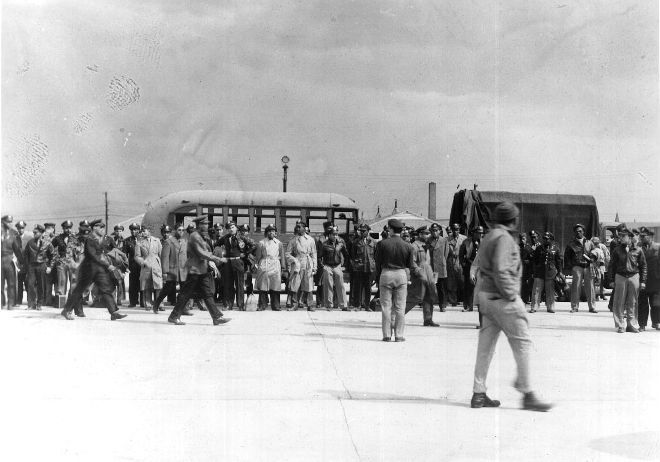
The Freeman Field mutiny was a series of incidents at Freeman Army Airfield, a United States Army Air Forces base near Seymour, Indiana, in 1945 in which African American members of the 477th Bombardment Group attempted to integrate an all-white officers' club. The mutiny resulted in 162 separate arrests of black officers, some of them twice. Three were court-martialed on relatively minor charges. One, Roger C. Terry, was convicted. In 1995, the Air Force officially vindicated the actions of the African-American officers, set aside the single court-martial conviction and removed letters of reprimand from the permanent files of 15 of the officers. The mutiny is generally regarded by historians of the Civil Rights Movement as an important step toward full integration of the armed forces and as a model for later efforts to integrate public facilities through civil disobedience.
Before and during World War II, the armed forces of the United States, like much of American society, were segregated by race. Historically, most African-American soldiers and sailors were relegated to support functions rather than combat roles, with few opportunities to advance to command positions.
In 1940, in response to pressure from prominent African-American leaders such as A. Philip Randolph and Walter White, President Franklin D. Roosevelt opened the United States Army Air Corps (after 1941, the United States Army Air Forces) to black men who volunteered to train as fighter pilots. The first of the black units, the 99th Fighter Squadron, trained at an airfield in Tuskegee, Alabama, which gave rise to the name "Tuskegee Airmen" as a blanket term for the Army's black aviators. Under the command of Colonel Benjamin O. Davis Jr., the first African American to fly solo as an officer, the 99th saw action in North Africa and Italy in 1943. In 1944, the 99th was assigned, with three other black squadrons, to form the 332d Fighter Group.
Continued pressure from African-American civilian leaders led the Army to let blacks train as members of bomber crews, a step that opened many more skilled combat roles to them. On January 15, 1944, the Army re-activated the 477th Bombardment Group (Medium) to train African-American aviators to fly the B-25J Mitchell twin-engine medium bomber in combat.
Under the command of Colonel Robert Selway, the 477th began training at Selfridge Field near Detroit, Michigan. Although the 477th had an authorized strength of 270 officer crew members, only 175 were initially assigned to Selfridge, a circumstance that led many of the black trainees to believe that the Army did not want the unit to advance to full combat readiness. All new air groups, however, activated during World War II began with a core cadre of officers around whom the entire group was subsequently built.
The 477th also suffered from morale problems stemming from segregation at Selfridge. Colonel Selway's superior, Major General Frank O'Driscoll Hunter, commander of the First Air Force, insisted on strict social segregation of black and white officers. Although Army Regulation 210–10, Paragraph 19, prohibited any public building on a military installation from being used "for the accommodation of any self-constituted special or exclusive group," thereby requiring officers' clubs be open to all officers regardless of race, the club at Selfridge was closed to black officers, a situation that led to an official War Department reprimand being issued to the Selfridge base commander, Colonel William Boyd.
On May 5, 1944, possibly out of fear of a repeat of the previous summer's race riot in nearby Detroit, the 477th was abruptly relocated to Godman Field at Fort Knox in Kentucky. Godman's only officers' club was open to blacks, but white officers used the club at Fort Knox on a "guest membership" basis. The morale of the 477th remained poor because the field was not suited for use by the B-25 and because black officers, including combat veterans of the 332nd Fighter Group who had transferred to the bomber unit, were not being advanced to command positions. By early 1945, however, the 477th reached its full combat strength: the 616th Bombardment Squadron, 617th Bombardment Squadron, 618th Bombardment Squadron, and 619th Bombardment Squadron. It was scheduled to enter combat on July 1, which made it necessary to relocate once more, this time to Freeman Army Airfield, a base fully suited to use by the B-25.
The 477th began moving by train to Freeman Field on March 1, 1945. Word soon got back to the remaining African-American officers at Godman that Colonel Selway had created two separate officers' clubs at Freeman: Club Number One for use by "trainees," all of whom were black; and Club Number Two for use by "instructors," all of whom were white. Led by Second Lieutenant Coleman A. Young, the future mayor of Detroit and an experienced labor organizer, a group of black officers still at Godman decided on a plan of action to challenge the de facto segregation at Freeman as soon as they arrived there.
Hub AI
Freeman Field mutiny AI simulator
(@Freeman Field mutiny_simulator)
Freeman Field mutiny
The Freeman Field mutiny was a series of incidents at Freeman Army Airfield, a United States Army Air Forces base near Seymour, Indiana, in 1945 in which African American members of the 477th Bombardment Group attempted to integrate an all-white officers' club. The mutiny resulted in 162 separate arrests of black officers, some of them twice. Three were court-martialed on relatively minor charges. One, Roger C. Terry, was convicted. In 1995, the Air Force officially vindicated the actions of the African-American officers, set aside the single court-martial conviction and removed letters of reprimand from the permanent files of 15 of the officers. The mutiny is generally regarded by historians of the Civil Rights Movement as an important step toward full integration of the armed forces and as a model for later efforts to integrate public facilities through civil disobedience.
Before and during World War II, the armed forces of the United States, like much of American society, were segregated by race. Historically, most African-American soldiers and sailors were relegated to support functions rather than combat roles, with few opportunities to advance to command positions.
In 1940, in response to pressure from prominent African-American leaders such as A. Philip Randolph and Walter White, President Franklin D. Roosevelt opened the United States Army Air Corps (after 1941, the United States Army Air Forces) to black men who volunteered to train as fighter pilots. The first of the black units, the 99th Fighter Squadron, trained at an airfield in Tuskegee, Alabama, which gave rise to the name "Tuskegee Airmen" as a blanket term for the Army's black aviators. Under the command of Colonel Benjamin O. Davis Jr., the first African American to fly solo as an officer, the 99th saw action in North Africa and Italy in 1943. In 1944, the 99th was assigned, with three other black squadrons, to form the 332d Fighter Group.
Continued pressure from African-American civilian leaders led the Army to let blacks train as members of bomber crews, a step that opened many more skilled combat roles to them. On January 15, 1944, the Army re-activated the 477th Bombardment Group (Medium) to train African-American aviators to fly the B-25J Mitchell twin-engine medium bomber in combat.
Under the command of Colonel Robert Selway, the 477th began training at Selfridge Field near Detroit, Michigan. Although the 477th had an authorized strength of 270 officer crew members, only 175 were initially assigned to Selfridge, a circumstance that led many of the black trainees to believe that the Army did not want the unit to advance to full combat readiness. All new air groups, however, activated during World War II began with a core cadre of officers around whom the entire group was subsequently built.
The 477th also suffered from morale problems stemming from segregation at Selfridge. Colonel Selway's superior, Major General Frank O'Driscoll Hunter, commander of the First Air Force, insisted on strict social segregation of black and white officers. Although Army Regulation 210–10, Paragraph 19, prohibited any public building on a military installation from being used "for the accommodation of any self-constituted special or exclusive group," thereby requiring officers' clubs be open to all officers regardless of race, the club at Selfridge was closed to black officers, a situation that led to an official War Department reprimand being issued to the Selfridge base commander, Colonel William Boyd.
On May 5, 1944, possibly out of fear of a repeat of the previous summer's race riot in nearby Detroit, the 477th was abruptly relocated to Godman Field at Fort Knox in Kentucky. Godman's only officers' club was open to blacks, but white officers used the club at Fort Knox on a "guest membership" basis. The morale of the 477th remained poor because the field was not suited for use by the B-25 and because black officers, including combat veterans of the 332nd Fighter Group who had transferred to the bomber unit, were not being advanced to command positions. By early 1945, however, the 477th reached its full combat strength: the 616th Bombardment Squadron, 617th Bombardment Squadron, 618th Bombardment Squadron, and 619th Bombardment Squadron. It was scheduled to enter combat on July 1, which made it necessary to relocate once more, this time to Freeman Army Airfield, a base fully suited to use by the B-25.
The 477th began moving by train to Freeman Field on March 1, 1945. Word soon got back to the remaining African-American officers at Godman that Colonel Selway had created two separate officers' clubs at Freeman: Club Number One for use by "trainees," all of whom were black; and Club Number Two for use by "instructors," all of whom were white. Led by Second Lieutenant Coleman A. Young, the future mayor of Detroit and an experienced labor organizer, a group of black officers still at Godman decided on a plan of action to challenge the de facto segregation at Freeman as soon as they arrived there.
Recent media