



Community hub
Recent from talks
Knowledge base stats:
Talk channels stats:
Members stats:
Cryopreservation
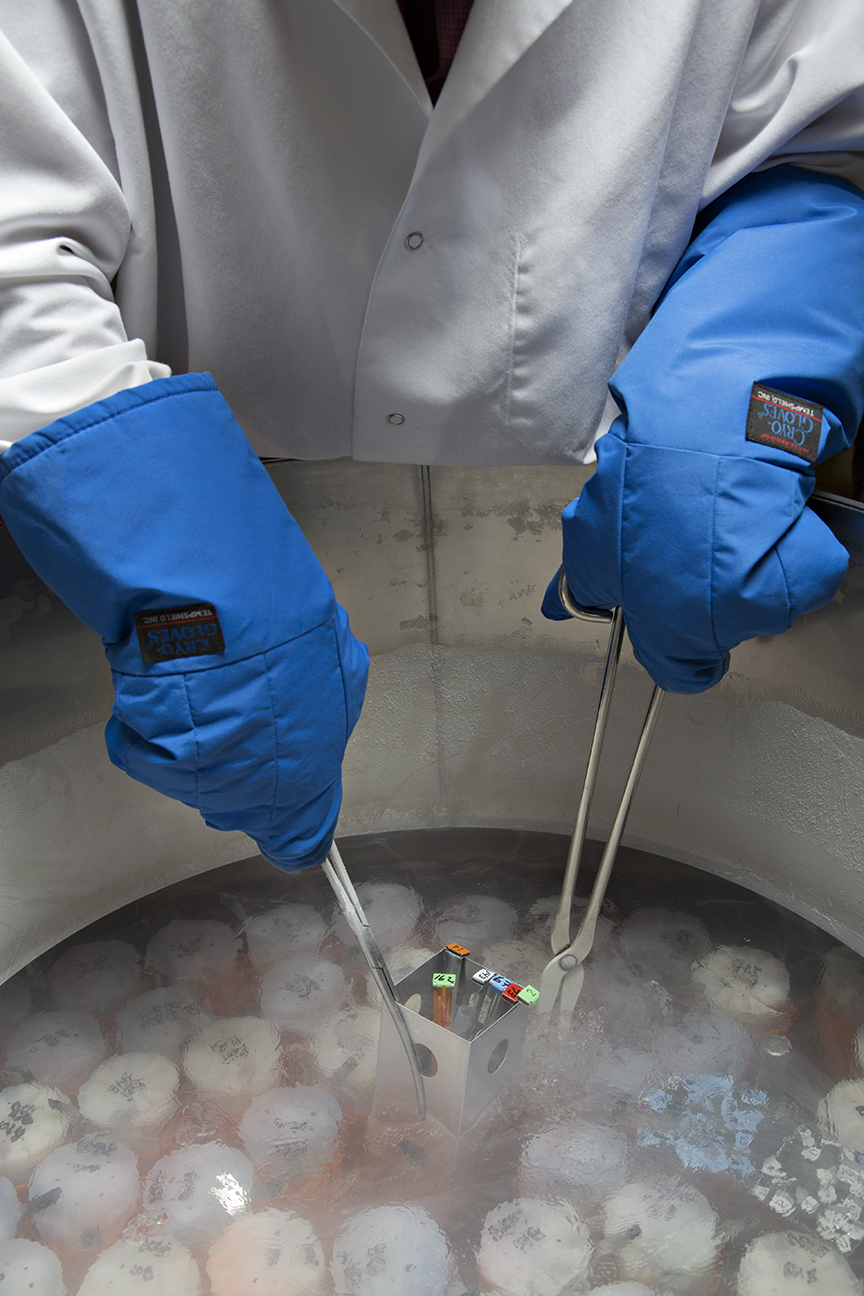
Cryopreservation or cryoconservation is a process where biological material - cells, tissues, or organs - are frozen to preserve the material for an extended period of time. At low temperatures (typically −80 °C (−112 °F) or −196 °C (−321 °F) using liquid nitrogen) any cell metabolism which might cause damage to the biological material in question is effectively stopped. Cryopreservation is an effective way to transport biological samples over long distances, store samples for prolonged periods of time, and create a bank of samples for users.
Molecules, referred to as cryoprotective agents (CPAs), are added to reduce the osmotic shock and physical stresses cells undergo in the freezing process. Some cryoprotective agents used in research are inspired by plants and animals in nature that have unique cold tolerance to survive harsh winters, including: trees, wood frogs, and tardigrades.
The first human corpse to be frozen with the hope of future resurrection was James Bedford's, a few hours after his cancer-caused death in 1967.
Tardigrades, microscopic animals sometimes known as water bears, can survive freezing by replacing most of their internal water with a sugar called trehalose, preventing it from crystallization that otherwise damages cell membranes. Mixtures of solutes can achieve similar effects. Some solutes, including salts, have the disadvantage that they may be toxic at intense concentrations. Wood frogs can also tolerate the freezing of their blood and other tissues. Urea is accumulated in tissues in preparation for overwintering, and liver glycogen is converted in large quantities to glucose in response to internal ice formation. Both urea and glucose act as "cryoprotectants" to limit the amount of ice that forms and to reduce osmotic shrinkage of cells. Frogs can survive many freeze/thaw events during winter if no more than about 65% of the total body water freezes. Research exploring the phenomenon of "freezing frogs" has been performed primarily by the Canadian researcher, Dr. Kenneth B. Storey.[citation needed]
Freeze tolerance, in which organisms survive the winter by freezing solid and ceasing life functions, is known in a few vertebrates: five species of frogs (Rana sylvatica, Pseudacris triseriata, Hyla crucifer, Hyla versicolor, Hyla chrysoscelis), one of salamanders (Salamandrella keyserlingii), one of snakes (Thamnophis sirtalis) and three of turtles (Chrysemys picta, Terrapene carolina, Terrapene ornata). Snapping turtles Chelydra serpentina and wall lizards Podarcis muralis also survive nominal freezing but it has not been established to be adaptive for overwintering. In the case of Rana sylvatica one cryopreservant is ordinary glucose, which increases in concentration by approximately 19 mmol/L when the frogs are cooled slowly.
One early theoretician of cryopreservation was James Lovelock. In 1953, he suggested that damage to red blood cells during freezing was due to osmotic stress, and that increasing the salt concentration in a dehydrating cell might damage it. In the mid-1950s, he experimented with the cryopreservation of rodents, determining that hamsters could be frozen with 60% of the water in the brain crystallized into ice with no adverse effects; other organs were shown to be susceptible to damage.
Cryopreservation was applied to human materials beginning in 1954 with three pregnancies resulting from the insemination of previously frozen sperm. Fowl sperm was cryopreserved in 1957 by a team of scientists in the UK directed by Christopher Polge. During 1963, Peter Mazur, at Oak Ridge National Laboratory in the U.S., demonstrated that lethal intracellular freezing could be avoided if cooling was slow enough to permit sufficient water to leave the cell during progressive freezing of the extracellular fluid. That rate differs between cells of differing size and water permeability: a typical cooling rate around 1 °C/minute is appropriate for many mammalian cells after treatment with cryoprotectants such as glycerol or dimethyl sulphoxide, but the rate is not a universal optimum.
On April 22, 1966, the first human cadaver was frozen—it had been embalmed for two months—by being placed in liquid nitrogen and stored at just above freezing. The cadaver was that of an elderly woman from Los Angeles, whose name is unknown, and was soon thawed out and buried by relatives. The first human corpse to be frozen with the hope of future resurrection was James Bedford's, a few hours after his cancer-caused death in 1967. Bedford's is the only cryonics corpse frozen before 1974 still frozen today.
Hub AI
Cryopreservation AI simulator
(@Cryopreservation_simulator)
Cryopreservation
Cryopreservation or cryoconservation is a process where biological material - cells, tissues, or organs - are frozen to preserve the material for an extended period of time. At low temperatures (typically −80 °C (−112 °F) or −196 °C (−321 °F) using liquid nitrogen) any cell metabolism which might cause damage to the biological material in question is effectively stopped. Cryopreservation is an effective way to transport biological samples over long distances, store samples for prolonged periods of time, and create a bank of samples for users.
Molecules, referred to as cryoprotective agents (CPAs), are added to reduce the osmotic shock and physical stresses cells undergo in the freezing process. Some cryoprotective agents used in research are inspired by plants and animals in nature that have unique cold tolerance to survive harsh winters, including: trees, wood frogs, and tardigrades.
The first human corpse to be frozen with the hope of future resurrection was James Bedford's, a few hours after his cancer-caused death in 1967.
Tardigrades, microscopic animals sometimes known as water bears, can survive freezing by replacing most of their internal water with a sugar called trehalose, preventing it from crystallization that otherwise damages cell membranes. Mixtures of solutes can achieve similar effects. Some solutes, including salts, have the disadvantage that they may be toxic at intense concentrations. Wood frogs can also tolerate the freezing of their blood and other tissues. Urea is accumulated in tissues in preparation for overwintering, and liver glycogen is converted in large quantities to glucose in response to internal ice formation. Both urea and glucose act as "cryoprotectants" to limit the amount of ice that forms and to reduce osmotic shrinkage of cells. Frogs can survive many freeze/thaw events during winter if no more than about 65% of the total body water freezes. Research exploring the phenomenon of "freezing frogs" has been performed primarily by the Canadian researcher, Dr. Kenneth B. Storey.[citation needed]
Freeze tolerance, in which organisms survive the winter by freezing solid and ceasing life functions, is known in a few vertebrates: five species of frogs (Rana sylvatica, Pseudacris triseriata, Hyla crucifer, Hyla versicolor, Hyla chrysoscelis), one of salamanders (Salamandrella keyserlingii), one of snakes (Thamnophis sirtalis) and three of turtles (Chrysemys picta, Terrapene carolina, Terrapene ornata). Snapping turtles Chelydra serpentina and wall lizards Podarcis muralis also survive nominal freezing but it has not been established to be adaptive for overwintering. In the case of Rana sylvatica one cryopreservant is ordinary glucose, which increases in concentration by approximately 19 mmol/L when the frogs are cooled slowly.
One early theoretician of cryopreservation was James Lovelock. In 1953, he suggested that damage to red blood cells during freezing was due to osmotic stress, and that increasing the salt concentration in a dehydrating cell might damage it. In the mid-1950s, he experimented with the cryopreservation of rodents, determining that hamsters could be frozen with 60% of the water in the brain crystallized into ice with no adverse effects; other organs were shown to be susceptible to damage.
Cryopreservation was applied to human materials beginning in 1954 with three pregnancies resulting from the insemination of previously frozen sperm. Fowl sperm was cryopreserved in 1957 by a team of scientists in the UK directed by Christopher Polge. During 1963, Peter Mazur, at Oak Ridge National Laboratory in the U.S., demonstrated that lethal intracellular freezing could be avoided if cooling was slow enough to permit sufficient water to leave the cell during progressive freezing of the extracellular fluid. That rate differs between cells of differing size and water permeability: a typical cooling rate around 1 °C/minute is appropriate for many mammalian cells after treatment with cryoprotectants such as glycerol or dimethyl sulphoxide, but the rate is not a universal optimum.
On April 22, 1966, the first human cadaver was frozen—it had been embalmed for two months—by being placed in liquid nitrogen and stored at just above freezing. The cadaver was that of an elderly woman from Los Angeles, whose name is unknown, and was soon thawed out and buried by relatives. The first human corpse to be frozen with the hope of future resurrection was James Bedford's, a few hours after his cancer-caused death in 1967. Bedford's is the only cryonics corpse frozen before 1974 still frozen today.