



Community hub
Recent from talks
Knowledge base stats:
Talk channels stats:
Members stats:
French-suited playing cards
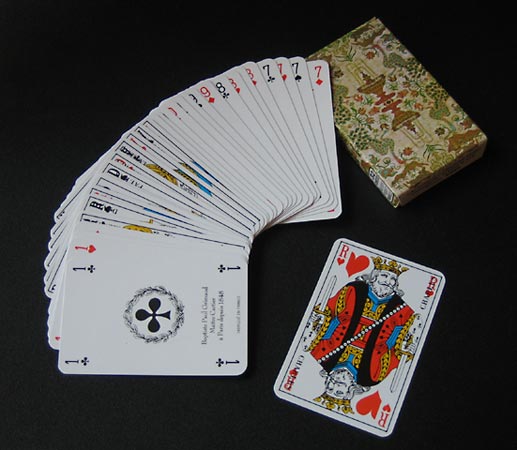
French-suited playing cards or French-suited cards are cards that use the French suits of trèfles (clovers or clubs ♣), carreaux (tiles or diamonds ♦), cœurs (hearts ♥), and piques (pikes or spades ♠). Each suit contains three or four face/court cards. In a standard 52-card deck these are the valet (knave or jack), the dame (lady or queen), and the roi (king). In addition, in Tarot packs, there is a cavalier (knight) ranking between the queen and the jack. Aside from these aspects, decks can include a wide variety of regional and national patterns, which often have different deck sizes. In comparison to Spanish, Italian, German, and Swiss playing cards, French cards are the most widespread due to the geopolitical, commercial, and cultural influence of France, the United Kingdom, and the United States in the 19th and 20th centuries. Other reasons for their popularity were the simplicity of the suit insignia, which simplifies mass production, and the popularity of whist and contract bridge. The Anglo-Saxon pattern of French-suited cards is so widespread that it is also known as the International or Anglo-American pattern.
Playing cards arrived in Europe from Mamluk Egypt around 1370 and were already reported in France in 1377. The French suit insignia was derived from German suits around 1480. Between the transition from the suit of bells to tiles there was a suit of crescents.
One of the most distinguishing features of the French cards is the queen. Mamluk cards and their derivatives, the Latin-suited and German-suited cards, all have three male face cards. Queens began appearing in Italian tarot decks in the mid-15th century and some German decks replaced two kings with queens. While other decks abandoned the queen in non-tarot decks, the French kept them and dropped the knight as the middle face card. Face card design was heavily influenced by Spanish cards that used to circulate in France. One of the most obvious traits inherited from Spain are the standing kings; kings from Italian, Portuguese, or Germanic cards are seated. Spanish-suited cards are still used in France, mostly in Northern Catalonia, and Brittany and the Vendée with the latter two using the archaic Aluette cards.
In the 19th century, corner indices and rounded corners were added and cards became reversible, relieving players from having to flip face cards right-side up. The index for aces and face cards usually follow the local language but most decks of the Paris pattern use the numeral "1" for aces.
The French suited pack has spawned many regional variations known as standard patterns based on their artwork and deck size. The Paris pattern was heavily exported throughout continental Europe which is why most French-suited patterns share a similar appearance. The English pattern, based on the extinct Rouennais pattern, is the most well known pattern in the world. It is also called the International or Anglo-American pattern.
Patterns do not factor in Jokers, which came about in the early 20th century. Almost all 52-card packs produced in the present will contain at least two jokers, sometimes more. In Germany, packs produced for the game of Zwicker have six jokers.
The Paris pattern came to dominate in France around 1780 and became known as the portrait officiel. From the 19th century to 1945, the appearance of the cards used for domestic consumption was regulated by the French government. All cards were produced on watermarked paper made by the state to show payment of the stamp tax. The most common deck sold in France is the 32-card deck with the 2 to 6 removed and 1s as the index for aces. 52-card packs are also popular. The French have a unique habit of associating their face cards with historical or mythical personages which survives only in the portrait officiel.
The Belgian-Genoese pattern is very similar to its Parisian parent and is basically an export version not subject to France's domestic stamp tax. Hence they lack the usual French court card names such as Alexander, Judith and Lancelot. Other differences from the portrait officiel are that: the jack of clubs has a triangular shield bearing the coat of arms of the former Spanish Netherlands (this is the main distinguishing feature); blue is usually replaced with green in the portraits and the diagonal dividing line lacks the beads. When the Ottoman Empire relaxed the ban against playing cards, Belgian type cards flooded their territory and are now found throughout the Balkans, North Africa, and the Middle East. They are also commonly found in France's former colonies. Within Belgium, the Francophone Walloons are the primary users of this pattern, while the Flemish prefer the Dutch pattern. This is the second most common pattern in the world after the English pattern. Belgian packs come in either 32 or 52 cards as they do in France. It was named the Belgian-Genoese pattern because of its popularity in both places and is the national pattern of Belgium.
Hub AI
French-suited playing cards AI simulator
(@French-suited playing cards_simulator)
French-suited playing cards
French-suited playing cards or French-suited cards are cards that use the French suits of trèfles (clovers or clubs ♣), carreaux (tiles or diamonds ♦), cœurs (hearts ♥), and piques (pikes or spades ♠). Each suit contains three or four face/court cards. In a standard 52-card deck these are the valet (knave or jack), the dame (lady or queen), and the roi (king). In addition, in Tarot packs, there is a cavalier (knight) ranking between the queen and the jack. Aside from these aspects, decks can include a wide variety of regional and national patterns, which often have different deck sizes. In comparison to Spanish, Italian, German, and Swiss playing cards, French cards are the most widespread due to the geopolitical, commercial, and cultural influence of France, the United Kingdom, and the United States in the 19th and 20th centuries. Other reasons for their popularity were the simplicity of the suit insignia, which simplifies mass production, and the popularity of whist and contract bridge. The Anglo-Saxon pattern of French-suited cards is so widespread that it is also known as the International or Anglo-American pattern.
Playing cards arrived in Europe from Mamluk Egypt around 1370 and were already reported in France in 1377. The French suit insignia was derived from German suits around 1480. Between the transition from the suit of bells to tiles there was a suit of crescents.
One of the most distinguishing features of the French cards is the queen. Mamluk cards and their derivatives, the Latin-suited and German-suited cards, all have three male face cards. Queens began appearing in Italian tarot decks in the mid-15th century and some German decks replaced two kings with queens. While other decks abandoned the queen in non-tarot decks, the French kept them and dropped the knight as the middle face card. Face card design was heavily influenced by Spanish cards that used to circulate in France. One of the most obvious traits inherited from Spain are the standing kings; kings from Italian, Portuguese, or Germanic cards are seated. Spanish-suited cards are still used in France, mostly in Northern Catalonia, and Brittany and the Vendée with the latter two using the archaic Aluette cards.
In the 19th century, corner indices and rounded corners were added and cards became reversible, relieving players from having to flip face cards right-side up. The index for aces and face cards usually follow the local language but most decks of the Paris pattern use the numeral "1" for aces.
The French suited pack has spawned many regional variations known as standard patterns based on their artwork and deck size. The Paris pattern was heavily exported throughout continental Europe which is why most French-suited patterns share a similar appearance. The English pattern, based on the extinct Rouennais pattern, is the most well known pattern in the world. It is also called the International or Anglo-American pattern.
Patterns do not factor in Jokers, which came about in the early 20th century. Almost all 52-card packs produced in the present will contain at least two jokers, sometimes more. In Germany, packs produced for the game of Zwicker have six jokers.
The Paris pattern came to dominate in France around 1780 and became known as the portrait officiel. From the 19th century to 1945, the appearance of the cards used for domestic consumption was regulated by the French government. All cards were produced on watermarked paper made by the state to show payment of the stamp tax. The most common deck sold in France is the 32-card deck with the 2 to 6 removed and 1s as the index for aces. 52-card packs are also popular. The French have a unique habit of associating their face cards with historical or mythical personages which survives only in the portrait officiel.
The Belgian-Genoese pattern is very similar to its Parisian parent and is basically an export version not subject to France's domestic stamp tax. Hence they lack the usual French court card names such as Alexander, Judith and Lancelot. Other differences from the portrait officiel are that: the jack of clubs has a triangular shield bearing the coat of arms of the former Spanish Netherlands (this is the main distinguishing feature); blue is usually replaced with green in the portraits and the diagonal dividing line lacks the beads. When the Ottoman Empire relaxed the ban against playing cards, Belgian type cards flooded their territory and are now found throughout the Balkans, North Africa, and the Middle East. They are also commonly found in France's former colonies. Within Belgium, the Francophone Walloons are the primary users of this pattern, while the Flemish prefer the Dutch pattern. This is the second most common pattern in the world after the English pattern. Belgian packs come in either 32 or 52 cards as they do in France. It was named the Belgian-Genoese pattern because of its popularity in both places and is the national pattern of Belgium.