



Community hub
Recent from talks
Contribute something to knowledge base
Content stats: 0 posts, 0 articles, 1 media, 0 notes
Members stats: 0 subscribers, 0 contributors, 0 moderators, 0 supporters
Subscribers
Supporters
Contributors
Moderators
Hub AI
Fresh frozen plasma AI simulator
(@Fresh frozen plasma_simulator)
Hub AI
Fresh frozen plasma AI simulator
(@Fresh frozen plasma_simulator)
Fresh frozen plasma
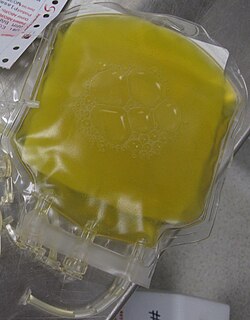
Fresh frozen plasma (FFP) is a blood product made from the liquid portion of whole blood. It is used to treat conditions in which there are low blood clotting factors (INR > 1.5) or low levels of other blood proteins. It may also be used as the replacement fluid in plasma exchange. Using ABO compatible plasma, while not required, may be recommended. Use as a volume expander is not recommended. It is administered by slow injection into a vein.
Side effects include nausea and itchiness. Rarely there may be allergic reactions, blood clots, or infections. It is unclear if use during pregnancy or breastfeeding is safe for the baby. Greater care should be taken in people with protein S deficiency, IgA deficiency, or heart failure. Fresh frozen plasma is made up of a complex mixture of water, proteins, carbohydrates, fats, and vitamins. When frozen it lasts about a year.
Plasma first came into medical use during the Second World War. It is on the World Health Organization's List of Essential Medicines. In the United Kingdom it costs about £30 per unit. A number of other versions also exist including plasma frozen within 24 hours after phlebotomy, cryoprecipitate reduced plasma, thawed plasma, and solvent detergent plasma.
In the United States it refers to the fluid portion of one unit of whole blood that has been centrifuged, separated, and frozen solid at −18 °C (0 °F) or colder within eight hours of collection from whole blood donation or was otherwise collected via apheresis device. The phrase "FFP" is often used to mean any transfused plasma product. The other commonly transfused plasma, plasma frozen within 24 hours after phlebotomy (PF24), has similar indications as those for FFP. PF24 has slightly lower levels of Factors V and VIII than FFP. PF24 is more commonly used than FFP in the United States.
There are few specific indications for FFP. These generally are limited to the treatment of deficiencies of coagulation proteins for which specific factor concentrates are unavailable or undesirable. A usual dose of plasma is 10–20 mL/kg recipient weight.
Indications for the use of FFP include the following:
FFP is not recommended unless there is ongoing bleeding or there is a significant blood clotting problem. That is, FFP is not used in people to reverse warfarin if there is no bleeding, even for an INR > 9 unless they need urgent surgery. It is also not used in elective surgery, or non-emergency surgery.
Thawed plasma is made from FFP or PF24 and kept refrigerated (at 1–6 °C) after thawing can be stored for 5 days post thaw.
Fresh frozen plasma
Fresh frozen plasma (FFP) is a blood product made from the liquid portion of whole blood. It is used to treat conditions in which there are low blood clotting factors (INR > 1.5) or low levels of other blood proteins. It may also be used as the replacement fluid in plasma exchange. Using ABO compatible plasma, while not required, may be recommended. Use as a volume expander is not recommended. It is administered by slow injection into a vein.
Side effects include nausea and itchiness. Rarely there may be allergic reactions, blood clots, or infections. It is unclear if use during pregnancy or breastfeeding is safe for the baby. Greater care should be taken in people with protein S deficiency, IgA deficiency, or heart failure. Fresh frozen plasma is made up of a complex mixture of water, proteins, carbohydrates, fats, and vitamins. When frozen it lasts about a year.
Plasma first came into medical use during the Second World War. It is on the World Health Organization's List of Essential Medicines. In the United Kingdom it costs about £30 per unit. A number of other versions also exist including plasma frozen within 24 hours after phlebotomy, cryoprecipitate reduced plasma, thawed plasma, and solvent detergent plasma.
In the United States it refers to the fluid portion of one unit of whole blood that has been centrifuged, separated, and frozen solid at −18 °C (0 °F) or colder within eight hours of collection from whole blood donation or was otherwise collected via apheresis device. The phrase "FFP" is often used to mean any transfused plasma product. The other commonly transfused plasma, plasma frozen within 24 hours after phlebotomy (PF24), has similar indications as those for FFP. PF24 has slightly lower levels of Factors V and VIII than FFP. PF24 is more commonly used than FFP in the United States.
There are few specific indications for FFP. These generally are limited to the treatment of deficiencies of coagulation proteins for which specific factor concentrates are unavailable or undesirable. A usual dose of plasma is 10–20 mL/kg recipient weight.
Indications for the use of FFP include the following:
FFP is not recommended unless there is ongoing bleeding or there is a significant blood clotting problem. That is, FFP is not used in people to reverse warfarin if there is no bleeding, even for an INR > 9 unless they need urgent surgery. It is also not used in elective surgery, or non-emergency surgery.
Thawed plasma is made from FFP or PF24 and kept refrigerated (at 1–6 °C) after thawing can be stored for 5 days post thaw.
Recent media
Recent media