


Community hub
Recent from talks
Contribute something to knowledge base
Content stats: 0 posts, 0 articles, 1 media, 0 notes
Members stats: 0 subscribers, 0 contributors, 0 moderators, 0 supporters
Subscribers
Supporters
Contributors
Moderators
Hub AI
Intravenous therapy AI simulator
(@Intravenous therapy_simulator)
Hub AI
Intravenous therapy AI simulator
(@Intravenous therapy_simulator)
Intravenous therapy
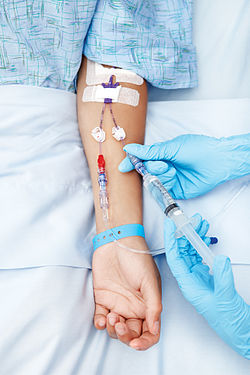
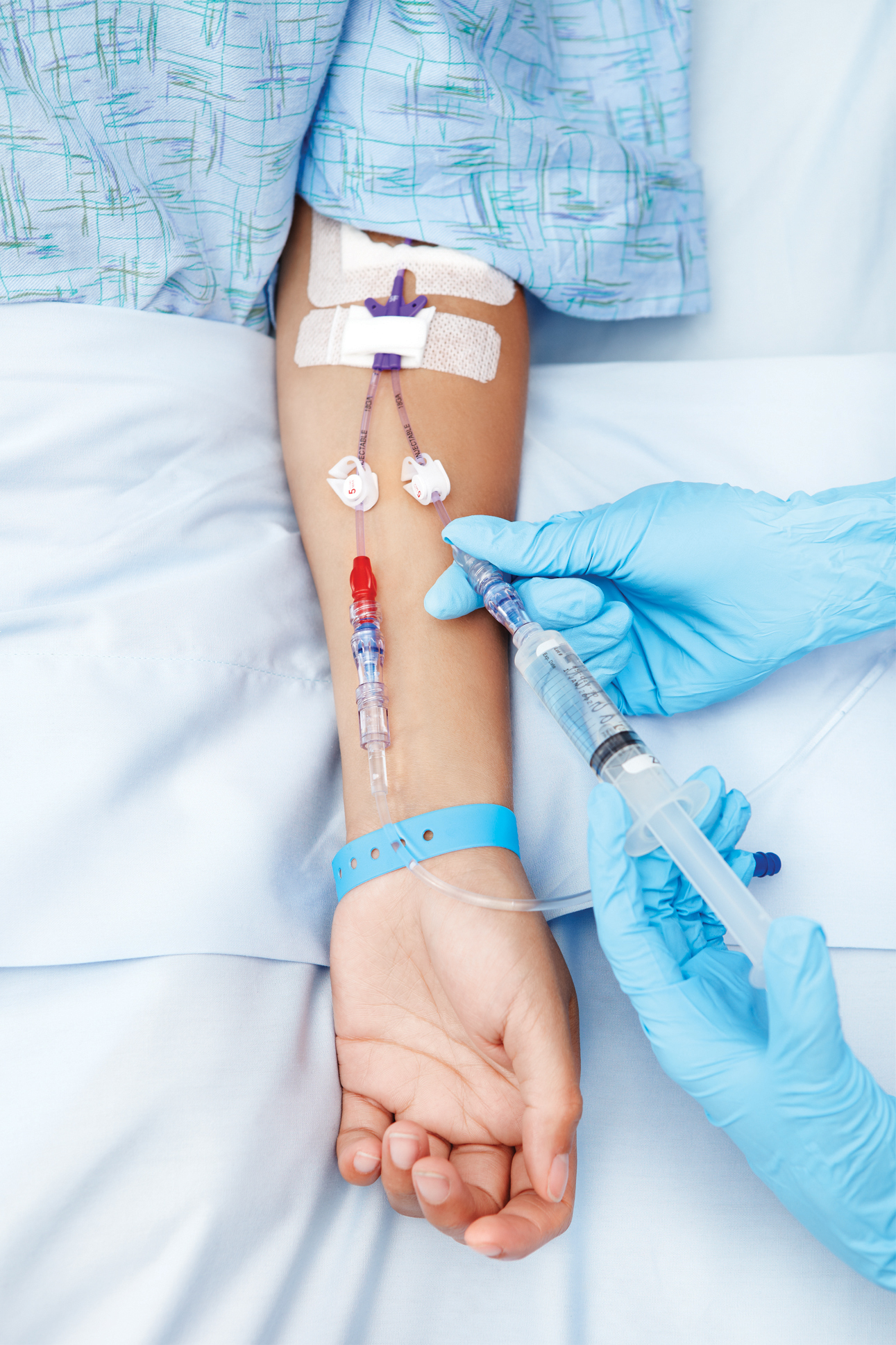
Intravenous therapy (abbreviated as IV therapy) is a medical process that administers fluids, medications and nutrients directly into a person's vein. The intravenous route of administration is commonly used for rehydration or to provide nutrients for those who cannot, or will not—due to reduced mental states or otherwise—consume food or water by mouth. It may also be used to administer medications or other medical therapy such as blood products or electrolytes to correct electrolyte imbalances. Attempts at providing intravenous therapy have been recorded as early as the 1400s, but the practice did not become widespread until the 1900s after the development of techniques for safe, effective use.
The intravenous route is the fastest way to deliver medications and fluid replacement throughout the body as they are introduced directly into the circulatory system and thus quickly distributed. For this reason, the intravenous route of administration is also used for the consumption of some recreational drugs. Many therapies are administered as a "bolus" or one-time dose, but they may also be administered as an extended infusion or drip. The act of administering a therapy intravenously, or placing an intravenous line ("IV line") for later use, is a procedure which should only be performed by a skilled professional. The most basic intravenous access consists of a needle piercing the skin and entering a vein which is connected to a syringe or to external tubing. This is used to administer the desired therapy. In cases where a patient is likely to receive many such interventions in a short period (with consequent risk of trauma to the vein), normal practice is to insert a cannula which leaves one end in the vein, and subsequent therapies can be administered easily through tubing at the other end. In some cases, multiple medications or therapies are administered through the same IV line.
IV lines are classified as "central lines" if they end in a large vein close to the heart, or as "peripheral lines" if their output is to a small vein in the periphery, such as the arm. An IV line can be threaded through a peripheral vein to end near the heart, which is termed a "peripherally inserted central catheter" or PICC line. If a person is likely to need long-term intravenous therapy, a medical port may be implanted to enable easier repeated access to the vein without having to pierce the vein repeatedly. A catheter can also be inserted into a central vein through the chest, which is known as a tunneled line. The specific type of catheter used and site of insertion are affected by the desired substance to be administered and the health of the veins in the desired site of insertion.
Placement of an IV line may cause pain, as it necessarily involves piercing the skin. Infections and inflammation (termed phlebitis) are also both common side effects of an IV line. Phlebitis may be more likely if the same vein is used repeatedly for intravenous access, and can eventually develop into a hard cord which is unsuitable for IV access. The unintentional administration of a therapy outside a vein, termed extravasation or infiltration, may cause other side effects.
Intravenous (IV) access is used to administer medications and fluid replacement which must be distributed throughout the body, especially when rapid distribution is desired. Another use of IV administration is the avoidance of first-pass metabolism in the liver. Substances that may be infused intravenously include volume expanders, blood-based products, blood substitutes, medications and nutrition.
Fluids may be administered as part of "volume expansion", or fluid replacement, through the intravenous route. Volume expansion consists of the administration of fluid-based solutions or suspensions designed to target specific areas of the body which need more water. There are two main types of volume expander: crystalloids and colloids. Crystalloids are aqueous solutions of mineral salts or other water-soluble molecules. Colloids contain larger insoluble molecules, such as gelatin. Blood itself is considered a colloid.
The most commonly used crystalloid fluid is normal saline, a solution of sodium chloride at 0.9% concentration, which is isotonic with blood. Lactated Ringer's (also known as Ringer's lactate) and the closely related Ringer's acetate, are mildly hypotonic solutions often used in those who have significant burns. Colloids preserve a high colloid osmotic pressure in the blood, while, on the other hand, this parameter is decreased by crystalloids due to hemodilution. Crystalloids generally are much cheaper than colloids.
Buffer solutions which are used to correct acidosis or alkalosis are also administered through intravenous access. Lactated Ringer's solution used as a fluid expander or base solution to which medications are added also has some buffering effect. Another solution administered intravenously as a buffering solution is sodium bicarbonate.
Intravenous therapy
Intravenous therapy (abbreviated as IV therapy) is a medical process that administers fluids, medications and nutrients directly into a person's vein. The intravenous route of administration is commonly used for rehydration or to provide nutrients for those who cannot, or will not—due to reduced mental states or otherwise—consume food or water by mouth. It may also be used to administer medications or other medical therapy such as blood products or electrolytes to correct electrolyte imbalances. Attempts at providing intravenous therapy have been recorded as early as the 1400s, but the practice did not become widespread until the 1900s after the development of techniques for safe, effective use.
The intravenous route is the fastest way to deliver medications and fluid replacement throughout the body as they are introduced directly into the circulatory system and thus quickly distributed. For this reason, the intravenous route of administration is also used for the consumption of some recreational drugs. Many therapies are administered as a "bolus" or one-time dose, but they may also be administered as an extended infusion or drip. The act of administering a therapy intravenously, or placing an intravenous line ("IV line") for later use, is a procedure which should only be performed by a skilled professional. The most basic intravenous access consists of a needle piercing the skin and entering a vein which is connected to a syringe or to external tubing. This is used to administer the desired therapy. In cases where a patient is likely to receive many such interventions in a short period (with consequent risk of trauma to the vein), normal practice is to insert a cannula which leaves one end in the vein, and subsequent therapies can be administered easily through tubing at the other end. In some cases, multiple medications or therapies are administered through the same IV line.
IV lines are classified as "central lines" if they end in a large vein close to the heart, or as "peripheral lines" if their output is to a small vein in the periphery, such as the arm. An IV line can be threaded through a peripheral vein to end near the heart, which is termed a "peripherally inserted central catheter" or PICC line. If a person is likely to need long-term intravenous therapy, a medical port may be implanted to enable easier repeated access to the vein without having to pierce the vein repeatedly. A catheter can also be inserted into a central vein through the chest, which is known as a tunneled line. The specific type of catheter used and site of insertion are affected by the desired substance to be administered and the health of the veins in the desired site of insertion.
Placement of an IV line may cause pain, as it necessarily involves piercing the skin. Infections and inflammation (termed phlebitis) are also both common side effects of an IV line. Phlebitis may be more likely if the same vein is used repeatedly for intravenous access, and can eventually develop into a hard cord which is unsuitable for IV access. The unintentional administration of a therapy outside a vein, termed extravasation or infiltration, may cause other side effects.
Intravenous (IV) access is used to administer medications and fluid replacement which must be distributed throughout the body, especially when rapid distribution is desired. Another use of IV administration is the avoidance of first-pass metabolism in the liver. Substances that may be infused intravenously include volume expanders, blood-based products, blood substitutes, medications and nutrition.
Fluids may be administered as part of "volume expansion", or fluid replacement, through the intravenous route. Volume expansion consists of the administration of fluid-based solutions or suspensions designed to target specific areas of the body which need more water. There are two main types of volume expander: crystalloids and colloids. Crystalloids are aqueous solutions of mineral salts or other water-soluble molecules. Colloids contain larger insoluble molecules, such as gelatin. Blood itself is considered a colloid.
The most commonly used crystalloid fluid is normal saline, a solution of sodium chloride at 0.9% concentration, which is isotonic with blood. Lactated Ringer's (also known as Ringer's lactate) and the closely related Ringer's acetate, are mildly hypotonic solutions often used in those who have significant burns. Colloids preserve a high colloid osmotic pressure in the blood, while, on the other hand, this parameter is decreased by crystalloids due to hemodilution. Crystalloids generally are much cheaper than colloids.
Buffer solutions which are used to correct acidosis or alkalosis are also administered through intravenous access. Lactated Ringer's solution used as a fluid expander or base solution to which medications are added also has some buffering effect. Another solution administered intravenously as a buffering solution is sodium bicarbonate.
Recent media
Recent media