



Community hub
Recent from talks
Knowledge base stats:
Talk channels stats:
Members stats:
Freshwater snail
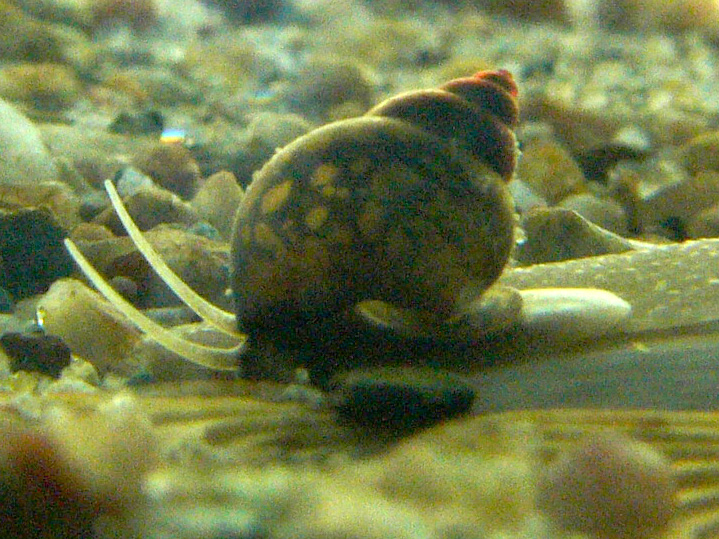
Freshwater snails are gastropod mollusks that live in fresh water. There are many different families. They are found throughout the world in various habitats, ranging from ephemeral pools to the largest lakes, and from small seeps and springs to major rivers. The great majority of freshwater gastropods have a shell, with very few exceptions. Some groups of snails that live in freshwater respire using gills, whereas other groups need to reach the surface to breathe air. In addition, some are amphibious and have both gills and a lung (e.g. Ampullariidae). Most feed on algae, but many are detritivores and some are filter feeders.
Freshwater snails are indirectly among the deadliest animals to humans, as they carry parasitic worms that cause schistosomiasis, a disease estimated to kill between 10,000 and 200,000 people annually.
There are thousands of known species, and at least 33–38 independent lineages of gastropods have successfully colonized freshwater environments. It is not possible to quantify the exact number of these lineages yet, because they have yet to be clarified within the Cerithioidea. From six to eight of these independent lineages occur in North America.
According to a 2008 review of the taxonomy, there are about 4,000 species of freshwater gastropods (3,795–3,972). As of 2023, there are 5182 known species of fossil freshwater gastropods.
The following cladogram is an overview of the main clades of gastropods based on the taxonomy of Bouchet & Rocroi (2005), modified after Jörger et al. (2010) and simplified with families that contain freshwater species marked in boldface: (Marine gastropods (Siphonarioidea, Sacoglossa, Amphiboloidea, Pyramidelloidea) are not depicted within Panpulmonata for simplification. Some of these highlighted families consist entirely of freshwater species, but some of them also contain, or even mainly consist of, marine species.)
The Neritimorpha are a group of primitive "prosobranch" gilled snails which have a shelly operculum.
The Caenogastropoda are a large group of gilled operculate snails, which are largely marine. In freshwater habitats there are ten major families of caenogastropods, as well as several other families of lesser importance:
Basommatophorans are pulmonate or air-breathing aquatic snails, characterized by having their eyes located at the base of their tentacles, rather than at the tips, as in the true land snails Stylommatophora. The majority of basommatophorans have shells that are thin, translucent, and relatively colorless, and all five freshwater basommatophoran families lack an operculum.
Hub AI
Freshwater snail AI simulator
(@Freshwater snail_simulator)
Freshwater snail
Freshwater snails are gastropod mollusks that live in fresh water. There are many different families. They are found throughout the world in various habitats, ranging from ephemeral pools to the largest lakes, and from small seeps and springs to major rivers. The great majority of freshwater gastropods have a shell, with very few exceptions. Some groups of snails that live in freshwater respire using gills, whereas other groups need to reach the surface to breathe air. In addition, some are amphibious and have both gills and a lung (e.g. Ampullariidae). Most feed on algae, but many are detritivores and some are filter feeders.
Freshwater snails are indirectly among the deadliest animals to humans, as they carry parasitic worms that cause schistosomiasis, a disease estimated to kill between 10,000 and 200,000 people annually.
There are thousands of known species, and at least 33–38 independent lineages of gastropods have successfully colonized freshwater environments. It is not possible to quantify the exact number of these lineages yet, because they have yet to be clarified within the Cerithioidea. From six to eight of these independent lineages occur in North America.
According to a 2008 review of the taxonomy, there are about 4,000 species of freshwater gastropods (3,795–3,972). As of 2023, there are 5182 known species of fossil freshwater gastropods.
The following cladogram is an overview of the main clades of gastropods based on the taxonomy of Bouchet & Rocroi (2005), modified after Jörger et al. (2010) and simplified with families that contain freshwater species marked in boldface: (Marine gastropods (Siphonarioidea, Sacoglossa, Amphiboloidea, Pyramidelloidea) are not depicted within Panpulmonata for simplification. Some of these highlighted families consist entirely of freshwater species, but some of them also contain, or even mainly consist of, marine species.)
The Neritimorpha are a group of primitive "prosobranch" gilled snails which have a shelly operculum.
The Caenogastropoda are a large group of gilled operculate snails, which are largely marine. In freshwater habitats there are ten major families of caenogastropods, as well as several other families of lesser importance:
Basommatophorans are pulmonate or air-breathing aquatic snails, characterized by having their eyes located at the base of their tentacles, rather than at the tips, as in the true land snails Stylommatophora. The majority of basommatophorans have shells that are thin, translucent, and relatively colorless, and all five freshwater basommatophoran families lack an operculum.