


Community hub
Recent from talks
Contribute something to knowledge base
Content stats: 0 posts, 0 articles, 1 media, 0 notes
Members stats: 0 subscribers, 0 contributors, 0 moderators, 0 supporters
Subscribers
Supporters
Contributors
Moderators
Apple snail
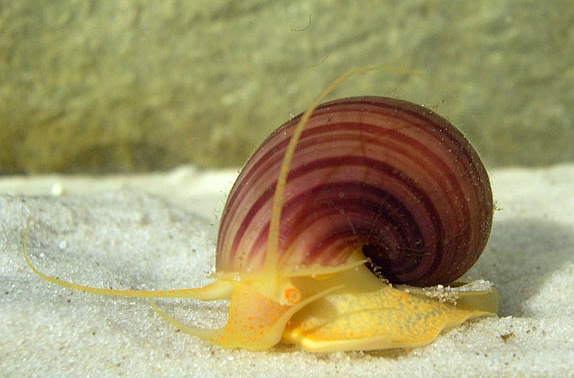
Ampullariidae, whose members are commonly known as apple snails, is a family of large freshwater snails that includes the mystery snail species. They are aquatic gastropod mollusks with a gill and an operculum. These snails simultaneously have a gill and a lung as functional respiratory structures, which are separated by a division of the mantle cavity. This adaptation allows these animals to be amphibious. Species in this family are considered gonochoristic, meaning that each individual organism is either male or female.
Ampullariidae belongs to the superfamily Ampullarioidea, and is also its type family. It comprised two subfamilies according to the taxonomy of the Gastropoda by Bouchet & Rocroi, 2005, which followed the classification proposed by Berthold (1991), including Ampullariinae Gray, 1824, and Afropominae Berthold, 1991. The current classification accepted by WoRMS includes Ampullariinae and Pomaceinae Starobogatov, 1983.
Ampullariidae are probably of Gondwanan origin, and the diversification of Ampullariidae started probably after the separation of the African and South American continental plates. The sister group of Ampullariidae has not been clearly identified yet. A cladogram showing phylogenic relations of 6 genera belonging to Ampullariidae was proposed by Jørgensen and colleagues in 2008.
There are nine extant genera in the family Ampullariidae:
Afropominae
The genera Asolene, Felipponea, Marisa, and Pomacea are New World genera that are native to South America, Central America, the West Indies and the Southern United States. The genera Afropomus, Lanistes, and Saulea are found in Africa. The genus Pila is native to both Africa and Asia.
Apple snails are exceptionally well adapted to tropical regions characterized by periods of drought alternating with periods of high rainfall. This adaptation is reflected in their life style; they are moderately amphibious. They have an operculum which enables the snail to seal the shell entrance to prevent drying out while they are buried in the mud during dry periods.
One of the more typical adaptations of apple snails is branchial respiration. The snail has a system comparable to the gills of a fish (at the right side of the snail body) to breathe under water as well as a lung (at the left side of the body) to respire air. This lung/gill combination expands the action radius of the snail in search for food. It is part of the snail's natural behaviour to leave the water when the food supply below the surface becomes inadequate.
Apple snail
Ampullariidae, whose members are commonly known as apple snails, is a family of large freshwater snails that includes the mystery snail species. They are aquatic gastropod mollusks with a gill and an operculum. These snails simultaneously have a gill and a lung as functional respiratory structures, which are separated by a division of the mantle cavity. This adaptation allows these animals to be amphibious. Species in this family are considered gonochoristic, meaning that each individual organism is either male or female.
Ampullariidae belongs to the superfamily Ampullarioidea, and is also its type family. It comprised two subfamilies according to the taxonomy of the Gastropoda by Bouchet & Rocroi, 2005, which followed the classification proposed by Berthold (1991), including Ampullariinae Gray, 1824, and Afropominae Berthold, 1991. The current classification accepted by WoRMS includes Ampullariinae and Pomaceinae Starobogatov, 1983.
Ampullariidae are probably of Gondwanan origin, and the diversification of Ampullariidae started probably after the separation of the African and South American continental plates. The sister group of Ampullariidae has not been clearly identified yet. A cladogram showing phylogenic relations of 6 genera belonging to Ampullariidae was proposed by Jørgensen and colleagues in 2008.
There are nine extant genera in the family Ampullariidae:
Afropominae
The genera Asolene, Felipponea, Marisa, and Pomacea are New World genera that are native to South America, Central America, the West Indies and the Southern United States. The genera Afropomus, Lanistes, and Saulea are found in Africa. The genus Pila is native to both Africa and Asia.
Apple snails are exceptionally well adapted to tropical regions characterized by periods of drought alternating with periods of high rainfall. This adaptation is reflected in their life style; they are moderately amphibious. They have an operculum which enables the snail to seal the shell entrance to prevent drying out while they are buried in the mud during dry periods.
One of the more typical adaptations of apple snails is branchial respiration. The snail has a system comparable to the gills of a fish (at the right side of the snail body) to breathe under water as well as a lung (at the left side of the body) to respire air. This lung/gill combination expands the action radius of the snail in search for food. It is part of the snail's natural behaviour to leave the water when the food supply below the surface becomes inadequate.
Recent media
Recent media