
Recent from talks
Friesian horse
Knowledge base stats:
Talk channels stats:
Members stats:
Friesian horse
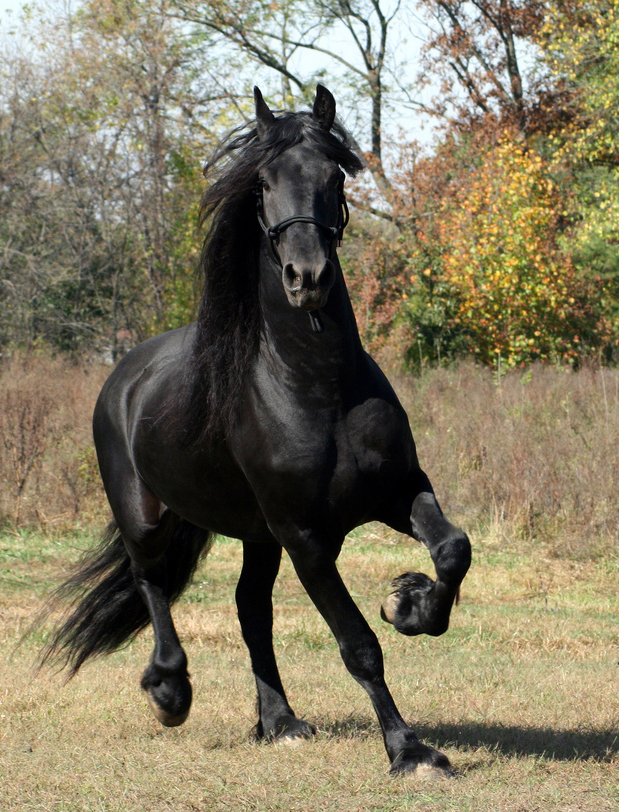
The Friesian (Fries paard in Dutch; Frysk hynder in West Frisian) is a horse breed originating in the province of Friesland in the northern Netherlands. The breed nearly became extinct on more than one occasion. It is classified as a light draught horse, and the modern day Friesian horse is used for riding and driving. The Friesian horse is most known for its all-black coat colour, its long flowing mane and tail, feathering on its legs, a high head carriage, and high stepping action.
The Friesian is black with no white markings, stands on average 15 to 16 hands (60 to 64 inches, 152 to 163 cm) at the withers, and weighs 1,250-1,450 pounds. The breed is compact and muscular with good bone. Friesians have long arched necks, small ears, and straight long heads. They have sloping shoulders, sloping hindquarters, and a low-set tail. Limbs are short and strong, with feathering—long hair on the lower legs. A Friesian horse also has a thick mane and tail. The breed is known for a brisk, high-stepping trot. The Friesian is considered willing, active, and energetic, but also gentle and docile.
Though Friesian horses have for decades been characteristically black, starting in 1991 the occasional chestnut foal was born. Friesch Paarden Stamboek (FPS) began to breed out the chestnut colour by requiring stallions to undergo genetic testing and denying registration of those that carry the chestnut genes. The former American Friesian Association, which closed its business in 2015 and was not affiliated with the FPS, allowed horses with white markings and chestnut colouration to be registered if purebred parentage could be proven.
There are four genetic disorders acknowledged by the industry that may affect horses of Friesian breeding: dwarfism, hydrocephalus, a tendency for aortic rupture, and megaesophagus. There are genetic tests for the first two conditions. The Friesian is also among several breeds that may develop equine polysaccharide storage myopathy. Approximately 0.25% of Friesians are affected by dwarfism, which results in horses with a normal-sized head, a broader chest than normal, an abnormally long back and very short limbs. It is a recessive condition. Additionally, the breed has a higher-than-usual rate of digestive system disorders, and a greater tendency to have insect bite hypersensitivity. Like other feathered draught breeds, they are prone to a skin condition called verrucous pastern dermatopathy and may be generally prone to having a compromised immune system. Friesian mares have a very high 54% rate of retained placenta after foaling. Some normal-sized Friesians also have a propensity toward tendon and ligament laxity which may or may not be associated with dwarfism. The relatively small gene pool and inbreeding are thought to be factors behind most of these disorders.
The Friesian originates in the province of Friesland in the northern Netherlands, where there is evidence of thousands of years of horse populations.
As far back in history as the 4th century there are mentions of Friesian troops which rode their own horses. One of the most well-known sources of this was by an English writer named Anthony Dent who wrote about the Friesian mounted troops in Carlisle. Dent, amongst others, wrote that the Friesian horse was the ancestor of both the British Shire horse and Fell pony, however, this is speculation.
It was not until the 11th century, that there were illustrations of what appeared to be Friesians. Many of the illustrations found depict knights riding horses which resemble the breed, with one of the most famous examples being William the Conqueror.
These ancestors of the modern Friesians were used in medieval times to carry knights to battle. In the 12th and 13th centuries, some eastern horses of crusaders were mated with Friesian stock. During the 16th and 17th centuries, when the Netherlands were briefly linked with Spain, there was less demand for heavy war horses, as battle arms changed and became lighter. Andalusian horses were bred with Friesians, producing a lighter horse more suitable for work as an urban carriage horse.
Hub AI
Friesian horse AI simulator
(@Friesian horse_simulator)
Friesian horse
The Friesian (Fries paard in Dutch; Frysk hynder in West Frisian) is a horse breed originating in the province of Friesland in the northern Netherlands. The breed nearly became extinct on more than one occasion. It is classified as a light draught horse, and the modern day Friesian horse is used for riding and driving. The Friesian horse is most known for its all-black coat colour, its long flowing mane and tail, feathering on its legs, a high head carriage, and high stepping action.
The Friesian is black with no white markings, stands on average 15 to 16 hands (60 to 64 inches, 152 to 163 cm) at the withers, and weighs 1,250-1,450 pounds. The breed is compact and muscular with good bone. Friesians have long arched necks, small ears, and straight long heads. They have sloping shoulders, sloping hindquarters, and a low-set tail. Limbs are short and strong, with feathering—long hair on the lower legs. A Friesian horse also has a thick mane and tail. The breed is known for a brisk, high-stepping trot. The Friesian is considered willing, active, and energetic, but also gentle and docile.
Though Friesian horses have for decades been characteristically black, starting in 1991 the occasional chestnut foal was born. Friesch Paarden Stamboek (FPS) began to breed out the chestnut colour by requiring stallions to undergo genetic testing and denying registration of those that carry the chestnut genes. The former American Friesian Association, which closed its business in 2015 and was not affiliated with the FPS, allowed horses with white markings and chestnut colouration to be registered if purebred parentage could be proven.
There are four genetic disorders acknowledged by the industry that may affect horses of Friesian breeding: dwarfism, hydrocephalus, a tendency for aortic rupture, and megaesophagus. There are genetic tests for the first two conditions. The Friesian is also among several breeds that may develop equine polysaccharide storage myopathy. Approximately 0.25% of Friesians are affected by dwarfism, which results in horses with a normal-sized head, a broader chest than normal, an abnormally long back and very short limbs. It is a recessive condition. Additionally, the breed has a higher-than-usual rate of digestive system disorders, and a greater tendency to have insect bite hypersensitivity. Like other feathered draught breeds, they are prone to a skin condition called verrucous pastern dermatopathy and may be generally prone to having a compromised immune system. Friesian mares have a very high 54% rate of retained placenta after foaling. Some normal-sized Friesians also have a propensity toward tendon and ligament laxity which may or may not be associated with dwarfism. The relatively small gene pool and inbreeding are thought to be factors behind most of these disorders.
The Friesian originates in the province of Friesland in the northern Netherlands, where there is evidence of thousands of years of horse populations.
As far back in history as the 4th century there are mentions of Friesian troops which rode their own horses. One of the most well-known sources of this was by an English writer named Anthony Dent who wrote about the Friesian mounted troops in Carlisle. Dent, amongst others, wrote that the Friesian horse was the ancestor of both the British Shire horse and Fell pony, however, this is speculation.
It was not until the 11th century, that there were illustrations of what appeared to be Friesians. Many of the illustrations found depict knights riding horses which resemble the breed, with one of the most famous examples being William the Conqueror.
These ancestors of the modern Friesians were used in medieval times to carry knights to battle. In the 12th and 13th centuries, some eastern horses of crusaders were mated with Friesian stock. During the 16th and 17th centuries, when the Netherlands were briefly linked with Spain, there was less demand for heavy war horses, as battle arms changed and became lighter. Andalusian horses were bred with Friesians, producing a lighter horse more suitable for work as an urban carriage horse.
Recent media