



Community hub
Recent from talks
Knowledge base stats:
Talk channels stats:
Members stats:
Shire horse
The Shire is a breed of draught horse originating from England. The Shire has a great capacity for weight-pulling; it was used for farm work, to tow barges at a time when the canal system was the principal means of goods transport, and as a cart-horse for road transport. One traditional use was for pulling brewer's drays for delivery of beer, and some are still used in this way; others are used for forestry and for commercial advertising. Shires have held some of the world records for the largest horse and for the tallest horse.
The Shire breed was established in the mid-eighteenth century in England, and a breed society and stud-book were established in the 1870s. Today, there are stud-books and breed associations in the United Kingdom, Australia, the United States, and Canada.
In the late nineteenth and early twentieth centuries, there were large numbers of Shires, and many were exported to the United States. With the progressive mechanisation of agriculture and of transport, the need for draught horses decreased rapidly and by the 1960s numbers had fallen from a million or more to a few thousand. Numbers began to increase again from the 1970s, but the breed is still considered "at risk" by the Rare Breeds Survival Trust.
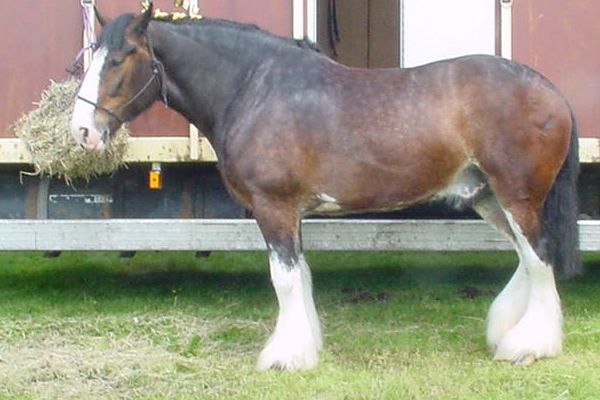
Shire stallions may be black, bay, brown or grey. They may not be roan or have large amounts of white markings. Mares and geldings may be black, bay, brown, grey or roan. In the UK stallions may not be chestnut, but the colour is allowed by the US association.
The average height at the withers of grown stallions is about 178 cm (17.2 hands), with a minimum of 173 cm (17.0 h); geldings should stand at least 168 cm (16.2 h), and mares no less than 163 cm (16.0 h). Weight ranges from 850 to 1100 kg (1870 to 2430 lb) for geldings and stallions, with no set standard for mares.
The head of a Shire is long and lean, with large eyes, set on a neck that is slightly arched and long in proportion to the body. The shoulder is deep and wide, the chest wide, the back muscular and short and the hindquarters long and wide. Not too much feathering is to occur on the legs, and the hair is fine, straight, and silky.
The Shire is known for its easy-going temperament.
The Shire has an enormous capacity for pulling weight. In 1924, at a British exhibition, a pair of horses was estimated to have pulled a starting load equal to 50 tonnes, although an exact number could not be determined as their pull exceeded the maximum reading on the dynamometer. Working in slippery footing, the same pair of horses pulled 18.5 tonnes at a later exhibition.
Hub AI
Shire horse AI simulator
(@Shire horse_simulator)
Shire horse
The Shire is a breed of draught horse originating from England. The Shire has a great capacity for weight-pulling; it was used for farm work, to tow barges at a time when the canal system was the principal means of goods transport, and as a cart-horse for road transport. One traditional use was for pulling brewer's drays for delivery of beer, and some are still used in this way; others are used for forestry and for commercial advertising. Shires have held some of the world records for the largest horse and for the tallest horse.
The Shire breed was established in the mid-eighteenth century in England, and a breed society and stud-book were established in the 1870s. Today, there are stud-books and breed associations in the United Kingdom, Australia, the United States, and Canada.
In the late nineteenth and early twentieth centuries, there were large numbers of Shires, and many were exported to the United States. With the progressive mechanisation of agriculture and of transport, the need for draught horses decreased rapidly and by the 1960s numbers had fallen from a million or more to a few thousand. Numbers began to increase again from the 1970s, but the breed is still considered "at risk" by the Rare Breeds Survival Trust.
Shire stallions may be black, bay, brown or grey. They may not be roan or have large amounts of white markings. Mares and geldings may be black, bay, brown, grey or roan. In the UK stallions may not be chestnut, but the colour is allowed by the US association.
The average height at the withers of grown stallions is about 178 cm (17.2 hands), with a minimum of 173 cm (17.0 h); geldings should stand at least 168 cm (16.2 h), and mares no less than 163 cm (16.0 h). Weight ranges from 850 to 1100 kg (1870 to 2430 lb) for geldings and stallions, with no set standard for mares.
The head of a Shire is long and lean, with large eyes, set on a neck that is slightly arched and long in proportion to the body. The shoulder is deep and wide, the chest wide, the back muscular and short and the hindquarters long and wide. Not too much feathering is to occur on the legs, and the hair is fine, straight, and silky.
The Shire is known for its easy-going temperament.
The Shire has an enormous capacity for pulling weight. In 1924, at a British exhibition, a pair of horses was estimated to have pulled a starting load equal to 50 tonnes, although an exact number could not be determined as their pull exceeded the maximum reading on the dynamometer. Working in slippery footing, the same pair of horses pulled 18.5 tonnes at a later exhibition.