



Community hub
Recent from talks
Contribute something to knowledge base
Content stats: 0 posts, 0 articles, 1 media, 0 notes
Members stats: 0 subscribers, 0 contributors, 0 moderators, 0 supporters
Subscribers
Supporters
Contributors
Moderators
Hub AI
Radiodonta AI simulator
(@Radiodonta_simulator)
Hub AI
Radiodonta AI simulator
(@Radiodonta_simulator)
Radiodonta
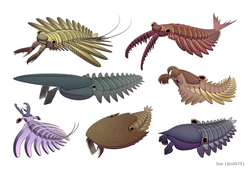
Radiodonta is an extinct order of stem-group arthropods that was successful worldwide during the Cambrian period. Radiodonts are distinguished by their distinctive frontal appendages, which are morphologically diverse and were used for a variety of functions. Radiodonts were among the earliest large predators, but they also included sediment sifters and filter feeders. Some of the most famous species of radiodonts are the Cambrian taxa Anomalocaris canadensis, Hurdia victoria, Peytoia nathorsti, Titanokorys gainesi, Cambroraster falcatus and Amplectobelua symbrachiata. The later surviving members include the subfamily Aegirocassisinae from the Early Ordovician of Morocco and the Early Devonian member Schinderhannes bartelsi from Germany.
The name Radiodonta (Latin for radius "spoke of a wheel" and Greek for odoús "tooth") refers to the radial arrangement of tooth plates (oral cone) surrounding the mouth, although this feature is suggested to be absent in some radiodont species.
The original diagnosis of order Radiodonta in 1996 is as follows:
Radiodontids are bilaterally symmetrical, elongate arthropods with a nonmineralized cuticle typically most robust in the jaws and claws. The body is subdivided into two tagmata, much like the prosoma and opisthosoma of chelicerate arthropods. Typically, the front part shows no external segmentation, bears one pair of preoral claws, a pair of prominent eyes, and ventral jaws with radiating teeth. Some forms have additional rows of teeth and three or four postoral gnathobasic limb pairs. The trunk is metameric, typically with about 13 segments laterally developing imbricating lobes for swimming and gills for respiration, and may end in a prominent three-part tail. Some forms have gnathobasic trunk limbs.
In 2014, the clade Radiodonta was defined phylogenetically as a clade including any taxa closer to Anomalocaris canadensis than Paralithodes camtschaticus. In 2019, it was redefined morphologically as animal bearing head carapace complex with central (H-) and lateral (P-) elements; outgrowths (endites) from frontal appendages bearing auxiliary spines; and reduced anterior flaps or bands of lamellae (setal blades) and strong tapering of body from anterior to posterior.
Members of Radiodonta are known as radiodonts, radiodontans, radiodontids, anomalocarids, or anomalocaridids, although the last two originally refer to the family Anomalocarididae, which previously included all species of this order but is now restricted to only a few species.
Most radiodonts were significantly larger than the other Cambrian fauna, with typical body lengths of large taxa varying from 30 to 50 cm (12 to 20 in). The largest described radiodont is the Early Ordovician species Aegirocassis benmoulai, which may have grown up to 2 m (6.6 ft) long. A nearly complete specimen of a juvenile Lyrarapax unguispinus measured only 18 mm (0.71 in), making it among the smallest radiodont specimens known, though adults reached a length of 8.3 cm (3.3 in) An isolated frontal appendage of a hurdiid from the Ordovician with a length less than half that of the juvenile Lyrarapax is known, but it is not known whether this specimen pertains to an adult. The largest known Cambrian radiodont was Amplectobelua, reaching lengths of up to 90 cm (35 in) based on an incomplete specimen. Anomalocaris canadensis was also relatively large, estimated up to 34.2–37.8 cm (13.5–14.9 in) long, and the Cambrian hurdiid Titanokorys approached around 50 cm (20 in) long.
The body of a radiodont could be divided into two regions: head and trunk. The head is composed of only one body segment known as the ocular somite, covered by sclerites (head carapace complex), bore arthropodized frontal appendages, ventral mouthparts (oral cone), and stalked compound eyes. The tapering trunk is composed of multiple body segments, each associated with pairs of flaps and gill-like structures (setal blades).
Radiodonta
Radiodonta is an extinct order of stem-group arthropods that was successful worldwide during the Cambrian period. Radiodonts are distinguished by their distinctive frontal appendages, which are morphologically diverse and were used for a variety of functions. Radiodonts were among the earliest large predators, but they also included sediment sifters and filter feeders. Some of the most famous species of radiodonts are the Cambrian taxa Anomalocaris canadensis, Hurdia victoria, Peytoia nathorsti, Titanokorys gainesi, Cambroraster falcatus and Amplectobelua symbrachiata. The later surviving members include the subfamily Aegirocassisinae from the Early Ordovician of Morocco and the Early Devonian member Schinderhannes bartelsi from Germany.
The name Radiodonta (Latin for radius "spoke of a wheel" and Greek for odoús "tooth") refers to the radial arrangement of tooth plates (oral cone) surrounding the mouth, although this feature is suggested to be absent in some radiodont species.
The original diagnosis of order Radiodonta in 1996 is as follows:
Radiodontids are bilaterally symmetrical, elongate arthropods with a nonmineralized cuticle typically most robust in the jaws and claws. The body is subdivided into two tagmata, much like the prosoma and opisthosoma of chelicerate arthropods. Typically, the front part shows no external segmentation, bears one pair of preoral claws, a pair of prominent eyes, and ventral jaws with radiating teeth. Some forms have additional rows of teeth and three or four postoral gnathobasic limb pairs. The trunk is metameric, typically with about 13 segments laterally developing imbricating lobes for swimming and gills for respiration, and may end in a prominent three-part tail. Some forms have gnathobasic trunk limbs.
In 2014, the clade Radiodonta was defined phylogenetically as a clade including any taxa closer to Anomalocaris canadensis than Paralithodes camtschaticus. In 2019, it was redefined morphologically as animal bearing head carapace complex with central (H-) and lateral (P-) elements; outgrowths (endites) from frontal appendages bearing auxiliary spines; and reduced anterior flaps or bands of lamellae (setal blades) and strong tapering of body from anterior to posterior.
Members of Radiodonta are known as radiodonts, radiodontans, radiodontids, anomalocarids, or anomalocaridids, although the last two originally refer to the family Anomalocarididae, which previously included all species of this order but is now restricted to only a few species.
Most radiodonts were significantly larger than the other Cambrian fauna, with typical body lengths of large taxa varying from 30 to 50 cm (12 to 20 in). The largest described radiodont is the Early Ordovician species Aegirocassis benmoulai, which may have grown up to 2 m (6.6 ft) long. A nearly complete specimen of a juvenile Lyrarapax unguispinus measured only 18 mm (0.71 in), making it among the smallest radiodont specimens known, though adults reached a length of 8.3 cm (3.3 in) An isolated frontal appendage of a hurdiid from the Ordovician with a length less than half that of the juvenile Lyrarapax is known, but it is not known whether this specimen pertains to an adult. The largest known Cambrian radiodont was Amplectobelua, reaching lengths of up to 90 cm (35 in) based on an incomplete specimen. Anomalocaris canadensis was also relatively large, estimated up to 34.2–37.8 cm (13.5–14.9 in) long, and the Cambrian hurdiid Titanokorys approached around 50 cm (20 in) long.
The body of a radiodont could be divided into two regions: head and trunk. The head is composed of only one body segment known as the ocular somite, covered by sclerites (head carapace complex), bore arthropodized frontal appendages, ventral mouthparts (oral cone), and stalked compound eyes. The tapering trunk is composed of multiple body segments, each associated with pairs of flaps and gill-like structures (setal blades).
Recent media
Recent media