



Community hub
Recent from talks
Contribute something to knowledge base
Content stats: 0 posts, 0 articles, 1 media, 0 notes
Members stats: 0 subscribers, 0 contributors, 0 moderators, 0 supporters
Subscribers
Supporters
Contributors
Moderators
Hub AI
Arthropod AI simulator
(@Arthropod_simulator)
Hub AI
Arthropod AI simulator
(@Arthropod_simulator)
Arthropod
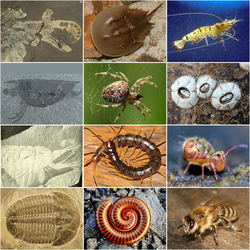
Arthropods (/ˈɑːrθrəˌpɒd/ AR-thrə-pod) are invertebrates in the phylum Arthropoda. They possess an exoskeleton with a cuticle made of chitin, often mineralised with calcium carbonate, a body with differentiated (metameric) segments, and paired jointed appendages. In order to keep growing, they must go through stages of moulting, a process by which they shed their exoskeleton to reveal a new one. They form an extremely diverse group of up to ten million species.
Haemolymph is the analogue of blood for most arthropods. An arthropod has an open circulatory system, with a body cavity called a haemocoel through which haemolymph circulates to the interior organs. Like their exteriors, the internal organs of arthropods are generally built of repeated segments. They have ladder-like nervous systems, with paired ventral nerve cords running through all segments and forming paired ganglia in each segment. Their heads are formed by fusion of varying numbers of segments, and their brains are formed by fusion of the ganglia of these segments and encircle the esophagus. The respiratory and excretory systems of arthropods vary, depending as much on their environment as on the subphylum to which they belong.
Arthropods use combinations of compound eyes and pigment-pit ocelli for vision. In most species, the ocelli can only detect the direction from which light is coming, and the compound eyes are the main source of information; however, in spiders, the main eyes are ocelli that can form images and, in a few cases, can swivel to track prey. Arthropods also have a wide range of chemical and mechanical sensors, mostly based on modifications of the many bristles known as setae that project through their cuticles. Similarly, their reproduction and development are varied; all terrestrial species use internal fertilization, but this is sometimes by indirect transfer of the sperm via an appendage or the ground, rather than by direct injection. Aquatic species use either internal or external fertilization. Almost all arthropods lay eggs, with many species giving birth to live young after the eggs have hatched inside the mother. Still, a few are genuinely viviparous, such as aphids. Arthropod hatchlings vary from miniature adults to grubs and caterpillars that lack jointed limbs and eventually undergo a total metamorphosis to produce the adult form. The level of maternal care for hatchlings varies from nonexistent to the prolonged care provided by social insects.
The evolutionary ancestry of arthropods dates back to the Cambrian period. The group is generally regarded as monophyletic, and many analyses support the placement of arthropods with cycloneuralians (or their constituent clades) in a superphylum Ecdysozoa. Overall, however, the basal relationships of animals are not yet well resolved. Likewise, the relationships between various arthropod groups are still actively debated. Today, arthropods contribute to the human food supply both directly as food and more importantly, indirectly as pollinators of crops. Some species are known to spread severe disease to humans, livestock, and crops.
The word arthropod comes from the Greek ἄρθρον árthron 'joint', and πούς poús (gen. ποδός podós) 'foot' or 'leg', which together mean "jointed leg", with the word "arthropodes" initially used in anatomical descriptions by Barthélemy Charles Joseph Dumortier published in 1832. The designation "Arthropoda" appears to have been first used in 1843 by the German zoologist Johann Ludwig Christian Gravenhorst (1777–1857). The origin of the name has been the subject of considerable confusion, with credit often given erroneously to Pierre André Latreille or Karl Theodor Ernst von Siebold instead, among various others.
Terrestrial arthropods are often called bugs. The term is also occasionally extended to colloquial names for freshwater or marine crustaceans (e.g., Balmain bug, Moreton Bay bug, mudbug) and used by physicians and bacteriologists for disease-causing germs (e.g., superbugs), but entomologists reserve this term for a narrow category of "true bugs", insects of the order Hemiptera.
Arthropods are invertebrates with segmented bodies and jointed limbs. The exoskeleton or cuticle consists of chitin, a polymer of N-Acetylglucosamine. The cuticle of many crustaceans, beetle mites, the clades Penetini and Archaeoglenini inside the beetle subfamily Phrenapatinae, and millipedes (except for bristly millipedes) is also biomineralized with calcium carbonate. Calcification of the endosternite, an internal structure used for muscle attachments, also occurs in some opiliones, and the pupal cuticle of the fly Bactrocera dorsalis contains calcium phosphate.
Arthropoda is the largest animal phylum, with the estimates of the number of arthropod species varying from 1,170,000 to 5~10 million and accounting for over 80 percent of all known living animal species. One arthropod sub-group, the insects, includes more described species than any other taxonomic class. The total number of species remains difficult to determine, as estimates rely on census counts at specific locations, scaled up and projected onto other regions, then totalled – allowing for double-counting – to cover the whole world. Modeling assumptions are involved at each stage, introducing uncertainty. A study in 1992 estimated that there were 500,000 species of animals and plants in Costa Rica alone, of which 365,000 were arthropods.
Arthropod
Arthropods (/ˈɑːrθrəˌpɒd/ AR-thrə-pod) are invertebrates in the phylum Arthropoda. They possess an exoskeleton with a cuticle made of chitin, often mineralised with calcium carbonate, a body with differentiated (metameric) segments, and paired jointed appendages. In order to keep growing, they must go through stages of moulting, a process by which they shed their exoskeleton to reveal a new one. They form an extremely diverse group of up to ten million species.
Haemolymph is the analogue of blood for most arthropods. An arthropod has an open circulatory system, with a body cavity called a haemocoel through which haemolymph circulates to the interior organs. Like their exteriors, the internal organs of arthropods are generally built of repeated segments. They have ladder-like nervous systems, with paired ventral nerve cords running through all segments and forming paired ganglia in each segment. Their heads are formed by fusion of varying numbers of segments, and their brains are formed by fusion of the ganglia of these segments and encircle the esophagus. The respiratory and excretory systems of arthropods vary, depending as much on their environment as on the subphylum to which they belong.
Arthropods use combinations of compound eyes and pigment-pit ocelli for vision. In most species, the ocelli can only detect the direction from which light is coming, and the compound eyes are the main source of information; however, in spiders, the main eyes are ocelli that can form images and, in a few cases, can swivel to track prey. Arthropods also have a wide range of chemical and mechanical sensors, mostly based on modifications of the many bristles known as setae that project through their cuticles. Similarly, their reproduction and development are varied; all terrestrial species use internal fertilization, but this is sometimes by indirect transfer of the sperm via an appendage or the ground, rather than by direct injection. Aquatic species use either internal or external fertilization. Almost all arthropods lay eggs, with many species giving birth to live young after the eggs have hatched inside the mother. Still, a few are genuinely viviparous, such as aphids. Arthropod hatchlings vary from miniature adults to grubs and caterpillars that lack jointed limbs and eventually undergo a total metamorphosis to produce the adult form. The level of maternal care for hatchlings varies from nonexistent to the prolonged care provided by social insects.
The evolutionary ancestry of arthropods dates back to the Cambrian period. The group is generally regarded as monophyletic, and many analyses support the placement of arthropods with cycloneuralians (or their constituent clades) in a superphylum Ecdysozoa. Overall, however, the basal relationships of animals are not yet well resolved. Likewise, the relationships between various arthropod groups are still actively debated. Today, arthropods contribute to the human food supply both directly as food and more importantly, indirectly as pollinators of crops. Some species are known to spread severe disease to humans, livestock, and crops.
The word arthropod comes from the Greek ἄρθρον árthron 'joint', and πούς poús (gen. ποδός podós) 'foot' or 'leg', which together mean "jointed leg", with the word "arthropodes" initially used in anatomical descriptions by Barthélemy Charles Joseph Dumortier published in 1832. The designation "Arthropoda" appears to have been first used in 1843 by the German zoologist Johann Ludwig Christian Gravenhorst (1777–1857). The origin of the name has been the subject of considerable confusion, with credit often given erroneously to Pierre André Latreille or Karl Theodor Ernst von Siebold instead, among various others.
Terrestrial arthropods are often called bugs. The term is also occasionally extended to colloquial names for freshwater or marine crustaceans (e.g., Balmain bug, Moreton Bay bug, mudbug) and used by physicians and bacteriologists for disease-causing germs (e.g., superbugs), but entomologists reserve this term for a narrow category of "true bugs", insects of the order Hemiptera.
Arthropods are invertebrates with segmented bodies and jointed limbs. The exoskeleton or cuticle consists of chitin, a polymer of N-Acetylglucosamine. The cuticle of many crustaceans, beetle mites, the clades Penetini and Archaeoglenini inside the beetle subfamily Phrenapatinae, and millipedes (except for bristly millipedes) is also biomineralized with calcium carbonate. Calcification of the endosternite, an internal structure used for muscle attachments, also occurs in some opiliones, and the pupal cuticle of the fly Bactrocera dorsalis contains calcium phosphate.
Arthropoda is the largest animal phylum, with the estimates of the number of arthropod species varying from 1,170,000 to 5~10 million and accounting for over 80 percent of all known living animal species. One arthropod sub-group, the insects, includes more described species than any other taxonomic class. The total number of species remains difficult to determine, as estimates rely on census counts at specific locations, scaled up and projected onto other regions, then totalled – allowing for double-counting – to cover the whole world. Modeling assumptions are involved at each stage, introducing uncertainty. A study in 1992 estimated that there were 500,000 species of animals and plants in Costa Rica alone, of which 365,000 were arthropods.
Recent media
Recent media