Hubbry Logo
CambrorasterCambrorasterMain
Open search
Cambroraster
Community hub
Cambroraster
logo
8 pages, 0 posts
0 subscribers
Be the first to start a discussion here.
Cambroraster
Cambroraster
from Wikipedia

Cambroraster
Temporal range: Mid Cambrian: Chengjiang–Burgess shale
Fossil of a Cambroraster head sclerite (ROMIP 65079)
Video animation
Scientific classification Edit this classification
Kingdom: Animalia
Stem group: Arthropoda
Class: Dinocaridida
Order: Radiodonta
Family: Hurdiidae
Subfamily: Hurdiinae
Genus: Cambroraster
Type species
Cambroraster falcatus
Moysiuk & Caron, 2019
Species
  • Cambroraster falcatus
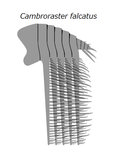
Reconstruction of the head region of Cambroraster falcatus. A: Dorsal view, B: Ventral view, Ey: Eye, Fa: Frontal appendage, He:H-element, Bp: Bilobate posterior region, Lp: Posterolateral process, Oc: Oral cone, Pe: P-element, Pn: P-element neck

Cambroraster is an extinct monotypic genus of hurdiid radiodont, dating to the middle Cambrian, and represented by the single formally described species Cambroraster falcatus.[1] Hundreds of specimens were found in the Burgess Shale, and described in 2019.[2] A large animal (for its era) at up to 30 centimetres (12 in) (but not as long as Titanokorys at 50 centimetres (20 in)), it is characterized by a significantly enlarged horseshoe-shaped dorsal carapace (H-element), and presumably fed by sifting through the sediment with its well-developed tooth plates (oral cone) and short frontal appendages with hooked spines.[1] Nicknamed the "spaceship" fossil when first found, for the way its dorsal carapace resembles the fictional Millennium Falcon, the specific epithet falcatus in its scientific name is a nod to that resemblance.[1][3][4]

A second species of Cambroraster is known from the Chengjiang Biota of South China, making it the first uncontroversial hurdiid from the Cambrian of China. This species is known only from a juvenile dorsal carapace, so it was not given a specific name.[5]

Although originally suggested to have used its frontal appendages to sift sediment for prey, a later study by different authors suggested that it may have been a filter feeder instead.[6]

See also

[edit]

References

[edit]
[edit]
Revisions and contributorsEdit on WikipediaRead on Wikipedia
from Grokipedia
Cambroraster falcatus is an extinct species of hurdiid radiodont, a group of early relatives, that inhabited marine environments during the Middle epoch around 508 million years ago. Known from over 140 exceptionally preserved fossils primarily from the Burgess Shale's locality in , , , it is distinguished by its large, horseshoe-shaped dorsal head reaching up to 18 cm in width, paired elliptical compound eyes, and specialized frontal appendages equipped with five robust endites bearing hooked spines for forming a feeding to capture suspended small prey such as planktonic particles and tiny invertebrates. This nektobenthic predator, estimated to have reached a total body length of approximately 30 cm, exhibited a unique body plan including eight pairs of lateral swimming flaps, a segmented trunk with gill blades, and a circular oral lined with toothed plates for shredding ingested food, positioning it near the top of the early food web as one of the largest known suspension feeders of its time. The species' name derives from "Cambro-" referencing the period, "raster" alluding to its rake-like appendages, and "falcatus" meaning sickle-shaped in Latin, evoking the carapace's distinctive form that also inspired comparisons to the Star Wars starship. Discovered in 2014 and formally described in 2019 by paleontologists Joseph Moysiuk and Jean-Bernard Caron, C. falcatus provides critical insights into the evolutionary diversification of radiodonts following the , particularly the hurdiid family's adaptation to suspension feeding behaviors that targeted emerging nektobenthic ecosystems. Evidence of mass moulting aggregations among the fossils suggests gregarious social habits, while its specialized morphology underscores the rapid ecological innovation among early arthropods in exploiting newly available niches.

Discovery and naming

Geological context

Cambroraster fossils were discovered in the Formation, specifically within the upper part of the 'Thick' Stephen Formation at the and Tokumm Creek localities in , , . Specimens were first discovered in 2014 at the locality, with additional material collected in subsequent years including 2018 at Tokumm Creek. These sites represent key outcrops of the Middle Cambrian deposits known for their exceptional fossil preservation. The formation dates to the Middle Cambrian, corresponding to the Series and Wuliuan Stage, approximately 506 million years ago, within the Ehmaniella . Over 140 specimens have been collected, comprising disarticulated and partially articulated remains, with clusters suggesting mass events on the seafloor. Taphonomic conditions at these localities facilitated exceptional preservation through rapid burial in fine-grained, sediments under anoxic seafloor environments, minimizing decay and scavenging. Specimens are preserved as thin carbon films, often with partial replication by clay or iron-rich minerals, and some features exhibit phosphatization, particularly in internal structures. This mode of preservation is characteristic of the Middle Cambrian deposits, which document ongoing arthropod diversification following the early .

Formal description and etymology

Cambroraster falcatus was formally described in as a new and of hurdiid radiodont by Joseph Moysiuk and Jean-Bernard Caron in a paper published in Proceedings of the Royal Society B. The is based on over 140 exceptionally preserved specimens from the , highlighting its distinctive morphology as a large, sediment-sifting hurdiid radiodont adapted for exploiting infaunal prey in seafloor sediments. The genus name Cambroraster combines "Cambro," referencing the period, with "raster," the Latin term for a rake, alluding to the rake-like endites on its frontal appendages that facilitated sediment sifting. The species epithet falcatus derives from the Latin word for sickle-shaped, describing the curved, falcate posterolateral processes of the H-element . The is ROMIP 65078, consisting of a part and partial counterpart preserving a partial and associated . Paratypes include ROMIP 65079 (detailing the oral cone), ROMIP 65081 (frontal ), and additional specimens ROMIP 65083, 65084, and 65092, all housed at the Royal Ontario Museum. Prior to formal naming, the fossil was nicknamed the "spaceship" due to its 's striking resemblance to the from Star Wars.

Anatomy

Carapace and overall body form

Cambroraster exhibited a broad, dorsoventrally flattened body form, reaching a maximum length of approximately 30 cm, which is notably large for radiodonts. This overall morphology featured a prominent head region dominated by an expansive dorsal , transitioning to a shorter, stout trunk that comprised the posterior portion of the body. The consisted of a large, horseshoe-shaped central H-element, or tergite, measuring up to 18 cm in width and occupying roughly half the total body length. The frontal region of this H-element was rounded, while the posterior margin was bilobate and projected into two elongate, sickle-shaped posterolateral spines lined with small, backward-pointing spines that decreased in size anteriorly. The surface bore a reticulate ornamentation of polygonal patterns, and deep lateral notches were present, likely accommodating sensory structures such as eyes. This H-element was complemented by paired, lenticular P-elements that covered the ventrolateral aspects of the head. The head region was overwhelmingly dominated by the , with the trunk exhibiting a short, segmented structure comprising 8–11 somites. Relative to other radiodonts, Cambroraster's was exceptionally large, providing extensive dorsal shielding that extended over much of the body's ventral features.

Frontal appendages

The frontal appendages of Cambroraster falcatus are a pair of segmented, grasping limbs positioned anteriorly near the mouth, functioning primarily in prey capture. These appendages are elliptical in cross-section and consist of 10 podomeres, including a terminal element, with the proximal-most podomere (the peduncle) being the largest and featuring a lateral notch for articulation. The proximal segments are robust, while the distal segments taper progressively, comprising five stout podomeres (pd2–pd6) that bear elongate endites and four reduced distal podomeres with enditic spines on the final three. Each supports five mesially curving, rake-like endites of subequal —each exceeding twice the height of the associated podomere—positioned on the inner margin to form a basket-like array. These endites are armed with 20–25 robust, hooked auxiliary spines per endite, alternating in size and directed anteriorly for secure grasping, while podomeres 8 and 9 bear tiny axial spines. The terminal podomere culminates in a sickle-shaped suited for raking motions. The appendages reach approximately 30 mm in , with spinose margins along the podomeres enabling disturbance of benthic sediments during . In comparison to other hurdiid radiodonts such as Hurdia victoria, the frontal appendages of Cambroraster exhibit greater robustness and spinosity, with more numerous, homonomous endites bearing densely packed, spiniform auxiliary spines rather than fewer, more spaced-out structures. This configuration reflects specialization for excavating infaunal prey from sediments, contrasting with the relatively slender, less spinose appendages of congeners adapted for epifaunal hunting.

Oral cone and mouthparts

The oral cone of Cambroraster falcatus displays tetraradial symmetry, formed by a convex outer ring comprising four large plates that alternate with four sets of seven smaller plates each, creating a structured array that converges centrally. Positioned ventrally beneath the and immediately behind the frontal appendages, this apparatus measures up to 4 cm in diameter, reflecting the animal's overall body size of approximately 30 cm. Internally, the oral cone features at least three tetraradially arranged rows of serrated plates that facilitate , with the four large outer plates each bearing up to three robust triangular teeth along their oral margins for gripping and manipulation. The outer plates exhibit serrations suited for grinding, while additional rows of small denticles, possibly from associated soft tissues, contribute to a densely overlapping arrangement that imparts a distinctive pineapple-like appearance—larger and more elaborate than in many other radiodonts. This mouthpart configuration implies a suction-feeding mechanism, enabling Cambroraster to draw in and handle disturbed prey items of varying sizes, in coordination with the surrounding frontal appendages that form a basket-like .

Trunk, flaps, and tail fan

The trunk of Cambroraster falcatus is relatively short and features a subtriangular cross-section, comprising eight somites that bear paired lateral flaps, with its anterior region covered by the posteriorly projecting . Anterior to these flaps, three additional somites bear smaller lamellar bands lacking flaps, interpreted as early setal structures. The eight pairs of lateral flaps extend laterally from the trunk and are largest anteriorly, where they nearly reach the posterolateral margins of the and collectively span much of the body width, gradually decreasing in size posteriorly. These biramous flaps bear setal blades functioning as gills and facilitated undulatory for in a benthic environment. At the terminal end of the trunk lies a small tail fan composed of two pairs of elongate, posteriorly directed blades with parallel rays, which contributed to maneuvering and stability during locomotion.

Eyes and sensory features

Cambroraster falcatus possessed paired compound eyes that are elongate and elliptical in shape, positioned within prominent posterolateral notches of its expansive horseshoe-shaped head . These eyes protrude dorsally, likely on short stalks as typical of radiodonts, enabling an upward orientation that facilitated visual monitoring from a benthic position. This arrangement is particularly suited to the animal's inferred nektobenthic , allowing detection of overhead activity such as passing shadows or potential prey while the body remained low to the seafloor during sediment sifting. The dorsally directed eyes represent a key in Cambroraster, contrasting with the more laterally or anteriorly oriented eyes in many other radiodonts and emphasizing its specialization for infaunal and epifaunal food sources in dimly lit, deep-water environments like the seafloor. No detailed preservation of ommatidial structure has been reported for , though the overall form suggests functionality in low-light conditions consistent with the group's visual . Beyond the eyes, no additional sensory organs such as antennule-like structures are preserved in known specimens of Cambroraster falcatus, despite their presence in some radiodont relatives that may have aided in chemosensory or mechanosensory detection. The reliance on visual input from the upward-facing eyes likely complemented its sediment-disturbing feeding strategy, providing in a complex ecosystem.

Classification

Taxonomic placement

Cambroraster is classified within the kingdom Animalia, phylum Arthropoda, order , family , genus Cambroraster, and species C. falcatus. The genus is monotypic, containing only the single species C. falcatus, which was formally described in 2019. The diagnosis of Cambroraster falcatus identifies it as a hurdiid radiodont distinguished by an extra-large, horseshoe-shaped head (H-element) with a bilobate posterior margin and conspicuous spinous posterolateral processes, paired lenticular P-elements lacking a posterior notch, and frontal appendages featuring five mesially curving endites armed with 20–25 auxiliary spines each. This was established in the original 2019 description, with no subsequent taxonomic revisions reported. As a member of the radiodonts, Cambroraster belongs to the and represents a stem-group euarthropod, positioned outside the crown-group of true arthropods such as crustaceans.

Phylogenetic relationships

Cambroraster falcatus is positioned within the monophyletic family , a derived of radiodonts that diverged from basal forms such as those in Anomalocarididae, exemplified by canadensis. The 2019 phylogenetic analysis resolved C. falcatus as sister to Zhenghecaris shankouensis ( 0.96) within a broader of hurdiids including Cordaticaris striatus, , Stanleycaris, Pahvantia, and ( 0.89 for the polytomy). This positioning is supported by a Bayesian phylogenetic analysis using 34 radiodont taxa and 72 morphological characters, which recovered with high (0.92). Key synapomorphies uniting Cambroraster with other hurdiids include a tetraradial oral cone featuring an outer ring of four large plates each delimiting seven smaller toothed plates, contrasting with the triradial oral cones of basal radiodonts like . Additionally, the frontal appendages exhibit five elongate, pectinate endites armed with hooked auxiliary spines, adapted for sifting sediments rather than grasping prey as in ancestral forms. These traits, combined with a large tripartite , distinguish hurdiids from other radiodont families. The 2019 Bayesian analysis, implemented in MrBayes with 3,000,000 generations and 20% burn-in, produced a 50% majority-rule consensus tree that highlights the diversification of during the , with Cambroraster emerging as a derived member. A 2021 analysis, incorporating the new hurdiid Titanokorys gainesi and additional characters, resolved C. falcatus within a including Titanokorys, Zhenghecaris shankouensis, and Cordaticaris striatus. This tree underscores the evolution of sediment-sifting adaptations in hurdiid ancestors, marking a transition from the pelagic lifestyles of basal radiodonts to more benthic ecologies in derived hurdiids like Cambroraster. Subsequent analyses reinforce this pattern, showing how enlarged and stout appendages in taxa such as Cambroraster and Titanokorys facilitated exploitation of infaunal resources in mid- seafloors.

Paleoecology

Habitat and distribution

Cambroraster falcatus inhabited shallow marine environments along the Laurentian , within an epicontinental characterized by subtidal seafloors and soft, muddy substrates conducive to sediment-sifting lifestyles. Fossils of this radiodont are known exclusively from the biota, specifically the assemblage in the Canadian Rockies of , with no confirmed occurrences reported from other localities. The specimens derive from the upper part of the 'Thick' Stephen Formation, dating to the Wuliuan stage of the Cambrian period (approximately 508 million years ago). The paleoenvironment featured warm, well-oxygenated waters at depths of roughly 200–500 meters, below storm wave base but still within a productive shelf setting that supported high in the aftermath of the . Cambroraster appears to have been relatively abundant in these assemblages, often co-occurring with other hurdiid radiodonts and suggesting the presence of localized populations.

Feeding strategy and diet

Cambroraster falcatus employed a micro- to macrophagous sediment-sifting feeding strategy, using its frontal appendages to rake and disturb the seafloor in search of infaunal prey. The stout, rigid appendages, equipped with multiple endites bearing densely packed hooked auxiliary spines, swept through soft sediments in a sideways motion, forming a basket-like structure to trap and direct particles toward the oral cone. This mechanism allowed the animal to dislodge and capture burrowing organisms without the need for grasping large, agile prey, distinguishing it from apex predators like . The diet primarily consisted of small benthic , such as priapulid worms and other meiofaunal arthropods, with a minimum prey size estimated at approximately 0.5 mm based on spine spacing. The oral facilitated and processing of these particles, with its tetraradial featuring four large toothed plates (each bearing up to three teeth) and serrated inner plates capable of grinding harder-shelled items, indicating durophagous capabilities. denticles further aided in , enabling opportunistic consumption of epifaunal prey when available. This adaptive feeding highlights C. falcatus as an infaunal specialist within the hurdiid radiodonts, exploiting seafloor resources overlooked by larger contemporaries.

Ecological role and behavior

Cambroraster falcatus occupied a nektobenthic niche as a predator and in mid-Cambrian soft-sediment communities, where it exploited infaunal food sources through sediment-sifting behaviors following the diversification of life after the . Its feeding apparatus supported a diet ranging from microscopic to larger particles, positioning it near the top of local food webs in environments like the Burgess Shale's and Tokumm sites, though it was abundant rather than ecologically dominant. Over 140 specimens indicate it thrived in areas with plentiful benthic resources, contributing to the trophic structure of these post-Explosion ecosystems without overwhelming other taxa. Fossil clusters, with dozens of individuals preserved on single bedding planes at the North Tokumm locality, suggest gregarious , likely involving synchronized mass to minimize predation risk during vulnerable periods. Paired appendages and elements in close proximity further support this moulting interpretation, a observed in other euarthropods for group protection. The organism's large, upward-directed elliptical eyes, adapted for detecting seafloor stimuli, align with a benthic spent near the sediment-water interface, using lateral flaps for mobility. As a mid-sized hurdiid, Cambroraster likely served as potential prey for larger radiodonts while competing with congeners like Titanokorys gainesi for benthic sediment resources in shared habitats. Both taxa employed similar rake-like frontal appendages for sifting, indicating niche overlap in infaunal exploitation within the same assemblages. Cambroraster exemplifies hurdiid diversification into specialized sediment-feeding roles, filling ecological gaps in infaunal niches as euarthropod body plans evolved during the early . This adaptation highlights how hurdiids, including phylogenetic relatives like Zhenghecaris, expanded into underutilized benthic communities.
Add your contribution
Related Hubs
User Avatar
No comments yet.