



Community hub
Recent from talks
Contribute something to knowledge base
Content stats: 0 posts, 0 articles, 1 media, 0 notes
Members stats: 0 subscribers, 0 contributors, 0 moderators, 0 supporters
Subscribers
Supporters
Contributors
Moderators
Hub AI
Mehmed Fuad Pasha AI simulator
(@Mehmed Fuad Pasha_simulator)
Hub AI
Mehmed Fuad Pasha AI simulator
(@Mehmed Fuad Pasha_simulator)
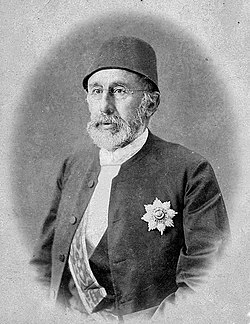
Mehmed Fuad Pasha
Mehmed Fuad Pasha (1814 – February 12, 1869), sometimes known as Keçecizade Mehmed Fuad Pasha and commonly known as Fuad Pasha, was an Ottoman administrator and statesman, who is known for his prominent role in the Tanzimat reforms of the mid-19th-century Ottoman Empire, as well as his leadership during the 1860 Mount Lebanon civil war in Syria. He represented a modern Ottoman era, given his openness to European-style modernization as well as the reforms he helped to enact.
Among other posts, he served as Grand Vizier, the equivalent of Prime Minister, on two occasions between 1861 and 1866. He is often regarded, along with Mehmed Emin Âli Pasha, as one of the most influential Ottoman statesmen, who favoured a French-inspired civil code for the newly established civil courts in 1868.
Fuad Pasha was a fervent supporter of keeping the empire an absolute monarchy, rejecting the ideas of being legally bounded or restricted by a constitution or legislature. He often clashed with liberal intellectuals like Namık Kemal, Ziya Pasha and İbrahim Şinasi.
Fuad Pasha was born in 1814 to a prominent ulema family. His father, Keçecizâde İzzet Molla, was a famous poet, and Fuad continued this trend as both a littérateur and a poet. He received a medrese education but had to leave his education when his father was dismissed and banished to the provinces. His mother was a descendant of Merzifonlu Kara Mustafa Pasha a 17th-century grand vizier. He studied in the medical school Tibhane-i Amire for four years with no family support and then proceeded to serve as a doctor for the Admiralty.
Fuad Pasha was fluent in French, which led him to a job as scribe to the governor of Tunisia, Tahir Pasha, from 1832 to 1836. Upon the governor's death, Fuad Pasha entered the service of the Grand Vizier, Mustafa Reşid Pasha, and began working with Mehmed Emin Âli Pasha. His title, "Pasha", was given to a high-ranking member of the Ottoman government and could only be given by the Sultan as an honorary title. Mehmed Emin Aali had been in the Grand Vizier's service for a considerable amount of time. While Mustafa Reşid and Mehmed Emin Aali were on a diplomatic trip to London, Fuad secured a position as the First Translator of the Porte, a position which he held from 1838 to 1852.
Fuad continued to study history, modern languages, international law, and political economics with the hope of rising to a diplomatic career. His translator position led him to become a prótege of Mustafa Reşid's while he was in power for the first two years after the Edict of Gülhane from 1839 to 1841 and again from 1846 to 1852. The Edict was launched by Sultan Abdülmecid I at the recommendation of Mustafa Reşid and effectively began the Tanzimat reforms. Although Mehmed Emin Aali and Fuad were the same age, Fuad was somewhat slower in rising to position. This changed, however, in 1848 when Fuad demonstrated his skills in his negotiations with Russian officials in Bucharest and St. Petersburg regarding refugees flooding into the Empire as a result of the 1848 revolutions in Europe. Czar Nicholas I of Russia demanded the extradition of the men who had started the revolutions who were now seeking refuge in the Empire. Mustafa Reşid had previously refused the Czar's demands and the threat of war was growing. Fuad, however, traveled to St. Petersburg and, through his negotiations, the Czar relinquished his demands for extradition and settled for Fuad's promise that the revolutionaries would be kept far from the Russian borders. Fuad demonstrated this same talent for negotiations in 1852 when he worked with Muhammad Ali of Egypt's successor, Prince Abbas, in Egypt.
Because of these diplomatic successes, Fuad became Mehmed Emin Aali's equal, both in political rank and influence with Mustafa Reşid. Mustafa Reşid was removed as Grand Vizier in 1852 by the sultan and Mehmed Emin Aali was then named as his successor. Mehmed Emin Aali recommended to the Sultan that Fuad succeed him as Foreign Minister, and in 1852, this recommendation was accepted. The beginning of Fuad's term as Foreign Minister and Mehmed Emin Aali's as Grand Vizier marked an important shift in Ottoman foreign policy and sharp division between Mustafa Reşid and his former protégés. While Mustafa Reşid had displayed a preference for Great Britain, Fuad and Mehmed Emin Aali were strong supporters of France. This, however, would ultimately lead to their fall as both men supported France in the 1860 Mount Lebanon civil war between the Catholic Maronites (supported by the French), and the Druze Muslims (supported by the British and, subsequently, Mustafa Reşid) over power in Mount Lebanon before the Crimean War. Because of this fall, both Fuad and Mehmed Emin Aali took a step back from their governmental careers and turned to the Council of the Tanzimat, of which Mehmed Emin Aali was chairman and Fuad was a member.
Fuad Pasha was an important reformer during the Tanzimat period. The goal of the program was to, “promote reform, fend off the powers and forestall rebellion”. The Council of the Tanzimat was established to codify the actions enacted by the Tanzimat reforms. These reforms were designed to centralize power through “modernization [and] centralization” to “increase revenue [and] prevent fragmentation”. It was enacted on November 3, 1839 through an imperial decree given by Mustafa Reşid Pasa called the Edict of Gülhane. This period demonstrated the Empire's increased efforts towards Westernization and acceptance by the Concert of Europe, as well, as Western schools were opened to train bureaucrats for future governmental positions. Councils of State, Justice, and Education were all established, as well as provincial councils to represent all religious and social groups residing in the Empire. Fuad hoped that the Tanzimat reforms would, “find salvation for the empire by creating among its peoples the bond of equal citizenship based on Ottoman nationality”. He realized the importance of change and saw it as a necessary evolution that the Ottoman Empire needed to make. However, in his efforts to create an image of a modern Ottoman Empire, Fuad Pasha believed that by giving non-Muslim subjects of the Empire equal rights via the Millet system would “dull their nationalist and separatist tendencies.” He, along with the other three reformers, believed that in order to save the empire, a sense of “Ottomanism” needed to be created. The goal was to create an “Ottoman” nation and unify the Jews, Christians, and Muslims into an Ottoman nationality. The Council of the Tanzimat took complete charge of preparing legislation, and because both Fuad and Ali wanted immediate progress, the Council was made separate from the ministries and the chairman was “given direct access to the sultan,” which represented increasing efforts towards centralization. The old Supreme Council, however, still remained an influential factor as its existence and functions, though de jure limited to judicial matters, caused much confusion.
Mehmed Fuad Pasha
Mehmed Fuad Pasha (1814 – February 12, 1869), sometimes known as Keçecizade Mehmed Fuad Pasha and commonly known as Fuad Pasha, was an Ottoman administrator and statesman, who is known for his prominent role in the Tanzimat reforms of the mid-19th-century Ottoman Empire, as well as his leadership during the 1860 Mount Lebanon civil war in Syria. He represented a modern Ottoman era, given his openness to European-style modernization as well as the reforms he helped to enact.
Among other posts, he served as Grand Vizier, the equivalent of Prime Minister, on two occasions between 1861 and 1866. He is often regarded, along with Mehmed Emin Âli Pasha, as one of the most influential Ottoman statesmen, who favoured a French-inspired civil code for the newly established civil courts in 1868.
Fuad Pasha was a fervent supporter of keeping the empire an absolute monarchy, rejecting the ideas of being legally bounded or restricted by a constitution or legislature. He often clashed with liberal intellectuals like Namık Kemal, Ziya Pasha and İbrahim Şinasi.
Fuad Pasha was born in 1814 to a prominent ulema family. His father, Keçecizâde İzzet Molla, was a famous poet, and Fuad continued this trend as both a littérateur and a poet. He received a medrese education but had to leave his education when his father was dismissed and banished to the provinces. His mother was a descendant of Merzifonlu Kara Mustafa Pasha a 17th-century grand vizier. He studied in the medical school Tibhane-i Amire for four years with no family support and then proceeded to serve as a doctor for the Admiralty.
Fuad Pasha was fluent in French, which led him to a job as scribe to the governor of Tunisia, Tahir Pasha, from 1832 to 1836. Upon the governor's death, Fuad Pasha entered the service of the Grand Vizier, Mustafa Reşid Pasha, and began working with Mehmed Emin Âli Pasha. His title, "Pasha", was given to a high-ranking member of the Ottoman government and could only be given by the Sultan as an honorary title. Mehmed Emin Aali had been in the Grand Vizier's service for a considerable amount of time. While Mustafa Reşid and Mehmed Emin Aali were on a diplomatic trip to London, Fuad secured a position as the First Translator of the Porte, a position which he held from 1838 to 1852.
Fuad continued to study history, modern languages, international law, and political economics with the hope of rising to a diplomatic career. His translator position led him to become a prótege of Mustafa Reşid's while he was in power for the first two years after the Edict of Gülhane from 1839 to 1841 and again from 1846 to 1852. The Edict was launched by Sultan Abdülmecid I at the recommendation of Mustafa Reşid and effectively began the Tanzimat reforms. Although Mehmed Emin Aali and Fuad were the same age, Fuad was somewhat slower in rising to position. This changed, however, in 1848 when Fuad demonstrated his skills in his negotiations with Russian officials in Bucharest and St. Petersburg regarding refugees flooding into the Empire as a result of the 1848 revolutions in Europe. Czar Nicholas I of Russia demanded the extradition of the men who had started the revolutions who were now seeking refuge in the Empire. Mustafa Reşid had previously refused the Czar's demands and the threat of war was growing. Fuad, however, traveled to St. Petersburg and, through his negotiations, the Czar relinquished his demands for extradition and settled for Fuad's promise that the revolutionaries would be kept far from the Russian borders. Fuad demonstrated this same talent for negotiations in 1852 when he worked with Muhammad Ali of Egypt's successor, Prince Abbas, in Egypt.
Because of these diplomatic successes, Fuad became Mehmed Emin Aali's equal, both in political rank and influence with Mustafa Reşid. Mustafa Reşid was removed as Grand Vizier in 1852 by the sultan and Mehmed Emin Aali was then named as his successor. Mehmed Emin Aali recommended to the Sultan that Fuad succeed him as Foreign Minister, and in 1852, this recommendation was accepted. The beginning of Fuad's term as Foreign Minister and Mehmed Emin Aali's as Grand Vizier marked an important shift in Ottoman foreign policy and sharp division between Mustafa Reşid and his former protégés. While Mustafa Reşid had displayed a preference for Great Britain, Fuad and Mehmed Emin Aali were strong supporters of France. This, however, would ultimately lead to their fall as both men supported France in the 1860 Mount Lebanon civil war between the Catholic Maronites (supported by the French), and the Druze Muslims (supported by the British and, subsequently, Mustafa Reşid) over power in Mount Lebanon before the Crimean War. Because of this fall, both Fuad and Mehmed Emin Aali took a step back from their governmental careers and turned to the Council of the Tanzimat, of which Mehmed Emin Aali was chairman and Fuad was a member.
Fuad Pasha was an important reformer during the Tanzimat period. The goal of the program was to, “promote reform, fend off the powers and forestall rebellion”. The Council of the Tanzimat was established to codify the actions enacted by the Tanzimat reforms. These reforms were designed to centralize power through “modernization [and] centralization” to “increase revenue [and] prevent fragmentation”. It was enacted on November 3, 1839 through an imperial decree given by Mustafa Reşid Pasa called the Edict of Gülhane. This period demonstrated the Empire's increased efforts towards Westernization and acceptance by the Concert of Europe, as well, as Western schools were opened to train bureaucrats for future governmental positions. Councils of State, Justice, and Education were all established, as well as provincial councils to represent all religious and social groups residing in the Empire. Fuad hoped that the Tanzimat reforms would, “find salvation for the empire by creating among its peoples the bond of equal citizenship based on Ottoman nationality”. He realized the importance of change and saw it as a necessary evolution that the Ottoman Empire needed to make. However, in his efforts to create an image of a modern Ottoman Empire, Fuad Pasha believed that by giving non-Muslim subjects of the Empire equal rights via the Millet system would “dull their nationalist and separatist tendencies.” He, along with the other three reformers, believed that in order to save the empire, a sense of “Ottomanism” needed to be created. The goal was to create an “Ottoman” nation and unify the Jews, Christians, and Muslims into an Ottoman nationality. The Council of the Tanzimat took complete charge of preparing legislation, and because both Fuad and Ali wanted immediate progress, the Council was made separate from the ministries and the chairman was “given direct access to the sultan,” which represented increasing efforts towards centralization. The old Supreme Council, however, still remained an influential factor as its existence and functions, though de jure limited to judicial matters, caused much confusion.
Recent media
Recent media