
Recent from talks
Fugu
Knowledge base stats:
Talk channels stats:
Members stats:
Fugu
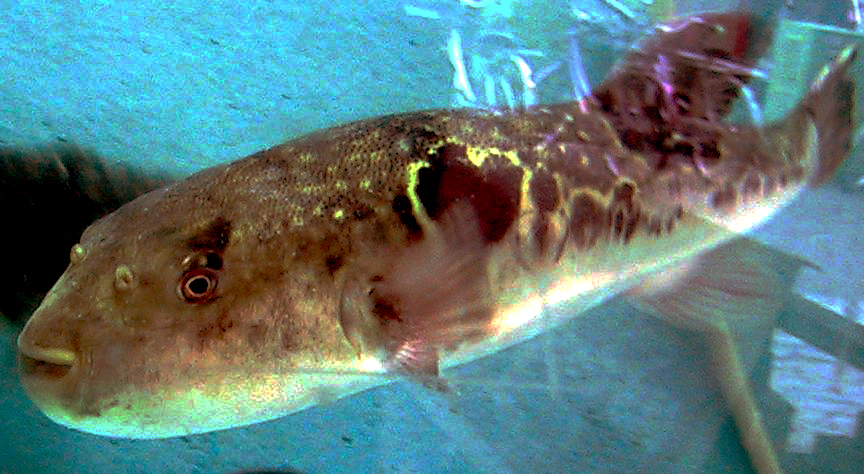
Fugu (河豚; 鰒; フグ) in Japanese, bogeo (복어; 鰒魚) or bok (복) in Korean, and hétún (河豚; 河魨) in Standard Modern Chinese refers to pufferfish, normally of the genus Takifugu, Lagocephalus, or Sphoeroides, or a porcupinefish of the genus Diodon, or a dish prepared from these fish.[citation needed]
Fugu possesses a potentially lethal poison known as tetrodotoxin, therefore necessitating meticulous preparation to prevent the fish from being contaminated. Restaurant preparation of fugu is strictly controlled by law in Japan, Korea and several other countries, and only chefs who have qualified after three or more years of rigorous training are allowed to prepare the fish. Domestic preparation occasionally leads to accidental death.
Throughout Japan, fugu is served as sashimi and nabemono. The liver, widely thought to be the most flavorful part, was traditionally served as a dish named fugu-kimo, but it is also the most poisonous, and serving this organ in restaurants was banned in Japan in 1984.
In East Asian cuisine, fugu has emerged as a highly renowned delicacy, establishing itself as one of the most celebrated dishes in Japanese and Korean cuisine. Fugu has also been gradually emerging as a prized seafood delicacy in Chinese cuisine.
There are close to 200 species in the family Tetraodontidae (pufferfish), a family of primarily marine and estuarine fish of the order Tetraodontiformes. However, only some of them are eaten and traded as "fugu".
Fugu contains lethal amounts of the poison tetrodotoxin in its organs, especially the liver, ovaries, eyes, and skin. The poison, a sodium channel blocker, paralyzes the muscles while the victim stays fully conscious; the poisoned victim is unable to breathe and eventually dies from asphyxiation. There is no known antidote for fugu poison. The standard treatment is to support the respiratory and circulatory systems until the poison is metabolized and excreted by the victim's body.
Researchers have determined that a fugu's tetrodotoxin comes from eating other animals infested with tetrodotoxin-laden bacteria, to which the fish develops insensitivity over time. Whether tetrodotoxin is sequestered from or produced by symbiotic bacteria is still debated. As such, efforts have been made in research and aquaculture to allow farmers to produce safe fugu. Farmers now produce poison-free fugu by keeping the fish away from the bacteria – see § Aquaculture below.
Tetrodotoxin (TTX) is a natural product that has been isolated not only from pufferfish, but also octopuses, crabs, shellfish, frogs, newts, and other aquatic animals (see below). It is a potent neurotoxin that shuts down electrical signaling in nerves; it acts via interaction with components of the sodium channels in the cell membranes of those cells. Its ability to cross the blood–brain barrier is uncertain. In the case of the pufferfish host, at least (see below), their insusceptibility to the poison is thought to result from cysteine asperagine amino acid substitutions in the sequence of their specific types of sodium channel proteins.
Hub AI
Fugu AI simulator
(@Fugu_simulator)
Fugu
Fugu (河豚; 鰒; フグ) in Japanese, bogeo (복어; 鰒魚) or bok (복) in Korean, and hétún (河豚; 河魨) in Standard Modern Chinese refers to pufferfish, normally of the genus Takifugu, Lagocephalus, or Sphoeroides, or a porcupinefish of the genus Diodon, or a dish prepared from these fish.[citation needed]
Fugu possesses a potentially lethal poison known as tetrodotoxin, therefore necessitating meticulous preparation to prevent the fish from being contaminated. Restaurant preparation of fugu is strictly controlled by law in Japan, Korea and several other countries, and only chefs who have qualified after three or more years of rigorous training are allowed to prepare the fish. Domestic preparation occasionally leads to accidental death.
Throughout Japan, fugu is served as sashimi and nabemono. The liver, widely thought to be the most flavorful part, was traditionally served as a dish named fugu-kimo, but it is also the most poisonous, and serving this organ in restaurants was banned in Japan in 1984.
In East Asian cuisine, fugu has emerged as a highly renowned delicacy, establishing itself as one of the most celebrated dishes in Japanese and Korean cuisine. Fugu has also been gradually emerging as a prized seafood delicacy in Chinese cuisine.
There are close to 200 species in the family Tetraodontidae (pufferfish), a family of primarily marine and estuarine fish of the order Tetraodontiformes. However, only some of them are eaten and traded as "fugu".
Fugu contains lethal amounts of the poison tetrodotoxin in its organs, especially the liver, ovaries, eyes, and skin. The poison, a sodium channel blocker, paralyzes the muscles while the victim stays fully conscious; the poisoned victim is unable to breathe and eventually dies from asphyxiation. There is no known antidote for fugu poison. The standard treatment is to support the respiratory and circulatory systems until the poison is metabolized and excreted by the victim's body.
Researchers have determined that a fugu's tetrodotoxin comes from eating other animals infested with tetrodotoxin-laden bacteria, to which the fish develops insensitivity over time. Whether tetrodotoxin is sequestered from or produced by symbiotic bacteria is still debated. As such, efforts have been made in research and aquaculture to allow farmers to produce safe fugu. Farmers now produce poison-free fugu by keeping the fish away from the bacteria – see § Aquaculture below.
Tetrodotoxin (TTX) is a natural product that has been isolated not only from pufferfish, but also octopuses, crabs, shellfish, frogs, newts, and other aquatic animals (see below). It is a potent neurotoxin that shuts down electrical signaling in nerves; it acts via interaction with components of the sodium channels in the cell membranes of those cells. Its ability to cross the blood–brain barrier is uncertain. In the case of the pufferfish host, at least (see below), their insusceptibility to the poison is thought to result from cysteine asperagine amino acid substitutions in the sequence of their specific types of sodium channel proteins.
Recent media