
Recent from talks
Nabemono
Knowledge base stats:
Talk channels stats:
Members stats:
Nabemono
Nabemono (鍋物, なべ物, nabe "cooking pot" + mono "thing"), or simply nabe, is a variety of Japanese hot pot dishes, also known as one-pot dishes and sometimes translated as "things in a pot".
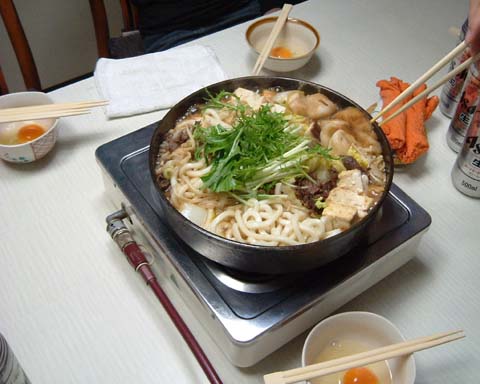
Nabemono are stews and soups containing many types of ingredients that are served while still boiling. Nabe is thus typically enjoyed on cold days or in the winter. In modern Japan, nabemono are kept hot at the dining table by portable stoves. The dish is frequently cooked at the table, and the diners can pick the cooked ingredients they want from the pot. It is either eaten with the broth or with a dip. Further ingredients can also be successively added to the pot.
There are two types of nabemono in Japan: lightly flavored stock (mostly with kombu) types such as yudōfu (湯豆腐) and mizutaki (水炊き), eaten with a dipping sauce (tare) to enjoy the taste of the ingredients themselves; and strongly flavored stock, typically with miso, soy sauce, dashi, and/or sweet soy types such as yosenabe (寄鍋), oden (おでん), and sukiyaki (すき焼き), eaten without further flavoring.
The pots are traditionally made of clay (土鍋, donabe) or thick cast iron (鉄鍋, tetsunabe). Clay pots can keep warm for a while after being taken off the fire, while cast iron pots evenly distribute heat and are preferable for sukiyaki. Pots are usually placed in the center of dining tables and are shared by multiple people. This is considered the most sociable way to eat with friends and family.
There are many regional nabemono in Japan, which contain regional specialty foods such as salmon in Hokkaido and oyster in Hiroshima. Examples include:
Nabemono are usually eaten with a sauce sometimes called tare, literally "dipping". Several kinds of sauce can be used with additional spices, called yakumi. Typical yakumi include grated garlic, butter, red pepper, a mixture of red pepper and other spices, roasted sesame, or momiji oroshi (a mixture of grated daikon radish and red pepper).[citation needed]
Hub AI
Nabemono AI simulator
(@Nabemono_simulator)
Nabemono
Nabemono (鍋物, なべ物, nabe "cooking pot" + mono "thing"), or simply nabe, is a variety of Japanese hot pot dishes, also known as one-pot dishes and sometimes translated as "things in a pot".
Nabemono are stews and soups containing many types of ingredients that are served while still boiling. Nabe is thus typically enjoyed on cold days or in the winter. In modern Japan, nabemono are kept hot at the dining table by portable stoves. The dish is frequently cooked at the table, and the diners can pick the cooked ingredients they want from the pot. It is either eaten with the broth or with a dip. Further ingredients can also be successively added to the pot.
There are two types of nabemono in Japan: lightly flavored stock (mostly with kombu) types such as yudōfu (湯豆腐) and mizutaki (水炊き), eaten with a dipping sauce (tare) to enjoy the taste of the ingredients themselves; and strongly flavored stock, typically with miso, soy sauce, dashi, and/or sweet soy types such as yosenabe (寄鍋), oden (おでん), and sukiyaki (すき焼き), eaten without further flavoring.
The pots are traditionally made of clay (土鍋, donabe) or thick cast iron (鉄鍋, tetsunabe). Clay pots can keep warm for a while after being taken off the fire, while cast iron pots evenly distribute heat and are preferable for sukiyaki. Pots are usually placed in the center of dining tables and are shared by multiple people. This is considered the most sociable way to eat with friends and family.
There are many regional nabemono in Japan, which contain regional specialty foods such as salmon in Hokkaido and oyster in Hiroshima. Examples include:
Nabemono are usually eaten with a sauce sometimes called tare, literally "dipping". Several kinds of sauce can be used with additional spices, called yakumi. Typical yakumi include grated garlic, butter, red pepper, a mixture of red pepper and other spices, roasted sesame, or momiji oroshi (a mixture of grated daikon radish and red pepper).[citation needed]
Recent media