Hubbry Logo
Fungus RockFungus RockMain
Open search
Fungus Rock
Community hub
Fungus Rock
logo
8 pages, 0 posts
0 subscribers
Be the first to start a discussion here.
Fungus Rock
Fungus Rock
from Wikipedia

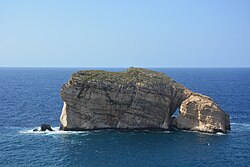
Fungus Rock, sometimes known as Mushroom Rock,[2] and among the Maltese as Il-Ġebla tal-Ġeneral (English: The General's Rock), is a small islet in the form of a 60-metre-high (200 ft) massive lump of limestone at the entrance to an almost circular black lagoon in Dwejra, on the coast of Gozo, itself an island in the Maltese archipelago. It is located at 36°02′45″N 14°11′27″E / 36.04583°N 14.19083°E / 36.04583; 14.19083 and falls within the jurisdiction of the town of San Lawrenz.

Key Information

The Dwejra nature reserve is administratively part of the town. The Fungus Rock is a prominent landmark of the reserve, as was formerly the Azure Window, before its collapse on March 8, 2017.[3]

History

[edit]

The Knights Hospitaller apparently discovered what is popularly known as the Maltese fungus growing on the rock's flat top. This plant, which is a kind of parasitic flowering plant, not a fungus, has a repulsive smell. Doctors at the time believed that it had medicinal properties. The Knights used it as a styptic dressing for wounds and a cure for dysentery. They so prized it that they often gave gifts of it to distinguished noblemen and visitors to the Maltese islands.

Grand Master Pinto decreed the Rock out of bounds in 1746; trespassers risked a three-year spell as oarsmen in the Knights' galleys. He posted a permanent guard there and even built a precarious cable-car basket from the rock to the mainland, 50 metres (160 ft) away. He also ordered the sides smoothed to remove handholds.[4][5]

Pinto's efforts were perhaps unnecessary. Pharmacologists are studying the medical effects of Fucus coccineus melitensis[6] today.[when?] [7]

Presently, Fungus Rock is a nature reserve. However, the shoreline nearby is accessible to bathers and the sea provides perfect snorkeling. Divers may experience big rocks, tiny caverns and swim-throughs along with varied species that swim around the vicinity of the rock.[8]

The sunset can be photographed through the opening in Fungus Rock, but only from the inlet anchorage, and only during seasons when the sun descends the right way.

Notes

[edit]
[edit]
Revisions and contributorsEdit on WikipediaRead on Wikipedia
from Grokipedia
Fungus Rock (Maltese: Il-Ġebla tal-Ġeneral), also known as the General's Rock, is a small, uninhabited approximately 60 metres high situated at the entrance to ix-Xini, an inlet on the northwestern coast of , . The islet gained its English name from Cynomorium coccineum, a rare, leafless parasitic that grows on its summit and was long mistaken for a due to its spongy, reddish-brown appearance emerging directly from the soil. Under the Knights Hospitaller, who ruled from 1530 to 1798, the rock was heavily guarded because the plant was believed to possess potent medicinal properties, including as a remedy for , , and hemorrhage; unauthorized removal was punishable by death or forced labor on the galleys. Geologically, it forms part of a collapsed system, contributing to 's landscape, while ecologically it supports a specialized with limited adapted to its arid, exposed conditions. Today, Fungus Rock is designated a , accessible only by permit for scientific purposes, preserving its amid ongoing threats from and .

Geography

Location and Physical Characteristics

Fungus Rock, locally known as Il-Ġebla tal-Ġeneral, is a small uninhabited positioned at the mouth of on the northwestern coast of , the second-largest island in the Maltese archipelago within the central . The formation guards the entrance to the bay's nearly circular , standing isolated from the mainland cliffs. Composed primarily of , the rises steeply to a height of approximately 60 above , featuring precipitous cliffs that render it largely inaccessible except by . Its summit is relatively flat, supporting limited , while the overall structure forms a massive, lump-like with a surface area of 0.007 square kilometers. The rock measures roughly 180 in length, contributing to its distinctive, imposing silhouette against the surrounding coastal landscape.

Geological Origins

Fungus Rock, located at the entrance to Dwejra Bay on the island of , , comprises Upper Coralline Limestone, a resistant, pale grey formation up to 170 meters thick across the . This rock unit was deposited during the epoch (approximately 23 to 5 million years ago) in shallow marine and intertidal settings on a subtropical platform associated with the African continental margin. Fossils within the limestone, including and , indicate accumulation in reef-related and lagoonal environments under warm, clear waters typical of the Oligo- Tethys Sea remnants. The broader geological framework of the Maltese islands, including , stems from sedimentary deposition on the Pelagian Block of the African plate, overlain by from the Pantelleria Rift System. Uplift during the elevated these sequences above sea level, preserving a stratigraphic pile exceeding 200 meters in places, with Upper Coralline capping harder, cliff-forming layers above erodible Blue Clay. No volcanic or igneous activity contributed to the formation; the islands represent a tectonic horst block amid regional rifting between and . The islet's isolated, 60-meter-high profile emerged through erosional processes acting on this . Differential preferentially removed underlying softer and Blue Clay via wave undercutting, rainwater dissolution, and mudslide activity, isolating resistant Upper Coralline remnants like Fungus Rock. Karstic features, including fissures and joints enlarged by acidic groundwater, combined with coastal abrasion during Pleistocene sea-level fluctuations, refined its steep cliffs and flat summit, typical of Maltese rdum () landscapes in the Dwejra area.

Biology and Ecology

Dominant Flora: Cynomorium coccineum

Cynomorium coccineum, commonly known as the Maltese fungus or General's root, is a holoparasitic flowering plant in the Cynomoriaceae family, despite its fungus-like appearance that led to the naming of Fungus Rock (Il-Ġebla tal-Ġeneral). This leafless, perennial herb emerges as a fleshy, reddish, club-shaped inflorescence up to 30 cm tall, lacking chlorophyll and relying entirely on host plants for nutrients. On Fungus Rock, it represents the sole dominant vascular plant species, historically believed to be unique to the islet until populations were documented elsewhere in Malta. Ecologically, C. coccineum parasitizes the roots of coastal halophytes, such as Atriplex lanfrancoi or other salt-tolerant species, thriving in the rock's saline, rupestral habitats with limited soil. It spends most of its life cycle as an underground rhizome, surfacing briefly from April to June for reproduction via small, apetalous flowers clustered in a spadix-like structure that emits a foul odor to attract pollinators. This parasitism limits competition, allowing it to dominate the sparse vegetation on the 60-meter-high limestone stack, where exposure to sea spray and erosion constrain other flora. Its rarity in the Maltese archipelago underscores its ecological significance as an indicator of specialized microhabitats. As the namesake flora, C. coccineum drove historical conservation efforts on Fungus Rock, with the Knights Hospitaller enforcing strict access controls from the to prevent overharvesting for purported medicinal uses, though modern analysis reveals limited pharmacological efficacy beyond properties. Today, its persistence contributes to the islet's status as a protected , highlighting the interplay between biological uniqueness and human intervention in maintaining .

Associated Fauna

The primary terrestrial fauna associated with Fungus Rock is the endemic subspecies Podarcis filfolensis generalensis, a wall lizard restricted exclusively to this islet off the coast of Gozo, Malta. This subspecies, named after the Maltese term for the rock (il-Ġebla tal-Ġeneral), exhibits distinct morphological traits including a reddish ventral coloration and bluish lateral flanks, differentiating it from other races of the Maltese wall lizard (Podarcis filfolensis). Measuring approximately 7–9 cm in body length, it inhabits the rock's steep, rocky cliffs and garigue vegetation, preying primarily on small arthropods such as insects and occasionally consuming plant matter or fruits. Limited surveys indicate sparse presence, with the lizard's diet suggesting abundance of small and arthropods adapted to the islet's oligotrophic, windswept environment, though specific inventories remain undocumented due to restricted access. Avifauna is transient, with seabirds such as shearwaters or utilizing the rock for nesting or perching, but no breeding colonies are confirmed endemic or unique to the site. The isolation and protection of Fungus Rock preserve this from mainland predators and competitors, contributing to its role as a microhabitat for relict populations amid broader Maltese decline.

Biodiversity and Habitat Role

Fungus Rock, with a surface area of approximately 0.007 square kilometers, exhibits low overall typical of small, isolated islets, yet holds significant conservation value due to its hosting of endemic taxa and distinct rupicolous communities. The islet's cliffs and limited support specialized flora beyond the dominant Cynomorium coccineum, including sparse occurrences of coastal halophytes and rupestral adapted to arid, exposed conditions, as documented in checklists of Maltese satellite islets. Faunal biodiversity is similarly constrained but includes the unique subspecies Podarcis filfolensis generalensis of the Maltese wall lizard, endemic exclusively to Fungus Rock and representing a distinct evolutionary lineage adapted to the islet's rocky terrain. Seabirds utilize the cliffs for nesting, contributing to regional avian populations, while invertebrate communities, including endemic insects, thrive in microhabitats formed by rock fissures and sparse vegetation. However, the documented presence of invasive black rats (Rattus rattus) since at least the late threatens native species through predation and competition, underscoring vulnerabilities in this isolated ecosystem. Ecologically, Fungus Rock functions as a critical refugium for cliff-adapted , buffering against mainland disturbances and supporting within Malta's fragmented biota. Its protection as a under Maltese law (SL 549.01) enhances connectivity in coastal-marine interfaces, where terrestrial influences adjacent subtidal zones via nutrient cycling and detrital input, though empirical data on these dynamics remain limited. The islet's role exemplifies how small offshore landforms preserve relict populations amid broader Mediterranean driven by and climate pressures.

History

Pre-Knights Period

Fungus Rock, a 60-meter-high stack measuring approximately 300 square meters at its summit, emerged through natural processes that isolated it from the mainland in Dwejra Bay over prehistoric timescales. Its geological formation is part of the Maltese islands' landscape, composed of Lower Limestone dating to the Oligocene-Miocene epochs around 25 million years ago. Human presence in dates to the period, with initial settlement by Sicilian farmers around 5000 BC, evidenced by megalithic structures and agricultural remains across the island. The adjacent Dwejra region preserves archaeological traces of activity extending back at least 7000 years, including potential prehistoric coastal use for fishing or navigation. However, the islet's steep cliffs and separation by approximately 200 meters of sea likely precluded regular access or settlement, with no documented artifacts or structures indicating human utilization of Fungus Rock itself during Phoenician (c. 800 BC onward), Roman, Byzantine, (870–1091 AD), or medieval Norman-Aragonese periods. The parasitic angiosperm Cynomorium coccineum, a leafless, red-stalked plant mistaken for a in later accounts, has inhabited the Maltese islands since before arrival, growing on the rock's plateau among arid scrub. While traditional Mediterranean herbal knowledge included Cynomorium species for purported remedies against and wounds, no records confirm harvesting from this specific site or recognition of its presence on Fungus Rock prior to the . Gozo's overlords from the Arab era through the Kingdom of treated the islands as a peripheral outpost, with scant attention to isolated coastal features like the rock.

Knights Hospitaller Protection (1530–1798)

The Knights Hospitaller, who governed Malta from 1530 to 1798 following their grant of the islands by Emperor Charles V, placed Fungus Rock under stringent protection due to the presence of Cynomorium coccineum, a parasitic plant endemic to the islet and prized for its perceived medicinal virtues. Hospitaller physicians utilized the plant, misidentified as a fungus, to treat dysentery, ulcers, hemorrhages, wounds, apoplexy, and venereal diseases, employing it as a styptic agent and general remedy. The Knights harvested it exclusively from the rock, often distributing specimens as prestigious gifts to European dignitaries, which elevated its status as a valuable commodity within their pharmacopeia. To safeguard the plant's supply, access to Fungus Rock—known locally as Il-Ġebla tal-Ġeneral—was rigorously controlled throughout ' tenure, with prohibitions intensifying in the . Grand Master Manuel Pinto da Fonseca decreed the islet out of bounds in 1746, imposing severe penalties on trespassers, including three years' forced labor as oarsmen on the order's galleys or, in cases of attempted theft, potential execution. A permanent guardsman was stationed to enforce these rules, while the rock's sheer faces were deliberately smoothed to deter unauthorized climbers. Authorized collection was limited to high-ranking and , facilitated by a 50-meter cable car extending from the nearby cliffs of Qala tad-Dwejra. These protective measures reflected the Knights' strategic emphasis on resource preservation amid their military and medical needs, particularly after the Great Siege of heightened demands for effective treatments. The rock's isolation and the plant's rarity underscored the order's monopolistic control, preventing depletion despite growing European interest in Maltese remedies. This regime persisted until the French invasion in disrupted Hospitaller authority, marking the end of their custodianship over the . Following the end of Knights Hospitaller rule in 1798, during successive French occupation and British colonial administration until Malta's independence in 1964, the stringent protections over Fungus Rock diminished, though the site's ecological value remained recognized informally. Harvesting of Cynomorium coccineum ceased due to the plant's scarcity beyond the islet, but without enforced legal barriers, occasional unauthorized access occurred. In the post-independence era, formalized conservation efforts amid growing environmental awareness. Fungus Rock, known locally as Il-Ġebla tal-Ġeneral, was designated a under Legal Notice 22 of 1992, enacted pursuant to the Environment Protection Act (Act No. V of 1991), prohibiting landing, collection of specimens, or disturbance without permit. This status integrates it into the broader Dwejra , established in 1992 to safeguard coastal habitats and endemic species, including the rare Cynomorium coccineum and the subspecies Podarcis filfolensis generalensis of the Maltese wall lizard, confined to the islet's approximately 7,000 square meters. Legal protections emphasize preservation over historical medicinal claims, with access restricted to authorized scientific or management purposes to mitigate risks like or introduction. Malta's accession to the in 2004 reinforced these measures through compliance with the , ensuring ongoing monitoring and habitat restoration initiatives. Violations, such as unauthorized boating or collection, incur penalties under national environmental legislation, underscoring the site's role as a benchmark for isolated conservation.

Conservation and Threats

Current Status and Management

Fungus Rock, known locally as il-Ġebla tal-Ġeneral, is designated as a under the Fungus Rock (il-Ġebla tal-Ġeneral) Regulations (S.L. 549.01), which prohibit landing, collection of or , and any disturbance to the site. This classification aligns with IUCN Category Ia, emphasizing minimal human intervention to preserve its ecological integrity. As government-owned land, it forms part of the broader L-Inħawi tad-Dwejra u tal-Qawra (SAC) and (SPA) within the EU network, ensuring compliance with habitat directives for endemic species like Cynomorium coccineum and Cremnophyton lanfrancoi. Management is overseen by Malta's Environment and Resources Authority (ERA), in coordination with a consultative group including the Department of Agriculture, local councils, and NGOs such as Nature Trust. A site-specific management plan for the Dwejra area (2019–2023) mandates annual monitoring of through field surveys, patrolling to deter and illegal access, and habitat restoration efforts, including invasive species removal (e.g., ). Access remains strictly forbidden, with enforcement via signage, seasonal restrictions near breeding sites for seabirds like , and prohibitions on activities such as or fishing that could impact cliffs or subsidence structures. The site's status remains stable, with high conservation value due to its role in supporting distinct communities and endemics, though vulnerabilities persist from potential spillover and invasive pressures. Ongoing efforts prioritize and legal protections under national strategies, contributing to measured improvements in coverage across Malta's islets.

Identified Risks and Mitigation

The primary environmental risks to Fungus Rock (Il-Ġebla tal-Ġeneral) stem from its exposed coastal position and limited size, exacerbating vulnerabilities to geological instability and external pressures. , driven by wave action, faulting, and intensified storm events linked to , poses a significant threat to the islet's structure, potentially leading to habitat loss for specialized rupestral species. Invasive alien species, such as , threaten native flora including the endemic Cremnophyton lanfrancoi and the parasitic Cynomorium coccineum, by outcompeting hosts and altering soil conditions. Pollution from nearby boating activities, including fuel spills and diesel emissions, alongside marine litter and , impacts nesting seabirds like yelkouan and Calonectris diomedea. Human-induced disturbances, such as unregulated (e.g., , , and fishing), and illegal activities like poaching and trapping further degrade , with the islet attracting around 750,000 visitors annually to the broader Dwejra area. For C. coccineum, historical over-collection for medicinal uses has left small, vulnerable populations, classified as threatened in Malta's Red Data Book, though not globally IUCN-listed. Mitigation efforts rely on stringent legal frameworks and active management within the L-Inħawi tad-Dwejra u tal-Qawra Natura 2000 site. Access to the islet is prohibited under national laws (e.g., LN 22/92 designating it a Nature Reserve, LN 79/06 as a Bird Sanctuary), with enforcement through patrolling by authorities to prevent landing, collection, or disturbance. Visitor management includes signage restricting activities during bird breeding seasons, boating regulations (e.g., electric engines in adjacent waters), and public awareness campaigns to minimize tourism impacts. Habitat restoration involves invasive species removal and monitoring programs for key taxa, such as annual inspections of C. lanfrancoi and assessments of C. coccineum populations, supplemented by proposals for geopark status to safeguard geological features. Broader strategies address climate-related erosion through site-wide erosion control and integration with Malta's national adaptation plans, though challenges persist due to the islet's isolation and dependence on regional marine health. These measures build on historical precedents from the Knights Hospitaller era, where guards enforced protection, evolving into modern EU-aligned conservation.

Cultural and Scientific Importance

Historical Perceptions and Traditional Uses

Cynomorium coccineum, the holoparasitic plant endemic to the Mediterranean that grows atop and lent the islet its name due to its fungus-like appearance, was historically perceived as a rare and potent medicinal agent by Hospitaller and Maltese locals. During rule from 1530 to 1798, the plant—misidentified as a true fungus known as Peziza melitensis—was valued for its supposed styptic properties in treating war wounds and as a cure for , prompting Grand Master Manuel Pinto da Fonseca to declare the rock a in 1764 with penalties including three years of galley slavery for trespassers. This protection stemmed from post-Siege of Malta (1565) demand, when the plant emerged as a key pharmaceutical export, though its perceived efficacy declined by the late amid growing scientific scrutiny. In traditional Maltese , C. coccineum was utilized as an to control traumatic and surgical , as well as for managing venereal diseases, reflecting its role in empirical folk remedies derived from observed hemostatic effects. Local healers also applied it for dental hygiene and as a treatment for and , attributing panacea-like qualities that echoed broader Mediterranean ethnopharmacological traditions dating to the . These uses persisted in peasant practices into the early , despite diminishing commercial value, underscoring a reliance on anecdotal over verified .

Contemporary Research and Accessibility

Recent pharmacological studies on Cynomorium coccineum, the historically associated with Fungus Rock, have investigated its bioactive compounds for potential therapeutic applications. A analysis of Maltese specimens demonstrated significant activity and value, including high levels of phenolics and that inhibit in cellular models. Subsequent 2020 research highlighted extracts' fertility-enhancing properties, such as improved and hormone regulation in animal trials, positioning the plant as a candidate for addressing human through its phytoandrogen-like effects. These findings build on earlier profiling but emphasize modern extraction techniques for scalable bioactive isolation, though field-specific ecological studies on the rock's populations remain limited due to access constraints. Ecological monitoring within the Dwejra , which encompasses Fungus Rock as a site, focuses on habitat integrity and species persistence amid climate pressures. Management plans prioritize non-invasive surveys to track C. coccineum rarity—Europe's sole representative—and associated endemics like Podarcis filfolensis generalensis, with data integrated into EU reporting since 2018. Fungus Rock functions as a , prohibiting public landing or climbing to safeguard its undisturbed biota, a status enforced since ' era and formalized under Maltese . Access for research requires permits from the Environment and Resources Authority, typically granted for scientific purposes only, while tourists observe the 60-meter islet from Dwejra Bay viewpoints or guided boat tours without disembarkation. This controlled approach minimizes erosion and risks, ensuring the site's isolation preserves its value for ongoing conservation and baseline studies.

References

Add your contribution
Related Hubs
User Avatar
No comments yet.