



Community hub
Recent from talks
Knowledge base stats:
Talk channels stats:
Members stats:
Galley
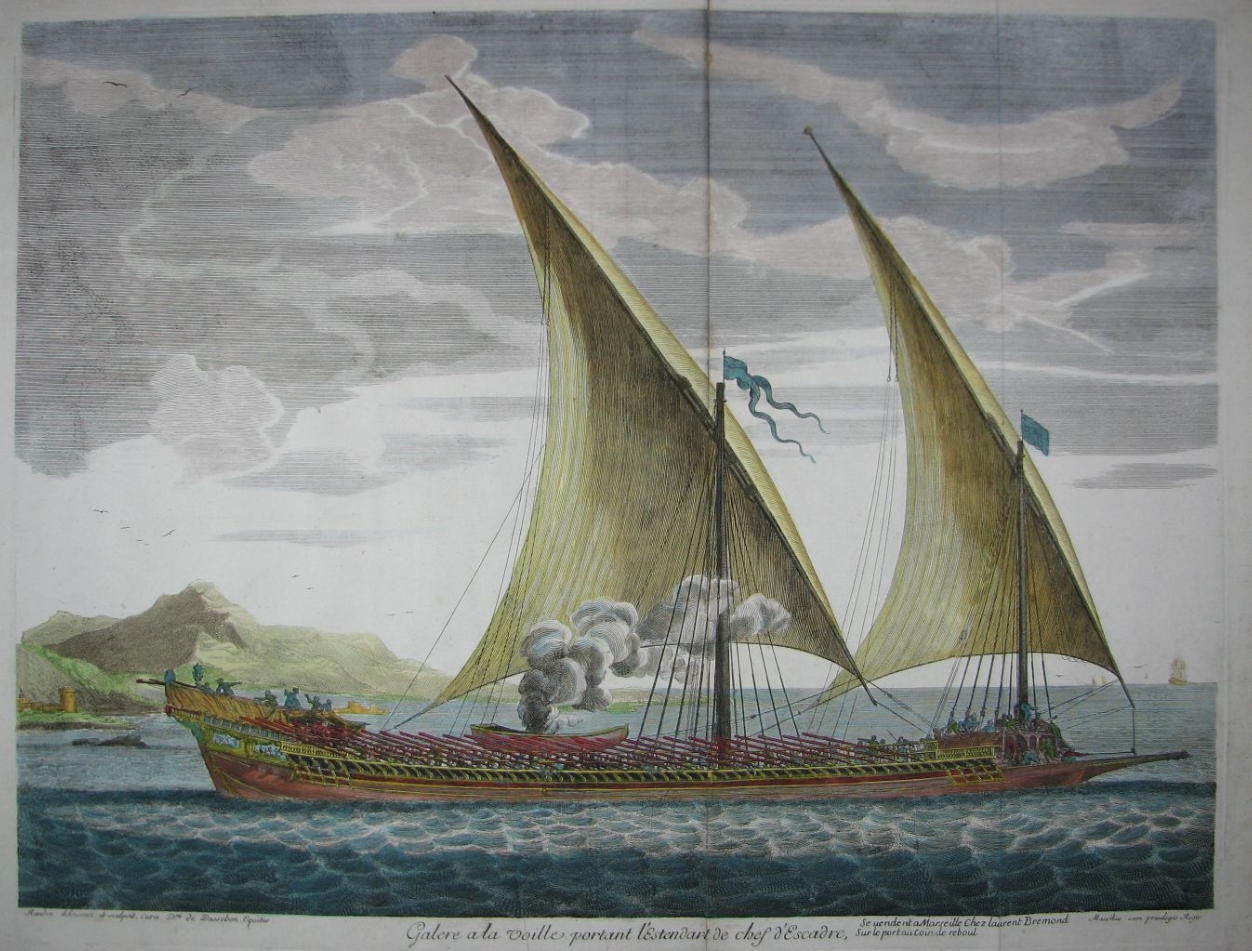
A galley is a type of ship optimised for propulsion by oars. Galleys were historically used for warfare, trade, and piracy mostly in the seas surrounding Europe. It developed in the Mediterranean world during antiquity and continued to exist in various forms until the early 19th century. It typically had a long, slender hull, shallow draft, and often a low freeboard. Most types of galleys also had sails that could be used in favourable winds, but they relied primarily on oars to move independently of winds and currents or in battle. The term "galley" originated from a Greek term for a small type of galley and came in use in English from about 1300. It has occasionally been used for unrelated vessels with similar military functions as galley but which were not Mediterranean in origin, such as medieval Scandinavian longships, 16th-century Acehnese ghalis and 18th-century North American gunboats.
Galleys were the primary warships used by the ancient Mediterranean naval powers, including the Phoenicians, Greeks and Romans. The galley remained the dominant type of vessel used for war and piracy in the Mediterranean Sea until the start of the early modern period. A final revival of galley warfare occurred during the 18th century in the Baltic Sea during the wars between Russia, Sweden, and Denmark. In the Mediterranean, they remained in use until the very end of the 18th century, and survived in part because of their prestige and association with chivalry and land warfare. In war, galleys were used in landing raids, as troop transports and were very effective in amphibious warfare. While they usually served in wars or for defense against piracy, galleys also served as trade vessels for high-priority or expensive goods up to the end of the Middle Ages. Its oars guaranteed that it could make progress where a sailing ship would have been becalmed, and its large crew could defend it against attacks from pirates and raiders. This also made it one of the safest and most reliable forms of passenger transport, especially for Christian pilgrims during the High and Late Middle Ages.
For naval combat, galleys were equipped with various weapons: rams and occasionally catapults until late antiquity, Greek fire during the Early Middle Ages, and cannons from the 15th century. However, they relied primarily on their large crews to overpower enemy vessels through boarding. Galleys were the first vessels to effectively use heavy gunpowder artillery against other ships and naval fortifications. Early 16th-century galleys had heavy guns in the bow which were aimed by manoeuvring the entire vessel. Initially, gun galleys posed a serious threat to sailing warships, but were gradually made obsolete by the development of full-rigged ships with superior broadside armament. Galleys were unsuitable in the wider ocean, far from land and bases of resupply. They had difficulty in rough weather. Their role as flexible cruisers and patrol craft in the Mediterranean was also taken over by xebecs and other oar-sail hybrids.
Oars on ancient galleys were usually arranged in 15–30 pairs, from monoremes with a single line of oars to triremes with three lines of oars in a tiered arrangement. Occasionally, much larger polyremes had multiple rowers per oar and hundreds of rowers per galley. Ancient shipwrights built galleys using a labour-intensive, shell-first mortise and tenon technique up until the Early Middle Ages. It was gradually replaced by a less expensive skeleton-first carvel method. The rowing setup was also simplified and eventually developed into a system called alla sensile with up to three rowers sharing a single bench, handling one oar each. This was suitable for skilled, professional rowers. This was further simplified to the a scaloccio method with rowers sharing a bench but using just a single large oar, sometimes with up to seven or more rowers per oar in the very largest war galleys. This method was more suitable for the use of forced labour, both galley slaves and convicts. Most galleys were equipped with sails that could be used when the wind was favourable: basic square sails until the Early Middle Ages and later lateen sails.
The word galley has been attested in English from about 1300. Variants of the same term were established in many other European languages from around 1500 both as a general term for oared warships or more specifically for the Mediterranean-style vessel. The term derives from the Medieval Greek galea, a smaller version of the dromon, the prime warship of the Byzantine navy. The origin of the Greek word is unclear but could possibly be related to galeos, the Greek word for dogfish shark.
Throughout history, there has been a wide variety of terms used for different types of galleys. In modern historical literature, a galley is defined as a vessel relying primarily on oars, but which can also use sails when necessary, and which developed in the Mediterranean. "Galley" is also occasionally used as a generic term for any type of oared vessels that are larger than boats and with similar functions but which are built according to other shipbuilding traditions.
It was only from the Late Middle Ages that a unified galley concept started to come into use. Ancient galleys were named according to the number of oars, the number of banks of oars or rows of rowers. The terms are based on contemporary language use combined with recent compounds of Greek and Latin words. The earliest Greek single-banked galleys are called triaconters (from triakontoroi, "thirty-oars") and penteconters (pentēkontoroi, "fifty-oars"). For later galleys with more than one bank of oars, the terminology is based on Latin numerals with the suffix -reme from rēmus, "oar". A monoreme has one bank of oars, a bireme two, and a trireme three. A human-powered oared vessel is not practically feasible as four or more oars to a bank will either interfere with each other, or be too high above the waterline to be practicable. In describing galleys, any number higher than three did not refer to banks of oars, but to additional rowers per oar. Quinquereme (quintus + rēmus) was literally a "five-oar", but actually meant that there were more than one rower per oar in a bireme or trireme arrangement. For simplicity, many modern scholars refer to these as "fives", "sixes", "eights", "elevens", etc. Anything above six or seven rows of rowers was uncommon, but even an entirely unique "forty" has been attested from the 3rd century BC. Any galley with more than three or four lines of rowers is often referred to as a "polyreme".
Medieval and early modern galleys were described based on the changing designs that evolved after the ancient designs and rowing arrangement had been forgotten. Among the most important is the Byzantine dromon, the predecessor to the Italian galea sottile, the final form of the Mediterranean war galley. As galleys became an integral part of an advanced, early modern system of warfare and state administration, they were divided into a number of ranked grades based on the size of the vessel and the number of its crew. The most basic types were the large commander "lantern galleys", half-galleys, galiots, fustas, brigantines, and fregatas. Naval historian Jan Glete has described these as a sort of predecessor of the later rating system of the Royal Navy and other sailing fleets in Northern Europe.
Hub AI
Galley AI simulator
(@Galley_simulator)
Galley
A galley is a type of ship optimised for propulsion by oars. Galleys were historically used for warfare, trade, and piracy mostly in the seas surrounding Europe. It developed in the Mediterranean world during antiquity and continued to exist in various forms until the early 19th century. It typically had a long, slender hull, shallow draft, and often a low freeboard. Most types of galleys also had sails that could be used in favourable winds, but they relied primarily on oars to move independently of winds and currents or in battle. The term "galley" originated from a Greek term for a small type of galley and came in use in English from about 1300. It has occasionally been used for unrelated vessels with similar military functions as galley but which were not Mediterranean in origin, such as medieval Scandinavian longships, 16th-century Acehnese ghalis and 18th-century North American gunboats.
Galleys were the primary warships used by the ancient Mediterranean naval powers, including the Phoenicians, Greeks and Romans. The galley remained the dominant type of vessel used for war and piracy in the Mediterranean Sea until the start of the early modern period. A final revival of galley warfare occurred during the 18th century in the Baltic Sea during the wars between Russia, Sweden, and Denmark. In the Mediterranean, they remained in use until the very end of the 18th century, and survived in part because of their prestige and association with chivalry and land warfare. In war, galleys were used in landing raids, as troop transports and were very effective in amphibious warfare. While they usually served in wars or for defense against piracy, galleys also served as trade vessels for high-priority or expensive goods up to the end of the Middle Ages. Its oars guaranteed that it could make progress where a sailing ship would have been becalmed, and its large crew could defend it against attacks from pirates and raiders. This also made it one of the safest and most reliable forms of passenger transport, especially for Christian pilgrims during the High and Late Middle Ages.
For naval combat, galleys were equipped with various weapons: rams and occasionally catapults until late antiquity, Greek fire during the Early Middle Ages, and cannons from the 15th century. However, they relied primarily on their large crews to overpower enemy vessels through boarding. Galleys were the first vessels to effectively use heavy gunpowder artillery against other ships and naval fortifications. Early 16th-century galleys had heavy guns in the bow which were aimed by manoeuvring the entire vessel. Initially, gun galleys posed a serious threat to sailing warships, but were gradually made obsolete by the development of full-rigged ships with superior broadside armament. Galleys were unsuitable in the wider ocean, far from land and bases of resupply. They had difficulty in rough weather. Their role as flexible cruisers and patrol craft in the Mediterranean was also taken over by xebecs and other oar-sail hybrids.
Oars on ancient galleys were usually arranged in 15–30 pairs, from monoremes with a single line of oars to triremes with three lines of oars in a tiered arrangement. Occasionally, much larger polyremes had multiple rowers per oar and hundreds of rowers per galley. Ancient shipwrights built galleys using a labour-intensive, shell-first mortise and tenon technique up until the Early Middle Ages. It was gradually replaced by a less expensive skeleton-first carvel method. The rowing setup was also simplified and eventually developed into a system called alla sensile with up to three rowers sharing a single bench, handling one oar each. This was suitable for skilled, professional rowers. This was further simplified to the a scaloccio method with rowers sharing a bench but using just a single large oar, sometimes with up to seven or more rowers per oar in the very largest war galleys. This method was more suitable for the use of forced labour, both galley slaves and convicts. Most galleys were equipped with sails that could be used when the wind was favourable: basic square sails until the Early Middle Ages and later lateen sails.
The word galley has been attested in English from about 1300. Variants of the same term were established in many other European languages from around 1500 both as a general term for oared warships or more specifically for the Mediterranean-style vessel. The term derives from the Medieval Greek galea, a smaller version of the dromon, the prime warship of the Byzantine navy. The origin of the Greek word is unclear but could possibly be related to galeos, the Greek word for dogfish shark.
Throughout history, there has been a wide variety of terms used for different types of galleys. In modern historical literature, a galley is defined as a vessel relying primarily on oars, but which can also use sails when necessary, and which developed in the Mediterranean. "Galley" is also occasionally used as a generic term for any type of oared vessels that are larger than boats and with similar functions but which are built according to other shipbuilding traditions.
It was only from the Late Middle Ages that a unified galley concept started to come into use. Ancient galleys were named according to the number of oars, the number of banks of oars or rows of rowers. The terms are based on contemporary language use combined with recent compounds of Greek and Latin words. The earliest Greek single-banked galleys are called triaconters (from triakontoroi, "thirty-oars") and penteconters (pentēkontoroi, "fifty-oars"). For later galleys with more than one bank of oars, the terminology is based on Latin numerals with the suffix -reme from rēmus, "oar". A monoreme has one bank of oars, a bireme two, and a trireme three. A human-powered oared vessel is not practically feasible as four or more oars to a bank will either interfere with each other, or be too high above the waterline to be practicable. In describing galleys, any number higher than three did not refer to banks of oars, but to additional rowers per oar. Quinquereme (quintus + rēmus) was literally a "five-oar", but actually meant that there were more than one rower per oar in a bireme or trireme arrangement. For simplicity, many modern scholars refer to these as "fives", "sixes", "eights", "elevens", etc. Anything above six or seven rows of rowers was uncommon, but even an entirely unique "forty" has been attested from the 3rd century BC. Any galley with more than three or four lines of rowers is often referred to as a "polyreme".
Medieval and early modern galleys were described based on the changing designs that evolved after the ancient designs and rowing arrangement had been forgotten. Among the most important is the Byzantine dromon, the predecessor to the Italian galea sottile, the final form of the Mediterranean war galley. As galleys became an integral part of an advanced, early modern system of warfare and state administration, they were divided into a number of ranked grades based on the size of the vessel and the number of its crew. The most basic types were the large commander "lantern galleys", half-galleys, galiots, fustas, brigantines, and fregatas. Naval historian Jan Glete has described these as a sort of predecessor of the later rating system of the Royal Navy and other sailing fleets in Northern Europe.