Recent from talks
Nothing was collected or created yet.
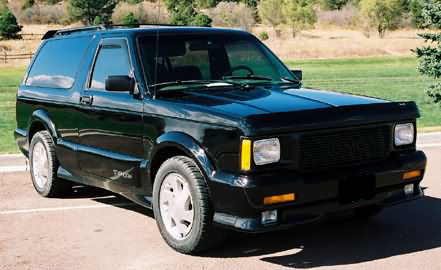
GMC Typhoon
View on Wikipedia| GMC Typhoon | |
|---|---|
| Overview | |
| Manufacturer | GMC (General Motors) |
| Production | 1992–1993 4697 produced |
| Body and chassis | |
| Class | Mid-size SUV |
| Body style | 2-door SUV |
| Layout | Front-engine, four-wheel-drive |
| Related | GMC Syclone GMC Jimmy/Chevrolet Blazer GMC Sonoma/Chevrolet S-10 Oldsmobile Bravada |
| Powertrain | |
| Engine | 4.3 L GM LB4 Turbocharged V-6 |
| Transmission | 4-speed 4L60 automatic |
| Dimensions | |
| Wheelbase | 100.5 in (2553 mm) |
| Length | 170.3 in (4326 mm) |
| Width | 68.2 in (1732 mm) |
| Height | 60.0 in (1524 mm) |
| Curb weight | 3822 lb (1734 kg) |
The GMC Typhoon is a high-performance SUV, produced from 1992 until 1993 by GMC. The Typhoon was based on the 1991 GMC Syclone.[1]
Description
[edit]Like the GMC Syclone, the Typhoon is powered by a 4.3 L LB4 V6 engine with unique pistons, main caps, head gaskets, intake manifolds, fuel system and exhaust manifolds, producing 280 hp (209 kW) and 360 lb⋅ft (475 N⋅m) of torque. The engine is a modified version of the Vortec engine found in the standard Jimmy, which originally produced 190 hp (142 kW).[2] The engine uses a Mitsubishi TD06-17C/8 cm2 turbocharger producing 14 psi (0.97 bar) of boost and a Garrett Water/Air intercooler, as well as revised intake manifolds, fuel system, exhaust manifolds, and a 48 mm (2 in) twin-bore throttle body from the 5.7 L GM Small-Block engine.[3] The Typhoon sends power to all four wheels through a 4L60 4-speed automatic transmission and a BorgWarner 4472 transfer case splitting torque with 35% forward and 65% to the rear wheels. Other features include upgraded brakes, a limited-slip rear differential and sport modifications to the standard suspensions. Unlike the Syclone, the Typhoon featured an air-operated self-leveling rear suspension.[4]
During tests by Car and Driver, the Typhoon was capable of accelerating from 0–60 mph (0–97 km/h) in 5.3 seconds[1] and could do a quarter-mile run in 14.1 seconds at 95 mph (153 km/h). Car and Driver compared the Syclone's performance favorably to the Ferrari 348ts, Chevrolet Corvette, and Nissan 300ZX Turbo.[1] It cost US$29,970, though the magazine criticized the plastic interior pieces.
Production and colors
[edit]All three model years were built for GMC by Production Automotive Services of Troy, Michigan. Aside from a handful of prototypes, only 4,697 Typhoons were built by GMC: 2,497 for 1992, and 2,200 for 1993. Unlike regular production Syclones, Typhoons were offered in various exterior color configurations (body color/lower-body cladding color) that differed by year, with black/black being the most common.

1991
- Typhoon Pre-Production (6 total)
1992
- Midnight Black with Black (1,262 total[a])
- Midnight Black with Gray (130 total)
- Frost White with Gray (518 total[b])
- Apple Red with Gray (345 total)
- Bright Teal with Gray (132 total)
- Forest Green Metallic with Gray (82 total)
- Aspen Blue with Gray (28 total)
- Raspberry Metallic with Raspberry Metallic (3 total[c])
- Radar Blue with Radar Blue (1 total[c])
1993
- Midnight Black with Black (1,008 total)
- Midnight Black with Gray (98 total)
- Frost White with White (532 total[d])
- Frost White with Gray (115 total)
- Apple Red with Apple Red (77 total)
- Apple Red with Gray (101 total)
- Forest Green Metallic with Gray (210 total)
- Garnet Red with Gray (24 total)
- Royal Blue Metallic with Gray (35 total)
- Radar Blue with Radar Blue (1 total[c])
Notes
[edit]- ^ Total includes 1 Raspberry Metallic w/ Raspberry Metallic factory test color truck.
- ^ Total includes 2 Raspberry Metallic w/ Raspberry Metallic and 1 Radar Blue w/ Radar Blue factory test color truck.
- ^ a b c These factory test colors are included in the totals of the original color combinations.
- ^ Total includes 1 Radar Blue w/ Radar Blue factory test color truck.
References
[edit]- ^ a b c St. Antoine, Arthur (March 1992). "Road Test: GMC Typhoon" (PDF). Car and Driver. 37 (9): 63–67. Retrieved July 6, 2017.
- ^ "Muscle Cars You Should Know: GMC Typhoon / Syclone". Street Muscle. 2016-09-19. Retrieved 2018-07-25.
- ^ "1992 GMC Typhoon: First Drive Flashback". Road & Track. 2015-07-30. Retrieved 2018-07-25.
- ^ Huizenga, Paul (27 February 2018). "Storm on the Horizon: Tracing Today's Super SUV Origins". Driving Line. Nitto Tire. Retrieved 19 December 2019.
External links
[edit]GMC Typhoon
View on GrokipediaDevelopment
Origins and Conception
The GMC Typhoon was a high-performance sport utility vehicle produced by GMC for the 1992 and 1993 model years, built on the mid-size S-15 Jimmy platform as an extension of General Motors' experimental efforts in performance trucks and SUVs.[1] It emerged from GM's broader initiative in the late 1980s to blend truck utility with sports car dynamics, drawing inspiration from the turbocharged V6 powertrains of earlier performance models like the Buick Grand National.[4] This project aimed to challenge conventional notions of vehicle categories by creating an SUV capable of rivaling established sports cars in acceleration and handling.[5] The Typhoon's direct predecessor was the 1991 GMC Syclone, a high-performance pickup based on the Sonoma platform that debuted as a limited-production halo vehicle to boost GMC's image in the truck market.[6] The Syclone's success, with 2,998 units produced and magazine tests showing it outperforming contemporary sports cars in 0-60 mph sprints, demonstrated strong consumer interest and prompted GM to develop an SUV counterpart to broaden the performance lineup.[7][8] Conceived under GMC's truck engineering team led by project manager Kim Nielsen, the Typhoon built on the Syclone's formula to target enthusiasts seeking SUV versatility with supercar-like speed, aiming to outperform contemporary sports cars in straight-line acceleration.[4][9] Development of the Typhoon followed the Syclone's 1989 concept reveal at the Chicago Auto Show, where GM secured internal approval to transition the platform from pickup to SUV after positive reception.[10] The project was greenlit around 1990 as part of GM's strategy to capitalize on the sport truck trend, with final engineering handled in collaboration with Production Automotive Services.[6] Production began in early 1992 at GM's Shreveport Assembly plant in Louisiana, where base Jimmy vehicles were modified and completed by PAS in Troy, Michigan, marking the Typhoon's entry as the world's quickest production SUV at launch.[11][12]Engineering Innovations
The GMC Typhoon featured a full-time all-wheel-drive system with a center differential incorporating viscous coupling, which automatically adjusted torque distribution—typically biased 35 percent front and 65 percent rear—to optimize traction under varying conditions, an adaptation of the setup from the related GMC Syclone pickup but recalibrated to account for the SUV's higher center of gravity and altered weight distribution.[2] This viscous coupling allowed seamless power transfer to wheels with the most grip, enhancing stability during acceleration on slippery surfaces without the need for driver intervention. To accommodate the increased power output while preserving a compliant ride, the Typhoon's suspension underwent significant upgrades over the standard GMC Jimmy, including lowered ride height with revised coil springs and monotube shocks for improved handling and reduced body roll, paired with a front independent control arm setup and a rear live axle.[13] These modifications were complemented by 16-inch cast-aluminum alloy wheels fitted with P245/50VR16 Firestone Firehawk SVX performance tires, providing enhanced cornering grip up to 0.79 g without sacrificing everyday comfort.[2][14] Aerodynamic refinements played a key role in the Typhoon's efficiency and high-speed stability, with additions such as a prominent front air dam, integrated side skirts, and a rear spoiler designed to smooth airflow and minimize lift, distinguishing it from the boxier standard Jimmy.[2] These elements contributed to better straight-line performance by reducing turbulence around the wheel arches and underbody. The braking system was bolstered for the Typhoon's rapid acceleration capabilities, incorporating larger 11.9-inch vented front disc rotors—up from the approximately 10.5-inch discs on the base Jimmy—along with 11.2-inch rear drums and standard anti-lock braking system (ABS) to ensure controlled stops, such as 185 feet from 70 mph.[2][15] Engine management in the Typhoon relied on General Motors' Powertrain Control Module (PCM), which precisely regulated the turbocharged 4.3-liter Vortec V6's boost pressure—up to 15 psi—for optimal power delivery and fuel efficiency.[2][16] This electronic oversight integrated sensor inputs to adjust ignition timing, fuel injection, and wastegate operation, ensuring reliable performance across the rev range.Design and Specifications
Body and Chassis
The GMC Typhoon was configured as a 2-door, 4-passenger SUV based on the GMC S-15 Jimmy platform, providing compact dimensions suited for agile on-road performance. It featured a wheelbase of 100.5 inches, an overall length of 170.3 inches, a width of 68.2 inches, and a curb weight of 3,822 pounds.[2][17] To enhance handling and stability, the Typhoon's body underwent significant modifications from the standard S-15 Jimmy, including a lowered ride height of nearly 3 inches achieved through stiffer springs, recalibrated shocks, and a self-leveling rear air suspension. The chassis incorporated a perimeter frame with stiffened components to accommodate the vehicle's high-torque demands, while wider fender flares were added to fit the larger P245/50VR16 performance tires. These adaptations shifted the Typhoon away from off-road capability toward sporty road dynamics, with a full-time all-wheel-drive system integrated for traction.[18][19][6] Exterior styling distinguished the Typhoon with performance-oriented elements, including a blacked-out grille, integrated fog lights in the front air dam, and a functional hood scoop designed to channel airflow to the turbocharger intercooler. Dual power antennas supported the premium audio system, and the overall body cladding contributed to its aggressive, low-slung appearance finished in black epoxy coating.[2][12] Inside, the Typhoon offered a driver-focused layout with front bucket seats upholstered in black leather and adjustable lumbar support, complemented by a leather-wrapped steering wheel. The analog gauge cluster emphasized a prominent tachometer with an inset boost meter, alongside standard readouts for speed, fuel, temperature, oil pressure, and voltage. Convenience features included power windows, power locks, cruise control, and air conditioning as standard equipment.[19][18][12] Safety integrations in the chassis included side-impact door beams for occupant protection and an antilock braking system (ABS) applied to all four wheels, with 10.5-inch front vented discs and 9.5-inch rear drums. While not featuring a full roll cage, the reinforced frame and stiffened suspension elements provided enhanced structural integrity during dynamic maneuvers.[2][19]Powertrain and Performance
The GMC Typhoon featured a turbocharged version of General Motors' 4.3-liter (262 cu in) V6 engine, designated by the LB4 code, which served as the core of its powertrain. This all-iron block engine incorporated unique components tailored for forced induction, including reinforced pistons, main bearing caps, and head gaskets to withstand boost pressures. A Mitsubishi TD06-17C turbocharger, sized at 8 cm², delivered up to 14 psi of boost, while a Garrett water-to-air intercooler cooled the intake charge to maintain efficiency and prevent detonation. The engine produced 280 horsepower at 4,400 rpm and 350 lb-ft of torque at 3,600 rpm, figures achieved through multi-port sequential fuel injection and a revised intake manifold optimized for airflow.[12][2][19] Power was routed through a four-speed automatic transmission with overdrive, specifically the 4L60 unit, which provided firm shifts calibrated for performance driving. This was paired with a BorgWarner full-time all-wheel-drive system featuring a transfer case and viscous coupling in the center differential, apportioning torque in a fixed 35/65 ratio front to rear under acceleration to optimize traction and handling. The setup included a limited-slip rear differential with a 3.42:1 final drive ratio, ensuring efficient power delivery to all wheels without driver intervention.[12][6][20] The fuel system employed sequential electronic fuel injection with high-flow injectors rated at approximately 32 lb/hr, supporting the engine's demands under boost; premium unleaded gasoline with a minimum 91-octane rating was required to achieve full performance and prevent knock in the high-compression, turbocharged setup. This configuration contributed to a favorable power-to-weight ratio of around 13.7 lb/hp, based on the vehicle's curb weight of approximately 3,860 pounds, enabling theoretical acceleration capabilities such as sub-6-second 0-60 mph times derived from dynamometer testing of the powertrain. The top speed was electronically limited to 124 mph, while quarter-mile performance was estimated at 14.1 seconds at 95 mph under controlled conditions.[21][22][19]Production
Model Years
The GMC Typhoon was introduced as a standalone high-performance SUV model for the 1992 model year, debuting as a production vehicle following its concept reveal at the 1991 Detroit Auto Show to generate enthusiast interest and media buzz.[23] A total of 2,497 units were produced that year, positioning the Typhoon as a limited-edition halo vehicle aimed at showcasing GMC's engineering capabilities in the compact SUV segment.[1] With a base MSRP of $29,530, the Typhoon emphasized all-wheel-drive performance and turbocharged power in a market dominated by conventional trucks and SUVs.[2] For the 1993 model year, production continued with minor refinements to enhance drivability, including an updated memcal chip in the powertrain control module (PCM) for improved turbocharger response and smoother low-end acceleration, along with subtle transmission adjustments and a shift from four-channel to three-channel ABS.[24] Optional dealer-installed graphics packages were also made available to allow customization. Output totaled 2,200 units, maintaining the model's exclusivity while addressing early feedback on throttle response.[1] Over its two-year run, the Typhoon achieved a combined production of 4,697 vehicles, underscoring its status as a rare halo project rather than a volume seller.[25] No 1994 model was produced, as General Motors redirected resources toward more mainstream SUV platforms amid evolving consumer preferences and the high development costs associated with the niche performance variant.[1] The vehicles underwent final assembly by Production Automotive Services in Troy, Michigan, after initial body construction on the S-series platform.[1] Authentic Typhoons can be verified via their unique 17-digit VIN format, typically starting with 1G D C T 18 Z followed by the model year code, plant identifier (often Z for the specialized assembly), and a sequential production number up to the yearly limit.[26]Colors and Options
The GMC Typhoon was offered in a limited palette of exterior colors, emphasizing its high-performance sport utility aesthetic with bold contrasts and metallic finishes. For the 1992 model year, production was dominated by black exteriors, available in solid black or two-tone schemes with argent gray lower cladding, while other hues like frost white, apple red, bright teal, forest green metallic, and aspen blue were paired exclusively with gray cladding for a sporty layered look. Optional red pinstriping was available on select black models to enhance visual appeal. These schemes reflected GMC's focus on a cohesive, aggressive styling without extensive customization, with black accounting for approximately 56% of 1992 production (1,392 out of 2,497 units).[27] In 1993, the color options expanded slightly to include additional metallic shades such as garnet red and royal blue metallic, alongside carryovers like forest green metallic, apple red (now available in solid or two-tone variants), frost white (solid or gray two-tone), and the standard black (solid or gray two-tone). Bright teal and aspen blue were discontinued after 1992, but the palette maintained black as the base color for most builds, comprising about 50% of that year's output (1,106 out of 2,200 units). Overall, across both years, black variants represented more than half of the total 4,697 Typhoons produced, contributing to their iconic status and elevated collector values today, where non-black examples command premiums due to rarity.[19][27]| Year | Color Scheme | Production Units |
|---|---|---|
| 1992 | Black / Black | 1,262 |
| 1992 | Black / Argent Gray | 130 |
| 1992 | Frost White / Argent Gray | 518 |
| 1992 | Apple Red / Argent Gray | 345 |
| 1992 | Bright Teal / Argent Gray | 132 |
| 1992 | Forest Green Metallic / Argent Gray | 82 |
| 1992 | Aspen Blue / Argent Gray | 28 |
| 1993 | Black / Black | 1,008 |
| 1993 | Black / Gray | 98 |
| 1993 | Frost White / White | 532 |
| 1993 | Frost White / Gray | 115 |
| 1993 | Apple Red / Apple Red | 77 |
| 1993 | Apple Red / Gray | 101 |
| 1993 | Forest Green Metallic / Gray | 210 |
| 1993 | Garnet Red / Gray | 24 |
| 1993 | Royal Blue Metallic / Gray | 35 |
