
Recent from talks
Gabbro
Knowledge base stats:
Talk channels stats:
Members stats:
Gabbro
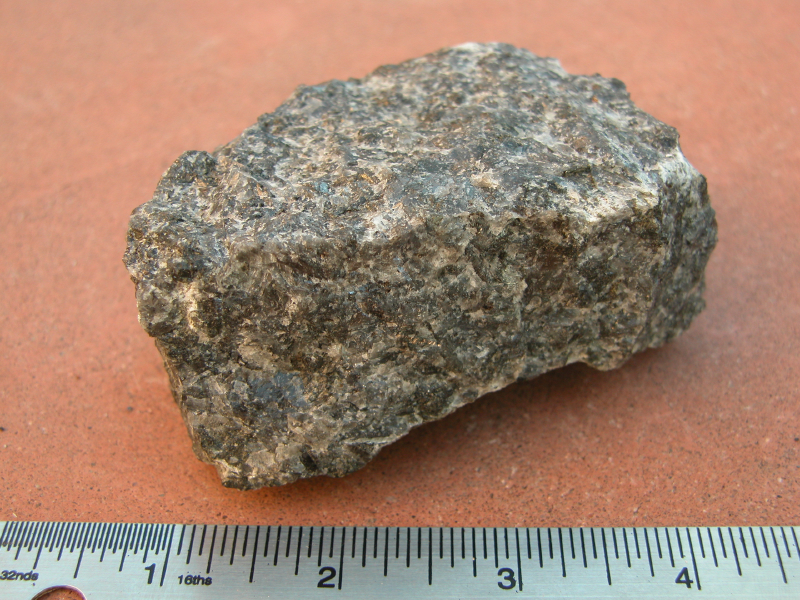
Gabbro (/ˈɡæbroʊ/ GAB-roh) is a phaneritic (coarse-grained), mafic (magnesium- and iron-rich), intrusive igneous rock formed from the slow cooling magma into a holocrystalline mass deep beneath the Earth's surface. Slow-cooling, coarse-grained gabbro has the same chemical composition and mineralogy as rapid-cooling, fine-grained basalt. Much of the Earth's oceanic crust is made of gabbro, formed at mid-ocean ridges. Gabbro is also found as plutons associated with continental volcanism. Due to its variant nature, the term gabbro may be applied loosely to a wide range of intrusive rocks, many of which are merely "gabbroic". By rough analogy, gabbro is to basalt as granite is to rhyolite.
The term "gabbro" was used in the 1760s to name a set of rock types that were found in the ophiolites of the Apennine Mountains in Italy. It was named after Gabbro, a hamlet near Rosignano Marittimo in Tuscany. Then, in 1809, the German geologist Christian Leopold von Buch used the term more restrictively in his description of these Italian ophiolitic rocks. He assigned the name "gabbro" to rocks that geologists nowadays would more strictly call "metagabbro" (metamorphosed gabbro).
Gabbro is a coarse-grained (phaneritic) igneous rock that is relatively low in silica and rich in iron, magnesium, and calcium. Such rock is described as mafic. Gabbro is composed of pyroxene (mostly clinopyroxene) and calcium-rich plagioclase, with minor amounts of hornblende, olivine, orthopyroxene and accessory minerals. With significant (>10%) olivine or orthopyroxene it is classified as olivine gabbro or gabbronorite respectively. Where present, hornblende is typically found as a rim around augite crystals or as large grains enclosing smaller grains of other minerals (poikilitic grains).
Geologists use rigorous quantitative definitions to classify coarse-grained igneous rocks, based on the mineral content of the rock. For igneous rocks composed mostly of silicate minerals, and in which at least 10% of the mineral content consists of quartz, feldspar, or feldspathoid minerals, classification begins with the QAPF diagram. The relative abundances of quartz (Q), alkali feldspar (A), plagioclase (P), and feldspathoid (F), are used to plot the position of the rock on the diagram. The rock will be classified as either a gabbroid or a dioritoid if quartz makes up less than 20% of the QAPF content, feldspathoid makes up less than 10% of the QAPF content, and plagioclase makes up more than 65% of the total feldspar content. Gabbroids are distinguished from dioritoids by an anorthite (calcium plagioclase) fraction of their total plagioclase of greater than 50%.
The composition of the plagioclase cannot easily be determined in the field, and then a preliminary distinction is made between dioritoid and gabbroid based on the content of mafic minerals. A gabbroid typically has over 35% mafic minerals, mostly pyroxenes or olivine, while a dioritoid typically has less than 35% mafic minerals, which typically includes hornblende.
Gabbroids form a family of rock types similar to gabbro, such as monzogabbro, quartz gabbro, or nepheline-bearing gabbro. Gabbro itself is more narrowly defined, as a gabbroid in which quartz makes up less than 5% of the QAPF content, feldspathoids are not present, and plagioclase makes up more than 90% of the feldspar content. Gabbro is distinct from anorthosite, which contains less than 10% mafic minerals.
Coarse-grained gabbroids are produced by slow crystallization of magma having the same composition as the lava that solidifies rapidly to form fine-grained (aphanitic) basalt.
There are a number of subtypes of gabbro recognized by geologists. Gabbros can be broadly divided into leucogabbros, with less than 35% mafic mineral content; mesogabbros, with 35% to 65% mafic mineral content; and melagabbros with more than 65% mafic mineral content. A rock with over 90% mafic mineral content will be classified instead as an ultramafic rock. A gabbroic rock with less than 10% mafic mineral content will be classified as an anorthosite.
Hub AI
Gabbro AI simulator
(@Gabbro_simulator)
Gabbro
Gabbro (/ˈɡæbroʊ/ GAB-roh) is a phaneritic (coarse-grained), mafic (magnesium- and iron-rich), intrusive igneous rock formed from the slow cooling magma into a holocrystalline mass deep beneath the Earth's surface. Slow-cooling, coarse-grained gabbro has the same chemical composition and mineralogy as rapid-cooling, fine-grained basalt. Much of the Earth's oceanic crust is made of gabbro, formed at mid-ocean ridges. Gabbro is also found as plutons associated with continental volcanism. Due to its variant nature, the term gabbro may be applied loosely to a wide range of intrusive rocks, many of which are merely "gabbroic". By rough analogy, gabbro is to basalt as granite is to rhyolite.
The term "gabbro" was used in the 1760s to name a set of rock types that were found in the ophiolites of the Apennine Mountains in Italy. It was named after Gabbro, a hamlet near Rosignano Marittimo in Tuscany. Then, in 1809, the German geologist Christian Leopold von Buch used the term more restrictively in his description of these Italian ophiolitic rocks. He assigned the name "gabbro" to rocks that geologists nowadays would more strictly call "metagabbro" (metamorphosed gabbro).
Gabbro is a coarse-grained (phaneritic) igneous rock that is relatively low in silica and rich in iron, magnesium, and calcium. Such rock is described as mafic. Gabbro is composed of pyroxene (mostly clinopyroxene) and calcium-rich plagioclase, with minor amounts of hornblende, olivine, orthopyroxene and accessory minerals. With significant (>10%) olivine or orthopyroxene it is classified as olivine gabbro or gabbronorite respectively. Where present, hornblende is typically found as a rim around augite crystals or as large grains enclosing smaller grains of other minerals (poikilitic grains).
Geologists use rigorous quantitative definitions to classify coarse-grained igneous rocks, based on the mineral content of the rock. For igneous rocks composed mostly of silicate minerals, and in which at least 10% of the mineral content consists of quartz, feldspar, or feldspathoid minerals, classification begins with the QAPF diagram. The relative abundances of quartz (Q), alkali feldspar (A), plagioclase (P), and feldspathoid (F), are used to plot the position of the rock on the diagram. The rock will be classified as either a gabbroid or a dioritoid if quartz makes up less than 20% of the QAPF content, feldspathoid makes up less than 10% of the QAPF content, and plagioclase makes up more than 65% of the total feldspar content. Gabbroids are distinguished from dioritoids by an anorthite (calcium plagioclase) fraction of their total plagioclase of greater than 50%.
The composition of the plagioclase cannot easily be determined in the field, and then a preliminary distinction is made between dioritoid and gabbroid based on the content of mafic minerals. A gabbroid typically has over 35% mafic minerals, mostly pyroxenes or olivine, while a dioritoid typically has less than 35% mafic minerals, which typically includes hornblende.
Gabbroids form a family of rock types similar to gabbro, such as monzogabbro, quartz gabbro, or nepheline-bearing gabbro. Gabbro itself is more narrowly defined, as a gabbroid in which quartz makes up less than 5% of the QAPF content, feldspathoids are not present, and plagioclase makes up more than 90% of the feldspar content. Gabbro is distinct from anorthosite, which contains less than 10% mafic minerals.
Coarse-grained gabbroids are produced by slow crystallization of magma having the same composition as the lava that solidifies rapidly to form fine-grained (aphanitic) basalt.
There are a number of subtypes of gabbro recognized by geologists. Gabbros can be broadly divided into leucogabbros, with less than 35% mafic mineral content; mesogabbros, with 35% to 65% mafic mineral content; and melagabbros with more than 65% mafic mineral content. A rock with over 90% mafic mineral content will be classified instead as an ultramafic rock. A gabbroic rock with less than 10% mafic mineral content will be classified as an anorthosite.
Recent media