Hubbry Logo
Igneous intrusionIgneous intrusionMain
Open search
Igneous intrusion
Community hub
Igneous intrusion
logo
8 pages, 0 posts
0 subscribers
Be the first to start a discussion here.
Igneous intrusion
Igneous intrusion
from Wikipedia
A Jurassic pluton of pink monzonite intruded below a section of gray sedimentary rocks which was subsequently uplifted and exposed, near Notch Peak, House Range, Utah.
The exposed laccolith atop a massive pluton system near Sofia, formed by the Vitosha syenite and Plana diorite domed mountains and later uplifted

In geology, an igneous intrusion (or intrusive body[1] or simply intrusion[2]) is a body of intrusive igneous rock that forms by crystallization of magma slowly cooling below the surface of the Earth. Intrusions have a wide variety of forms and compositions, illustrated by examples like the Palisades Sill of New York and New Jersey;[3] the Henry Mountains of Utah;[4] the Bushveld Igneous Complex of South Africa;[5] Shiprock in New Mexico;[6] the Ardnamurchan intrusion in Scotland;[7] and the Sierra Nevada Batholith of California.[8]

Because the solid country rock into which magma intrudes is an excellent insulator, cooling of the magma is extremely slow, and intrusive igneous rock is coarse-grained (phaneritic). Intrusive igneous rocks are classified separately from extrusive igneous rocks, generally on the basis of their mineral content. The relative amounts of quartz, alkali feldspar, plagioclase, and feldspathoid is particularly important in classifying intrusive igneous rocks.[9][10]

Intrusions must displace existing country rock to make room for themselves. The question of how this takes place is called the room problem, and it remains a subject of active investigation for many kinds of intrusions.[11]

The term pluton is poorly defined,[12] but has been used to describe an intrusion emplaced at great depth;[13] as a synonym for all igneous intrusions;[14] as a dustbin category for intrusions whose size or character are not well determined;[15] or as a name for a very large intrusion[16] or for a crystallized magma chamber.[17] A pluton that has intruded and obscured the contact between a terrane and adjacent rock is called a stitching pluton.

Classification

[edit]
Basic types of intrusions: 1. Laccolith, 2. Small dike, 3. Batholith, 4. Dike, 5. Sill, 6. Volcanic neck, pipe, 7. Lopolith.

Intrusions are broadly divided into discordant intrusions, which cut across the existing structure of the country rock, and concordant intrusions that intrude parallel to existing bedding or fabric.[18] These are further classified according to such criteria as size, evident mode of origin, or whether they are tabular in shape.[1][2]

An intrusive suite is a group of intrusions related in time and space.[19][20][21]

Discordant intrusions

[edit]

Dikes

[edit]

Dikes are tabular discordant intrusions, taking the form of sheets that cut across existing rock beds.[22] They tend to resist erosion, so that they stand out as natural walls on the landscape. They vary in thickness from millimeter-thick films to over 300 meters (980 ft) and an individual sheet can have an area of 12,000 square kilometers (4,600 sq mi). They also vary widely in composition. Dikes form by hydraulic fracturing of the country rock by magma under pressure,[23] and are more common in regions of crustal tension.[24]

Ring dikes and cone sheets
[edit]

Ring dikes[25] and cone sheets are dikes with particular forms that are associated with the formation of calderas.[26]

Volcanic necks

[edit]

Volcanic necks are feeder pipes for volcanoes that have been exposed by erosion. Surface exposures are typically cylindrical, but the intrusion often becomes elliptical or even cloverleaf-shaped at depth. Dikes often radiate from a volcanic neck, suggesting that necks tend to form at intersections of dikes where passage of magma is least obstructed.[11]

Diatremes and breccia pipes

[edit]

Diatremes and breccia pipes are pipe-like bodies of breccia that are formed by particular kinds of explosive eruptions.[27] As they have reached the surface they are really extrusions, but the non erupted material is an intrusion and indeed due to erosion may be difficult to distinguish from an intrusion that never reached the surface when magma/lava. The root material of a diatreme is identical to intrusive material nearby, if it exists, that never reached the then surface when formed.

Stocks

[edit]

A stock is a non-tabular discordant intrusion whose exposure covers less than 100 square kilometers (39 sq mi). Although this seems arbitrary, particularly since the exposure may be only the tip of a larger intrusive body, the classification is meaningful for bodies which do not change much in area with depth and that have other features suggesting a distinctive origin and mode of emplacement.[28]

Batholiths

[edit]

Batholiths are discordant intrusions with an exposed area greater than 100 square kilometers (39 sq mi). Some are of truly enormous size, and their lower contacts are very rarely exposed. For example, the Coastal Batholith of Peru is 1,100 kilometers (680 mi) long and 50 kilometers (31 mi) wide. They are usually formed from magma rich in silica, and never from gabbro or other rock rich in mafic minerals, but some batholiths are composed almost entirely of anorthosite.[29]

Concordant intrusions

[edit]

Sills

[edit]

A sill is a tabular concordant intrusion, typically taking the form of a sheet parallel to sedimentary beds. They are otherwise similar to dikes. Most are of mafic composition, relatively low in silica, which gives them the low viscosity necessary to penetrate between sedimentary beds.[23]

Laccoliths

[edit]

A laccolith is a concordant intrusion with a flat base and domed roof. Laccoliths typically form at shallow depth, less than 3 kilometers (1.9 mi),[30] and in regions of crustal compression.[24]

Lopoliths and layered intrusions

[edit]

Lopoliths are concordant intrusions with a saucer shape, somewhat resembling an inverted laccolith, but they can be much larger and form by different processes. Their immense size promotes very slow cooling, and this produces an unusually complete mineral segregation called a layered intrusion.[31]

Formation

[edit]

The room problem

[edit]

The ultimate source of magma is partial melting of rock in the upper mantle and lower crust. This produces magma that is less dense than its source rock. For example, a granitic magma, which is high in silica, has a density of 2.4 Mg/m3, much less than the 2.8 Mg/m3 of high-grade metamorphic rock. This gives the magma tremendous buoyancy, so that ascent of the magma is inevitable once enough magma has accumulated. However, the question of precisely how large quantities of magma are able to shove aside country rock to make room for themselves (the room problem) is still a matter of research.[11]

The composition of the magma and country rock and the stresses affecting the country rock strongly influence the kinds of intrusions that take place. For example, where the crust is undergoing extension, magma can easily rise into tensional fractures in the upper crust to form dikes.[11] Where the crust is under compression, magma at shallow depth will tend to form laccoliths instead, with the magma penetrating the least competent beds, such as shale beds.[24] Ring dikes and cone sheets form only at shallow depth, where a plug of overlying country rock can be raised or lowered.[32] The immense volumes of magma involved in batholiths can force their way upwards only when the magma is highly silicic and buoyant, and are likely do so as diapirs in the ductile deep crust and through a variety of other mechanisms in the brittle upper crust.[33]

Multiple and composite intrusions

[edit]

Igneous intrusions may form from a single magmatic event or several incremental events. Recent evidence suggests that incremental formation is more common for large intrusions.[34][35] For example, the Palisades Sill was never a single body of magma 300 meters (980 ft) thick, but was formed from multiple injections of magma.[36] An intrusive body is described as multiple when it forms from repeated injections of magma of similar composition, and as composite when formed of repeated injections of magma of unlike composition. A composite dike can include rocks as different as granophyre and diabase.[37]

While there is often little visual evidence of multiple injections in the field, there is geochemical evidence.[38] Zircon zoning provides important evidence for determining if a single magmatic event or a series of injections were the methods of emplacement.

Large felsic intrusions likely form from melting of lower crust that has been heated by an intrusion of mafic magma from the upper mantle. The different densities of felsic and mafic magma limit mixing, so that the silicic magma floats on the mafic magma. Such limited mixing as takes place results in the small inclusions of mafic rock commonly found in granites and granodiorites.[39]

Cooling

[edit]
Thermal profiles at different times after intrusion, illustrating square root law

An intrusion of magma loses heat to the surrounding country rock through heat conduction. Near the contact of hot material with cold material, if the hot material is initially uniform in temperature, the temperature profile across the contact is given by the relationship
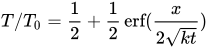
where is the initial temperature of the hot material, k is the thermal diffusivity (typically close to 10−6 m2 s−1 for most geologic materials), x is the distance from the contact, and t is the time since intrusion. This formula suggests that the magma close to the contact will be rapidly chilled while the country rock close to the contact is rapidly heated, while material further from the contact will be much slower to cool or heat.[40] Thus a chilled margin is often found on the intrusion side of the contact,[41] while a contact aureole is found on the country rock side. The chilled margin is much finer grained than most of the intrusion, and may be different in composition, reflecting the initial composition of the intrusion before fractional crystallization, assimilation of country rock, or further magmatic injections modified the composition of the rest of the intrusion.[42] Isotherms (surfaces of constant temperature) propagate away from the margin according to a square root law,[40] so that if the outermost meter of the magma takes ten years to cool to a given temperature, the next inward meter will take 40 years, the next will take 90 years, and so on.

This is an idealization, and such processes as magma convection (where cooled magma next to the contact sinks to the bottom of the magma chamber and hotter magma takes its place) can alter the cooling process, reducing the thickness of chilled margins while hastening cooling of the intrusion as a whole.[43] However, it is clear that thin dikes will cool much faster than larger intrusions, which explains why small intrusions near the surface (where the country rock is initially cold) are often nearly as fine-grained as volcanic rock.

Structural features of the contact between intrusion and country rock give clues to the conditions under which the intrusion took place. Catazonal intrusions have a thick aureole that grades into the intrusive body with no sharp margin, indicating considerable chemical reaction between intrusion and country rock, and often have broad migmatite zones. Foliations in the intrusion and the surrounding country rock are roughly parallel, with indications of extreme deformation in the country rock. Such intrusions are interpreted as taking placed at great depth. Mesozonal intrusions have a much lower degree of metamorphism in their contact aureoles, and the contact between country rock and intrusion is clearly discernible. Migmatites are rare and deformation of country rock is moderate. Such intrusions are interpreted as occurring at medium depth. Epizonal intrusions are discordant with country rock and have sharp contacts with chilled margins, with only limited metamorphism in a contact aureole, and often contain xenolithic fragments of country rock suggesting brittle fracturing. Such intrusions are interpreted as occurring at shallow depth, and are commonly associated with volcanic rocks and collapse structures.[44]

Cumulates

[edit]

An intrusion does not crystallize all minerals at once; rather, there is a sequence of crystallization that is reflected in the Bowen reaction series. Crystals formed early in cooling are generally denser than the remaining magma and can settle to the bottom of a large intrusive body. This forms a cumulate layer with distinctive texture and composition.[45] Such cumulate layers may contain valuable ore deposits of chromite.[46][47] The vast Bushveld Igneous Complex of South Africa includes cumulate layers of the rare rock type, chromitite, composed of 90% chromite,[48]

See also

[edit]
  • Plutonism – Geological theory that Earth's igneous rocks formed by solidification of molten material
  • Salt dome – Structural dome formed of salt or halite
  • Salt tectonics – Geometries and processes associated with the presence of significant thicknesses of evaporites

References

[edit]

Further reading

[edit]
[edit]
Revisions and contributorsEdit on WikipediaRead on Wikipedia
from Grokipedia
An igneous intrusion, also known as a pluton or intrusive igneous body, is a mass of that forms when cools and solidifies slowly beneath the Earth's surface, without reaching the exterior to erupt as lava. These intrusions develop as buoyant rises from deeper mantle or crustal sources, intruding into surrounding pre-existing rocks called , often along fractures or weaknesses in the crust. The slow cooling process, which can span thousands to millions of years, allows for the growth of large, visible crystals, resulting in coarse-grained textures such as phaneritic, distinguishing them from finer-grained extrusive igneous rocks. Igneous intrusions vary widely in size, shape, and composition, influenced by the magma's silica content—ranging from mafic (low silica, dark-colored rocks like gabbro) to felsic (high silica, light-colored rocks like granite)—and the tectonic setting in which they form. Common types include batholiths, the largest intrusions exceeding 100 square kilometers in exposed area, which form the backbone of many continental mountain ranges; stocks, smaller versions of batholiths under 100 square kilometers; dikes, tabular bodies that cut across existing rock layers in a discordant manner; sills, tabular bodies that parallel layering in a concordant fashion; and laccoliths, mushroom-shaped intrusions that dome overlying strata. Magma emplacement occurs through mechanisms like forceful injection, stoping (where blocks of country rock break off and sink into the magma), or assimilation of surrounding material, often leading to chilled margins where the intrusion contacts cooler host rock. Geologically, igneous intrusions play a critical role in crustal evolution, particularly at convergent plate boundaries where generates intermediate to magmas, or at divergent boundaries and hotspots producing varieties; they contribute to the formation of ore deposits through hydrothermal fluids and expose over time via erosion. Examples include the in and the Coast Range Plutonic Complex along the , which illustrate how these features shape landscapes and influence regional geology.

Definition and Basics

Definition and Overview

Igneous intrusions are bodies of intrusive formed when cools and solidifies beneath the Earth's surface, becoming emplaced into surrounding pre-existing rock formations. These structures develop as molten material, generated from within or crust, ascends and intrudes into cooler host rocks without reaching the surface. In contrast to extrusive igneous rocks, which originate from lava that erupts onto the surface and cools rapidly to form fine-grained textures like those in or rhyolite, intrusions undergo slow cooling at depth. This prolonged crystallization process results in coarse-grained textures with visible , often exceeding several millimeters in size, due to the insulating effect of overlying rocks. The broad term for these features is plutons, encompassing various scales and shapes of intrusive bodies. Plutons formed at significant depths, typically several kilometers below the surface, are classified as plutonic intrusions, while those emplaced at shallower crustal levels—generally less than 2 kilometers—are termed hypabyssal intrusions, exhibiting intermediate grain sizes between fully plutonic and volcanic rocks. The recognition of igneous intrusions as solidified magma dates to the early , when geologists like Leopold von Buch, influenced by observations of volcanic activity in regions such as and Vesuvius, championed their igneous origins against prevailing neptunist views that attributed such rocks to sedimentary processes. Von Buch's work helped solidify the plutonist perspective, emphasizing crystallization from subterranean molten material.

Key Characteristics

Igneous intrusions exhibit distinctive physical properties arising from their formation deep within the , where cools slowly over extended periods. This slow cooling process results in coarse-grained textures, with large enough to be visible to the , a characteristic known as phaneritic texture. Unlike extrusive igneous rocks, which cool rapidly at the surface and form fine-grained or glassy textures, intrusive rocks are typically holocrystalline, meaning they are composed entirely of interlocking without significant glass content. The compositional range of igneous intrusions spans from to types, primarily determined by their silica (SiO₂) content, which influences , color, and density. intrusions, such as , contain more than 65% SiO₂ and are dominated by light-colored minerals like and , giving them a lighter tone and lower density. In contrast, intrusions like have less than 52% SiO₂, featuring darker ferromagnesian minerals such as and , resulting in denser, darker rocks. Intermediate compositions, with 52-65% SiO₂, occur in rocks like , bridging these extremes. Structurally, igneous intrusions are defined by their contacts with the surrounding country rock, which often display chilled margins—narrow zones of finer-grained or glassy rock formed by rapid cooling against the cooler host material. These margins contrast with the coarser interior and can vary in thickness from centimeters to meters depending on intrusion size and magma temperature. Xenoliths, or fragments of the country rock entrained within the intrusion, are common structural features, appearing as angular or rounded inclusions that provide evidence of magma interaction with the host. Additionally, the heat from the intrusion can cause deformation, baking, or contact metamorphism in the adjacent country rock, altering its minerals and texture without melting it. Igneous intrusions vary widely in size, from small measuring a few kilometers in to massive batholiths extending hundreds of kilometers across. are typically irregular, discordant bodies less than 100 km² in exposed area, while batholiths represent the largest plutonic forms, often exceeding 100 km² and comprising multiple coalesced intrusions. This scale reflects the volume of involved and the depth of emplacement, with larger bodies indicating prolonged magmatic activity.

Geological Context

Formation Environments

Igneous intrusions form in diverse tectonic settings where ascends from and crystallizes within the crust, primarily at convergent plate margins, divergent plate margins, and intraplate hotspots. At convergent margins, such as zones, of wedge and subducted generates hydrous magmas that rise to form extensive plutonic complexes, often emplaced at depths of 5-15 km in the upper crust. Divergent margins, including continental rifts and mid-ocean ridges, facilitate intrusions through decompression melting of upwelling , producing bodies like gabbroic sills and dikes within extensional basins. Intraplate hotspots, driven by mantle plumes, lead to alkali-rich intrusions in stable continental interiors or oceanic settings, where buoyant exploits crustal weaknesses. Many igneous intrusions are closely associated with orogenic processes, particularly at convergent margins, where subduction-related magmatism contributes to crustal thickening and mountain building. For instance, the formed during subduction along the western North American margin, with granitic plutons emplaced between 120-80 million years ago at mid-crustal depths of approximately 10 km, aiding the development of the Sierra Nevada orogeny. Similarly, Andean-type batholiths along the modern South American subduction zone exemplify how prolonged arc magmatism builds large intrusive volumes, with some plutons reaching deeper levels exceeding 15 km in thickened crust. In divergent settings, rift-related intrusions, such as those in the , occur at shallower upper crustal depths of 5-10 km and support basin formation without dominant compressional tectonics. Hotspot intrusions, like those beneath the Hawaiian chain, are typically emplaced at variable depths influenced by lithospheric thickness, often in the 10-20 km range under . Modern analogs for these ancient environments are inferred from geophysical data, revealing active intrusive processes in analogous settings. Seismic tomography in subduction zones, such as the Cascadia margin, images low-velocity zones indicative of partial melt and crystal mush at 5-20 km depths, suggesting ongoing pluton assembly similar to ancient batholiths. In divergent regions like the , reflection seismology detects transparent bodies interpreted as active magmatic intrusions at shallow crustal levels, linked to elevated geothermal gradients exceeding 50°C/km. Intraplate hotspots provide further evidence, with seismic studies at Yellowstone revealing a mid-crustal magma reservoir at 5-15 km depth, where high geothermal gradients (up to 100°C/km) facilitate intrusion amid plume-driven .

Relationship to Volcanism and Plutonism

Plutonism represents the intrusive counterpart to in the igneous rock cycle, where ascends through the crust but primarily solidifies at depth rather than erupting at the surface. Most generated never reaches the Earth's surface, instead cooling and crystallizing underground to form intrusions, while only a small fraction erupts as lava during volcanic episodes. This subsurface process dominates in tectonic settings such as subduction zones, where produces voluminous that accumulates in crustal reservoirs. Volcanic-plutonic connections are evident in the structural and compositional links between surface eruptions and underlying intrusions, particularly in caldera systems. The roof zones of plutons often expose volcanic equivalents, such as rhyolite porphyry overlying granite plutons, indicating that shallow intrusive bodies feed explosive eruptions before solidifying. In calderas, repeated magma injections build chambers that supply pyroclastic flows and lavas, with the plutonic roots preserving the compositional evolution of these systems. The evolutionary sequence linking and plutonism involves dynamic chambers that initially sustain surface activity before transitioning to intrusive solidification. Active chambers periodically supply volcanoes with eruptible melt, but upon cessation of —due to reduced supply or — the remaining cools in place to form plutons. This progression is supported by geochemical similarities between volcanic products and associated intrusions, highlighting a continuum from eruption to subsurface emplacement. Eroded terrains provide direct evidence of these ancient volcanic roots preserved as intrusions, as seen in the . Extensive uplift and erosion have unroofed Caledonian-era plutons, revealing their origins in volcanic arcs where magma chambers fed now-vanished surface activity around 420 million years ago. For instance, the Glencoe complex exposes plutonic remnants intruding volcanic sequences, illustrating how prolonged transitioned from explosive to deep-seated intrusion formation.

Classification

Discordant Intrusions

Discordant intrusions are igneous bodies whose contacts with the surrounding host rock cut across existing planes, , or other pre-existing structures, indicating that the has forcibly injected and disrupted the . This cross-cutting geometry distinguishes them from concordant intrusions, which parallel the layering of the host rock. Key subtypes of discordant intrusions include dikes (or dykes), which are sheet-like or wall-like intrusive rock bodies that cut across the layering of surrounding rock, typically near-vertical, formed by magma intruding along fissures and cooling. They are composed of igneous rock, such as porphyrite in porphyry dykes, and are common in igneous provinces, linked to volcanic-intrusive activity. Dikes are tabular, sheet-like bodies typically less than 20 meters wide that fill fractures and extend vertically or near-vertically through the host rock. represent smaller, irregular plutonic masses, often less than 100 km² in exposed area, that serve as potential feeders for larger volcanic systems and are exposed through . Batholiths are massive, discordant plutons exceeding 100 km², commonly composed of granitic rocks and forming the cores of mountain ranges through multiple intrusive episodes. Volcanic necks, or plugs, are cylindrical to conical remnants of solidified conduits from eroded es, standing prominently above the surrounding terrain. Diatremes and pipes form through explosive eruptions of gas-rich , creating breccia-filled vertical pipes that disrupt and fragment the host rock, often resembling structures. These intrusions form when ascends and exploits fractures, faults, or zones of weakness in the crust, particularly in extensional tectonic settings where tensile stresses facilitate forceful injection. The discordant nature arises from the 's ability to propagate through and deform the brittle host rock, resulting in sharp, irregular contacts that preserve evidence of mechanical emplacement. Notable examples include the volcanic neck in northwestern , a 30-million-year-old remnant of an explosive volcanic conduit rising about 500 meters above the desert floor, surrounded by radiating dikes that exemplify tabular discordant sheets. The in , spanning roughly 640 km long and 100 km wide, represents one of the largest discordant intrusive complexes, intruded primarily during the era into older metamorphic and sedimentary rocks. For diatremes, lamproite pipes such as the one at in illustrate explosive breccia-filled structures formed by phreatomagmatic activity.

Concordant Intrusions

Concordant intrusions are igneous bodies that form parallel to the existing layering or planes of the surrounding host rock, resulting in contacts that conform to the regional . This parallelism distinguishes them from discordant intrusions, which cross-cut the host rock structure. Concordant intrusions typically develop through passive emplacement, where exploits pre-existing weaknesses such as bedding planes in sedimentary sequences. Common subtypes of concordant intrusions include sills, laccoliths, lopoliths, and layered intrusions. Sills are thin, tabular sheets of that intrude horizontally between layers of sedimentary or , maintaining parallelism with the host over large areas. Laccoliths form as mushroom- or dome-shaped bodies where initially spreads as a sill but then expands upward, doming the overlying strata while remaining concordant at the base. Lopoliths, in contrast, are large, saucer-shaped intrusions that sag downward into the underlying rock, creating a concave-up profile parallel to the and often associated with basin-like depressions. Layered intrusions exhibit rhythmic or cryptic variations in mineral composition, formed by repeated injections of that settle and crystallize in layers concordant with the intrusion's internal structure. Formation of concordant intrusions occurs when buoyant magma rises through the crust and encounters planes of weakness, such as bedding interfaces in sedimentary basins, allowing it to spread laterally rather than forcing its way vertically. This lateral flow is facilitated by the lower density contrast and reduced resistance along these planes, often in extensional tectonic settings where the crust is thinned. In layered varieties, multiple pulses of magma contribute to the development of stratification through gravitational settling and density-driven segregation during crystallization. Notable examples include the , a intrusion approximately 300 meters thick that parallels the sedimentary bedding of the Newark Basin in New York and . The Skaergaard Intrusion in East is a classic layered example, a ferrobasaltic body approximately 11 km by 8 km in plan view with well-developed rhythmic layering from repeated magma replenishment. The Bushveld Complex in represents one of the largest lopolith-like layered intrusions, spanning over 66,000 square kilometers with concordant mafic-ultramafic layers formed in a magma chamber.

Emplacement Processes

Magma Ascent and the Room Problem

Magma ascent to form igneous intrusions begins with the mobilization of buoyant melt within the or , driven primarily by density contrasts between the and surrounding host rock. Low-density magmas, such as compositions with densities around 2.3-2.6 g/cm³ compared to host rocks at 2.9-3.0 g/cm³, experience greater and thus ascend more readily than denser basaltic magmas. This process occurs through several mechanisms, including diapirism, where hot, low-viscosity melt rises as a buoyant blob through ductile deformation of the overlying crust, and via dikes or hydraulic fracturing, where overpressurized exploits tensile cracks. plays a critical role; magmas with higher viscosities (10^3-10^5 Pa·s) ascend slower than ones (10-10^2 Pa·s), often favoring fracture-dominated pathways over diapiric flow in brittle upper crust. The buoyant force propelling this ascent arises from the density difference (Δρ) between magma and host rock, balanced against gravitational and viscous forces, expressed simply as Fb=ΔρgVF_b = \Delta \rho \, g \, V, where gg is and VV is the volume of the ascending body. For typical crustal Δρ values of 0.1-0.3 g/cm³, this force enables rise through the , though lithostatic pressure (P_lith = ρ g z, increasing with depth z) imposes constraints by favoring neutral buoyancy zones where magma stalls. Inferred ascent rates from models range from 0.1 to 10 m/year for diapiric or slow fracture propagation in plutonic settings, limited by viscous drag and host rock strength; faster rates (up to cm/s) occur in active volcanic conduits but are atypical for deep intrusions. A central challenge in magma emplacement, known as the "room problem," concerns how space is created underground for large intrusion volumes without excessive crustal disruption. Mechanisms include stoping, where magma thermally fractures and assimilates host rock blocks, generating xenoliths that sink and melt to accommodate the intrusion; doming and uplift, whereby buoyant magma arches overlying strata, often along faults or through elastic flexure; and ductile flow, particularly in hot, weakened lower crust, allowing lateral spreading or ballooning of the magma body. In syntectonic settings, such as transpressional orogens, space may also form via floor subsidence and roof elevation in thermal antiforms, with shear zones facilitating dilation. These processes ensure that intrusions, often spanning kilometers in scale, integrate into the crust without violating mass balance.

Multiple and Composite Emplacement

Igneous intrusions often form through multiple sequential pulses of injection, resulting in stacked or nested bodies where younger units cross-cut older ones, creating complex internal architectures. This episodic emplacement is evident in field observations of shear zones, lobate contacts, and intercalated host rock lenses that delineate individual sheets within larger intrusions. For instance, in the of , the Trachyte Mesa assembled from more than 10 sub-horizontal igneous sheets, with showing younger pulses intruding beneath older layers and forming bulbous terminations against the roof. Such incremental growth addresses aspects of the room problem by allowing progressive expansion without requiring instantaneous creation of large void spaces. Geochronological studies confirm that these multiple intrusions typically span 1 to 10 million years, reflecting prolonged magmatic activity rather than single events. In the Tuolumne Intrusive Suite of , U-Pb dating reveals incremental assembly over at least 10 million years (95–85 Ma), with the Granodiorite alone forming through pulses over approximately 4 million years, as indicated by systematic age decreases toward the pluton centers. Compositional zoning within plutons further supports this, featuring fine-grained chilled margins from rapid cooling of initial pulses contrasting with coarser interiors from later, hotter injections that reheated and recrystallized surrounding rock. Composite emplacements arise when magmas of contrasting compositions mingle during intrusion, producing hybrid rocks through incomplete mixing and interaction. and magmas, for example, can form dioritic hybrids in composite dikes and plutons, as seen in collisional settings where synmetamorphic shearing facilitates mingling. The Tertiary Austurhorn intrusive complex in exemplifies this, where extensive mafic-felsic interactions created hybrid zones with mingled textures, documenting a history of repeated injections that preserved distinct compositional domains. A prominent is the Coastal of , which extends over 1,600 km and comprises a composite body built from at least eight time-separated magmatic pulses, involving surges of into Cretaceous volcanics. These pulses, dated to the , produced segmented super-units with cross-cutting relations and zoning that record episodic assembly over millions of years.

Petrology and Cooling

Mineralogy and Textures

Igneous intrusions exhibit mineral assemblages that reflect their , broadly categorized as or . intrusions, such as granites, are dominated by , alkali (like ), and , with accessory micas such as contributing to their light color and silica-rich nature. In contrast, intrusions like gabbros primarily consist of , , and calcium-rich , along with and , imparting a darker hue due to higher iron and magnesium content. Accessory minerals, including , are ubiquitous in both and intrusions, often occurring as trace phases that enable through uranium-lead methods. The textural characteristics of igneous intrusions arise from slow cooling rates in crustal environments, promoting visible . Phaneritic textures predominate, featuring equigranular arrangements where minerals form interlocking crystals of similar size, typically 1-5 mm or larger, as seen in uniform granites or gabbros. variants occur when larger phenocrysts, often or , embed in a finer phaneritic groundmass, indicating episodes of rapid followed by slow . Poikilitic textures develop where large, isolated crystals (oikocrysts) of or enclose smaller, randomly oriented grains (chadacrysts) of , reflecting heterogeneous during cooling. Fractional crystallization profoundly influences the of intrusions by sequentially removing early-formed crystals from the melt, altering the residual composition. In mafic magmas, dense early minerals like and settle due to gravitational differentiation, depleting the melt in magnesium and iron while enriching it in silica, leading to more upper zones. This process, akin to , results in zoned intrusions where cumulate textures at the base concentrate phases, though detailed layering is addressed elsewhere. Analytical approaches to intrusion rely on petrographic for textural and , complemented by geochemical techniques. Thin sections under polarized light reveal identities, habits, and intergrowths, essential for interpreting crystallization sequences. Geochemical classification employs the , standardized by the , which plots modal percentages of (Q), alkali (A), (P), and feldspathoids (F) to delineate rock types like or .

Cooling Mechanisms and Cumulates

Igneous intrusions cool primarily through conduction of heat into the surrounding , a insulated by the low conductivity of crustal materials, resulting in protracted timescales typically ranging from 10^5 to 10^7 years (0.1 to 10 million years) for solidification and thermal equilibration of large plutons. This slow cooling promotes the growth of large, euhedral crystals, contributing to the coarse-grained textures characteristic of plutonic rocks. At the margins of intrusions, however, —driven by convecting fluids released from the crystallizing or infiltrating from the host rock—can accelerate cooling rates by orders of magnitude, forming chilled margins and facilitating metasomatic alteration. Cumulates form within intrusions when early-formed crystals settle gravitationally through the denser magma, accumulating at the chamber floor to produce layered sequences. This settling is governed by , which describes the terminal velocity vv of a spherical particle as v=29(ρcrystalρmelt)gr2η,v = \frac{2}{9} \frac{(\rho_{\text{crystal}} - \rho_{\text{melt}}) g r^2}{\eta}, where ρcrystal\rho_{\text{crystal}} is the density of the , ρmelt\rho_{\text{melt}} is the of the melt, gg is , rr is the crystal , and η\eta is the of the melt; denser, larger crystals thus settle faster in less viscous magmas. The resulting rocks include adcumulates, featuring dense packing of >95% cumulus crystals with minimal trapped melt due to post-accumulative growth and drainage, and mesocumulates, with 85–95% cumulus crystals and more intercumulus material. In layered intrusions, such as mafic-ultramafic bodies, cumulate layers often exhibit cyclic units reflecting periodic replenishment by fresh pulses, which stir the chamber and promote renewed and settling. A prominent example is the Stillwater Complex in , , where chromite-rich layers (e.g., the G chromitite seam) form through the sinking of dense plumes triggered by influxes of primitive, high-Mg mixing with evolved melts. The heat from cooling intrusions induces contact metamorphism in adjacent host rocks, creating aureoles—concentric zones of increasing metamorphic grade extending from tens of meters to several kilometers around the intrusion. These aureoles alter the and texture of the , typically producing fine-grained, non-foliated through devolatilization and recrystallization, with inner zones reaching facies and outer zones limited to .

Significance and Examples

Tectonic and Economic Importance

Igneous intrusions are integral to tectonic processes, serving as key indicators of arc magmatism at convergent plate boundaries, where subduction drives the generation of magma that ascends and solidifies within the crust. This magmatism is the primary mechanism for continental crust formation, with plutonic rocks comprising a predominant portion of the continental crust through repeated episodes of intrusion and differentiation. Over geological time, tectonic uplift followed by erosion exposes these deep-seated bodies, revealing their role in crustal thickening and the stabilization of continental margins. Economically, igneous intrusions host significant mineral resources, including porphyry deposits associated with intermediate-composition stocks formed in subduction-related settings, which supply a substantial share of global production. These deposits often feature dykes, particularly porphyry dykes, that serve as conduits for mineralizing hydrothermal fluids, facilitating the transport and deposition of copper and associated metals. Layered intrusions, such as lopoliths, are major sources of platinum-group elements (PGE), with examples like the Bushveld Complex containing over 75% of the world's reserves. Additionally, granitic plutons provide dimension stone for and ornamentation, with quarries contributing to a global market valued in billions of dollars annually as of 2021. From an environmental perspective, active or recently emplaced intrusions serve as heat sources for systems, enabling the extraction of renewable power in regions like convergent margins and rifts. However, exploitation of these systems through enhanced geothermal methods, which involve hydraulic stimulation akin to , carries risks of due to fluid injection altering subsurface stresses. Advances in research, particularly zircon U-Pb , have illuminated the timing of intrusion emplacement, linking pulses of to assembly and breakup cycles throughout Earth's history. This technique, applied to crystals within plutonic rocks, reveals episodic crustal growth tied to major tectonic events, enhancing models of planetary .

Notable Examples

One prominent example of a discordant igneous intrusion is the in , , which extends approximately 640 km (400 miles) in length and formed between 80 and 140 million years ago during the of the Farallon Plate beneath the North American Plate. This exposes sections of the deep , revealing plutonic rocks intruded into volcanic and sedimentary sequences. The Bushveld Complex in exemplifies a layered concordant lopolith, emplaced around 2 billion years ago as a vast, saucer-shaped intrusion concordant with underlying sedimentary layers. Covering over 65,000 km², it represents the world's largest known reserve of platinum-group elements (PGEs), with estimated reserves exceeding 8,500 metric tons. In , the Isle of hosts a Tertiary central complex characterized by multiple nested intrusions, including ultramafic and layers formed during around 60 million years ago. These intrusions provide classic evidence of magma mingling, where hybrid rocks formed from the interaction of and melts, as seen in mingled textures within the Eastern Layered Series. The Kimberley Diatreme in illustrates an explosive discordant pipe intrusion, formed approximately 90 million years ago as a kimberlite pipe that erupted violently, brecciating surrounding rocks. This pipe serves as a of , transporting them from to the surface in a discordant, pipe-like structure.

References

Add your contribution
Related Hubs
User Avatar
No comments yet.