Hubbry Logo
GabbroGabbroMain
Open search
Gabbro
Community hub
Gabbro
logo
8 pages, 0 posts
0 subscribers
Be the first to start a discussion here.
Gabbro
Gabbro
from Wikipedia
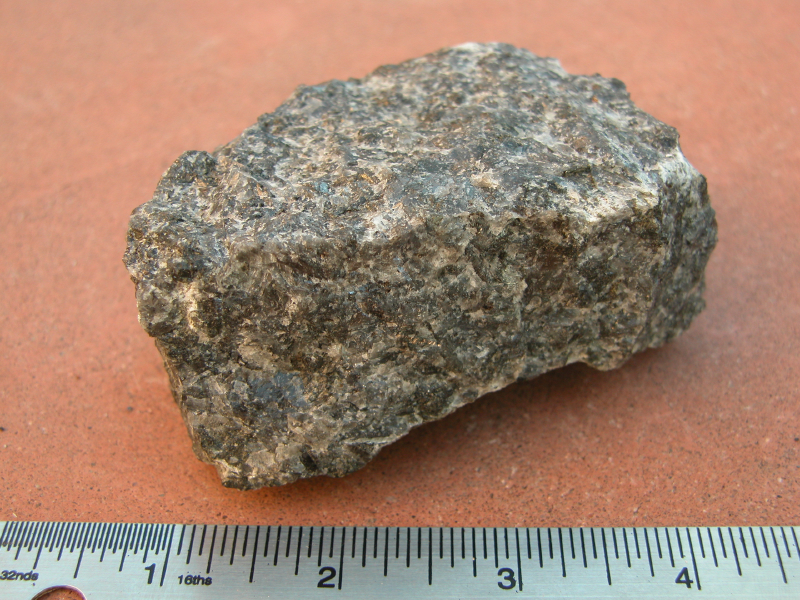
Gabbro specimen
Photomicrograph of a thin section of gabbro

Gabbro (/ˈɡæbr/ GAB-roh) is a phaneritic (coarse-grained), mafic (magnesium- and iron-rich), intrusive igneous rock formed from the slow cooling magma into a holocrystalline mass deep beneath the Earth's surface. Slow-cooling, coarse-grained gabbro has the same chemical composition and mineralogy as rapid-cooling, fine-grained basalt. Much of the Earth's oceanic crust is made of gabbro, formed at mid-ocean ridges. Gabbro is also found as plutons associated with continental volcanism. Due to its variant nature, the term gabbro may be applied loosely to a wide range of intrusive rocks, many of which are merely "gabbroic". By rough analogy, gabbro is to basalt as granite is to rhyolite.

Etymology

[edit]

The term "gabbro" was used in the 1760s to name a set of rock types that were found in the ophiolites of the Apennine Mountains in Italy.[1] It was named after Gabbro, a hamlet near Rosignano Marittimo in Tuscany. Then, in 1809, the German geologist Christian Leopold von Buch used the term more restrictively in his description of these Italian ophiolitic rocks.[2] He assigned the name "gabbro" to rocks that geologists nowadays would more strictly call "metagabbro" (metamorphosed gabbro).[3]

Petrology

[edit]
Mineral assemblage of igneous rocks

Gabbro is a coarse-grained (phaneritic) igneous rock that is relatively low in silica and rich in iron, magnesium, and calcium. Such rock is described as mafic. Gabbro is composed of pyroxene (mostly clinopyroxene) and calcium-rich plagioclase, with minor amounts of hornblende, olivine, orthopyroxene and accessory minerals.[4] With significant (>10%) olivine or orthopyroxene it is classified as olivine gabbro or gabbronorite respectively. Where present, hornblende is typically found as a rim around augite crystals or as large grains enclosing smaller grains of other minerals (poikilitic grains).[5][6]

QAPF diagram with the gabbroid/dioritoid fields highlighted in yellow. Gabbroids are distinguished from dioritoids by an anorthite content of greater than 50% of their plagioclase.
QAPF diagram with the gabbro field highlighted in yellow. Gabbro is distinguished from diorite by an anorthite content of greater than 50% of its plagioclase and from anorthosite by a mafic mineral content greater than 10%.

Geologists use rigorous quantitative definitions to classify coarse-grained igneous rocks, based on the mineral content of the rock. For igneous rocks composed mostly of silicate minerals, and in which at least 10% of the mineral content consists of quartz, feldspar, or feldspathoid minerals, classification begins with the QAPF diagram. The relative abundances of quartz (Q), alkali feldspar (A), plagioclase (P), and feldspathoid (F), are used to plot the position of the rock on the diagram.[7][8][9] The rock will be classified as either a gabbroid or a dioritoid if quartz makes up less than 20% of the QAPF content, feldspathoid makes up less than 10% of the QAPF content, and plagioclase makes up more than 65% of the total feldspar content. Gabbroids are distinguished from dioritoids by an anorthite (calcium plagioclase) fraction of their total plagioclase of greater than 50%.[10]

The composition of the plagioclase cannot easily be determined in the field, and then a preliminary distinction is made between dioritoid and gabbroid based on the content of mafic minerals. A gabbroid typically has over 35% mafic minerals, mostly pyroxenes or olivine, while a dioritoid typically has less than 35% mafic minerals, which typically includes hornblende.[11]

Gabbroids form a family of rock types similar to gabbro, such as monzogabbro, quartz gabbro, or nepheline-bearing gabbro. Gabbro itself is more narrowly defined, as a gabbroid in which quartz makes up less than 5% of the QAPF content, feldspathoids are not present, and plagioclase makes up more than 90% of the feldspar content. Gabbro is distinct from anorthosite, which contains less than 10% mafic minerals.[12][7][8]

Coarse-grained gabbroids are produced by slow crystallization of magma having the same composition as the lava that solidifies rapidly to form fine-grained (aphanitic) basalt.[7][8]

Subtypes

[edit]

There are a number of subtypes of gabbro recognized by geologists. Gabbros can be broadly divided into leucogabbros, with less than 35% mafic mineral content; mesogabbros, with 35% to 65% mafic mineral content; and melagabbros with more than 65% mafic mineral content. A rock with over 90% mafic mineral content will be classified instead as an ultramafic rock. A gabbroic rock with less than 10% mafic mineral content will be classified as an anorthosite.[8][13]

A more detailed classification is based on the relative percentages of plagioclase, pyroxene, hornblende, and olivine. The end members are:[8][13]

  • Normal gabbro (gabbro sensu stricto[8]) is composed almost entirely of plagioclase and clinopyroxene (typically augite), with less than 5% each of hornblende, olivine, or orthopyroxene.
  • Norite is composed almost entirely of plagioclase and orthopyroxene, with less than 5% each of hornblende, clinopyroxene, or olivine.
  • Troctolite is composed almost entirely of plagioclase and olivine, with less than 5% each of pyroxene or hornblende.
  • Hornblende gabbro is composed almost entirely of plagioclase and hornblende, with less than 5% each of pyroxene or olivine.

Gabbros intermediate between these compositions are given names such as gabbronorite (for a gabbro intermediate between normal gabbro and norite, with almost equal amounts of clinopyroxene and orthopyroxene) or olivine gabbro (for a gabbro containing significant olivine, but almost no clinopyroxene or hornblende). A rock similar to normal gabbro but containing more orthopyroxene is called an orthopyroxene gabbro, while a rock similar to norite but containing more clinopyroxene is called a clinopyroxene norite.[8]

A gabbro landscape – the main ridge of the Cuillin, Isle of Skye, Scotland
Cizlakite sample

Gabbros are also sometimes classified as alkali or tholleiitic gabbros, by analogy with alkali or tholeiitic basalts, of which they are considered the intrusive equivalents.[14] Alkali gabbro usually contains olivine, nepheline, or analcime, up to 10% of the mineral content,[15] while tholeiitic gabbro contains both clinopyroxene and orthopyroxene, making it a gabbronorite.[14]

Gabbroids

[edit]

Gabbroids (also known as gabbroic-rocks[8]) are a family of coarse-grained igneous rocks similar to gabbro:[10]

  • Quartz gabbro contains 5% to 20% quartz in its QAPF fraction. One example is the cizlakite at Pohorje in northeastern Slovenia,[16]
  • Monzogabbro contains 65% to 90% plagioclase out of its total feldspar content.
  • Quartz monzogabbro combines the features of quartz gabbro and monzogabbro. It contains 5% to 20% quartz in its QAPF fraction, and 65% to 90% of its feldspar is plagioclase.
  • Foid-bearing gabbro contains up to 10% feldspathoids rather than quartz. "Foid" in the name is usually replaced by the specific feldspathoid that is most abundant in the rock. For example, a nepheline-bearing gabbro is a foid-bearing gabbro in which the most abundant feldspathoid is nepheline.
  • Foid-bearing monzogabbro resembles monzogabbro, but containing up to 10% feldspathoids in place of quartz. The same naming conventions apply as for foid-bearing gabbro, so that a gabbroid might be classified as a leucite-bearing monzogabbro.[8]

Gabbroids contain minor amounts, typically a few percent, of iron-titanium oxides such as magnetite, ilmenite, and ulvospinel. Apatite, zircon, and biotite may also be present as accessory minerals.[6]

Gabbro is generally coarse-grained, with crystals in the size range of 1 mm or larger. Finer-grained equivalents of gabbro are called diabase (also known as dolerite), although the term microgabbro is often used when extra descriptiveness is desired. Gabbro may be extremely coarse-grained to pegmatitic.[8] Some pyroxene-plagioclase cumulates are essentially coarse-grained gabbro,[17] and may exhibit acicular crystal habits.[18]

Gabbro is usually equigranular in texture, although it may also show ophitic texture[6] (with laths of plagioclase enclosed in pyroxene[19]).

Distribution

[edit]
Zuma Rock, Nigeria, a massive, nearly uniform, intrusion of gabbro and granodiorite.

Nearly all gabbros are found in plutonic bodies, and the term (as the International Union of Geological Sciences recommends) is normally restricted just to plutonic rocks, although gabbro may be found as a coarse-grained interior facies of certain thick lavas.[20][21] Gabbro can be formed as a massive, uniform intrusion via in-situ crystallisation of pyroxene and plagioclase, or as part of a layered intrusion as a cumulate formed by settling of pyroxene and plagioclase.[22] An alternative name for gabbros formed by crystal settling is pyroxene-plagioclase adcumulate.

Gabbro is much less common than more silica-rich intrusive rocks in the continental crust of the Earth. Gabbro and gabbroids occur in some batholiths but these rocks are relatively minor components of these very large intrusions because their iron and calcium content usually makes gabbro and gabbroid magmas too dense to have the necessary buoyancy.[23] However, gabbro is an essential part of the oceanic crust, and can be found in many ophiolite complexes as layered gabbro underling sheeted dike complexes and overlying ultramafic rock derived from the Earth's mantle. These layered gabbros may have formed from relatively small but long-lived magma chambers underlying mid-ocean ridges.[24]

Layered gabbros are also characteristic of lopoliths, which are large, saucer-shaped intrusions that are primarily Precambrian in age. Prominent examples of lopoliths include the Bushveld Complex of South Africa, the Muskox intrusion of the Northwest Territories of Canada, the Rum layered intrusion of Scotland, the Stillwater complex of Montana, and the layered gabbros near Stavanger, Norway.[25] Gabbros are also present in stocks associated with alkaline volcanism of continental rifting.[26]

Uses

[edit]

Gabbro often contains valuable amounts of chromium, nickel, cobalt, gold, silver, platinum, and copper sulfides.[27][28][29] For example, the Merensky Reef is the world's most important source of platinum.[30]

Gabbro is known in the construction industry by the trade name of black granite.[31] However, gabbro is hard and difficult to work, which limits its use.[32]

The term "indigo gabbro" is used as a common name for a mineralogically complex rock type often found in mottled tones of black and lilac-grey. It is mined in central Madagascar for use as a semi-precious stone. Indigo Gabbro can contain numerous minerals, including quartz and feldspar. Reports state that the dark matrix of the rock is composed of a mafic igneous rock, but whether this is basalt or gabbro is unclear.[citation needed]

See also

[edit]

References

[edit]
[edit]
Revisions and contributorsEdit on WikipediaRead on Wikipedia
from Grokipedia
Gabbro is a dark-colored, coarse-grained (phaneritic) intrusive with a composition, formed by the slow of iron- and magnesium-rich deep within the or . It is characterized by visible interlocking crystals, typically ranging from a few millimeters to centimeters in size, resulting from prolonged cooling over thousands to millions of years. The primary minerals in gabbro include calcium-rich (often making up 50-75% of the rock), clinopyroxene, and , with minor amounts of orthopyroxene, , or . The term "gabbro" originates from the Italian word for a type of coarse-grained used in , and was introduced into geological terminology by Christian Leopold von Buch in 1809. Gabbro commonly occurs in large plutonic bodies such as batholiths, layered intrusions, and complexes, often associated with tectonic settings like zones or mid-ocean ridges. Notable examples include the Bushveld Complex in and exposures in the of the . Due to its durability and dark appearance, gabbro is used as a dimension stone for , countertops, and monuments, while its mineral content makes it a potential source for metals like , , and . Gabbro's fine-grained equivalent is , and variations like or troctolite reflect slight differences in mineral proportions.

Overview

Definition and Characteristics

Gabbro is a coarse-grained, intrusive formed from the slow of at depth within the . It is chemically equivalent to the , possessing a similar overall composition but developing larger, visible crystals due to the prolonged cooling process underground. This rock displays a phaneritic texture, featuring interlocking crystals observable to the , and typically appears dark in color, ranging from black to dark green or gray. Gabbro has a density of approximately 3.0 g/cm³ (with a typical range of 2.7–3.3 g/cm³) and a of 6–7 on the , contributing to its durability. Chemically, gabbro is characterized by low silica content (45–52 wt%) and elevated levels of iron and magnesium, with ferromagnesian minerals forming the primary components. As a key element of , gabbro dominates the deeper layers beneath the basaltic surface, forming through magmatic processes at mid-ocean ridges.

Etymology

The term "gabbro" originates from the Italian word of the same spelling, referring to a type of dark, coarse-grained rock found in the vicinity of the village of Gabbro near Rosignano Marittimo in , . The name was first documented in geological literature by Italian Giovanni Targioni Tozzetti in 1768, who applied it to rocks observed in the ' ophiolites. This early usage marked the initial recognition of gabbro as a distinct rock type among intrusives. In 1809, German geologist Christian Leopold von Buch refined and formalized the term in scientific nomenclature, establishing gabbro as a specific within German and distinguishing it from similar dark rocks. Von Buch's work helped clarify its plutonic nature, drawing from Italian field observations to integrate it into broader European petrological frameworks. The of the Italian "gabbro" itself may trace back to Latin glaber, meaning "smooth" or "bare," possibly alluding to the rock's polished appearance in outcrops or its use in local stoneworking. The terminology evolved amid early confusions with other dark intrusive rocks, such as (or dolerite), which shares a similar composition but finer ; these overlaps persisted in 19th-century descriptions before clearer textural distinctions emerged. By the mid-19th century, "gabbro" had been adopted into English geological texts, reflecting its growing international use in describing coarse-grained equivalents of . Older literature occasionally employed variants like "gabbroitic" to describe related textures or compositions.

Petrology

Mineral Composition

Gabbro is characterized by a mineral assemblage dominated by and minerals, which together constitute the majority of its volume and impart its nature. The primary plagioclase is calcic, ranging from (An50-70) to (An70-90), typically comprising 40-60% of the modal composition. Clinopyroxene, most commonly , forms the next abundant phase at 20-40%, while orthopyroxene, such as , is present in 10-20% in many variants, contributing to the rock's ferromagnesian content. appears in some gabbros, reaching up to 20% in olivine-rich varieties like troctolitic gabbro, often as euhedral crystals. Accessory minerals include opaque oxides like and , which can constitute several percent and influence the rock's magnetic properties, along with and trace amounts of or . These minor phases fill interstices and reflect late-stage crystallization. The modal composition of gabbro emphasizes its character, with high concentrations of calcium (from ), iron, and magnesium (from pyroxenes and ), coupled with relatively low sodium, potassium, and silica compared to more rocks; this results in SiO₂ contents typically below 52 wt% and elevated FeO + MgO. A distinctive textural feature of gabbro is its ophitic texture, where larger crystals partially or fully enclose laths of , indicating that crystallized after the onset of nucleation but before its complete growth. This intergrowth reflects the slow cooling rates in plutonic environments and enhances the rock's interlocking crystalline structure.

Classification

Gabbro is classified as a plutonic within the compositional range using the QAPF modal classification diagram, recommended by the (IUGS), which plots the relative proportions of (Q), alkali feldspar (A), (P), and (F) plus minerals. In this scheme, gabbro occupies field 10 of the diagram, characterized by 0-5% , 0-10% alkali feldspar, 50-90% , and 10-50% minerals (predominantly clinopyroxene), with the total light-colored minerals (Q + A + P) exceeding 10% but less than 90%. This modal approach emphasizes the rock's mineral assemblage, where calcic (typically or , An50-An100) dominates over , distinguishing it from more rocks. The IUGS further subdivides gabbroic rocks based on the dominant mafic phases within the QAPF field 10 framework, prioritizing the ratio of to and the type of present. Standard gabbro features exceeding in volume, with clinopyroxene (often ) as the primary mafic mineral; in contrast, substitutes orthopyroxene ( or ) as the dominant mafic phase, while gabbronorite exhibits roughly equal proportions of clinopyroxene and orthopyroxene. Variants such as olivine gabbro incorporate 5-85% alongside these minerals, but the core distinction relies on mineralogy rather than accessory phases like or oxides. Chemical classification of gabbro supplements modal schemes through the total alkali-silica (TAS) diagram, adapted for plutonic equivalents of volcanic rocks, which plots silica content against total alkalis (Na₂O + K₂O in wt%). Gabbro typically falls within the subalkaline gabbro field, with SiO₂ ranging from 45-52 wt% and total alkalis below the alkaline-subalkaline boundary (approximately 3-5 wt% at those silica levels), encompassing both tholeiitic and calc-alkaline series based on further discrimination like the K₂O-SiO₂ plot. This chemical approach highlights gabbro's low-silica, low-alkali nature, contrasting with alkalic variants that plot above the boundary and may include foid-bearing gabbros. Gabbro is distinguished from its finer-grained extrusive equivalent, , primarily by texture—coarse-grained (phaneritic) due to slow cooling in plutonic settings—while sharing similar mineralogy and chemistry; intermediate rocks like , however, occupy QAPF field 9 with higher silica (52-63 wt%), more sodic (An₀-An₅₀), and increased or content. These boundaries ensure gabbro's placement among ultramafic to intermediate plutonics without overlapping categories.

Formation

Magmatic Processes

Gabbroic magmas originate from the of mantle , primarily within the at depths ranging from 50 to 100 km, where melting can occur in either the stability field (shallower, approximately 50-70 km) or the field (deeper, above 70 km). This process typically involves low degrees of melting (around 5-15%) of a depleted or fertile source, producing primitive basaltic melts that are rich in magnesium and calcium, which ascend and eventually crystallize to form gabbro. The transition between and fields influences signatures, with garnet-bearing melting retaining heavier rare earth elements in the residue. Upon reaching crustal levels, these s undergo fractional crystallization within chambers, where early-formed crystals of and settle to the chamber floor, effectively removing components from the residual liquid and enriching it in plagioclase-forming constituents. This differentiation process follows , with crystallizing first at higher temperatures, followed by , and then calcium-rich becoming dominant in the later stages, leading to the typical mineral assemblage of gabbro. The accumulation of these cumulate layers at the base of the chamber contributes to the layered textures observed in many gabbroic intrusions. Crystallization of gabbro occurs over a temperature range of approximately 1100-1200°C, beginning with the liquidus phases and progressing as the magma cools slowly in plutonic environments. These slow cooling rates, typically on the order of 10^{-3} to 10^{-6} °C/year in deeper crustal settings, allow for the development of coarse-grained phaneritic textures characteristic of gabbro, as prolonged time enables significant crystal growth without rapid quenching. Volatiles such as H₂O and CO₂ play a crucial role in modifying stability and texture during gabbro formation by lowering the solidus temperature and altering phase equilibria in the . Increased H₂O content stabilizes hydrous phases like over and promotes slower kinetics, leading to larger sizes, while CO₂ can enhance the stability of minerals and induce textural variations such as oscillatory zoning in through fluxing effects. These influences can result in more complex interstitial textures in volatile-enriched gabbros compared to dry systems.

Geological Settings

Gabbro primarily forms in divergent tectonic environments, particularly at mid-ocean ridges and oceanic hotspots, where it dominates the lower . At mid-ocean ridges, gabbro constitutes the principal of seismic layer 3, which averages about 4.7 km in thickness and accounts for roughly 70% of the total oceanic crustal thickness of 6-7 km. In oceanic hotspots, gabbroic intrusions underlie thickened volcanic plateaus, forming the intrusive foundation of large oceanic crustal additions similar to those at ridges but with greater volume due to enhanced mantle . Within continental settings, gabbro intrudes the crust during rifting or -related , often developing as layered intrusions through repeated magma injections and crystal settling. During continental rifting, melts underplate or emplace as sills beneath thinning , facilitating crustal extension. In subduction zones, gabbro arises from of wedge, intruding the overriding plate to form plutonic roots of volcanic arcs. Gabbro is a key component of sequences, which represent obducted fragments of ancient and emplaced onto continental margins during plate convergence. These complexes preserve layered gabbroic units that formed at spreading centers and were later thrust overland. In large igneous provinces (), such as those associated with flood basalts, gabbro forms voluminous intrusive layers beneath extrusive sequences, acting as the primary reservoir for storage and differentiation. These subvolcanic gabbroic bodies can exceed the volume of overlying lavas, stabilizing the crustal architecture of .

Varieties

Subtypes

Gabbro exhibits several subtypes distinguished primarily by variations in color, grain size, and the relative proportions of felsic (light-colored) and mafic (dark-colored) minerals, reflecting differences in their magmatic differentiation. These variants fall within the broader gabbroic rock family and are often identified through modal mineralogy, where the percentage of light minerals like plagioclase determines the classification. Leucogabbro, for instance, is a light-colored subtype characterized by a high content of plagioclase feldspar, typically exceeding 65% light minerals, often around 75-80%, with subordinate clinopyroxene and minor olivine or hornblende, resulting in a pale gray to whitish appearance. This subtype commonly forms in layered intrusions where fractional crystallization concentrates plagioclase early in the process. Mesogabbro represents an intermediate subtype, featuring a balanced composition with approximately 50-65% light minerals and 35-50% minerals such as , , and , yielding a medium gray tone and coarser grain sizes in some occurrences. This variant often occurs in transitional zones of gabbroic complexes, where mixing or moderate differentiation produces equigranular textures without extreme enrichment in either endmember. In contrast, melagabbro is the dark-colored counterpart, dominated by more than 65% minerals including abundant , clinopyroxene, and iron oxides, which impart a black to deep green hue and denser structure. Melagabbro typically develops in the lower portions of intrusive bodies, where denser components accumulate during . Special variants further diversify gabbro subtypes based on dominant mineral pairs. Troctolite is an olivine-plagioclase dominant subtype with pyroxene comprising less than 5% of the ferromagnesian minerals, making it a pyroxene-depleted relative of standard gabbro and often exhibiting cumulate textures in layered intrusions. Anorthositic gabbro, meanwhile, contains over 70% plagioclase with lesser amounts of mafic minerals like pyroxene or , bridging the gap between pure and typical gabbro and commonly appearing in rhythmic layering sequences. A notable ornamental variant is indigo gabbro from , a sodalite-bearing gabbro with hues derived from its mineral assemblage of , , , and , though its petrogenetic uniqueness remains under ongoing geological investigation. This subtype's distinctive color arises from the interplay of these minerals in a brecciated texture, setting it apart from more common gabbroic rocks.

Gabbroids

Gabbroids are plutonic igneous rocks that resemble gabbro in their overall mineral assemblages, primarily featuring calcic and minerals, but differ through variations in type, iron enrichment, or the prominence of accessory minerals such as oxides or amphiboles. These rocks are often grouped under the broader term "gabbroid" in geological classifications to encompass compositions where the content ranges between 10% and 90% relative to and , with low (<20%) or feldspathoid (<10%) presence. Unlike strict gabbro definitions, which emphasize clinopyroxene dominance, gabbroids allow for transitional or modified assemblages that blur boundaries with related intrusions. A key example is norite, which shares gabbro's coarse-grained texture and plagioclase base but substitutes orthopyroxene (such as hypersthene or enstatite) for the dominant clinopyroxene found in typical gabbro, often comprising over 50% of the mafic minerals. This pyroxene shift results in a higher MgO/SiO2 ratio and less calcic character compared to gabbro. Ferrogabbro represents another variant, characterized by iron-enriched pyroxene (ferroaugite) and olivine (fayalite), where FeO content exceeds typical mafic levels, leading to darker hues and increased density. Oxide gabbro, meanwhile, incorporates abundant magnetite or ilmenite (5-15% or more), altering the rock's magnetic properties and reflecting late-stage magmatic differentiation. Distinctions among gabbroids often hinge on pyroxene ratios or accessory phases; for instance, hornblende gabbro features amphibole (hornblende) as a major mafic component exceeding 5% of femics, with pyroxene reduced below this threshold, imparting a greenish tint and potential foliation from hornblende alignment. These variations maintain the essential mafic framework—plagioclase with pyroxene or equivalents—but adapt to specific crystallization conditions without crossing into dioritic or ultramafic territories. Historically, the term "gabbroid" has served as an informal descriptor in field geology for grouping these similar rocks during mapping and reconnaissance, particularly in early 20th-century surveys of Precambrian shields where precise modal analysis was impractical. This usage facilitated broader discussions of intrusive suites without rigid taxonomy, as seen in descriptions of discontinuous gabbro-norite bodies in regions like central Wisconsin.

Distribution and Examples

Global Occurrence

Gabbro is a dominant rock type in the oceanic lithosphere, forming the bulk of the lower oceanic crust, which typically ranges from 4 to 5 km in thickness. This layer underlies the pillow basalts and sheeted dike complex of the upper crust, comprising the plutonic foundation generated at . The oceanic crust as a whole covers approximately 60% of Earth's surface, making gabbro one of the most abundant rocks on the planet by volume, though largely hidden beneath ocean waters. In continental settings, gabbro occurs much less frequently, representing a minor component of exposed plutonic rocks—estimated at roughly 5-10%—and is commonly associated with large batholiths or as layered sills intruded into older crustal sequences. These continental occurrences reflect episodic mafic magmatism linked to rifting or subduction-related processes, but they pale in comparison to the vast oceanic reserves. The global volume of gabbro is on the order of billions of cubic kilometers, with the majority residing in the inaccessible lower oceanic crust; calculations based on an oceanic crustal area of about 300 million km² and average lower crust thickness of 4-5 km yield an estimated 1.2-1.5 billion km³. Gabbro's distribution is closely tied to major tectonic provinces, particularly divergent plate margins like the , where it crystallizes from mantle-derived melts during seafloor spreading. In convergent settings, gabbro appears in ophiolite sequences, which represent obducted fragments of ancient oceanic crust preserved in suture zones. This tectonic association underscores gabbro's role in the construction and recycling of Earth's lithosphere across plate boundaries.

Notable Localities

The Bushveld Igneous Complex in South Africa represents the world's largest layered igneous intrusion, covering approximately 66,000 km² with a volume exceeding 500,000 km³, and dated to around 2.05 Ga. It features extensive gabbroic layers within its Rustenburg Layered Suite, particularly rich in chromitite seams and platinum-group elements (PGE), making it a key site for studying magmatic differentiation and ore formation in large intrusions. The Skaergaard Intrusion in East Greenland is a classic example of a layered mafic intrusion emplaced during the Early Eocene (ca. 55–56 Ma), renowned for illustrating fractional crystallization processes in a closed-system magma chamber. Its Layered Series consists primarily of gabbroic cumulates that record progressive iron enrichment from the Lower Zone (olivine gabbro) to the Upper Zone (ferrogabbro), providing insights into cryptic and modal layering in basaltic magmas. The Rum Layered Suite, part of the Palaeocene Igneous Centre in the Inner Hebrides of Scotland (ca. 60 Ma), exposes well-preserved ultramafic and gabbroic cumulates in its Eastern, Western, and Central intrusions. These rocks display diverse cumulate textures, including adcumulates and mesocumulates, which highlight periodic influxes of primitive magma and cryptic variations in mineral compositions, serving as a model for small-scale layered intrusions. The Troodos Ophiolite in Cyprus preserves a complete section of obducted Late Cretaceous oceanic crust (ca. 92 Ma), where gabbroic rocks form the plutonic foundation underlying sheeted dikes and pillow lavas. The lower crustal gabbros, including isotropic and layered varieties, exhibit variably deformed fabrics that reflect magma chamber dynamics at a supra-subduction zone spreading center. As a modern analog to ophiolitic gabbros, the Hess Deep rift in the equatorial Pacific Ocean exposes fast-spreading lower oceanic crust through tectonic unroofing, with primitive gabbroic rocks sampled via Integrated Ocean Drilling Program (IODP) Expedition 345 in 2013. These variably depleted gabbros, including troctolites and olivine gabbros, provide direct evidence of melt extraction and crystallization processes in the plutonic section of mid-ocean ridge crust.

Uses

Construction and Ornamental

Gabbro is frequently polished and marketed as "black granite" due to its dark color and fine texture, making it suitable for dimensional stone applications such as countertops, flooring tiles, and monuments. Its durability stems from low porosity, typically ranging from 0.3% to 2.7%, which minimizes water absorption and enhances resistance to weathering. The stone's compressive strength, often exceeding 200 MPa, supports its use in load-bearing structures and high-traffic surfaces. Notable examples include the Vietnam Veterans Memorial in Washington, D.C., constructed from highly polished ultramafic gabbro quarried in Bengaluru, India, chosen for its uniform black appearance and reflective finish. Varieties such as absolute black gabbro, sourced from India and Angola, are prized for high-end ornamental finishes in luxury interiors and memorials due to their consistent deep black hue with minimal veining.

Economic and Industrial

Gabbro, particularly in layered intrusions, serves as a primary host for economically significant deposits of platinum-group elements (PGE), chromium, and vanadium. These elements are concentrated in stratiform layers within mafic-ultramafic complexes, where PGE occur in association with sulfides or chromite, chromium forms chromitite seams, and vanadium partitions into magnetite as solid solution. The Bushveld Complex in exemplifies this, hosting over half of the world's reserves of these metals in its gabbroic layers. Annual PGE production from the Bushveld reaches approximately 200 metric tons, primarily from reefs like the and UG2, underscoring its global dominance in supplying catalytic converters, electronics, and jewelry industries. Magnetitite layers within gabbro complexes also yield substantial iron ore resources, often enriched in titanium and vanadium. In such formations, dense oxide cumulates segregate during magma crystallization, forming lenses and bands exploitable for steel production and alloying. The Panzhihua intrusion in China, a gabbroic layered body, contains over 1.3 billion tons of Fe-Ti-V oxide ore in its lower zones, where titanomagnetite dominates, contributing significantly to global vanadium supply for steel strengthening. Beyond mining, gabbro finds bulk industrial applications as crushed aggregate due to its durability and angular fracture. It is extensively used in road base construction for stability under heavy loads and as railroad ballast to distribute track weight and facilitate drainage. Additionally, finely crushed gabbro serves as an abrasive in grinding and polishing operations, leveraging its hardness comparable to commercial granite. Emerging research highlights gabbro's potential in sustainable technologies, particularly carbon capture through enhanced weathering of its mafic minerals like pyroxene and olivine. These react with CO₂ to form stable carbonates, with studies screening gabbroic massifs for in situ mineralization feasibility based on fracture density and mineralogy. In oceanic settings, gabbroic crust supports geothermal energy extraction; Iceland's Deep Drilling Project, ongoing post-2020, taps superhot fluids (>500°C) from gabbroic sheeted dikes at , yielding high-enthalpy steam for power generation up to ten times conventional yields. Further initiatives, like the Krafla Magma Testbed, explore drilling into hot gabbroic rocks for geothermal systems by 2026–2028.

References

Add your contribution
Related Hubs
User Avatar
No comments yet.