



Community hub
Recent from talks
Contribute something to knowledge base
Content stats: 0 posts, 0 articles, 1 media, 0 notes
Members stats: 0 subscribers, 0 contributors, 0 moderators, 0 supporters
Subscribers
Supporters
Contributors
Moderators
Hub AI
Gaeltacht AI simulator
(@Gaeltacht_simulator)
Hub AI
Gaeltacht AI simulator
(@Gaeltacht_simulator)
Gaeltacht
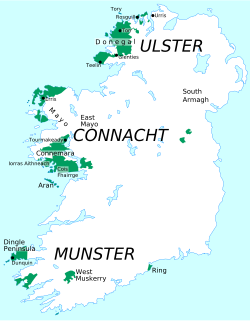
A Gaeltacht (/ˈɡeɪltəxt/ GAYL-təkht, Irish: [ˈɡeːl̪ˠt̪ˠəxt̪ˠ], pl. Gaeltachtaí) is a district of Ireland, either individually or collectively, where the Irish government recognises that the Irish language is the predominant vernacular, or language of the home. The Gaeltacht districts were first officially recognised during the 1920s in the early years of the Irish Free State, following the Gaelic revival, as part of a government policy aimed at restoring the Irish language.
The Gaeltacht is threatened by serious language decline. Research published in 2015 showed that Irish is spoken on a daily basis by two-thirds or more of the population in only 21 of the 155 electoral divisions in the Gaeltacht. Daily language use by two-thirds or more of the population is regarded by some academics as a tipping point for language survival.
In 1926, the official Gaeltacht was designated as a result of the report of the first Gaeltacht Commission Coimisiún na Gaeltachta. The exact boundaries were not defined. At the time, an area was classified as Gaeltacht if 80% or more of the population was Irish-speaking; however, partial-Gaeltacht status was also accorded to many areas that did not meet the threshold, so long as they were at least 25% Irish-speaking. The Irish Free State recognised that there were predominantly Irish-speaking or semi-Irish-speaking districts in 7 of its 26 counties, covering 22 districts.
In the 1950s, another Gaeltacht Commission concluded that the Gaeltacht boundaries were ill-defined. It recommended that Gaeltacht status be based solely on the strength of language use in an area.
The Ministers and Secretaries (Amendment) Act 1956 created the office Department of the Gaeltacht a Department of State headed by the Minister for the Gaeltacht, a member of the Government. The same legislation allowed the government to designate areas as being Gaeltacht districts. They were defined precisely by designating district electoral divisions and townlands, and excluded many areas in which the number of Irish speakers had declined. Gaeltacht areas were recognised in six of the state's 26 counties: Donegal, Galway, Mayo, Kerry, Cork, and Waterford. Two areas of County Meath, were added in 1967. Since then, there have been minor extensions: in 1974 to include Brandon, County Kerry and in Waterford, and in 1982 in Meath and Cork.
From 1956 to 1993, the Minister for the Gaeltacht often simultaneously held another portfolio (i.e. charge of another Department of State). Since 1993, rearrangements have combined the Gaeltacht with other responsibilities in a single Department of State and ministerial portfolio. The ministers, and the relevant titles (Department of... and Minister for...) have been as follows:
1956–2011: (Transfers of functions; List of ministers)
2011–2025: (Transfers of functions; List of ministers)
Gaeltacht
A Gaeltacht (/ˈɡeɪltəxt/ GAYL-təkht, Irish: [ˈɡeːl̪ˠt̪ˠəxt̪ˠ], pl. Gaeltachtaí) is a district of Ireland, either individually or collectively, where the Irish government recognises that the Irish language is the predominant vernacular, or language of the home. The Gaeltacht districts were first officially recognised during the 1920s in the early years of the Irish Free State, following the Gaelic revival, as part of a government policy aimed at restoring the Irish language.
The Gaeltacht is threatened by serious language decline. Research published in 2015 showed that Irish is spoken on a daily basis by two-thirds or more of the population in only 21 of the 155 electoral divisions in the Gaeltacht. Daily language use by two-thirds or more of the population is regarded by some academics as a tipping point for language survival.
In 1926, the official Gaeltacht was designated as a result of the report of the first Gaeltacht Commission Coimisiún na Gaeltachta. The exact boundaries were not defined. At the time, an area was classified as Gaeltacht if 80% or more of the population was Irish-speaking; however, partial-Gaeltacht status was also accorded to many areas that did not meet the threshold, so long as they were at least 25% Irish-speaking. The Irish Free State recognised that there were predominantly Irish-speaking or semi-Irish-speaking districts in 7 of its 26 counties, covering 22 districts.
In the 1950s, another Gaeltacht Commission concluded that the Gaeltacht boundaries were ill-defined. It recommended that Gaeltacht status be based solely on the strength of language use in an area.
The Ministers and Secretaries (Amendment) Act 1956 created the office Department of the Gaeltacht a Department of State headed by the Minister for the Gaeltacht, a member of the Government. The same legislation allowed the government to designate areas as being Gaeltacht districts. They were defined precisely by designating district electoral divisions and townlands, and excluded many areas in which the number of Irish speakers had declined. Gaeltacht areas were recognised in six of the state's 26 counties: Donegal, Galway, Mayo, Kerry, Cork, and Waterford. Two areas of County Meath, were added in 1967. Since then, there have been minor extensions: in 1974 to include Brandon, County Kerry and in Waterford, and in 1982 in Meath and Cork.
From 1956 to 1993, the Minister for the Gaeltacht often simultaneously held another portfolio (i.e. charge of another Department of State). Since 1993, rearrangements have combined the Gaeltacht with other responsibilities in a single Department of State and ministerial portfolio. The ministers, and the relevant titles (Department of... and Minister for...) have been as follows:
1956–2011: (Transfers of functions; List of ministers)
2011–2025: (Transfers of functions; List of ministers)
Recent media
Recent media