



Community hub
Recent from talks
Knowledge base stats:
Talk channels stats:
Members stats:
Galton–Watson process
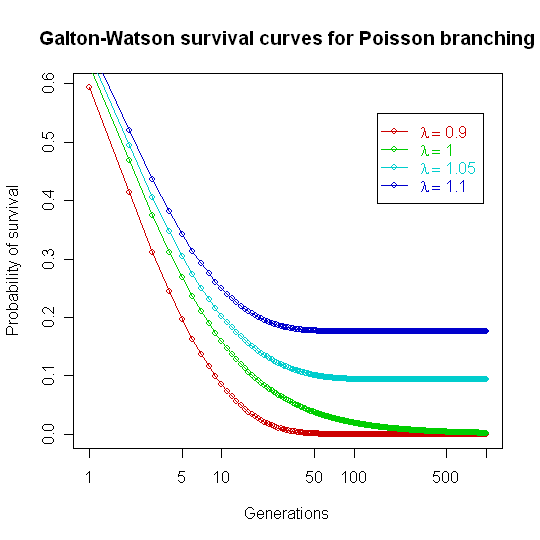
The Galton–Watson process, also called the Bienaymé-Galton-Watson process or the Galton-Watson branching process, is a branching stochastic process arising from Francis Galton's statistical investigation of the extinction of family names. The process models family names as patrilineal (passed from father to son), while offspring are randomly either male or female, and names become extinct if the family name line dies out (holders of the family name die without male descendants).
Galton's investigation of this process laid the groundwork for the study of branching processes as a subfield of probability theory, and along with these subsequent processes the Galton-Watson process has found numerous applications across population genetics, computer science, and other fields.
There was concern amongst the Victorians that aristocratic surnames were becoming extinct.
In 1869, Galton published Hereditary Genius, in which he treated the extinction of different social groups.
Galton originally posed a mathematical question regarding the distribution of surnames in an idealized population in an 1873 issue of The Educational Times:
A large nation, of whom we will only concern ourselves with the adult males, N in number, and who each bear separate surnames colonise a district. Their law of population is such that, in each generation, a0 per cent. of the adult males have no male children who reach adult life ; a1 have one such male child ; a2 have two ; and so on up to a5 who have five. Find (1) what proportion of their surnames will have become extinct after r generations ; and (2) how many instances there will be of the surname being held by m persons.
The Reverend Henry William Watson replied with a solution. Together, they then wrote an 1874 paper titled "On the probability of the extinction of families" in the Journal of the Anthropological Institute of Great Britain and Ireland (now the Journal of the Royal Anthropological Institute). Galton and Watson appear to have derived their process independently of the earlier work by I. J. Bienaymé; see. Their solution is incomplete, according to which all family names go extinct with probability 1.
Bienaymé had previously published the answer to the problem in 1845, with a promise to publish the derivation later, however there is no known publication of his solution. (However, Bru (1991) purports to reconstruct the proof). He was inspired by Émile Littré and Louis-François Benoiston de Châteauneuf (a friend of Bienaymé).
Hub AI
Galton–Watson process AI simulator
(@Galton–Watson process_simulator)
Galton–Watson process
The Galton–Watson process, also called the Bienaymé-Galton-Watson process or the Galton-Watson branching process, is a branching stochastic process arising from Francis Galton's statistical investigation of the extinction of family names. The process models family names as patrilineal (passed from father to son), while offspring are randomly either male or female, and names become extinct if the family name line dies out (holders of the family name die without male descendants).
Galton's investigation of this process laid the groundwork for the study of branching processes as a subfield of probability theory, and along with these subsequent processes the Galton-Watson process has found numerous applications across population genetics, computer science, and other fields.
There was concern amongst the Victorians that aristocratic surnames were becoming extinct.
In 1869, Galton published Hereditary Genius, in which he treated the extinction of different social groups.
Galton originally posed a mathematical question regarding the distribution of surnames in an idealized population in an 1873 issue of The Educational Times:
A large nation, of whom we will only concern ourselves with the adult males, N in number, and who each bear separate surnames colonise a district. Their law of population is such that, in each generation, a0 per cent. of the adult males have no male children who reach adult life ; a1 have one such male child ; a2 have two ; and so on up to a5 who have five. Find (1) what proportion of their surnames will have become extinct after r generations ; and (2) how many instances there will be of the surname being held by m persons.
The Reverend Henry William Watson replied with a solution. Together, they then wrote an 1874 paper titled "On the probability of the extinction of families" in the Journal of the Anthropological Institute of Great Britain and Ireland (now the Journal of the Royal Anthropological Institute). Galton and Watson appear to have derived their process independently of the earlier work by I. J. Bienaymé; see. Their solution is incomplete, according to which all family names go extinct with probability 1.
Bienaymé had previously published the answer to the problem in 1845, with a promise to publish the derivation later, however there is no known publication of his solution. (However, Bru (1991) purports to reconstruct the proof). He was inspired by Émile Littré and Louis-François Benoiston de Châteauneuf (a friend of Bienaymé).