Hubbry Logo
Gang signGang signMain
Open search
Gang sign
Community hub
Gang sign
logo
8 pages, 0 posts
0 subscribers
Be the first to start a discussion here.
Gang sign
Gang sign
from Wikipedia
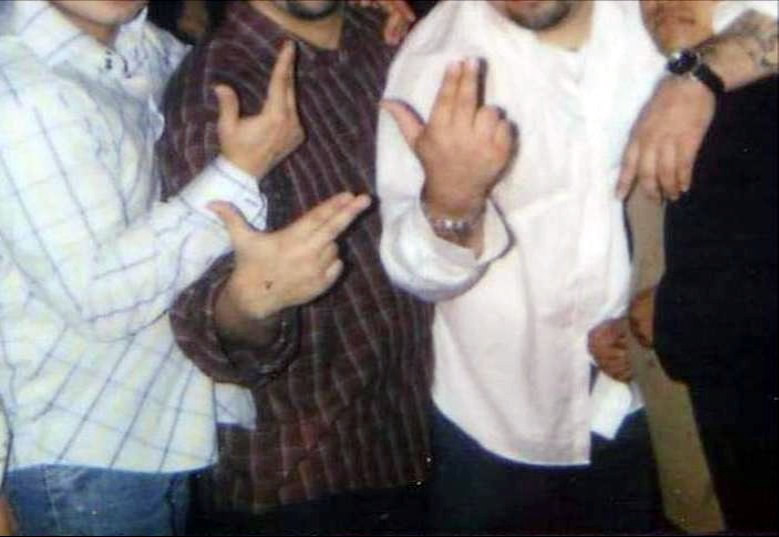
Hand signals of the Hermanos de Pistoleros Latinos

A gang sign, also known as a gang signal, is a verbal or visual way gang members identify their affiliation. This can take many forms including slogans, hand signs, colored clothing, and graffiti to indicate that the signaller favors, or is a member of, the associated gang. Many of these, especially slogans and hand signs, have become part of popular culture, especially in African American hip hop culture.

Hand signs

[edit]

"Throwing up" a gang sign (e.g., "stacking", "page", "gang walk", "banging") with the hands is one of the most known and obvious forms of "claiming" or stating the gang one is affiliated with. It is used in many situations where other identifiers may not be possible or appropriate, and it can also show that a gang member is in the area to "do business"[clarification needed] as opposed to just passing through. Usually, these signs are made by formation of the fingers on one or both hands to make some sort of symbol or letter.[1] It can also serve to relay more specific information, such as what set they represent within a larger gang or in which activities they are currently taking part. Individual letters can be used to tell stories when flashed in rapid succession, each representing a word beginning with that letter. These signs, because they are displayed only when wanted (as opposed to the types of identifiers above), are usually the most consistent across various areas. Many of these hand signals are quite close to other common hand signs, and this can cause confusion among gang members, non-gang members, and anti-gang authorities. Most African American and Mexican gangs use these symbols.

Another identifier that can be displayed only when desired is a gang handshake, which usually includes some component of the gang hand signs and/or other hand and finger symbols.[citation needed]

Clothing and other forms of identification

[edit]

Clothing is a strong signal that all gangs show. The clothing gangs wear allows rival gangs to identify who is friend and who is foe. For example, the uniforms for many Hispanic gangs are standard and easily recognizable. Gangs such as the Latin Kings would wear long yellow T-shirts, baggy pants, and either a bandana or a hat, sometimes both. Black gang members are generally more individualistic with their clothing. The gang would wear specific clothing and certain accessories that would match their crew's colors. Most gang members wear brands such as Pro Club, Dickies, and Levi's.[2]

Mask

[edit]

Masks can be worn in various types of colors and ways. This is done by gang members to signify which gang they are affiliated with. The most popular mask colors are red, blue, black, white, grey, pink, and yellow. It is typically worn on the left or right back pockets of gang members. They can also be worn as a camp mask by wrapping around the head so only the eyes show.[3]

Tattoos

[edit]

Gang members will often get tattoos to represent their gang, or subset of a gang which can include markings related to the street their set is from, or a nickname of the neighborhood given by a gang. For example, members of the Maniac Latin Disciples set known as "Rata World" may get a tattoo of the street their set originates from.

Varsity clothing

[edit]

Around the 1970s to 1990s, it was common for some of Chicago's strongest street gangs to create custom varsity sweaters to represent their gang. This trend however eventually died out due to gang members in the Chicago area being robbed, beaten, or even killed by rival gangs due to the increased status of having a rival's varsity jacket, the implication being that the victim was too weak or cowardly to keep it.

Business cards

[edit]

Another common gang identifier in 1970s to 1990s Chicago were business cards. Street gangs often used these cards in order to present themselves as businessmen, or in the case of gangs like the Almighty Gaylords, were used to intimidate rivals with text telling rival gang members to hand over their gang sweaters.

Vests

[edit]

Outlaw motorcycle clubs, and even some street gangs from New York City and New Zealand have been known to wear vests with patches representing their gangs. These vests can come in a variety of materials such as denim or leather.

Tracksuits

[edit]

Tracksuits are common among street gangs and criminals in Russia since the 1980s.[4][5][6] They later become a staple feature of a criminal-derived subculture known as gopnik.[7][8]

References

[edit]
Revisions and contributorsEdit on WikipediaRead on Wikipedia
from Grokipedia
A gang sign is a hand utilized by members of gangs as a form of to assert affiliation with a specific group, identify allies or rivals, or issue challenges. These signs typically involve configurations of fingers and hands that symbolize the gang's initials, numbers, or icons, functioning as a visual within subcultures primarily in urban environments. Originating in the early alongside the emergence of organized youth s in American cities, gang signs evolved as tools for internal cohesion and external signaling amid territorial disputes and . Their use extends beyond mere identification to encode messages, commemorate deceased members, or provoke violence, with recognizing them as indicators of gang involvement and potential threats. Distinct signs differentiate alliances like the or , where gestures such as or specific letter formations denote membership and can precipitate conflicts if displayed inappropriately. While integral to gang identity, these symbols have been documented in criminological contexts for their role in facilitating , including drug trafficking and , underscoring their practical utility in illicit operations rather than benign cultural expression.

Definition and Purpose

Core Definition

A gang sign is a hand or symbolic display used by members of criminal street to indicate affiliation, communicate non-verbally, or intimidate rivals. These signs typically involve forming letters, numbers, or icons with the fingers and hands that represent the gang's name, territory, or ideology, such as the "pitchfork" associated with the or the "bunny ears" for certain sets. Gang signs function as a discreet method of identification in environments where overt declaration could provoke , allowing members to recognize allies or signal threats without spoken words. While primarily hand-based, gang signs may extend to body postures or combined movements that convey specific meanings within the group's coded language, often evolving to evade detection. Empirical observations from reports indicate that these gestures originated as practical tools for cohesion in adversarial urban settings, where verbal communication risks interception by authorities or enemies. Unlike casual in mainstream culture, gang signs carry inherent connotations of criminal intent, with documented use in coordinating illicit activities or asserting territorial claims. Their deployment underscores the causal role of in maintaining group loyalty and operational secrecy amid ongoing rivalries.

Primary Functions

Gang signs primarily serve to assert membership and affiliation within street gangs, allowing individuals to visibly claim association with a specific group. This function of "claiming" enables members to signal and deter potential threats from rivals by publicly displaying . In addition to identification, gang signs facilitate communication among members, including greetings, silent warnings, and coordination of activities without verbal exchange. These signals help maintain group cohesion and operational secrecy in environments where overt discussion could attract attention. Externally, signs function to intimidate rivals and non-members, often conveying challenges, threats, or territorial claims through provocative gestures. This intimidation reinforces gang boundaries and escalates conflicts, contributing to patterns of violence observed in gang-dominated areas. Symbols embedded in signs also foster intra-gang pride and cultural identity, distinguishing one group from others via unique hand formations tied to gang lore or numbers. While these roles promote solidarity, they can perpetuate cycles of retaliation when misinterpreted or mimicked by outsiders.

Causal Role in Gang Dynamics

signs, particularly hand gestures, exert a causal influence on dynamics by functioning as visible signals that reduce informational asymmetries regarding membership, thereby enhancing organizational legitimacy and enabling efficient communication of threats and status to allies and rivals alike. These symbols facilitate coordinated actions, such as territorial defense and retaliation, by clearly delineating group boundaries and affiliations in high-risk environments where verbal communication may be impractical or detectable. Within gangs, the routine display of hand signs strengthens internal cohesion and , activating social categorization processes that boost in-group pride and commitment while lowering rates. Quantitative assessments reveal that organizational features like symbols correlate with reduced member exits, with each such element associated with a 12% decrease in exit probability due to heightened perceived structure and a 26% decrease tied to reinforced identity. This entrenchment sustains group processes, including loyalty enforcement and cultural , which perpetuate involvement in criminal endeavors. In inter-gang conflicts, gang signs serve to intimidate opponents and issue non-verbal warnings, often escalating tensions by signaling violent intentions or dominance assertions. For instance, gang members employ specific hand gestures—such as forming a "B" or "CK" (Crip Killer)—to greet affiliates, alert to dangers like police presence, or provoke rivals, thereby shaping the initiation and resolution of confrontations while reinforcing hierarchical interactions. Such displays identify targets for retaliation, contributing to patterns of reciprocal violence observed in gang homicides. During recruitment, overt signaling through hand signs demonstrates prospective members' dedication, functioning as a mechanism to attract and select committed individuals into the group, which prospectively elevates the likelihood of entry and escalates criminal offending thereafter. This process embeds recruits into dynamic networks where symbols amplify behavioral alignment with gang norms, further causal in perpetuating cycles of and delinquency.

Historical Development

Origins in Early 20th Century

Street proliferated in the early amid rapid , massive from , and socioeconomic disruptions in cities like New York, , and , where ethnic enclaves fostered youth groups for mutual protection against rivals and authorities. These groups, often comprising Irish, Italian, Jewish, and Polish immigrants' children, initially relied on territorial claims, nicknames, and informal verbal cues rather than elaborate visual signals, as their primary functions centered on defending neighborhoods and engaging in petty crime or labor disputes. By the and , such gangs numbered in the hundreds in major cities, with alone documenting over 1,300 youth gangs by 1927, many evolving from social clubs or athletic associations into more structured entities amid industrial competition and ethnic tensions. Symbolic communication emerged as a precursor to modern gang signs, particularly among Italian-American criminal networks like the Black Hand societies active from approximately 1900 to the mid-1920s, which used standardized icons such as a black handprint, , or in extortion letters to signify threats and affiliation without direct confrontation. These visual markers served causal roles in intimidating victims and coordinating among members across dispersed immigrant communities in New York and , where over 100 Black Hand cases were reported annually in peak years, demonstrating early reliance on covert, recognizable symbology to maintain operational secrecy and group cohesion. While not hand gestures per se, these practices laid groundwork for later gestural adaptations by providing a model of non-verbal identification in high-risk environments. During the Prohibition era (1920–1933), syndicates such as Chicago's and the Outfit expanded gang dynamics, incorporating rudimentary signals for coordination in bootlegging and turf wars, though documentation emphasizes hierarchical verbal orders over public displays. Economic pressures from the further entrenched these groups, with gang membership swelling as unemployment hit 25% in urban areas by 1933, prompting improvised identifiers like clothing styles or meeting spots to signal loyalty amid violent rivalries that claimed hundreds of lives in alone between 1920 and 1930. Empirical accounts from the period indicate limited use of hand-based signals, attributable to the era's focus on armed enforcement rather than subtle affiliation displays, contrasting with post-World War II evolutions in street-level gangs.

Post-WWII Expansion and Evolution

Following , the continuation of the Great Migration and postwar urbanization swelled African American populations in cities like and , exacerbating , housing shortages, and racial tensions that fueled the expansion of neighborhood-based street gangs. In , Black gangs proliferated from dozens in the —such as the Slausons, which numbered around 500 members by the early —to more violent entities amid economic dislocation and police pressures. These groups initially used informal identifiers like preferred attire or verbal codes, but escalating turf disputes necessitated quicker visual signals for affiliation during encounters. The late 1960s marked a turning point with the founding of the in South Central Los Angeles in 1969 by and , who organized teenagers into a protective alliance that rapidly grew to over 1,000 members by adopting structured hand signs—typically forming a "C" with the fingers—to denote loyalty and deter rivals without verbal disclosure. This innovation addressed the causal need for covert communication in high-stakes environments, where misidentification could lead to lethal , evolving signs from ad hoc gestures to deliberate tools for group cohesion. By 1972, the formed as a loose of smaller gangs, including the Piru Street Boys, to counter Crip expansion, employing rival hand signs like the "B" formed by extending the thumb and index finger while tucking others, often paired with verbal disses crossing out "C" references. In , parallel growth saw the Vice Lords consolidate in 1957 on the West Side, incorporating hand signs such as the gesture by the 1970s within the alliance, which united over 20,000 members across sets for mutual defense and drug operations. These signs evolved to encode hierarchies, with variations signaling rank or specific subsets, reflecting adaptive responses to and inter-gang warfare. Gang member migrations eastward and nationwide by the 1980s—driven by markets and policies—propagated LA- and Chicago-style hand signs, standardizing them as core identifiers while incorporating local adaptations, such as numerical throws representing block numbers. This diffusion amplified signs' role in causal chains of violence, enabling remote coordination and , though empirical from federal surveys indicate over 30,000 gangs nationwide by decade's end, with signs aiding territorial claims in 80% of documented incidents.

Modern Adaptations Since 1990s

Since the , the visibility of gang signs expanded significantly through the influence of and music videos, where artists affiliated with groups like the and incorporated hand gestures into performances, disseminating symbols to broader audiences and prompting adaptations such as rival mockery signs or diluted imitations by non-members. This media exposure, peaking with albums like N.W.A.'s in 1988 but accelerating in the , led to greater awareness among and the public, incentivizing gangs to develop more localized, set-specific variations to maintain exclusivity. By the 2000s, the rise of platforms shifted communication patterns, with members increasingly flashing signs in and videos rather than on , viewing digital displays as less risky for identification by authorities. A 2017 New Jersey State Police assessment reported that younger members exhibited a generational for expression of affiliation, including hand signs, over public demonstrations, correlating with reduced street-level visibility in surveyed areas. In response to enhanced technologies and policing, some contemporary gangs adopted subtler or abandoned overt displays altogether, prioritizing "business-oriented" models that minimize attention from ; a 2020 study identified this , where entrepreneurial sets evolved toward covert operations while traditional groups persisted with visible symbols online. Digital platforms further adapted traditional signs through proxies like emojis and hashtags in "cyberbanging," where sequences represent affiliations, threats, or instructions—such as a emoji for death threats or symbols for violence intent—escalating rivalries from virtual taunts to real-world incidents. In 2018, researchers documented cases in where emoji-laden posts fueled shootings, with gangs using platforms like (now X) for rapid dissemination, extending the causal chain from physical gestures to algorithmic amplification. New York gangs, by , employed strings for operational planning, exemplified by combinations of running man, , and icons to direct recruits in scams, blending with encrypted intent to evade monitoring tools. This evolution reflects causal adaptations to technological affordances, where platforms' permanence and reach amplify signaling efficiency but also heighten risks of decontextualized escalation or infiltration by rivals and police.

Forms of Gang Signs

Hand Gestures and Signals

Hand gestures and constitute a core non-verbal communication method among street , enabling members to identify affiliations, convey warnings, greet peers, or intimidate rivals without spoken words. These signs typically involve manipulating fingers to form initials, numbers, or symbolic shapes derived from gang , graffiti motifs, or territorial markers. Law enforcement documentation notes that such gestures facilitate discreet coordination during and serve as visual assertions of , often performed in public to deter opposition or recruit sympathizers. Prominent examples include the ' "C" sign, formed by joining the thumb and forefinger into a circle while extending the remaining fingers, which symbolizes the gang's name and distinguishes it from rivals. counter with a "B" gesture, similarly isolating the thumb and index finger, and may extend this to spell "BLOOD" across sequential hand positions or incorporate "CK" (Crip Killer) motifs to denote enmity. Latino-oriented gangs like utilize configurations such as extended thumb, index, and pinky fingers with folded middle and ring fingers, evoking horns or the number 13, alongside tattoos and clothing for layered identification. These practices trace to gangs in the 1970s, where (founded around 1969) and responding (circa 1972) adapted amid territorial conflicts, evolving into standardized lexicon by the 1980s for intra-gang signaling and inter-gang provocation. Variations exist across alliances, with affiliates employing a pitchfork-up (fingers splayed upward) to represent defiance, while uses a or bunny ears formation tied to their symbols. Empirical observations by agencies indicate hand signs' utility in rapid threat assessment—such as signaling an ambush—but reliability for individual identification varies, as non-members may mimic them via media exposure or cultural appropriation, complicating validation. Documentation emphasizes contextual observation over isolated s, as standalone displays insufficiently prove membership absent corroborating evidence like tattoos or associations.

Verbal and Non-Verbal Communications

Street gangs employ verbal communications through a of specialized , coded phrases, and identifiers that signal affiliation, coordinate illicit activities, and convey threats or disrespect toward rivals, often designed to obscure meaning from and outsiders. This terminology fosters group identity and operational secrecy; for example, Bloods members derogatorily refer to as "crabs," while use "slobs" for . Terms like "slanging" denote selling or other drugs on the street, "slippin'" warns of carelessness or vulnerability to attack, and phrases such as "send me a kite" in contexts request smuggled messages. Such verbal codes vary by gang and region but commonly include numeric substitutions (e.g., "13" for affiliations tied to influence) and abbreviations adapted into everyday speech to test loyalties or plan without detection. analyses, including glossaries from correctional agencies, document these as indicators of membership, with usage persisting in both street and incarcerated settings to maintain hierarchies and evade . Non-verbal communications in gangs, distinct from hand gestures, encompass body language cues such as deliberate postures of dominance—like puffed chests or invasive proximity—to assert or intimidate without alerting authorities, particularly in high-surveillance environments like prisons where overt signals risk interception. These include averted gazes to signal within the group or unbroken stares to challenge outsiders, reflecting subcultural norms of vigilance and power dynamics derived from street survival imperatives. In operational contexts, subtle head nods or synchronized movements among members convey coordinated intent during confrontations, minimizing verbal exposure. Empirical observations from gang reports highlight how these cues integrate with verbal to form a layered system, enhancing intra-group coordination while complicating external interpretation.

Visual and Material Identifiers

Visual and material of gang affiliation include tattoos, , accessories, , and other symbolic objects that convey membership, , or territorial claims without relying on transient gestures. These elements function as durable signals of , often enduring even after active participation wanes, and are scrutinized by law enforcement for investigative purposes. Unlike hand signs, which are performative, material identifiers provide tangible that can be documented and analyzed for patterns across incidents. Tattoos represent a primary form of permanent visual marking, frequently incorporating gang-specific icons such as numbers, initials, or imagery like crowns, pitchforks, or regional motifs that denote origin or . In and street contexts, these tattoos serve as "identity work," reinforcing group bonds through visible commitment and sometimes indicating rank or achievements within the . agencies, including the FBI, utilize tattoo analysis to link individuals to groups involved in trafficking or violence, though such markers can evolve or be concealed, limiting their reliability as standalone proof. tattoos are not merely decorative; they symbolize extended family-like ties and deter by imposing social costs for removal or cover-up. Clothing and colors act as accessible, modifiable identifiers, with gangs adopting specific hues—such as or —or apparel from teams, brands, or designers that align with their symbolism to signal presence in public spaces. Bandanas, hats, or jerseys worn in particular styles or combinations allow quick recognition among affiliates while blending into urban environments. Accessories like jewelry bearing gang acronyms or religious icons repurposed for group identity further amplify these signals, often customized to reflect sub-factions or personal status. Graffiti constitutes a territorial material identifier, involving sprayed or inscribed tags of gang names, symbols, or threats that demarcate controlled areas and commemorate events like retaliatory acts. These markings, executed with standardized styles or codes, serve as public declarations of dominance and warnings to rivals, persisting as forensic evidence in investigations. Beyond static items, vehicles modified with gang decals or emblems extend identifiers into mobile displays of affiliation. While effective for cohesion, these identifiers risk misattribution, as non-members may mimic them for fashion or protection, complicating law enforcement validation.

Regional and Organizational Variations

United States-Specific Examples

The , a predominantly African-American street gang founded in in the early 1970s, use a hand forming the letter "C" with the thumb and fingers to identify members and communicate affiliation, often paired with blue clothing as a identifier. This sign serves purposes including greeting allies, issuing warnings, and taunting rivals. The , formed in 1972 as a rival alliance to the , counter with a "B" created by extending the thumb and index finger while folding the others into the palm, frequently displayed alongside red apparel to assert loyalty and intimidate opponents. These gestures originated in South Central amid escalating turf wars and have proliferated nationwide through gang migration and subsets. Mara Salvatrucha (), a transnational gang with heavy U.S. presence since the 1980s Salvadoran immigrant waves, employs hand signs such as interlocking fingers to spell "MS" or the "devil horns" formed by extending the index and pinky fingers, symbolizing aggression and used in rituals or confrontations. , aligned with the Mexican Mafia and prevalent in and Southwest states, flash an "S" sign with the thumb and fingers to denote allegiance and opposition to . reciprocate with an "N" gesture, emphasizing ties and rivalries rooted in hierarchies exported to streets. In the Northeast and Midwest, Latin Kings—a Hispanic prison-originated gang active since the 1950s—display a "K" sign or crown gesture mimicking their five-pointed crown symbol to signal unity and dominance in drug territories. These U.S.-specific signs vary by locale, with subsets adapting them for local identifiers, but law enforcement notes their consistent role in non-verbal threats and recruitment, as documented in federal gang intelligence reports tracking over 30,000 gang members nationwide as of 2016.

International Contexts

In Central America, particularly El Salvador and Honduras, the transnational gang Mara Salvatrucha (MS-13), which originated among Salvadoran immigrants in the United States during the 1980s, utilizes hand signs to signal membership and intimidate rivals. These gestures, often forming the letters "M" and "S" or devil horn motifs, serve as quick identifiers in street confrontations and are employed by an estimated 10,000 active members across the region as of 2023. MS-13's symbols reflect a blend of Salvadoran cultural elements and adaptations from Los Angeles street gangs, emphasizing loyalty and territorial control amid high violence rates, including over 1,000 homicides linked to the gang in El Salvador alone between 2015 and 2018. Mexican cartels and affiliated groups, such as the , deploy distinct hand signals to denote faction allegiance during operations and communications. These signs, visible in documented imagery from seizures, facilitate coordination in cross-border activities and distinguish subgroups within broader criminal networks like remnants. In , the prison-originated Numbers Gangs—comprising the 26s (gold merchants), 27s (mediators and warriors), and 28s (sexual predators and enforcers)—employ numerical hand signs as core elements of their fraternal codes. Originating in the early on Johannesburg's mines, these gestures, such as for the 26s or specific finger counts for the 28s, convey , warnings, and greetings without verbal disclosure, persisting in both incarceration and urban street variants with thousands of adherents. The symbols underscore a rigid internal structure, where betrayal incurs severe penalties, contributing to ongoing documented in over 200 gang-related incidents annually in facilities like Pollsmoor as of the 2010s. European contexts, notably in the , feature urban youth gangs influenced by imported , adopting hand signs representing local postcodes (e.g., "410" for zones in ) or acronyms to mark territory and rivalries. These practices, emerging prominently since the , mirror U.S. styles but adapt to multicultural enclaves, with police reporting increased use in gang-related stabbings exceeding 1,000 incidents yearly in by 2022. In , Chinese Triad societies maintain esoteric rooted in 19th-century secret society rituals, used for covert recognition among members spanning , , and overseas diasporas. Unlike overt street displays, these subtle gestures accompany numbered codes and oaths, supporting activities like and trafficking, with an estimated 50 major Triads operating as of 2018. Japanese groups prioritize full-body tattoos over prominent hand signs, though informal signals aid internal dealings in a syndicate claiming around 25,000 members in 2023.

Gang-Affiliated Adaptations

Gang-affiliated adaptations of hand signs typically involve modifications to represent specific organizational nomenclature, symbols derived from , or gestures tailored to denote affiliation, territory, or rivalry. These adaptations emerged prominently in the late among urban street , where members developed unique gestures to communicate non-verbally in environments hostile to overt identification. For instance, signs often replicate the initials or key terms of the , such as forming letters with fingers to spell out group names. Prominent examples include the Bloods, who adapt hand formations to spell "BLOOD" using both hands or display a simple "B" gesture, sometimes incorporating an upside-down three-point crown to signify dominance over rivals like the Latin Kings. The Crips counter with a "C" sign formed by the thumb and index finger, while hybrid adaptations appear in alliances like Folk-Crip groups using an "8-Balla" gesture combining elements from both. Folk Nation affiliates adapt the pitchfork gesture upward to symbolize their six-pointed star ideology, distinct from the People Nation's five-pointed star variations. Rival gangs frequently modify these by inversion or addition, such as Crips using "BK" for "Blood Killer" to disrespect Bloods. Asian-American gangs like the Tiny Rascals Gang adapt Western signs, such as mimicking spellings while incorporating their own territorial markers like "TRG" initials. Latino groups, including , employ pointed finger clusters or crown motifs adapted from broader influences to signal loyalty and intimidate. These modifications serve functional roles beyond identification, including greetings among allies and provocations toward enemies, evolving over time to maintain secrecy amid scrutiny.

Societal and Cultural Impact

Role in Criminal Activity and Violence

Gang signs function as identifiers that enable members to signal affiliation during criminal operations, facilitating coordination in activities such as drug distribution and targeted assaults. These visual cues allow rapid recognition of allies and rivals in high-risk environments, contributing to the of gangs distinguished by their use of open intimidation and . Flashing hand signs often serves as a provocative challenge to opposing groups, escalating tensions into physical confrontations or gunfire. For instance, in a 2001 incident documented in court records, members of rival gangs exchanged signs, prompting a verbal dispute that rapidly intensified into . Similarly, during drive-by shootings, perpetrators have been reported flashing signs to communicate intent or affiliate with observers, as in cases involving pursuits where suspects displayed gestures amid the attacks. In documented gang-related homicides, signs have appeared as evidence of motive and involvement. A former and Gangster Disciples member, photographed displaying the group's hand sign, received a prison sentence in 2020 for participation in 12 murders linked to the gang's enforcement activities. associates convicted in 2024 for multiple killings similarly used hand signs in photos shown to recruits, underscoring their role in signaling loyalty and inciting retaliatory violence within territorial disputes. Such displays extend to intimidation of non-members and , embedding signs within broader patterns of gang warfare where minor provocations, including gestures, precipitate drive-by shootings or ambushes. gang reports indicate that actions like flashing signs in rival territories often trigger immediate retaliatory acts, perpetuating cycles of and injury.

Representation in Media and Pop Culture

Gang signs first entered mainstream media visibility during the 1980s through documentary-style depictions of urban gang life in Los Angeles, evolving into stylized representations in gangsta rap music videos and films by the early 1990s. In the 1988 film Colors, directed by Dennis Hopper, LAPD officers confront Crips and Bloods members who employ hand gestures to signal affiliations during territorial disputes, reflecting real street practices observed by screenwriter Michael Schiller based on embedded police experiences. Similarly, John Singleton's 1991 film Boyz n the Hood portrayed South Central Los Angeles gangs using thumb-and-finger "b" and "c" signs to denote Bloods and Crips loyalties amid drive-by shootings and initiations, drawing from Singleton's Crenshaw neighborhood upbringing for authenticity. By the and , hip-hop artists integrated signs into as markers of street credibility, often flashing them to represent sets like the ' "C" or ' "B" while narrating rivalries and hustling. West Coast rappers such as and displayed these in videos tied to releases, like (1993), where gestures underscored lyrical disses against East Coast foes, blending bravado with taxonomy. In the drill subgenre emerging around 2010 in , artists like popularized hyper-local signs in videos such as "" (2012), where pyramid or fork gestures denoted factions like , contributing to viral dissemination via platforms like . Courts have since admitted such videos as evidence of affiliation, as seen in cases where performers' on-screen signs matched documented identifiers. Television series amplified these portrayals from the 2000s onward, with shows like HBO's (2002–2008) incorporating Baltimore ' subtle during drug trade scenes to evade , based on creator David Simon's reporting on real crews like the . Athletes and non-gang celebrities adopted signs in public, such as NBA players flashing them during broadcasts, blurring lines between authentic affiliation and performative homage, as noted in analyses of sports-entertainment crossovers. This mainstreaming extended to fashion and dance, with the Crips-originated "C-Walk" incorporating footwork mimicking patterns in viral clips, influencing global youth trends by the 2010s. Critics argue that repeated media depictions glamorize semiotics, potentially normalizing violence for impressionable audiences, though empirical studies link exposure to heightened risk perceptions rather than direct causation; for instance, municipal reports highlight how rap and visuals tout prestige without proportional emphasis on incarceration rates exceeding 70% for chronic affiliates.

Public Misinterpretations and Copycat Behaviors

Instances of innocent hand gestures being misinterpreted as gang signs have led to serious consequences, including threats of violence and disciplinary actions. In October 2021, a deaf woman in the reported that a man threatened to shoot her after mistaking her (ASL) movements for gang-affiliated signals, highlighting the risks faced by deaf individuals in high-crime areas where such confusion can escalate rapidly. Similarly, in January 2014, two high school basketball players in Sheboygan Falls, , were suspended after a photograph showed them forming a "3" symbol with their fingers, which school officials erroneously identified as a gang sign despite the players' explanation that it represented their jersey numbers. Cultural and regional variations exacerbate these misinterpretations, particularly in gang-prevalent locales. In parts of , the common thumbs-up has been perceived by some as a signal, prompting warnings for visitors to avoid it to prevent misunderstandings. In , where enforce strict prohibitions on rival symbols, innocuous signs like the peace sign or "OK" have resulted in lethal retaliations; for instance, in January 2025 reports documented cases where individuals were attacked or killed for deemed provocative by members enforcing territorial codes. Such incidents underscore how context-specific can override universal meanings, leading to erroneous escalations based on visual cues alone. Copycat behaviors among non-gang often involve imitating signs to project toughness or affiliation, frequently influenced by media portrayals or peer dynamics rather than genuine criminal involvement. Research indicates that many groups adopt gang-like signals, such as hand signs, to mimic the menacing appearance of urban , thereby inflating perceived threats in suburban or rural areas without corresponding increases in persistent violence. In U.S. schools, where approximately 9% of students reported presence in 2019—a decline from 20% in —such contributes to administrative overreactions, as students replicate signs seen in music videos or , sometimes resulting in suspensions or heightened security measures despite lacking deeper ties to . These copycat practices can perpetuate cycles of misperception, as imitated signs blur lines between play and peril, prompting or community responses that treat adolescents as threats. Empirical analyses of youth reveal that signaling behaviors, including hand gestures, serve more as performative in low-risk environments than indicators of coordinated criminality, with many groups dissolving quickly after initial posturing. Consequently, educational interventions focus on distinguishing authentic gang indicators from youthful emulation to mitigate unnecessary conflicts.

Use in Law Enforcement Identification

![Hermanos de Pistoleros Latinos hand signals][float-right] agencies employ the recognition of gang hand signs as an indicator of affiliation during investigations, , and arrests, often integrating it with other identifiers such as tattoos, colors, and . These gestures, typically formed by arranging fingers to represent letters, numbers, or symbols denoting names or territories, facilitate among members and challenges to rivals. Training programs, including those from the Peace Officer Standards and Training (POST) in , instruct officers on distinguishing gang-specific hand signs across groups like African-American, , Asian, and gangs to enhance field identification. Gang intelligence units document and analyze hand signs to track membership, crime patterns, and inter-gang dynamics, as outlined in resources from the National Gang Intelligence Center and local police guides. For example, during searches, photographs capturing suspects displaying hand signs alongside known members provide evidentiary support linking individuals to organized criminal activity. In legal contexts, such as Florida's criminal statutes enacted in 2014, the deliberate adoption of a hand sign identified with a criminal constitutes a factor in proving membership or participation. Quick-reference guides distributed to officers, like the U.S. Department of Justice's overview of North American gang symbols, emphasize hand signs' role in rapid on-scene assessments while cautioning that isolated gestures require contextual corroboration to avoid misattribution. This approach aids in preempting , as hand signs can signal threats or territorial claims, but relies on empirical validation from multiple sources to ensure accuracy in enforcement actions.

Regulatory Measures and Prohibitions

In the United States, outright federal prohibitions on displaying hand signs do not exist, as such gestures are generally protected under the First Amendment unless they constitute a , to imminent violence, or communication of criminal intent, such as signaling drug sales or targeted . However, numerous municipalities have enacted local ordinances explicitly banning the public display, demonstration, or "throwing" of signs to curb and gang-related activity. For instance, in , Village Code § 132.07 deems it a violation to exhibit signs in any public place, enforceable through fines or other municipal penalties. Similarly, , under § 13.5/700-5, prohibits such actions in public, reflecting a pattern in some Midwestern communities to treat visible signaling as a public safety nuisance. Tribal jurisdictions, like the , have codified display of signs as a punishable by fines up to $100 or brief , emphasizing prevention of gang influence on reservations. Educational institutions frequently impose stricter internal regulations, with many school districts prohibiting gang signs as part of broader anti-gang policies aimed at reducing violence and disruptions. DeSoto County School District in Mississippi, for example, maintains a detailed list of prohibited gang symbols, including hand signs, which may result in disciplinary actions such as suspension or expulsion if displayed on campus. In Northampton County, Pennsylvania, high school policies adopted around 2019 allow for student removal if flashing gang signs or wearing associated colors signals affiliation, prioritizing campus safety over expressive rights in a controlled environment. Riverhead Central School District in New York updated its Code of Conduct in May 2025 to explicitly ban gang-related activities, including gestures, across all district facilities to deter recruitment and conflicts. These measures, while effective in some contexts for maintaining order, have faced legal scrutiny; a 1997 federal appeals court ruling struck down an Iowa district's gang symbol ban as unconstitutionally vague, highlighting tensions between administrative control and students' free speech protections. Correctional facilities regulate signs primarily through validation processes and security protocols rather than standalone bans, using observed gestures as evidence to classify inmates as affiliates, which can lead to placement in restrictive housing or heightened supervision. mail policies may withhold materials containing symbols, including depictions of hand signs, to prevent covert communication, as upheld in federal appeals without violating First Amendment rights in the carceral context. Internationally, state-level prohibitions remain limited and often target more broadly than hand signs; New Zealand's Gangs Act 2024, effective November 21, 2024, criminalizes public display of symbols with fines up to NZ$5,000 or six months' , resulting in immediate arrests, though focuses on patches rather than transient gestures. In , while no formal laws ban hand signs, internal has led to lethal crackdowns, with 16 executions in 2024 linked to inadvertent gestures captured in photos, underscoring non-state regulatory dynamics. Overall, prohibitions hinge on context-specific risks, with from data supporting their role in reducing overt signaling in high-risk settings.

Controversies Over Evidence and Rights

The admissibility of gang hand signs as evidence of affiliation in criminal proceedings has sparked debate over their evidentiary reliability, with critics arguing that such gestures are often ambiguous and subject to misinterpretation. Courts have required that gang-related evidence, including hand signs, be logically connected to a material issue in the case, as unsubstantiated claims risk unfair prejudice. For instance, in Martinez v. State (2003), a Texas appeals court addressed objections to photographs showing the defendant with someone displaying hand signs, weighing their probative value against potential bias. Legal experts note that hand signs overlap with non-criminal expressions, such as those in hip-hop culture or sports celebrations, undermining their use as definitive proof of membership. Misidentification based on hand signs has led to wrongful arrests and entries into gang databases, raising concerns. In 2013, a deaf man in was stabbed after bystanders mistook his gestures for signs, highlighting perceptual errors in real-world encounters. Law enforcement scandals, such as the 2020 Los Angeles Police Department case, involved officers falsifying records to label individuals as members, sometimes citing hand signs or associations, resulting in improper database inclusions that triggered heightened surveillance and biased sentencing. A 2018 analysis found that reliance on visible indicators like hand signs in gang databases contributes to and extended punishments without corroborated criminal activity. Constitutional challenges center on First Amendment protections for expressive conduct and Fourth Amendment safeguards against unreasonable seizures predicated on ambiguous signs. While probation conditions prohibiting social media posts of gang hand signs have been upheld as viewpoint-neutral restrictions tied to rehabilitation, broader bans on symbols in schools have been struck down for , as in a 1997 federal appeals ruling against an district's policy. Courts have rejected absolute free speech claims for flashing signs in threatening contexts, viewing them as unprotected if conveying imminent harm, yet emphasize that mere display does not inherently prove criminal intent. Gang databases' incorporation of hand sign evidence has faced scrutiny for arbitrariness, potentially violating privacy rights by criminalizing innocuous behavior without procedural safeguards.

References

Add your contribution
Related Hubs
User Avatar
No comments yet.