


Community hub
Recent from talks
Contribute something
Nothing was collected or created yet.
Kerchief
View on Wikipedia
A kerchief (from the Old French couvre-chef, "cover head"), also known as a bandana or bandanna, is a triangular or square piece of cloth tied around the head, face, or neck for protective or decorative purposes. The popularity of head kerchiefs may vary by culture or religion, often being used as a Christian headcovering by men and women of the Anabaptist, Eastern Orthodox, and Plymouth Brethren denominations,[1] as well as by some Orthodox Jewish and Muslim men and women and is also considered a hat.
The neckerchief and handkerchief are related items.
Types
[edit]Bandana
[edit]A bandana or bandanna (from Hindi and Urdu, ultimately from Sanskrit बन्धन or bandhana, "a bond")[2] is a type of large, usually colourful kerchief, originating from the Indian subcontinent, often worn on the head or around the neck of a person. Bandanas are frequently printed in a paisley pattern and are most often used to hold hair back, either as a fashionable head accessory or for practical purposes. It is also used to tie around the neck to prevent sunburn, and around the mouth and nose to protect from dust inhalation or to hide the identity of its wearer.
The word bandana stems from the Hindi words 'bāndhnū', or "tie-dyeing", and 'bāndhnā', "to tie". These stem from Sanskrit roots 'badhnāti', "he ties", and Sanskrit 'bandhana' (बन्धन), "a bond".[3] In the 18th and 19th centuries bandanas were frequently known as bandannoes.[4]
Bandanas originated in India as bright-coloured handkerchiefs of silk and cotton with spots in white on coloured grounds, chiefly red and blue Bandhani. The silk styles were made of the finest-quality yarns and were popular. Bandana prints for clothing were first produced in Glasgow from cotton yarns, and are now made in many qualities. The term, at present, generally means a fabric in printed styles, whether silk, silk and cotton, or all cotton.[5]
The bandana found popularity in the US during the late 1700s because snuff users preferred coloured and patterned silk handkerchiefs over white ones, as the former hid tobacco stains better when the users blew their noses. In the late 18th and early 19th centuries, bandanas began to appear with political and military advertisements printed on them.[citation needed] Such printed bandanas were common in the early and mid-1900s during World War I and World War II. Decorative bandanas were also common gear, particularly as neckwear, for cowboys, and so for country and western entertainers such as Roy Rogers and, later, Willie Nelson.[6] The latter singer began wearing bandanas when he moved from Nashville back to Austin, Texas, "just in time to catch the hippie wave cresting at counterculture center the Armadillo World Headquarters".[7]
Around the same time, bandanas also became popular with motorcyclists, particularly with Harley-Davidson riders and bikers.[citation needed] In the 1970s paisley bandanas also became popular amongst gangs in California, most notably with two well-known rival gangs, the Bloods, who wore red bandanas, and the Crips, who wore blue ones.[8]
Green bandanas have become a symbol of the abortion-rights movement.[9]
-
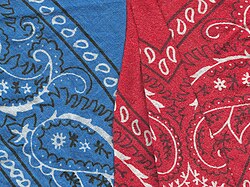 Red and blue bandanas in traditional paisley patterns
 -
 Bandanas are produced in a variety of colors and designs
 -

-
 A man wearing a bandana around his neck
 -
 A girl wearing a bandana on her head to support Portugal in football in the colors of that country's flag
 -
 Ukrainian army soldiers wearing bandanas during a military exercise


.jpg)


Oramal
[edit]
The Oramal is a traditional kerchief used in Central Asia and the Caucasus (note how it is tied, the neck is usually not covered by it). In some countries like Uzbekistan, it was traditionally used only at home, while in public the paranja was more popular. In other countries, like Kazakhstan, it was commonly used in public. In Kyrgyzstan, the white color is an indication that the woman is married.
As well it was widely used by men at horse riding in summertime instead of wearing a cap (cf. bandana of bikers).
Austronesian headscarves
[edit]Kerchiefs are also worn as headdresses by Austronesian cultures in maritime Southeast Asia. Among Malay men it is known as tengkolok and is worn during traditional occasions, such as weddings (worn by the groom) and the pesilat.
See also
[edit]References
[edit]- ^ Hume, Lynne (24 October 2013). The Religious Life of Dress: Global Fashion and Faith. Bloomsbury Publishing. ISBN 978-0-85785-363-9.
Following the general Anabaptist worldview, Hutterite dress not only emphasizes modesty but also separation from the world. ... The women wear ankle-length skirts or dresses with a blouse, a kerchief-style head covering with polka dots (tiechle), usually black and white, and solid comfortable shoes.
- ^ "Definition of bandanna". Merriam-webster.com. 2012-08-31. Retrieved 2013-03-15.
- ^ "Bandanna from Dictionary.com". Dictionary.reference.com. Retrieved 2017-06-10.
- ^ Yule and Burnell (2013), "Bandanna", p.78.
- ^ Curtis, H. P. (1921). Glossary of Textile Terms. Marsden & Co. Ltd.
- ^ Hilgers, Laura (November 2020). "The Global History of the Bandana". Smithsonian Magazine. Retrieved 14 March 2024.
- ^ "Nine-Things-You-Didnt-Know-About-Willie-Nelson". 6 June 2012. Retrieved 2021-01-19.
- ^ "Ethnic Dress in the United States: A Cultural Encyclopedia2016 010 Edited by Annette Lynch and Mitchell D.Strauss Ethnic Dress in the United States: A Cultural Encyclopedia Lanham, MD Rowman & Littlefield 2015 x + 326 pp. 9780759121485(print) 9780759121508(e-book) £49.95 $75". Reference Reviews. 30 (1): 17. 2016-01-18. doi:10.1108/rr-09-2015-0225. ISSN 0950-4125.
- ^ "How the green bandanna became a symbol of the abortion rights movement". The Seattle Times. 2022-07-07. Retrieved 2023-06-19.
- Additional sources


- Hilger, Laura (November 2020). "The Global History of the Bandana". Smithsonian Magazine.
- Yule, Henry, & A.C. Burnell (2013). Hobson-Jobson: The Definitive Glossary of British India. (Oxford, England: OUP). ISBN 9780191645839.
External links
[edit]| Headwear | |||||||||
|---|---|---|---|---|---|---|---|---|---|
| Neckwear | |||||||||
| Underwear and lingerie |
| ||||||||
| Tops | |||||||||
| Bottoms |
| ||||||||
| Full-Body Wear |
| ||||||||
| Coats and outerwear |
| ||||||||
| Nightwear | |||||||||
| Swimwear | |||||||||
| Legwear | |||||||||
| Footwear | |||||||||
| Accessories |
| ||||||||
| Dress codes |
| ||||||||
| Related | |||||||||

Kerchief
View on GrokipediaDefinition and Etymology
Definition
A kerchief is a square or triangular piece of cloth, typically folded and tied around the head or neck for covering or adornment.[1][7] It differs from a handkerchief, which is primarily a portable cloth for personal hygiene such as wiping the face or nose, though the terms have historically overlapped in usage.[1][2] Traditionally associated with women's headwear, kerchiefs provide protection from sun, dust, or wind, or serve decorative functions through patterns and folds.[8][9] The cloth is often made from lightweight fabrics like cotton or silk, allowing versatility in tying methods, such as triangular folds for neckerchiefs or square draping for headscarves.[10][2]Etymology
The English word kerchief entered the language in the 13th century as coverchef or curchef, derived from Anglo-Norman French courchief and Old French couvrechef, a compound of couvrir ("to cover") and chef ("head"), literally signifying "cover-head."[3][1] This reflects the garment's primary historical function as a head covering, with the term evolving through phonetic simplification from the original French phrasing.[3] The root chef itself traces to Latin caput ("head"), underscoring a direct etymological link to head-related apparel across Romance languages.[3] Over time, kerchief extended to denote cloths worn around the neck or used as handkerchiefs, influencing compounds like handkerchief by the 16th century, though its core meaning retained the emphasis on head coverage.[11]History
Ancient Origins
Head coverings serving as precursors to the kerchief emerged in ancient Mesopotamia, where linen cloths were used practically to protect against sun, rain, and dust across various societies. These early textiles, documented in artistic and textual records, emphasized functionality over decoration, reflecting the harsh environmental conditions of the region.[12] Around the 13th century BCE, an Assyrian legal code mandated veiling for free women and those dedicated to deities, enforcing head coverings as markers of social status and respectability while prohibiting slaves and prostitutes from adopting them. This regulation, preserved in cuneiform tablets, underscores how such attire denoted class distinctions rather than universal custom.[12][13] In ancient Egypt, archaeological evidence from tombs and reliefs dates headscarves to approximately 1350 BCE, with elite figures like Queen Nefertiti depicted wearing fine linen wraps to shield from solar exposure; these were sometimes adorned with gold or beads, blending utility with status symbolism. Linen's prevalence stemmed from its breathability in the Nile climate, as confirmed by textile remnants and iconography.[14][15] Veiling practices extended to Mycenaean Greece by circa 1300 BCE, where textual references indicate head cloths for women, possibly influenced by Near Eastern contacts, though primarily for modesty or protection rather than rigid enforcement. Physical preservation of fabrics remains rare due to decomposition, but depictions on pottery and seals provide consistent evidence of tied or draped cloths.[16]Medieval and Early Modern Periods
In medieval Europe, kerchiefs functioned chiefly as head coverings for women, enforcing modesty under Christian doctrine, shielding against weather, and containing hair for hygiene. Constructed from white or undyed linen, with occasional silk for elite variants, they included rectangular forms wrapped securely for labor-intensive tasks, as illustrated in the Tractatus de Herbis (c. 1458) and Très Riches Heures du Duc de Berry (c. 1410s).[17] Half-oval or veil-like kerchiefs, often fastened with a linen fillet headband, appeared in casual settings, evidenced in the Maciejowski Bible (13th century).[17] Among affluent classes, frilled kruselers—half-oval kerchiefs with pleated edges—prevailed in 14th-century Bohemia and Germany, drawing from fashions in Jan van Eyck's paintings, such as The Arnolfini Portrait (1434). These were frequently combined with wimples, rectangular cloths draping the neck and chin, to fully conceal a married woman's form. Smaller kerchiefs, akin to early handkerchiefs, reemerged around the 14th century as plain linen sudaria for wiping sweat or wounds, transitioning by the 15th century to decorated pieces with embroidery, signaling status and used as tokens in chivalric contexts like knights affixing them to helmets.[17][18] In the early modern era, kerchiefs adapted to shifting fashions, with neck variants proliferating alongside head uses. The term "scarf" entered English records mid-16th century, denoting versatile cloths for neck or head, influencing cravats from Croatian military neckwear adopted in 17th-century France and England. By the 18th century, triangular fichus draped over low bodices to veil the décolletage became standard for women, while buffons—voluminous, translucent neckerchiefs—adorned elite attire in the 1780s–1790s to frame ruffled collars. British men and sailors knotted handkerchiefs snugly around necks from the 1740s to 1760s, blending utility with ornamentation in cambric or silk.[19][20][21][22]Industrial and Contemporary Era
The Industrial Revolution in the 18th and 19th centuries transformed kerchief production from artisanal methods to mechanized textile manufacturing, enabling mass production of printed bandanas in Europe and the United States.[23] Advancements in dyeing and printing, such as the development of chemical Turkey red in Mulhouse, France, allowed for vibrant, durable colors mimicking traditional Indian imports, with production scaling significantly by the early 1800s.[24] In Scotland, French entrepreneur Joseph Macintyre introduced bandana printing in 1785 at the Vale of Leven, where cotton mills adopted calico techniques for large-scale output.[25] Similarly, early American production emerged in Philadelphia under printers like John Hewson, incorporating local motifs into kerchief designs.[26] In the 19th century, kerchiefs gained practical prominence among laborers, frontiersmen, and political campaigns in the United States, where bandanas served as dust masks, sweat rags, and election symbols—such as in the 1880s when printed bandannas resembled tie-dyed Indian bhandas and promoted candidates.[27] This era's industrialization democratized access, shifting kerchiefs from elite imports to everyday items for cowboys, factory workers, and farmers, often in paisley or spotted patterns for functionality over ornament.[25] In the 20th and 21st centuries, kerchiefs retained utility in occupational and military contexts while evolving into fashion staples. Neckerchiefs protected necks from environmental hazards, as seen in Ukrainian army exercises like Cooperative Osprey '98, where soldiers wore bandanas for camouflage and sweat management.[28] Contemporary uses include head kerchiefs as sweatbands during workouts, sun shields, or dust barriers, with versatile styling as belts or bracelets expanding beyond traditional ties.[29] Fashion revivals, notably in 2025, positioned bandanas as headscarves paired with prairie gowns or athletic wear, blending historical patterns with modern aesthetics across genders and cultures.[30]Types and Variations
Neck Kerchiefs
A neckerchief consists of a square cloth folded into a triangle and tied around the neck, often secured with a knot or slide.[31][32] It originated as practical neckwear for outdoor laborers and has evolved into ceremonial and fashion items across various professions.[33] In naval tradition, neckerchiefs appeared in the 16th century to serve as sweat rags and protect sailors' necks from rope abrasion during rigging tasks.[34] By 1817, the U.S. Navy standardized them as 36-inch-square black silk squares tied with a square knot, a style retained in dress blues to symbolize discipline and utility, such as for tourniquets or battle dressings.[34] Scouting adopted the neckerchief from Robert Baden-Powell's experiences in the 1896 Second Matabele War, where soldiers used scarves for bandages, slings, or sun protection.[35] Baden-Powell incorporated it into the uniform for its versatility—as a signaling flag, emergency rope, or neck guard—and as a symbol of troop identity and the Scout Promise to "do my best."[36][37] Troops select unique colors and patterns, worn triangularly over the collar or shoulder.[38] Among cowboys, square bandanas functioned as neckerchiefs from the 19th century onward for filtering dust, quenching thirst when wet, or signaling, later becoming cultural icons of the American West.[39] In culinary professions, French chef Marie-Antoine Carême introduced neckerchiefs in the early 1800s to absorb sweat in coal-oven kitchens, preventing contamination of food and uniforms amid poor ventilation.[40] Contemporary neckerchiefs, crafted from cotton, silk, or wool, appear in casual fashion tied in knots like the ascot or cowboy style, emphasizing functionality and aesthetics over historical utility.[41][42]Head Kerchiefs
Head kerchiefs are square or triangular cloths tied around the head, primarily for protective, decorative, or symbolic purposes, distinguishing them from longer scarves by their compact size and typical folding method over the crown and under the chin or at the nape.[43] They have been used across cultures to shield hair from sun, wind, or labor-related damage while signaling marital status, social role, or identity.[44] Historical records trace head kerchiefs to ancient Egypt circa 1350 BC, where fabrics covered the head in tombs and artwork for practical protection against harsh climates.[15] In Mesopotamian societies, linen head coverings similarly guarded against rain and sun, evolving into broader cultural practices by the 13th century in regions like northern Iraq.[12] [45] In European traditions, such as Bohemian, Moravian, and Slovakian folk dress, head kerchiefs (known as šátek) held deep cultural value, denoting marital status—unmarried women wore colorful patterns, while married women used white or embroidered versions—and serving in rituals from baptisms to funerals as of the 19th century.[6] Christian contexts often mandated them for women in churches until the mid-20th century, with widows and nuns employing them for modesty and mourning. In African American communities, cotton head kerchiefs originated pre-slavery as heritage links, repurposed during enslavement for resistance against dehumanizing policies that banned elaborate hairstyles, symbolizing self-definition amid oppression by the 18th-19th centuries.[46] [47] Modern head kerchiefs include casual bandanas for fashion or sports, as seen in athletic events, and traditional variants like Indian bandhani-dyed squares for ceremonial wear.[48] They continue in rural or religious settings worldwide, adapting synthetic fabrics for durability while retaining symbolic roles.[49]Regional and Cultural Variants
In South Asia, particularly India, kerchiefs produced using the ancient bandhani tie-dye technique date back over 1,000 years, featuring vibrant silk and cotton squares with white spots on red or blue grounds that influenced global designs like the paisley pattern.[24] These were traded widely, spreading to Europe via East India companies in the 18th century and adapting into practical accessories across cultures.[24] In the Americas, the bandana variant gained prominence in mid-19th-century American cowboy culture, where square cloths—often cut from flour sacks and measuring around 22 by 22 inches—served functional roles as dust filters, sweat rags, neck protection from sun and wind, and even slings or bandages during ranch work.[50] This Western adaptation retained Indian-inspired motifs but emphasized utility in arid frontiers, evolving into a symbol of rugged individualism.[24] Sub-Saharan African headwraps, a kerchief form tied with intricate folds, pleats, and knots, originated centuries ago and vary by ethnic group, region, clan affiliation, age, and marital status, signaling personal and communal identity among women.[46] In the African diaspora, such as among enslaved women in 19th-century North America, plain cotton versions preserved cultural heritage, protected hair from environmental hazards, and asserted subtle resistance amid oppression.[46] In Eastern European Slavic cultures, including Ukrainian and Russian traditions, square kerchiefs known as khustka or platok feature geometric or floral embroidery and are tied in region-specific styles—often under the chin for younger women or over the head for older ones—with colors denoting life stages: bright for unmarried girls, darker for married women, and black for widows.[51] These served practical purposes like warmth and hair coverage while embodying folk aesthetics in daily and festive attire.[52] Across Arab regions, the keffiyeh (or shemagh in variants like Jordanian or Saudi ghutrah) consists of a checkered cotton square folded into a triangular headdress secured by an agal cord, rooted in Bedouin desert protection from sun and sand, with black-and-white patterns symbolizing Palestinian solidarity in modern contexts.[53]Materials and Construction
Traditional Fabrics and Methods
Kerchiefs were traditionally fabricated from natural fibers such as cotton, linen, silk, and wool, prized for durability, breathability, and regional availability. In India, plain-woven cotton cambric or silk formed the base for early examples, while 18th-century European variants utilized fine cottons, linens, or costly silks imported via trade routes like those of the British East India Company.[25][54] Handcrafting began with spinning fibers into yarn, followed by weaving into square cloths on manual looms, often by peasant women using primitive domestic setups in regions like Russia. Dyeing employed natural sources, exemplified by the Turkey red process refined in 18th-century Scotland and France, which used madder root combined with mordants like sheep dung, olive oil, and urine across 20-30 steps for vibrant, fast cotton dyes.[54][55][25] Decorative methods featured resist techniques, including the millennia-old Indian bandhani tie-dye, where fabric is meticulously knotted to resist dye penetration, yielding dotted patterns on silk or cotton kerchiefs exported to Europe by the 18th century. Hand-block printing, with roots in ancient India, involved carving intricate designs into wooden blocks, dipping them in natural dyes, and stamping onto pre-dyed fabric to create motifs like the paisley boteh, a Persian-influenced pinecone shape adapted for kerchiefs. European adaptations initially mirrored these with wood-block prints on imported cottons, supplemented by embroidery, lace edging, or woven patterns such as stripes and checks.[24][24][25]Modern Materials and Production
Contemporary kerchiefs, including bandanas and headscarves, are primarily manufactured using cotton, polyester, silk, wool, linen, and blended fabrics such as silk-cotton or modal blends, chosen for properties like breathability, softness, and dye absorption.[56][57][58] Polyester variants offer cost-effective durability for mass production, while natural fibers like mulberry silk provide a smooth sheen suitable for fashion-oriented items.[59][60] Production processes have shifted toward automated techniques, with digital printing enabling precise, vibrant patterns on fabrics without the limitations of traditional block methods.[61] Screen printing and rotary methods using water-based pigments ensure colorfastness and fabric penetration for softer hand-feel, while dye sublimation and heat transfer apply designs via heat and pressure, ideal for custom logos on polyester blends.[62][63][64] Fabrics are cut to standard squares—typically 22 by 22 inches—then hemmed or edged for finished edges, often in high-volume facilities in regions like Asia.[65][66] Innovations include eco-friendly pigments and antimicrobial treatments in bamboo-derived materials for medical headscarves, enhancing moisture-wicking and hygiene.[67] These methods support rapid prototyping for personalized kerchiefs, with vinyl heat-pressing for short-run customizations.[65] Overall, modern output prioritizes scalability and versatility over artisanal labor, contrasting historical hand-dyeing.[61]Cultural and Religious Roles
In Western and Christian Contexts
In Western Christian traditions, kerchiefs served predominantly as head coverings for women during worship and prayer, in accordance with the Apostle Paul's exhortation in 1 Corinthians 11:5 that "every woman who prays or prophesies with her head uncovered dishonors her head."[68] This custom, observed from early Christianity onward, signified modesty, submission to divine order, and reverence, particularly as a counter to pagan practices where uncovered hair might symbolize seduction or autonomy.[69] In medieval Europe, Christian women of various social classes donned kerchiefs—simple triangular or square cloths draped over the head and secured under the chin—as standard attire for church attendance and public life, aligning with ecclesiastical teachings on female propriety and the Pauline veil.[17] Exposing hair was viewed as immodest, potentially inviting moral lapse, and kerchiefs thus reinforced communal norms of chastity and humility; unmarried women might wear them loosely, while married women tied them more securely to denote marital status.[69] The Roman Catholic Church formalized this in Canon 1262 of the 1917 Code of Canon Law, mandating head coverings for women in sacred spaces, fulfilled by kerchiefs, lace mantillas, or hats until the 1983 Code omitted the requirement amid post-Vatican II liturgical reforms and shifting cultural attitudes toward gender roles.[70] [71] Practice waned broadly by the 1960s, coinciding with broader secularization, though voluntary veiling persists among traditionalist Catholics as an act of personal piety.[68] Among conservative Anabaptist groups like the Amish and Mennonites—rooted in 16th-century Western Protestant dissent—women continue wearing plain white or black kerchiefs or cape-like prayer coverings daily and in worship, interpreting 1 Corinthians 11 as a timeless ordinance for headship and separation from fashionable worldliness; these are often heart-shaped or pleated caps supplemented by kerchiefs for outdoor labor.[72] Neckerchiefs, by contrast, hold negligible religious symbolism in these contexts, appearing more in practical or uniform applications without doctrinal mandate.In Middle Eastern and Islamic Contexts
In Middle Eastern cultures, particularly among Arabs in Islamic societies, the keffiyeh functions as a traditional kerchief, consisting of a square cotton scarf often patterned in black-and-white checks or red-and-white motifs. Worn predominantly by men, it is folded diagonally into a triangle, draped over the head for protection against intense sunlight, dust storms, and sand in arid desert environments, and secured with an agal—a black woolen cord that prevents slippage during wind or activity. This practical garment traces its origins to Bedouin nomads in the early 20th century, evolving from simple cloth wraps used by shepherds and farmers to a staple across Jordan, Iraq, Syria, and the Arabian Peninsula.[73][74][75] The keffiyeh holds cultural rather than strictly religious significance, embodying heritage, resilience, and regional identity in Muslim-majority areas, though it is not prescribed by Islamic texts like the Quran or Hadith. Historically gender-neutral, it has been adopted by both men and women in Arab contexts for everyday utility or symbolic purposes, such as during the 1936–1939 Arab Revolt in Palestine, where patterns denoted affiliation with rural or urban resistance. In Gulf states, variants like the red-and-white shemagh or plain white ghutra serve similar roles, often paired with the thobe for formal or daily wear.[76][77][78] For Muslim women, head kerchiefs align with Islamic mandates for modesty outlined in Quran 24:31 and 33:59, which instruct covering the hair, neck, and bosom to preserve privacy and deter harassment, though specific styles vary by cultural interpretation rather than doctrine. Rectangular or square scarves, pinned or wrapped to conceal hair while exposing the face, fulfill this hijab requirement in many Middle Eastern traditions, emphasizing piety over fashion; square formats akin to kerchiefs are used in some rural or conservative settings for simplicity and coverage during prayer or public life. Enforcement and styles differ, with urban women in countries like Saudi Arabia or Iran historically favoring fuller wraps, while observance remains a personal religious choice amid debates on compulsion versus voluntarism.[79][80][81]In African and Other Non-Western Contexts
In sub-Saharan African societies, head kerchiefs—locally termed doek in South Africa and Namibia, dhuku in Zimbabwe and Malawi, gele in Nigeria, and duku in Ghana—function as multifaceted cultural artifacts primarily donned by women for protection against solar exposure and as markers of identity.[82][83] These square or rectangular cloths, often fashioned from vibrant Ankara or wax prints, shield the scalp and hair from intense sunlight while absorbing perspiration during labor-intensive activities like farming.[46] Originating pre-colonially, their use predates European contact, with archaeological and ethnographic evidence linking them to indigenous textile traditions in regions such as the Yoruba kingdoms by at least the 16th century.[84] The tying styles encode social hierarchies and personal narratives; for instance, among Zulu women, intricate folds denote marital status, with married individuals employing taller, more elaborate structures symbolizing fertility and household authority, while unmarried women opt for simpler wraps.[85] In Igbo communities of Nigeria, the gele's height and fabric quality signal wealth and occasion, with premium silk variants reserved for ceremonies like weddings or funerals, where up to 10 yards of material may be layered.[82] Such practices reinforce communal bonds and gender roles, as elder women transmit tying techniques across generations, preserving oral histories embedded in knot patterns.[86] Though less tied to formalized religion than modesty veils elsewhere, these kerchiefs hold ritual significance in African traditional religions; Shona women in Zimbabwe, for example, wear dhuku during ancestor veneration rites to honor mhondoro spirits, invoking protection and fertility.[84] In Vodun practices among Fon people in Benin, headwraps dyed with indigo or adorned with cowrie shells serve as conduits for spiritual energy during initiations, dated to practices documented in 18th-century Dahomey records.[46] In other non-Western contexts, such as South Asia, kerchief variants like the Indian madras or bandhani-tied cloths function culturally as shoulder drapes or head covers in Hindu rituals, symbolizing purity during festivals like Diwali, with tie-dye techniques traceable to 4th-century Indus Valley motifs.[87] Among Polynesian societies, tapa cloth kerchiefs—beaten from mulberry bark—carry ancestral motifs in ceremonies, as evidenced in Tongan ngatu traditions from the 18th century, denoting chiefly status without direct religious mandates.[88] These usages underscore kerchiefs' role in encoding heritage amid environmental and social exigencies, distinct from Western or Abrahamic prescriptions.Controversies and Symbolism
Political Associations
The keffiyeh, a traditional checkered kerchief worn by Arab men, emerged as a symbol of Palestinian nationalism during the 1936–1939 Arab revolt against British mandate authorities and Jewish immigration, when it was adopted by rebels to conceal identities and signify resistance.[89] Its prominence grew under Yasser Arafat, leader of the Palestine Liberation Organization, who wore it draped over his shoulder in a fishtail pattern resembling historic Palestine's map, embedding it in the iconography of Palestinian self-determination and opposition to Israeli control.[90] In contemporary contexts, the keffiyeh functions as a marker of solidarity with Palestinian causes among activists worldwide, though its association with groups like Hamas—whose militants have worn it in attacks—has led critics, particularly in Israel and Western Jewish communities, to view it as emblematic of terrorism rather than mere cultural attire.[89] Bandanas, versatile square kerchiefs often in paisley prints, have carried political connotations in labor and protest movements, with red variants symbolizing worker solidarity and defiance during strikes and civil rights actions in the 20th century United States and beyond.[91] Historically, printed kerchiefs served as campaign paraphernalia in 19th-century American elections, such as silk squares featuring William Henry Harrison's portrait in 1840, waved by supporters at rallies to demonstrate allegiance before modern advertising dominated.[27] [92] In communist youth organizations, red neckerchiefs denoted ideological commitment, as seen in Soviet Pioneer groups from the 1920s onward, where the garment ritualized loyalty to Marxist-Leninist principles among children.[93] These associations highlight kerchiefs' adaptability as low-cost signals of affiliation, though interpretations vary by context: practical utility in arid regions for the keffiyeh evolved into politicized symbolism amid conflict, while bandanas' protest role reflects broader anti-establishment currents without uniform ideological fixity.[89] [91] Mainstream depictions often emphasize emancipatory narratives for such items, potentially underplaying associations with violence or authoritarianism due to prevailing sympathies in academic and media sources.Debates on Religious Mandates and Personal Freedom
In Islamic jurisprudence, the hijab—often manifested as a kerchief or headscarf—is interpreted by many scholars as a religious obligation derived from Quranic verses such as 24:31 and 33:59, which command women to cover their adornments and draw veils over their bosoms for modesty, with non-compliance viewed as sinful rather than a matter of personal discretion. This perspective holds that individual choice yields to divine command, as articulated in traditional exegeses emphasizing submission to Allah over autonomous preference, though reformist views contest its mandatory status, arguing it reflects cultural norms rather than unequivocal scriptural fiat.[94] Empirical surveys in Muslim-majority countries, such as a 2013 Pew Research poll, indicate widespread adherence, with 44% of women in Turkey and over 90% in Iraq viewing it as obligatory, underscoring communal enforcement over isolated volition. State-enforced mandates exemplify tensions between religious duty and personal liberty, as seen in Iran's post-1979 requirement for women to wear hijab in public under penalty of arrest by morality police, a policy that precipitated the 2022 protests following the death of Mahsa Amini, a 22-year-old Kurdish woman detained for improper veiling.[95] The ensuing "Woman, Life, Freedom" uprising, which expanded into broader anti-regime dissent, resulted in over 500 deaths and 22,000 detentions by security forces, with protesters explicitly rejecting coerced covering as antithetical to bodily autonomy and human dignity.[96] By 2024, defiance persisted, with increasing numbers of women forgoing the hijab in urban areas like Tehran, signaling a causal link between mandatory policies and sustained resistance, as documented by human rights monitors tracking non-compliance rates post-Amini.[97][98] Conversely, secular restrictions in Western Europe frame bans on religious head coverings as safeguards for public order and gender equality, pitting individual religious expression against collective freedoms like visibility in schools or sports. France's 2004 law prohibiting conspicuous religious symbols in public schools, including the hijab, and its 2010 full-face veil ban, were justified under laïcité principles to prevent communal segregation and promote assimilation, with proponents citing security concerns and empirical data on Islamist radicalization in veiled populations.[99][100] Critics, including European Court of Human Rights rulings on cases like Belgium's school bans, argue such measures indirectly discriminate against Muslim women, violating Article 9 of the European Convention on Human Rights by subordinating personal faith to state neutrality without proportionate justification.[101] France's 2024 Olympic hijab prohibition for athletes further intensified debates, with human rights analyses contending it exacerbates alienation rather than fostering integration, as evidenced by heightened exclusion of Muslim participants.[102][103] These conflicts reveal a core causal realism: mandates erode consent through coercion, while prohibitions risk entrenching parallel cultural norms, with outcomes hinging on enforcement's empirical effects on social cohesion versus individual agency.Uses and Applications
Practical Functions
Kerchiefs provide protection from environmental hazards in manual labor and outdoor activities. Cowboys employed them as dust filters over the mouth and nose during cattle drives to prevent inhalation of trail dust, a practice rooted in 19th-century American ranching.[104] Sailors, farmers, and miners similarly used kerchiefs to shield against sun, wind, and particulate matter, leveraging the cloth's breathability and absorbency to manage sweat and maintain visibility.[105][106] In hygiene applications, kerchiefs facilitate personal cleanliness by absorbing perspiration from the face and neck during physical exertion, as seen in historical accounts of workers in hot climates wiping sweat to avoid irritation.[107] They also serve to clean hands, faces, or noses, with origins tracing to ancient Roman "sudaria" for sweat removal during public activities.[108] For emergency medical uses, folded kerchiefs function as improvised bandages or slings to immobilize injuries. In scouting and survival contexts, the triangular configuration supports arms or secures dressings, stemming from military and pioneer traditions where such versatility addressed wounds without specialized equipment.[109][110] This adaptability arises from the cloth's pliability and sufficient surface area to distribute pressure evenly on limbs.[111]Fashion and Recent Trends
In modern fashion, kerchiefs serve as versatile accessories, frequently styled as headscarves, neckerchiefs, or bandanas to add color, pattern, and texture to outfits. Designers emphasize silk and cotton variants in paisley, floral, or solid prints, often tying them into bohemian, western, or minimalist ensembles.[112][113] Recent trends highlight a revival of the hair kerchief, evoking 1990s nostalgia and dubbed a "must-have" for summer 2025 by fashion publications, with endorsements from celebrities including Anya Taylor-Joy and Hailey Bieber.[114] Worn as a knotted headband or full covering, it pairs with casual streetwear or elevated looks, supplanting traditional sun hats in some styling guides.[115] Neckerchiefs have resurged prominently in high fashion for 2024-2025 seasons, featured in collections by Hermès, Giorgio Armani, and Begg, tied loosely around the neck for a polished, Audrey Hepburn-inspired effect.[116] Oversized iterations function as statement scarves, incorporating sustainable fabrics to align with eco-conscious preferences.[113] This accessory's adaptability extends to "Euro summer" aesthetics, where silk kerchiefs enhance vacation-ready attire.[117]References
- https://en.wiktionary.org/wiki/kerchief