



Community hub
Recent from talks
Knowledge base stats:
Talk channels stats:
Members stats:
Garden city movement
The garden city movement was a 20th century urban planning movement promoting satellite communities surrounding the central city and separated with greenbelts. These Garden Cities would contain proportionate areas of residences, industry, and agriculture. Ebenezer Howard first posited the idea in 1898 as a way to capture the primary benefits of the countryside and the city while avoiding the disadvantages presented by both. In the early 20th century, Letchworth and Welwyn Garden City were built near London according to Howard's concept and many other garden cities inspired by his model have since been built all over the world.
Inspired by the utopian novel Looking Backward by Edward Bellamy, and Henry George's work Progress and Poverty, Howard published the book To-morrow: a Peaceful Path to Real Reform in 1898 (reissued in 1902 as Garden Cities of To-morrow). His idealised garden city would house 32,000 people on a site of 9,000 acres (3,600 ha). Howard's diagrams presented such a city in a concentric pattern with open spaces, public parks, and six radial boulevards, 120 ft (37 m) wide, extending from the centre, although he made it clear that the actual site planning should be left to experts. The garden city would be self-sufficient and when it reached full population, another would be developed nearby. Howard envisaged a cluster of several garden cities as satellites of a central city of 58,000 people, linked by road and rail.
Howard's To-morrow: A Peaceful Path to Real Reform sold enough copies to warrant a second edition, now titled Garden Cities of To-morrow. This success of this book provided him the support necessary to pursue the chance to bring his vision into reality. Howard believed that all people agreed the overcrowding and deterioration of cities was one of the troubling issues of their time. He quotes a number of respected thinkers and their disdain of cities. Howard's garden city concept combined the town and country in order to provide the working class an alternative to working on farms or in "crowded, unhealthy cities".
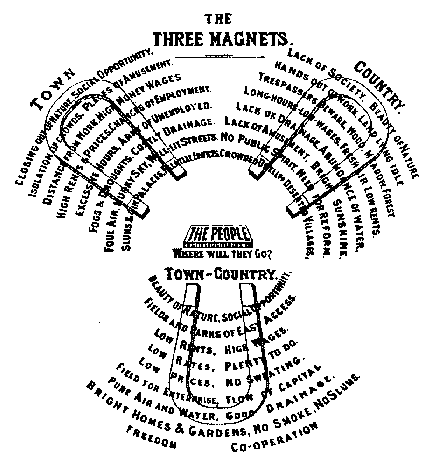
Howard envisioned the Garden City as a "third magnet" which would draw residents and small businesses from both the too-crowded city and the too-isolated countryside. He theorized that it would thus shield people from the social ills of rapid industrialization through population and density limits, strict land use controls, and shared ownership with collective management.
To build a garden city, Howard needed money to buy land. He decided to get funding from "gentlemen of responsible position and undoubted probity and honour". He founded the Garden City Association (later known as the Town and Country Planning Association or TCPA), which created First Garden City, Ltd. in 1899 to create the garden city of Letchworth. However, these donors would collect interest on their investment if the garden city generated profits through rents or, as Fishman calls the process, "philanthropic land speculation". Howard tried to include working class cooperative organisations, which included over two million members, but could not win their financial support. Because he had to rely only on the wealthy investors of First Garden City, Howard had to make concessions to his plan, such as eliminating the cooperative ownership scheme with no landlords, short-term rent increases, and hiring architects who did not agree with his rigid design plans.
In 1904, Raymond Unwin, a noted architect and town planner, and his partner Barry Parker, won the competition run by First Garden City Ltd. to plan Letchworth, an area 34 miles outside London. Unwin and Parker planned the town in the centre of the Letchworth estate with Howard's large agricultural greenbelt surrounding the town, and they shared Howard's notion that the working class deserved better and more affordable housing. However, the architects ignored Howard's symmetric design, instead replacing it with a more 'organic' design.
Letchworth slowly attracted more residents because it brought in manufacturers through low taxes, low rents, and more space. Despite Howard's best efforts, the home prices in this garden city could not remain affordable for blue-collar workers to live in. The populations comprised mostly skilled middle class workers. After a decade, the First Garden City became profitable and started paying dividends to its investors. Although many viewed Letchworth as a success, it did not immediately inspire government investment into the next line of garden cities.
In reference to the lack of government support for garden cities, Frederic James Osborn, a colleague of Howard and his eventual successor at the Garden City Association, recalled him saying, "The only way to get anything done is to do it yourself." Likely in frustration, Howard bought land at Welwyn to house the second garden city in 1919. The purchase was at auction, with money Howard desperately and successfully borrowed from friends. The Welwyn Garden City Corporation was formed to oversee the construction. But Welwyn did not become self-sustaining because it was only 20 miles from London.
Hub AI
Garden city movement AI simulator
(@Garden city movement_simulator)
Garden city movement
The garden city movement was a 20th century urban planning movement promoting satellite communities surrounding the central city and separated with greenbelts. These Garden Cities would contain proportionate areas of residences, industry, and agriculture. Ebenezer Howard first posited the idea in 1898 as a way to capture the primary benefits of the countryside and the city while avoiding the disadvantages presented by both. In the early 20th century, Letchworth and Welwyn Garden City were built near London according to Howard's concept and many other garden cities inspired by his model have since been built all over the world.
Inspired by the utopian novel Looking Backward by Edward Bellamy, and Henry George's work Progress and Poverty, Howard published the book To-morrow: a Peaceful Path to Real Reform in 1898 (reissued in 1902 as Garden Cities of To-morrow). His idealised garden city would house 32,000 people on a site of 9,000 acres (3,600 ha). Howard's diagrams presented such a city in a concentric pattern with open spaces, public parks, and six radial boulevards, 120 ft (37 m) wide, extending from the centre, although he made it clear that the actual site planning should be left to experts. The garden city would be self-sufficient and when it reached full population, another would be developed nearby. Howard envisaged a cluster of several garden cities as satellites of a central city of 58,000 people, linked by road and rail.
Howard's To-morrow: A Peaceful Path to Real Reform sold enough copies to warrant a second edition, now titled Garden Cities of To-morrow. This success of this book provided him the support necessary to pursue the chance to bring his vision into reality. Howard believed that all people agreed the overcrowding and deterioration of cities was one of the troubling issues of their time. He quotes a number of respected thinkers and their disdain of cities. Howard's garden city concept combined the town and country in order to provide the working class an alternative to working on farms or in "crowded, unhealthy cities".
Howard envisioned the Garden City as a "third magnet" which would draw residents and small businesses from both the too-crowded city and the too-isolated countryside. He theorized that it would thus shield people from the social ills of rapid industrialization through population and density limits, strict land use controls, and shared ownership with collective management.
To build a garden city, Howard needed money to buy land. He decided to get funding from "gentlemen of responsible position and undoubted probity and honour". He founded the Garden City Association (later known as the Town and Country Planning Association or TCPA), which created First Garden City, Ltd. in 1899 to create the garden city of Letchworth. However, these donors would collect interest on their investment if the garden city generated profits through rents or, as Fishman calls the process, "philanthropic land speculation". Howard tried to include working class cooperative organisations, which included over two million members, but could not win their financial support. Because he had to rely only on the wealthy investors of First Garden City, Howard had to make concessions to his plan, such as eliminating the cooperative ownership scheme with no landlords, short-term rent increases, and hiring architects who did not agree with his rigid design plans.
In 1904, Raymond Unwin, a noted architect and town planner, and his partner Barry Parker, won the competition run by First Garden City Ltd. to plan Letchworth, an area 34 miles outside London. Unwin and Parker planned the town in the centre of the Letchworth estate with Howard's large agricultural greenbelt surrounding the town, and they shared Howard's notion that the working class deserved better and more affordable housing. However, the architects ignored Howard's symmetric design, instead replacing it with a more 'organic' design.
Letchworth slowly attracted more residents because it brought in manufacturers through low taxes, low rents, and more space. Despite Howard's best efforts, the home prices in this garden city could not remain affordable for blue-collar workers to live in. The populations comprised mostly skilled middle class workers. After a decade, the First Garden City became profitable and started paying dividends to its investors. Although many viewed Letchworth as a success, it did not immediately inspire government investment into the next line of garden cities.
In reference to the lack of government support for garden cities, Frederic James Osborn, a colleague of Howard and his eventual successor at the Garden City Association, recalled him saying, "The only way to get anything done is to do it yourself." Likely in frustration, Howard bought land at Welwyn to house the second garden city in 1919. The purchase was at auction, with money Howard desperately and successfully borrowed from friends. The Welwyn Garden City Corporation was formed to oversee the construction. But Welwyn did not become self-sustaining because it was only 20 miles from London.