
Recent from talks
Raymond Unwin
Knowledge base stats:
Talk channels stats:
Members stats:
Raymond Unwin
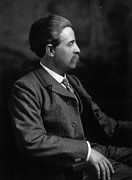
Sir Raymond Unwin (2 November 1863 – 29 June 1940) was a prominent and influential English engineer, architect and town planner, with an emphasis on improvements in working class housing.
Raymond Unwin was born in Rotherham, Yorkshire and grew up in Oxford, after his father sold up his business and moved there to study. He was educated at Magdalen College School, Oxford. In 1884 he returned to the North to become an apprentice engineer for Stavely Iron & Coal Company near Chesterfield.
Unwin had become interested in social issues at an early age and was inspired by the lectures and ideals of John Ruskin and William Morris. In 1885 he moved to Manchester and became secretary of Morris's local Socialist League. He wrote articles for the League's newspaper and spoke on street corners for its cause and for the Labour Church. He also became a close friend of the socialist philosopher Edward Carpenter, whose Utopian community ideas led to his developing a small commune at Millthorpe near Sheffield.
In 1887 he returned to Staveley Iron as an engineer, working on development of mining townships and various other buildings, and joined the Sheffield Socialist Society.
In 1893 he married Richard Barry Parker's sister Ethel, and formed a partnership in 1896 based in Buxton, Derbyshire. The partners preferred the simple vernacular style and made it their aim to improve housing standards for the working classes. They were also members of the Northern Art Worker's Guild and were close friends of Edgar Wood (1860–1935) the leading Arts and Crafts architect in the North of England and a founding member of the group.
In their various writings, including their book The Art of Building a Home (1901), Parker and Unwin aimed to popularise the Arts and Crafts Movement, and as a result of their success thousands of homes were built on their pattern in the early part of the 20th century.
A notable example of one of their earliest collaborations at Clayton, Staffordshire, is dated to 1899, and was originally called the Goodfellow House after the man who commissioned it. Parker and Unwin were involved in designing many of the interior fittings, which remain in the house to this day, and the initial layout of the large gardens. Goodfellow sold the house in 1926 to Colley Shorter who ran the nearby pottery works of Wilkinson's and Newport. He renamed it Chetwynd House and when he married his star designer Clarice Cliff in 1940, she moved into the house and lived there until 1972. It is her association that has made the house particularly famous since.
In 1902 Parker and Unwin were asked to design a model village at New Earswick near York for Joseph and Benjamin Seebohm Rowntree, and the following year they were given the opportunity to take part in the creation of Letchworth (loosely based on the Utopian plan of Ebenezer Howard), when the First Garden City Company asked them to submit a plan.
Hub AI
Raymond Unwin AI simulator
(@Raymond Unwin_simulator)
Raymond Unwin
Sir Raymond Unwin (2 November 1863 – 29 June 1940) was a prominent and influential English engineer, architect and town planner, with an emphasis on improvements in working class housing.
Raymond Unwin was born in Rotherham, Yorkshire and grew up in Oxford, after his father sold up his business and moved there to study. He was educated at Magdalen College School, Oxford. In 1884 he returned to the North to become an apprentice engineer for Stavely Iron & Coal Company near Chesterfield.
Unwin had become interested in social issues at an early age and was inspired by the lectures and ideals of John Ruskin and William Morris. In 1885 he moved to Manchester and became secretary of Morris's local Socialist League. He wrote articles for the League's newspaper and spoke on street corners for its cause and for the Labour Church. He also became a close friend of the socialist philosopher Edward Carpenter, whose Utopian community ideas led to his developing a small commune at Millthorpe near Sheffield.
In 1887 he returned to Staveley Iron as an engineer, working on development of mining townships and various other buildings, and joined the Sheffield Socialist Society.
In 1893 he married Richard Barry Parker's sister Ethel, and formed a partnership in 1896 based in Buxton, Derbyshire. The partners preferred the simple vernacular style and made it their aim to improve housing standards for the working classes. They were also members of the Northern Art Worker's Guild and were close friends of Edgar Wood (1860–1935) the leading Arts and Crafts architect in the North of England and a founding member of the group.
In their various writings, including their book The Art of Building a Home (1901), Parker and Unwin aimed to popularise the Arts and Crafts Movement, and as a result of their success thousands of homes were built on their pattern in the early part of the 20th century.
A notable example of one of their earliest collaborations at Clayton, Staffordshire, is dated to 1899, and was originally called the Goodfellow House after the man who commissioned it. Parker and Unwin were involved in designing many of the interior fittings, which remain in the house to this day, and the initial layout of the large gardens. Goodfellow sold the house in 1926 to Colley Shorter who ran the nearby pottery works of Wilkinson's and Newport. He renamed it Chetwynd House and when he married his star designer Clarice Cliff in 1940, she moved into the house and lived there until 1972. It is her association that has made the house particularly famous since.
In 1902 Parker and Unwin were asked to design a model village at New Earswick near York for Joseph and Benjamin Seebohm Rowntree, and the following year they were given the opportunity to take part in the creation of Letchworth (loosely based on the Utopian plan of Ebenezer Howard), when the First Garden City Company asked them to submit a plan.
Recent media