
Recent from talks
Garlic
Knowledge base stats:
Talk channels stats:
Members stats:
Garlic
Garlic (Allium sativum) is a species of bulbous flowering plants in the genus Allium. Its close relatives include the onion, shallot, leek, chives, Welsh onion, and Chinese onion. Garlic is native to central and south Asia, stretching from the Black Sea through the southern Caucasus, northeastern Iran, and the Hindu Kush; it also grows wild in parts of Mediterranean Europe. There are two subspecies and hundreds of varieties of garlic.
Garlic has been used for thousands of years as a seasoning, culinary ingredient, and traditional medical remedy. It was known in many ancient civilizations, including the Babylonians, Egyptians, Jews, Romans, and Chinese, and remains significant in many cuisines and folk treatments, especially across the Mediterranean and Asia. Garlic propagates in a variety of climates and conditions and is produced globally; China is by far the largest producer, accounting for over two thirds (73%) of the world's supply in 2021.[according to whom?]
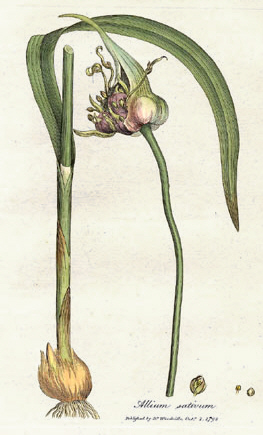
Garlic is a perennial flowering plant that is native to Central Asia, South Asia and northeastern Iran. It grows from a bulb, with a tall, erect flowering stem that reaches up to 1 m (3 ft). The leaf blade is flat, linear, solid, and approximately 1.25–2.5 cm (0.5–1.0 in) wide, with an acute apex. The plant may produce pink to purple flowers from July to September in the Northern Hemisphere. The bulb has a strong odor and is typically made up of 10 to 20 cloves. The cloves close to the center are symmetrical, and those surrounding the center can be asymmetrical. Each clove is enclosed in an inner sheathing leaf surrounded by layers of outer sheathing leaves. If garlic is planted at the proper time and depth, it can be grown as far north as Alaska. It produces hermaphroditic flowers. It is pollinated by butterflies, moths, and other insects.
Fresh or crushed garlic yields the sulfur-containing compounds allicin, ajoene, diallyl polysulfides, vinyldithiins, and S-allylcysteine, as well as enzymes, saponins, flavonoids, and Maillard reaction products when cooked, which are not sulfur-containing compounds.
The phytochemicals responsible for the sharp flavor of garlic are produced when the plant's cells are damaged. When a cell is broken by chopping, chewing, or crushing, enzymes stored in cell vacuoles trigger the breakdown of several sulfur-containing compounds stored in the cell fluids (cytosol). The resultant compounds are responsible for the sharp or hot taste and strong smell of garlic. Some of the compounds are unstable and continue to react over time.
Among alliums, garlic has by far the highest concentrations of initial reaction products, making garlic much more potent than onion, shallot, or leeks. Although many humans enjoy the taste of garlic, these compounds are believed to have evolved as a defensive mechanism, deterring animals such as birds, insects, and worms from eating the plant.
A large number of sulfur compounds contribute to the smell and taste of garlic. Allicin has been found to be the compound most responsible for the "hot" sensation of raw garlic. This chemical opens thermo-transient receptor potential channels that are responsible for the burning sense of heat in foods. The process of cooking garlic removes allicin, thus mellowing its spiciness. Allicin, along with its decomposition products diallyl disulfide and diallyl trisulfide, are major contributors to the characteristic odor of garlic, with other allicin-derived compounds, such as vinyldithiins and ajoene.
Identification of the wild progenitor of common garlic is difficult due to the sterility of its many cultivars, which limits the ability to cross test with wild relatives.[citation needed] Genetically and morphologically, garlic is most similar to the wild species Allium longicuspis, which grows in central and southwestern Asia. However, because A. longicuspis is also mostly sterile, it is doubtful that it is the ancestor of A. sativum. Other candidates that have been suggested include A. tuncelianum, A. macrochaetum, and A. truncatum, all of which are native to the Middle East.
Hub AI
Garlic AI simulator
(@Garlic_simulator)
Garlic
Garlic (Allium sativum) is a species of bulbous flowering plants in the genus Allium. Its close relatives include the onion, shallot, leek, chives, Welsh onion, and Chinese onion. Garlic is native to central and south Asia, stretching from the Black Sea through the southern Caucasus, northeastern Iran, and the Hindu Kush; it also grows wild in parts of Mediterranean Europe. There are two subspecies and hundreds of varieties of garlic.
Garlic has been used for thousands of years as a seasoning, culinary ingredient, and traditional medical remedy. It was known in many ancient civilizations, including the Babylonians, Egyptians, Jews, Romans, and Chinese, and remains significant in many cuisines and folk treatments, especially across the Mediterranean and Asia. Garlic propagates in a variety of climates and conditions and is produced globally; China is by far the largest producer, accounting for over two thirds (73%) of the world's supply in 2021.[according to whom?]
Garlic is a perennial flowering plant that is native to Central Asia, South Asia and northeastern Iran. It grows from a bulb, with a tall, erect flowering stem that reaches up to 1 m (3 ft). The leaf blade is flat, linear, solid, and approximately 1.25–2.5 cm (0.5–1.0 in) wide, with an acute apex. The plant may produce pink to purple flowers from July to September in the Northern Hemisphere. The bulb has a strong odor and is typically made up of 10 to 20 cloves. The cloves close to the center are symmetrical, and those surrounding the center can be asymmetrical. Each clove is enclosed in an inner sheathing leaf surrounded by layers of outer sheathing leaves. If garlic is planted at the proper time and depth, it can be grown as far north as Alaska. It produces hermaphroditic flowers. It is pollinated by butterflies, moths, and other insects.
Fresh or crushed garlic yields the sulfur-containing compounds allicin, ajoene, diallyl polysulfides, vinyldithiins, and S-allylcysteine, as well as enzymes, saponins, flavonoids, and Maillard reaction products when cooked, which are not sulfur-containing compounds.
The phytochemicals responsible for the sharp flavor of garlic are produced when the plant's cells are damaged. When a cell is broken by chopping, chewing, or crushing, enzymes stored in cell vacuoles trigger the breakdown of several sulfur-containing compounds stored in the cell fluids (cytosol). The resultant compounds are responsible for the sharp or hot taste and strong smell of garlic. Some of the compounds are unstable and continue to react over time.
Among alliums, garlic has by far the highest concentrations of initial reaction products, making garlic much more potent than onion, shallot, or leeks. Although many humans enjoy the taste of garlic, these compounds are believed to have evolved as a defensive mechanism, deterring animals such as birds, insects, and worms from eating the plant.
A large number of sulfur compounds contribute to the smell and taste of garlic. Allicin has been found to be the compound most responsible for the "hot" sensation of raw garlic. This chemical opens thermo-transient receptor potential channels that are responsible for the burning sense of heat in foods. The process of cooking garlic removes allicin, thus mellowing its spiciness. Allicin, along with its decomposition products diallyl disulfide and diallyl trisulfide, are major contributors to the characteristic odor of garlic, with other allicin-derived compounds, such as vinyldithiins and ajoene.
Identification of the wild progenitor of common garlic is difficult due to the sterility of its many cultivars, which limits the ability to cross test with wild relatives.[citation needed] Genetically and morphologically, garlic is most similar to the wild species Allium longicuspis, which grows in central and southwestern Asia. However, because A. longicuspis is also mostly sterile, it is doubtful that it is the ancestor of A. sativum. Other candidates that have been suggested include A. tuncelianum, A. macrochaetum, and A. truncatum, all of which are native to the Middle East.
Recent media