



Community hub
Recent from talks
Knowledge base stats:
Talk channels stats:
Members stats:
Gateball
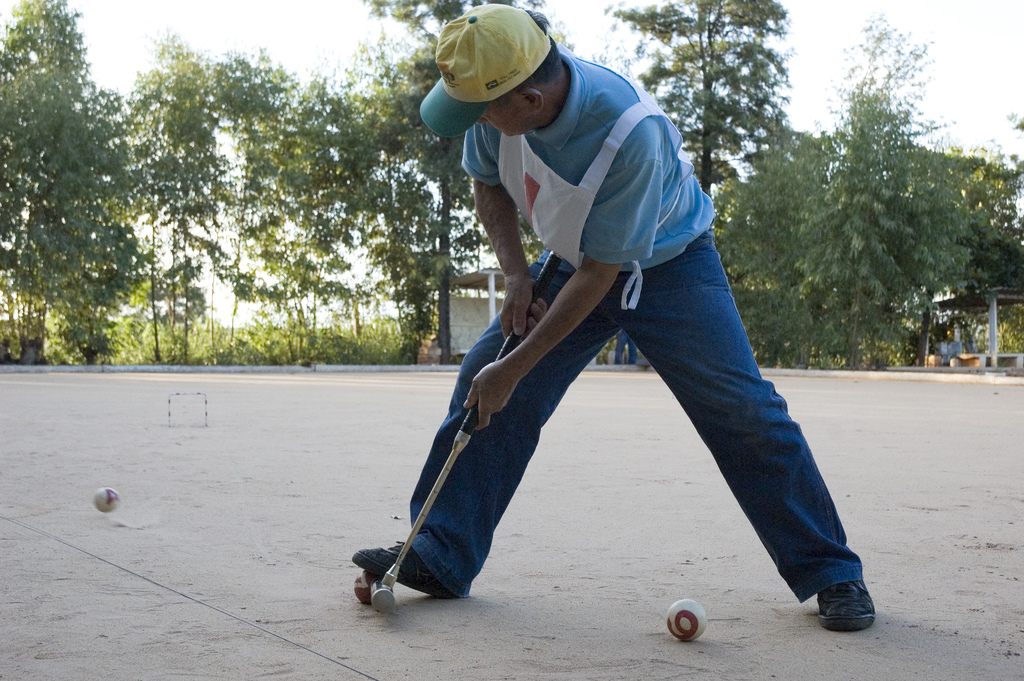
Gateball (Japanese: ゲートボール, Hepburn: gētobōru) is a mallet team sport inspired by croquet. It is a fast-paced, non-contact, highly strategic team game, which can be played by anyone regardless of age or gender. Gateball is most popular in China, Indonesia, Japan, South Korea and Taiwan, with a growing presence in other countries.
Gateball is played on a rectangular court 20 metres (66 ft) long and 15 metres (49 ft) wide. Each court has three gates and a goal pole. The game is played by two teams (red and white) of up to five players. Each player has a numbered ball corresponding to their playing order. The odd-numbered balls are red and the even-numbered balls are white. Teams score one point for each ball hit through a gate and two points for hitting the goal pole, in accordance with the rules. A game of gateball lasts for thirty minutes and the winner is the team with the most points at the end of the game.
Gateball was invented in Japan by Suzuki Kazunobu in 1947. At the time there was a severe shortage of rubber needed to make the balls used in many sports. Suzuki, then working in the lumber industry on the northern island of Hokkaido, realised there was a ready supply of the wood used to make croquet balls and mallets. He revised the rules of croquet and created gateball as a game for young people.
Gateball first became popular in the late 1950s when a physical education instructor introduced gateball to the women's societies and senior citizens' clubs of Kumamoto City. In 1962, the Kumamoto Gateball Association was formed and established a local set of rules. This version of the game became known nationally when it was demonstrated at a national fitness meet in Kumamoto in 1976. Shortly afterwards gateball's popularity exploded as local government officials and representatives of senior citizens' organisations introduced the sport around the country.
In 1984, the Japanese Gateball Union (JGU) was founded. Under the leadership of its inaugural chairman, Ryoichi Sasakawa, the JGU developed a unified set of rules and organised the first national meet. The following year, the JGU joined with five countries and regions, China, Korea, Brazil, United States of America and Chinese Taipei (Taiwan), to form the World Gateball Union (WGU). The WGU has since been joined by Bolivia (1987), Paraguay (1987), Peru (1987), Argentina (1989), Canada (1989), Singapore (1994), Hong Kong (1998), Australia (2003), Macao (2005), Philippines (2012) and Indonesia (2013).
The World Gateball Union was founded in 1985 and have 16 countries members in 2025. In 1986, the first World Gateball Championship (WGU) was held in Hokkaido, the birthplace of Gateball.
16 Nations in March 2025:
Also have about 30 no member nations.
Hub AI
Gateball AI simulator
(@Gateball_simulator)
Gateball
Gateball (Japanese: ゲートボール, Hepburn: gētobōru) is a mallet team sport inspired by croquet. It is a fast-paced, non-contact, highly strategic team game, which can be played by anyone regardless of age or gender. Gateball is most popular in China, Indonesia, Japan, South Korea and Taiwan, with a growing presence in other countries.
Gateball is played on a rectangular court 20 metres (66 ft) long and 15 metres (49 ft) wide. Each court has three gates and a goal pole. The game is played by two teams (red and white) of up to five players. Each player has a numbered ball corresponding to their playing order. The odd-numbered balls are red and the even-numbered balls are white. Teams score one point for each ball hit through a gate and two points for hitting the goal pole, in accordance with the rules. A game of gateball lasts for thirty minutes and the winner is the team with the most points at the end of the game.
Gateball was invented in Japan by Suzuki Kazunobu in 1947. At the time there was a severe shortage of rubber needed to make the balls used in many sports. Suzuki, then working in the lumber industry on the northern island of Hokkaido, realised there was a ready supply of the wood used to make croquet balls and mallets. He revised the rules of croquet and created gateball as a game for young people.
Gateball first became popular in the late 1950s when a physical education instructor introduced gateball to the women's societies and senior citizens' clubs of Kumamoto City. In 1962, the Kumamoto Gateball Association was formed and established a local set of rules. This version of the game became known nationally when it was demonstrated at a national fitness meet in Kumamoto in 1976. Shortly afterwards gateball's popularity exploded as local government officials and representatives of senior citizens' organisations introduced the sport around the country.
In 1984, the Japanese Gateball Union (JGU) was founded. Under the leadership of its inaugural chairman, Ryoichi Sasakawa, the JGU developed a unified set of rules and organised the first national meet. The following year, the JGU joined with five countries and regions, China, Korea, Brazil, United States of America and Chinese Taipei (Taiwan), to form the World Gateball Union (WGU). The WGU has since been joined by Bolivia (1987), Paraguay (1987), Peru (1987), Argentina (1989), Canada (1989), Singapore (1994), Hong Kong (1998), Australia (2003), Macao (2005), Philippines (2012) and Indonesia (2013).
The World Gateball Union was founded in 1985 and have 16 countries members in 2025. In 1986, the first World Gateball Championship (WGU) was held in Hokkaido, the birthplace of Gateball.
16 Nations in March 2025:
Also have about 30 no member nations.