


Community hub
Recent from talks
Contribute something
Nothing was collected or created yet.
Rectangle
View on Wikipedia
| Rectangle | |
|---|---|
 Rectangle | |
| Type | quadrilateral, trapezium, parallelogram, orthotope |
| Edges and vertices | 4 |
| Schläfli symbol | { } × { } |
| Coxeter–Dynkin diagrams |   |
| Symmetry group | Dihedral (D2), [2], (*22), order 4 |
| Properties | convex, isogonal, cyclic Opposite angles and sides are congruent |
| Dual polygon | rhombus |
In Euclidean plane geometry, a rectangle is a rectilinear convex polygon or a quadrilateral with four right angles. It can also be defined as: an equiangular quadrilateral, since equiangular means that all of its angles are equal (360°/4 = 90°); or a parallelogram containing a right angle. A rectangle with four sides of equal length is a square. The term "oblong" is used to refer to a non-square rectangle.[1][2][3] A rectangle with vertices ABCD would be denoted as  ABCD.
ABCD.
The word rectangle comes from the Latin rectangulus, which is a combination of rectus (as an adjective, right, proper) and angulus (angle).
A crossed rectangle is a crossed (self-intersecting) quadrilateral which consists of two opposite sides of a rectangle along with the two diagonals[4] (therefore only two sides are parallel). It is a special case of an antiparallelogram, and its angles are not right angles and not all equal, though opposite angles are equal. Other geometries, such as spherical, elliptic, and hyperbolic, have so-called rectangles with opposite sides equal in length and equal angles that are not right angles.
Rectangles are involved in many tiling problems, such as tiling the plane by rectangles or tiling a rectangle by polygons.
Characterizations
[edit]A convex quadrilateral is a rectangle if and only if it is any one of the following:[5][6]
- a parallelogram with at least one right angle
- a parallelogram with diagonals of equal length
- a parallelogram ABCD where triangles ABD and DCA are congruent
- an equiangular quadrilateral
- a quadrilateral with four right angles
- a quadrilateral where the two diagonals are equal in length and bisect each other[7]
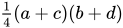
- a convex quadrilateral with successive sides a, b, c, d whose area is .[8]: fn.1
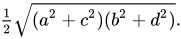
- a convex quadrilateral with successive sides a, b, c, d whose area is [8]
Classification
[edit]
Traditional hierarchy
[edit]A rectangle is a special case of a parallelogram in which each pair of adjacent sides is perpendicular.
A parallelogram is a special case of a trapezium (known as a trapezoid in North America) in which both pairs of opposite sides are parallel and equal in length.
A trapezium is a convex quadrilateral which has at least one pair of parallel opposite sides.
A convex quadrilateral is
- Simple: The boundary does not cross itself.
- Star-shaped: The whole interior is visible from a single point, without crossing any edge.
Alternative hierarchy
[edit]De Villiers defines a rectangle more generally as any quadrilateral with axes of symmetry through each pair of opposite sides.[9] This definition includes both right-angled rectangles and crossed rectangles. Each has an axis of symmetry parallel to and equidistant from a pair of opposite sides, and another which is the perpendicular bisector of those sides, but, in the case of the crossed rectangle, the first axis is not an axis of symmetry for either side that it bisects.
Quadrilaterals with two axes of symmetry, each through a pair of opposite sides, belong to the larger class of quadrilaterals with at least one axis of symmetry through a pair of opposite sides. These quadrilaterals comprise isosceles trapezia and crossed isosceles trapezia (crossed quadrilaterals with the same vertex arrangement as isosceles trapezia).
Properties
[edit]Symmetry
[edit]A rectangle is cyclic: all corners lie on a single circle.
It is equiangular: all its corner angles are equal (each of 90 degrees).
It is isogonal or vertex-transitive: all corners lie within the same symmetry orbit.
It has two lines of reflectional symmetry and rotational symmetry of order 2 (through 180°).
Rectangle-rhombus duality
[edit]The dual polygon of a rectangle is a rhombus, as shown in the table below.[10]
| Rectangle | Rhombus |
|---|---|
| All angles are equal. | All sides are equal. |
| Alternate sides are equal. | Alternate angles are equal. |
| Its centre is equidistant from its vertices, hence it has a circumcircle. | Its centre is equidistant from its sides, hence it has an incircle. |
| Two axes of symmetry bisect opposite sides. | Two axes of symmetry bisect opposite angles. |
| Diagonals are equal in length. | Diagonals intersect at equal angles. |
| All angles are right angles; opposite sides are equal and parallel | All sides are equal; opposite sides are parallel. |
- The figure formed by joining, in order, the midpoints of the sides of a rectangle is a rhombus and vice versa.
Miscellaneous
[edit]A rectangle is a rectilinear polygon: its sides meet at right angles.
A rectangle in the plane can be defined by five independent degrees of freedom consisting, for example, of three for position (comprising two of translation and one of rotation), one for shape (aspect ratio), and one for overall size (area).
Two rectangles, neither of which will fit inside the other, are said to be incomparable.
Formulae
[edit]

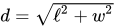
If a rectangle has length and width , then:[11]




Theorems
[edit]The isoperimetric theorem for rectangles states that among all rectangles of a given perimeter, the square has the largest area.
The midpoints of the sides of any quadrilateral with perpendicular diagonals form a rectangle.
A parallelogram with equal diagonals is a rectangle.
The Japanese theorem for cyclic quadrilaterals[12] states that the incentres of the four triangles determined by the vertices of a cyclic quadrilateral taken three at a time form a rectangle.
The British flag theorem states that with vertices denoted A, B, C, and D, for any point P on the same plane of a rectangle:[13]

For every convex body C in the plane, we can inscribe a rectangle r in C such that a homothetic copy R of r is circumscribed about C and the positive homothety ratio is at most 2 and .[14]

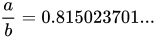
There exists a unique rectangle with sides and , where is less than , with two ways of being folded along a line through its center such that the area of overlap is minimized and each area yields a different shape – a triangle and a pentagon. The unique ratio of side lengths is .[15]


Crossed rectangles
[edit]A crossed quadrilateral (self-intersecting) consists of two opposite sides of a non-self-intersecting quadrilateral along with the two diagonals. Similarly, a crossed rectangle is a crossed quadrilateral which consists of two opposite sides of a rectangle along with the two diagonals. It has the same vertex arrangement as the rectangle. It appears as two identical triangles with a common vertex, but the geometric intersection is not considered a vertex.
A crossed quadrilateral is sometimes likened to a bow tie or butterfly, sometimes called an "angular eight". A three-dimensional rectangular wire frame that is twisted can take the shape of a bow tie.
The interior of a crossed rectangle can have a polygon density of ±1 in each triangle, dependent upon the winding orientation as clockwise or counterclockwise.
A crossed rectangle may be considered equiangular if right and left turns are allowed. As with any crossed quadrilateral, the sum of its interior angles is 720°, allowing for internal angles to appear on the outside and exceed 180°.[16]
A rectangle and a crossed rectangle are quadrilaterals with the following properties in common:
- Opposite sides are equal in length.
- The two diagonals are equal in length.
- It has two lines of reflectional symmetry and rotational symmetry of order 2 (through 180°).

Other rectangles
[edit]
In spherical geometry, a spherical rectangle is a figure whose four edges are great circle arcs which meet at equal angles greater than 90°. Opposite arcs are equal in length. The surface of a sphere in Euclidean solid geometry is a non-Euclidean surface in the sense of elliptic geometry. Spherical geometry is the simplest form of elliptic geometry.
In elliptic geometry, an elliptic rectangle is a figure in the elliptic plane whose four edges are elliptic arcs which meet at equal angles greater than 90°. Opposite arcs are equal in length.
In hyperbolic geometry, a hyperbolic rectangle is a figure in the hyperbolic plane whose four edges are hyperbolic arcs which meet at equal angles less than 90°. Opposite arcs are equal in length.
Tessellations
[edit]The rectangle is used in many periodic tessellation patterns, in brickwork, for example, these tilings:
 Stacked bond |
 Running bond |
 Basket weave |
 Basket weave |
 Herringbone pattern |
Squared, perfect, and other tiled rectangles
[edit]

A rectangle tiled by squares, rectangles, or triangles is said to be a "squared", "rectangled", or "triangulated" (or "triangled") rectangle respectively. The tiled rectangle is perfect[17][18] if the tiles are similar and finite in number and no two tiles are the same size. If two such tiles are the same size, the tiling is imperfect. In a perfect (or imperfect) triangled rectangle the triangles must be right triangles. A database of all known perfect rectangles, perfect squares and related shapes can be found at squaring.net. The lowest number of squares need for a perfect tiling of a rectangle is 9[19] and the lowest number needed for a perfect tilling a square is 21, found in 1978 by computer search.[20]
A rectangle has commensurable sides if and only if it is tileable by a finite number of unequal squares.[17][21] The same is true if the tiles are unequal isosceles right triangles.
The tilings of rectangles by other tiles which have attracted the most attention are those by congruent non-rectangular polyominoes, allowing all rotations and reflections. There are also tilings by congruent polyaboloes.
Unicode
[edit]The following Unicode code points depict rectangles:
   U+25AC ▬ BLACK RECTANGLE
   U+25AD ▭ WHITE RECTANGLE
   U+25AE ▮ BLACK VERTICAL RECTANGLE
   U+25AF ▯ WHITE VERTICAL RECTANGLE
See also
[edit]- Cuboid
- Golden rectangle
- Hyperrectangle
- Superellipse (includes a rectangle with rounded corners)
References
[edit]- ^ a b Tapson, Frank (July 1999). "A Miscellany of Extracts from a Dictionary of Mathematics" (PDF). Oxford University Press. Archived from the original (PDF) on 2014-05-14. Retrieved 2013-06-20.
- ^ "Definition of Oblong". Math Is Fun. Retrieved 2011-11-13.
- ^ Oblong – Geometry – Math Dictionary Archived 2009-04-08 at the Wayback Machine. Icoachmath.com. Retrieved 2011-11-13.
- ^ Coxeter, Harold Scott MacDonald; Longuet-Higgins, M.S.; Miller, J.C.P. (1954). "Uniform polyhedra". Philosophical Transactions of the Royal Society of London. Series A. Mathematical and Physical Sciences. 246 (916). The Royal Society: 401–450. Bibcode:1954RSPTA.246..401C. doi:10.1098/rsta.1954.0003. ISSN 0080-4614. JSTOR 91532. MR 0062446. S2CID 202575183.
- ^ Zalman Usiskin and Jennifer Griffin, "The Classification of Quadrilaterals. A Study of Definition", Information Age Publishing, 2008, pp. 34–36 ISBN 1-59311-695-0.
- ^ Owen Byer; Felix Lazebnik; Deirdre L. Smeltzer (19 August 2010). Methods for Euclidean Geometry. MAA. pp. 53–. ISBN 978-0-88385-763-2. Retrieved 2011-11-13.
- ^ Gerard Venema, "Exploring Advanced Euclidean Geometry with GeoGebra", MAA, 2013, p. 56.
- ^ a b Josefsson Martin (2013). "Five Proofs of an Area Characterization of Rectangles" (PDF). Forum Geometricorum. 13: 17–21. Archived from the original (PDF) on 2016-03-04. Retrieved 2013-02-08.
- ^ An Extended Classification of Quadrilaterals Archived 2019-12-30 at the Wayback Machine (An excerpt from De Villiers, M. 1996. Some Adventures in Euclidean Geometry. University of Durban-Westville.)
- ^ de Villiers, Michael, "Generalizing Van Aubel Using Duality", Mathematics Magazine 73 (4), Oct. 2000, pp. 303–307.
- ^ "Rectangle". Math Is Fun. Retrieved 2024-03-22.
- ^ Cyclic Quadrilateral Incentre-Rectangle Archived 2011-09-28 at the Wayback Machine with interactive animation illustrating a rectangle that becomes a 'crossed rectangle', making a good case for regarding a 'crossed rectangle' as a type of rectangle.
- ^ Hall, Leon M. & Robert P. Roe (1998). "An Unexpected Maximum in a Family of Rectangles" (PDF). Mathematics Magazine. 71 (4): 285–291. doi:10.1080/0025570X.1998.11996653. JSTOR 2690700. Archived from the original (PDF) on 2010-07-23. Retrieved 2011-11-13.
- ^ Lassak, M. (1993). "Approximation of convex bodies by rectangles". Geometriae Dedicata. 47: 111–117. doi:10.1007/BF01263495. S2CID 119508642.
- ^ Sloane, N. J. A. (ed.). "Sequence A366185 (Decimal expansion of the real root of the quintic equation )". The On-Line Encyclopedia of Integer Sequences. OEIS Foundation.
- ^ Stars: A Second Look. (PDF). Retrieved 2011-11-13.
- ^ a b R.L. Brooks; C.A.B. Smith; A.H. Stone & W.T. Tutte (1940). "The dissection of rectangles into squares". Duke Math. J. 7 (1): 312–340. doi:10.1215/S0012-7094-40-00718-9.
- ^ J.D. Skinner II; C.A.B. Smith & W.T. Tutte (November 2000). "On the Dissection of Rectangles into Right-Angled Isosceles Triangles". Journal of Combinatorial Theory, Series B. 80 (2): 277–319. doi:10.1006/jctb.2000.1987.
- ^ Sloane, N. J. A. (ed.). "Sequence A219766 (Number of nonsquare simple perfect squared rectangles of order n up to symmetry)". The On-Line Encyclopedia of Integer Sequences. OEIS Foundation.
- ^ "Squared Squares; Perfect Simples, Perfect Compounds and Imperfect Simples". www.squaring.net. Retrieved 2021-09-26.
- ^ R. Sprague (1940). "Ũber die Zerlegung von Rechtecken in lauter verschiedene Quadrate". Journal für die reine und angewandte Mathematik (in German). 1940 (182): 60–64. doi:10.1515/crll.1940.182.60. S2CID 118088887.

External links
[edit]
- Weisstein, Eric W. "Rectangle". MathWorld.
- Definition and properties of a rectangle with interactive animation.
- Area of a rectangle with interactive animation.

Rectangle
View on GrokipediaDefinition and Characterizations
Formal Definition
A rectangle is defined as a quadrilateral in the Euclidean plane with four right angles, each measuring 90 degrees.[10] This configuration ensures that the figure is a closed planar shape bounded by four line segments.[11] This definition is equivalent to that of a quadrilateral possessing four equal interior angles and pairs of opposite sides of equal length, as the right angles imply congruence among all angles and parallelism of opposite sides.[10][12] The term "rectangle" derives from the Latin rectangulus, combining rectus (meaning "right" or "straight") and angulus (meaning "angle"), thus signifying a "right-angled" figure; it entered English usage in the 1570s via French.[13] In ancient geometry, Euclid implicitly referenced rectangles in his Elements (circa 300 BCE) through the concept of a "rectangular parallelogram," described as a parallelogram contained by two straight lines forming a right angle.[14][15] Visually, a rectangle consists of two pairs of parallel sides, with all four angles congruent at 90 degrees, distinguishing it as a specific type of parallelogram.[10]Equivalent Characterizations
A rectangle can be characterized as an equiangular quadrilateral, meaning all four interior angles measure 90 degrees. This equivalence holds because in Euclidean geometry, a quadrilateral with four equal angles must have each angle as a right angle, given that the sum of interior angles in any quadrilateral is 360 degrees.[16] Equivalently, a rectangle is a parallelogram that contains at least one right angle. In a parallelogram, opposite angles are equal and consecutive angles are supplementary; thus, if one angle is 90 degrees, all angles must be 90 degrees. Another equivalent condition is that a parallelogram has congruent diagonals. To see this, consider a parallelogram ABCD with position vectors: let vector and . The diagonals are and . Setting their magnitudes equal gives , which simplifies to , implying . Thus, adjacent sides are perpendicular, confirming it is a rectangle.[17] In vector terms, a rectangle is defined by two adjacent sides represented by vectors and such that opposite sides are equal and parallel (, ), and adjacent sides are perpendicular (). This ensures the figure has the required right angles and parallel sides.[18] In coordinate geometry, an axis-aligned rectangle has vertices at , , , and , where and . The horizontal and vertical sides are parallel to the axes, and adjacent sides are perpendicular by construction.[19]Classification
Within Quadrilaterals
A rectangle is a special type of parallelogram, characterized by having opposite sides that are both parallel and equal in length, with the additional property of all interior angles measuring 90 degrees.[20] This distinguishes it from a general parallelogram, where angles may not be right angles.[21] Within the category of rectangles, subtypes exist based on side lengths: a square is a rectangle where all four sides are equal, while an oblong, also known as a non-square rectangle, has unequal adjacent sides but retains the four right angles.[22] The square represents the most symmetric subtype, overlapping with other quadrilateral forms.[21] Rectangles differ from other quadrilaterals such as trapezoids, which feature exactly one pair of parallel sides, and kites, which have two pairs of adjacent sides that are equal in length.[20] Unlike these, rectangles require both pairs of opposite sides to be parallel. In the taxonomy of quadrilaterals, rectangles form a subset of parallelograms, which in turn are a subset of all quadrilaterals; rhombuses, with all sides equal, also subset parallelograms, and the square lies at the intersection of rectangles and rhombuses.[20] This hierarchical structure illustrates how rectangles occupy a specific position among convex quadrilaterals with parallel opposite sides.In Broader Geometric Hierarchies
In non-Euclidean geometries, the rectangle's classification extends beyond the Euclidean plane, revealing how its defining properties—such as right angles and opposite equal sides—adapt or fail under different metrics and axioms. In hyperbolic geometry, quadrilaterals with four right angles are impossible because the sum of interior angles in any hyperbolic quadrilateral is less than 360 degrees, a consequence of the constant negative curvature.[23] However, analogous figures known as hyperbolic rectangles can be constructed as equiangular quadrilaterals with four equal angles each less than 90 degrees and opposite sides of equal length; in these, the diagonals are unequal, contrasting the equal diagonals of Euclidean rectangles.[24] In taxicab geometry, also known as Manhattan geometry and governed by the L1 norm where distance is the sum of absolute differences in coordinates, rectangles are defined as four-sided figures with four right angles (measured 90 degrees in the Euclidean sense but interpreted via the taxicab metric) and opposite sides congruent. These "rectangles" exhibit distinct properties from their Euclidean counterparts, such as diagonals whose taxicab length equals the sum of adjacent side lengths rather than the Euclidean hypotenuse, leading to altered notions of symmetry and congruence criteria like SASAS for triangles.[25][26] Beyond plane geometries, the rectangle fits into abstract hierarchies as a special case of higher-dimensional polytopes. Specifically, a rectangle is a two-dimensional orthotope, the generalization of a rectangle to n dimensions defined as the Cartesian product of n closed intervals along mutually orthogonal axes; for example, in three dimensions, this yields a rectangular prism (or cuboid) with all right angles and pairwise perpendicular faces.[27] Rectangles also belong to the family of zonotopes, centrally symmetric polytopes formed as the Minkowski sum of line segments; a rectangle arises from the sum of two perpendicular line segments of appropriate lengths, placing it within broader polyhedral classifications including parallelograms and higher-dimensional analogs like zonoids.[28] These classifications highlight the rectangle's role in unifying geometric structures across metrics and dimensions, with extensions to tessellations in non-Euclidean spaces noted in specialized tilings.[23]Core Properties
Sides and Angles
A rectangle is defined by its four interior angles, each measuring exactly 90 degrees, resulting in a total sum of 360 degrees, consistent with the interior angle sum of any quadrilateral.[6] These right angles ensure that the figure's corners form perfect perpendicular intersections, distinguishing the rectangle from other parallelograms where angles may vary.[29] The sides of a rectangle consist of two pairs of opposite sides that are equal in length, typically denoted as length and width , where adjacent sides may differ unless the rectangle is a square.[30] This equality of opposite sides, combined with the property that opposite sides are parallel to each other, positions the rectangle as a special type of parallelogram.[29] The parallelism arises from the right angles, which align the sides such that no side intersects another except at the vertices.[6] Regarding the possibility of an inscribed circle tangent to all four sides, a rectangle admits such an incircle only if it is a square, as non-square rectangles fail the condition that the sums of the lengths of opposite sides must be equal—a requirement established by Pitot's theorem for tangential quadrilaterals.[31] In a general rectangle with , the sums are and , which are unequal, preventing the existence of an incircle.[32] This property highlights the rectangle's geometric constraints, briefly noting its duality with the rhombus in quadrilateral classifications.[30]Diagonals and Symmetry
In a rectangle, the two diagonals are congruent in length and bisect each other at their midpoint.[30][33] This bisection occurs because a rectangle is a special type of parallelogram, where the diagonals always intersect at their midpoints, and the congruence follows from the equal right angles at the vertices.[30][33] The rectangle exhibits reflection symmetry across two lines: the horizontal axis passing through the midpoints of the top and bottom sides, and the vertical axis passing through the midpoints of the left and right sides.[34] These reflection symmetries, combined with the identity transformation and a 180° rotation about the center, form the full symmetry group of a non-square rectangle, known as the Klein four-group or dihedral group .[35] Each non-identity element of this group has order 2, reflecting the pairwise commuting nature of the rotations and reflections. In the special case of a square, the symmetry group expands to the dihedral group of order 8, incorporating additional 90° and 270° rotations as well as reflections over the diagonals.[35] Applying Varignon's theorem to a rectangle, the quadrilateral formed by connecting the midpoints of its sides is a rhombus. This result stems from the theorem's general statement that such midpoints always form a parallelogram, with the additional property of equal side lengths arising specifically when the original quadrilateral has congruent diagonals, as in the rectangle. The rhombus's sides are parallel to the diagonals of the original rectangle and half their lengths, highlighting the rectangle's inherent symmetry in midpoint constructions.Rectangle-Rhombus Duality
In geometry, rectangles and rhombi exhibit a fundamental duality, where the rectangle emphasizes equality among its angles—all four being right angles—while allowing for unequal adjacent sides, and the rhombus prioritizes equality among all four sides while permitting unequal adjacent angles.[36] This complementary relationship trades uniformity in one attribute (angles versus sides) for flexibility in the other, reflecting a broader duality in Euclidean plane geometry between angular and linear measures.[36] The square serves as the fixed point of this duality, satisfying both conditions simultaneously: all angles are right angles, and all sides are equal.[36] In this configuration, the trade-off resolves, yielding a shape with maximal symmetry that aligns with both the rectangle's angular precision and the rhombus's side congruence. This intersection underscores the square's unique position within the family of parallelograms. This duality manifests in optimization problems, such as the isoperimetric inequality for quadrilaterals, where for a fixed area, the square achieves the minimal perimeter among both rectangles and rhombi.[37][38] Specifically, the inequality holds for any quadrilateral with perimeter and area , with equality only for the square, highlighting how deviating from squareness in either direction—increases angular variance in rhombi or side disparity in rectangles—results in larger perimeters for the same area.[37]| Property | Rectangle | Rhombus |
|---|---|---|
| Angles | All equal (90°) | Opposite equal, adjacent supplementary |
| Sides | Opposite equal, adjacent may differ | All equal |
| Diagonals | Equal in length | Perpendicular |
| Symmetry Axes | Bisect opposite sides | Bisect opposite angles |