


Community hub
Recent from talks
Contribute something to knowledge base
Content stats: 0 posts, 0 articles, 1 media, 0 notes
Members stats: 0 subscribers, 0 contributors, 0 moderators, 0 supporters
Subscribers
Supporters
Contributors
Moderators
Hub AI
Gomukh AI simulator
(@Gomukh_simulator)
Hub AI
Gomukh AI simulator
(@Gomukh_simulator)
Gomukh
Gomukh, also known as "Gaumukh" or "Gomukhi" (Hindi: गौमुख or गौमुखी ; Assamese and Bengali: গোমুখ or গোমুখী), is the terminus or snout of the Gangotri Glacier and the source of the Bhagirathi River, one of the primary headstreams of the Ganga River. The word Gomukh/Gaumukh (go/gau=cow, mukh= mouth) literally means "Mouth of a Cow."
The place is situated at a height of 13,200 ft (4,023 m) in the Uttarkashi district in the state of Uttarakhand, India. It is one of the largest glaciers in the Himalayas with an estimated volume of over 27 cubic kilometers.
It is a Hindu holy pilgrimage site, visited by many who visit Gangotri. It is around 20 km away from Gangotri and can be reached by trekking.
Gomukh is mentioned in the Puranas. It is said there that, searching a lost sheep, a boy reached near a glacier in Gangotri, the snout of which exactly looked like the face of a cow, and thus it got its name 'Gomukh'.
The first recorded visit to the Gomukh Glacier was made by John Hodgson and James Herbert on May 31, 1817. However, it is believed that visits to Gomukh occurred long before the 19th century, as it lies on the ancient route of the Chota Char Dham Yatra, connecting Gangotri to Kedarnath. This pilgrimage route was used by travelers and devotees for centuries. In 1935, J B Auden made the first documented crossing of this challenging route, and in his honor, the route was subsequently named Auden’s Col.
Gomukh is 18 km from Gangotri in the foothills of Bhagirathi at a height of 4,023 m. It is the snout of the Gangotri Glacier.
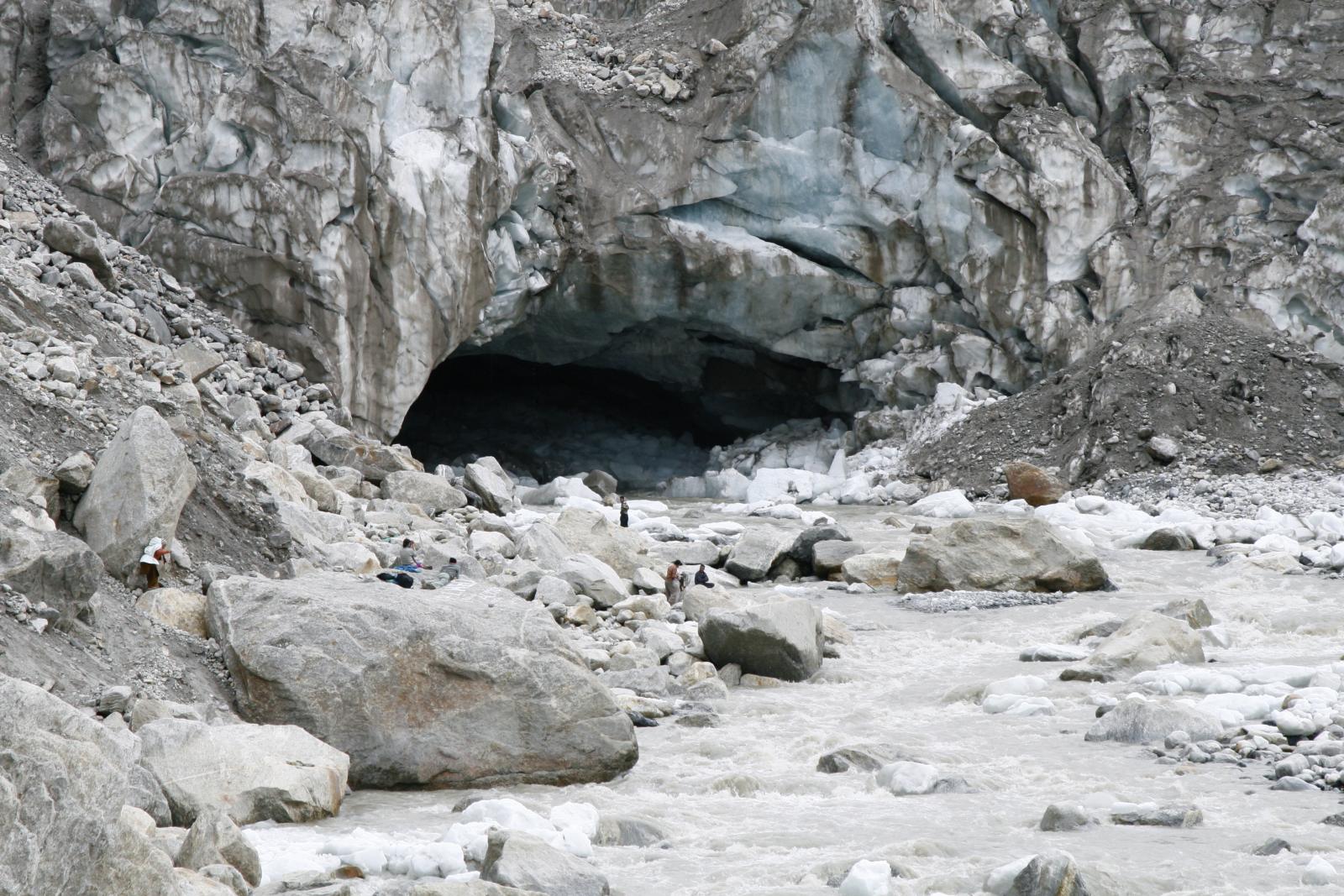
Around the snout, nature presents a wild topography. There are boulders scattered here and there with some pieces of broken snow, along with the hard clayey snow of the glacier.
The Gomukh snout is rapidly moving backwards. According to the modern research the snout has moved 1 km in just 70 years.
Gomukh
Gomukh, also known as "Gaumukh" or "Gomukhi" (Hindi: गौमुख or गौमुखी ; Assamese and Bengali: গোমুখ or গোমুখী), is the terminus or snout of the Gangotri Glacier and the source of the Bhagirathi River, one of the primary headstreams of the Ganga River. The word Gomukh/Gaumukh (go/gau=cow, mukh= mouth) literally means "Mouth of a Cow."
The place is situated at a height of 13,200 ft (4,023 m) in the Uttarkashi district in the state of Uttarakhand, India. It is one of the largest glaciers in the Himalayas with an estimated volume of over 27 cubic kilometers.
It is a Hindu holy pilgrimage site, visited by many who visit Gangotri. It is around 20 km away from Gangotri and can be reached by trekking.
Gomukh is mentioned in the Puranas. It is said there that, searching a lost sheep, a boy reached near a glacier in Gangotri, the snout of which exactly looked like the face of a cow, and thus it got its name 'Gomukh'.
The first recorded visit to the Gomukh Glacier was made by John Hodgson and James Herbert on May 31, 1817. However, it is believed that visits to Gomukh occurred long before the 19th century, as it lies on the ancient route of the Chota Char Dham Yatra, connecting Gangotri to Kedarnath. This pilgrimage route was used by travelers and devotees for centuries. In 1935, J B Auden made the first documented crossing of this challenging route, and in his honor, the route was subsequently named Auden’s Col.
Gomukh is 18 km from Gangotri in the foothills of Bhagirathi at a height of 4,023 m. It is the snout of the Gangotri Glacier.
Around the snout, nature presents a wild topography. There are boulders scattered here and there with some pieces of broken snow, along with the hard clayey snow of the glacier.
The Gomukh snout is rapidly moving backwards. According to the modern research the snout has moved 1 km in just 70 years.
Recent media
Recent media