
Recent from talks
Force-feeding
Knowledge base stats:
Talk channels stats:
Members stats:
Force-feeding
Force-feeding is the practice of feeding a human or animal against their will. The term gavage (UK: /ˈɡævɑːʒ, ɡæˈvɑːʒ/, US: /ɡəˈvɑːʒ/, French: [ɡavaʒ] ⓘ) refers to supplying a substance by means of a small plastic feeding tube passed through the nose (nasogastric) or mouth (orogastric) into the stomach.
Within some countries,[which?] in extreme cases, patients with anorexia nervosa who continually refuse significant dietary intake and weight restoration interventions may be involuntarily fed by force via nasogastric tube under restraint within specialist psychiatric hospitals. Such a practice may be highly distressing for both anorexia patients and healthcare staff.
Some countries force-feed prisoners when they go on hunger strike. It has been prohibited since 1975 by the Declaration of Tokyo of the World Medical Association, provided that the prisoner is "capable of forming an unimpaired and rational judgment." The violation of this prohibition may be carried out in a manner that can be categorised as torture, as it may be extremely painful and result in severe bleeding and spreading of various diseases via the exchanged blood and mucus, especially when conducted with dirty equipment on a prison population.
The Canadian government accepts the Declaration of Tokyo as made by the World Medical Association, and does not carry out the force-feeding of inmates against their will who reject any nourishment, however the Correction Service of Canada has stated that they reserve the right to do so since they have a legal obligation to maintain the health of individuals in their care. The Corrections and Conditional Release Act of 1992 directly prohibits the force feeding of inmates in Canada.
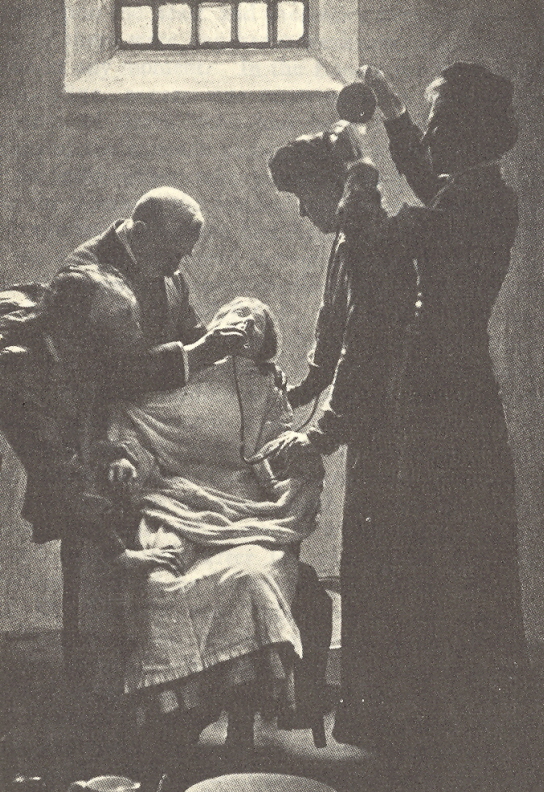
Suffragettes who had been imprisoned while campaigning for votes for women went on hunger strike and were force fed. This lasted until the Prisoners Act of 1913, also known as the Cat and Mouse Act, whereby debilitated prisoners would be released, allowed to recover, and then re-arrested. Rubber tubes were inserted through the mouth (only occasionally through the nose) and into the stomach, and food poured down; the suffragettes were held down by force while the instruments were inserted into their bodies, which has been likened to rape. In a smuggled letter, Sylvia Pankhurst described how the warders held her down and forced her mouth open with a steel gag. Her gums bled, and she vomited most of the liquid.
Emmeline Pankhurst, founder of the Women's Social and Political Union, was horrified by the screams of women being force-fed in HM Prison Holloway. She wrote: "Holloway became a place of horror and torment. Sickening scenes of violence took place almost every hour of the day, as the doctors went from cell to cell performing their hideous office. ... I shall never while I live forget the suffering I experienced during the days when those cries were ringing in my ears." When prison officials tried to enter her cell, Pankhurst, in order to avoid being force-fed, raised a clay jug over her head and announced: "If any of you dares so much as to take one step inside this cell, I shall defend myself."
In 1911, Wiliam Ball, a male working class supporter who had broken two windows and consequently been sentenced to two months, was given this treatment and then separated from contact with his family, leading to his clandestine transfer to a mental hospital. This case was taken up by groups such as WSPU and the Men's League for Women's Suffrage, whose pamphlet on the case had the subtitle Official Brutality on the increase.
The first woman in Scotland to be force fed was Ethel Moorhead, in Calton Jail, who despite being under medical supervision became seriously ill. The governor, Major William Stewart, argued that her illness was not caused by the feeding regime, but also said:
Hub AI
Force-feeding AI simulator
(@Force-feeding_simulator)
Force-feeding
Force-feeding is the practice of feeding a human or animal against their will. The term gavage (UK: /ˈɡævɑːʒ, ɡæˈvɑːʒ/, US: /ɡəˈvɑːʒ/, French: [ɡavaʒ] ⓘ) refers to supplying a substance by means of a small plastic feeding tube passed through the nose (nasogastric) or mouth (orogastric) into the stomach.
Within some countries,[which?] in extreme cases, patients with anorexia nervosa who continually refuse significant dietary intake and weight restoration interventions may be involuntarily fed by force via nasogastric tube under restraint within specialist psychiatric hospitals. Such a practice may be highly distressing for both anorexia patients and healthcare staff.
Some countries force-feed prisoners when they go on hunger strike. It has been prohibited since 1975 by the Declaration of Tokyo of the World Medical Association, provided that the prisoner is "capable of forming an unimpaired and rational judgment." The violation of this prohibition may be carried out in a manner that can be categorised as torture, as it may be extremely painful and result in severe bleeding and spreading of various diseases via the exchanged blood and mucus, especially when conducted with dirty equipment on a prison population.
The Canadian government accepts the Declaration of Tokyo as made by the World Medical Association, and does not carry out the force-feeding of inmates against their will who reject any nourishment, however the Correction Service of Canada has stated that they reserve the right to do so since they have a legal obligation to maintain the health of individuals in their care. The Corrections and Conditional Release Act of 1992 directly prohibits the force feeding of inmates in Canada.
Suffragettes who had been imprisoned while campaigning for votes for women went on hunger strike and were force fed. This lasted until the Prisoners Act of 1913, also known as the Cat and Mouse Act, whereby debilitated prisoners would be released, allowed to recover, and then re-arrested. Rubber tubes were inserted through the mouth (only occasionally through the nose) and into the stomach, and food poured down; the suffragettes were held down by force while the instruments were inserted into their bodies, which has been likened to rape. In a smuggled letter, Sylvia Pankhurst described how the warders held her down and forced her mouth open with a steel gag. Her gums bled, and she vomited most of the liquid.
Emmeline Pankhurst, founder of the Women's Social and Political Union, was horrified by the screams of women being force-fed in HM Prison Holloway. She wrote: "Holloway became a place of horror and torment. Sickening scenes of violence took place almost every hour of the day, as the doctors went from cell to cell performing their hideous office. ... I shall never while I live forget the suffering I experienced during the days when those cries were ringing in my ears." When prison officials tried to enter her cell, Pankhurst, in order to avoid being force-fed, raised a clay jug over her head and announced: "If any of you dares so much as to take one step inside this cell, I shall defend myself."
In 1911, Wiliam Ball, a male working class supporter who had broken two windows and consequently been sentenced to two months, was given this treatment and then separated from contact with his family, leading to his clandestine transfer to a mental hospital. This case was taken up by groups such as WSPU and the Men's League for Women's Suffrage, whose pamphlet on the case had the subtitle Official Brutality on the increase.
The first woman in Scotland to be force fed was Ethel Moorhead, in Calton Jail, who despite being under medical supervision became seriously ill. The governor, Major William Stewart, argued that her illness was not caused by the feeding regime, but also said:
Recent media