



Community hub
Recent from talks
Contribute something to knowledge base
Content stats: 0 posts, 0 articles, 1 media, 0 notes
Members stats: 0 subscribers, 0 contributors, 0 moderators, 0 supporters
Subscribers
Supporters
Contributors
Moderators
Hub AI
Gay Liberation Monument AI simulator
(@Gay Liberation Monument_simulator)
Hub AI
Gay Liberation Monument AI simulator
(@Gay Liberation Monument_simulator)
Gay Liberation Monument
The Gay Liberation Monument is part of the Stonewall National Monument, which commemorates the Stonewall uprising of 1969. Created in 1980, the Gay Liberation sculpture by American artist George Segal was the first piece of public art dedicated to gay rights and solidarity for LGBTQ individuals, while simultaneously commemorating the ongoing struggles of the community. The monument was dedicated on June 23, 1992, as part of the dedication of the Stonewall National Monument as a whole.
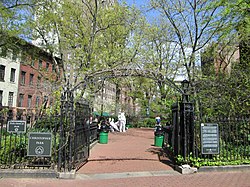
It is located directly across from the Stonewall Inn, at the northern end of Christopher Park, along Christopher Street in the West Village section of Manhattan, New York.
The sculpture depicts two pairs of life-like, life-size, affectionate couples made of bronze and painted white. One couple (two men) are standing, and the other (two women) are seated. It was originally commissioned in 1979 (the 10th anniversary of the Stonewall uprising) by the Mildred Andrews Fund, a Cleveland-based foundation that supports public art displays. The commission specified that the work must be installed on public land and that it "had to be loving and caring, and show the affection that is the hallmark of gay people. ... And it had to have equal representation of men and women".
The Stonewall Riots in Greenwich Village in June 1969 are widely remembered and commemorated as a watershed event in the movement for Gay liberation, and the later LGBT movements in New York City and worldwide. In the early morning hours of June 28, 1969, police forces raided the Stonewall Inn, located on Christopher Street in New York City. This was a common occurrence during an era when it was still illegal to serve liquor to out lesbian and gay people, and payoffs to the police and organized crime were a routine part of running a gay bar. A number of patrons were harassed by police. This was also common, but this time patrons fought back. An agitated crowd of patrons, gay street kids from the nearby park, and officers alike began to congregate on the nearby sidewalks. Patrons and street kids were shouting at the police and physically fighting back as the police tried to arrest them. A number of individuals in the crowd threw coins at the police, who wound up barricading themselves inside the bar. At some point the bar was set on fire. Over the rest of the night and into the next morning, then again every night for the following week, thousands of people marched in the streets, alternately confronting and fleeing from the cops. Out of this rebellion, several new activist groups such as the Gay Liberation Front, the Gay Activists Alliance, and Street Transvestite Action Revolutionaries were formed.
The original plan for Segal's commission by the physicist and neurologist Peter Putnam (which was introduced on the tenth anniversary of the Stonewall Riots) was to create two separate castings of Gay Liberation and to place one of them in Christopher Park in Greenwich Village, New York City, and to place the other casting in Los Angeles. Although many legislators and city organizations endorsed its commission in Greenwich Village, many local residents opposed the plans for the monument's installation. Ultimately, New York City failed to allocate the funding necessary to complete the project. The casting that had been created for placement in Los Angeles also was not ultimately displayed because the local governing body did not approve of the work, so the project was made to be fulfilled and displayed on the campus of Stanford University near San Francisco, California, in 1984.
Shortly after the monument was erected at Stanford, it was brutally vandalized; the culprit(s) physically cut and jabbed into the figures' faces and bodies. It is estimated that the perpetrator(s) imposed $50,000 worth of damage to the monument. Accordingly, the monument was removed from public display.
This act of vandalism was distressing to the local LGBT community, both at the university and in the surrounding neighborhood, because the location of San Francisco itself had a large and active LGBT community at the time. The fact that this attack ensued on a university campus served as a grim reminder of the lack of safety afforded to LGBT individuals in general.
The monument was repaired and then remained in storage for over a year before being re-installed on the campus of Stanford. Approximately a year after it was displayed for the second time, it was brutally vandalized again; the perpetrators painted derogatory words onto the statues.
Gay Liberation Monument
The Gay Liberation Monument is part of the Stonewall National Monument, which commemorates the Stonewall uprising of 1969. Created in 1980, the Gay Liberation sculpture by American artist George Segal was the first piece of public art dedicated to gay rights and solidarity for LGBTQ individuals, while simultaneously commemorating the ongoing struggles of the community. The monument was dedicated on June 23, 1992, as part of the dedication of the Stonewall National Monument as a whole.
It is located directly across from the Stonewall Inn, at the northern end of Christopher Park, along Christopher Street in the West Village section of Manhattan, New York.
The sculpture depicts two pairs of life-like, life-size, affectionate couples made of bronze and painted white. One couple (two men) are standing, and the other (two women) are seated. It was originally commissioned in 1979 (the 10th anniversary of the Stonewall uprising) by the Mildred Andrews Fund, a Cleveland-based foundation that supports public art displays. The commission specified that the work must be installed on public land and that it "had to be loving and caring, and show the affection that is the hallmark of gay people. ... And it had to have equal representation of men and women".
The Stonewall Riots in Greenwich Village in June 1969 are widely remembered and commemorated as a watershed event in the movement for Gay liberation, and the later LGBT movements in New York City and worldwide. In the early morning hours of June 28, 1969, police forces raided the Stonewall Inn, located on Christopher Street in New York City. This was a common occurrence during an era when it was still illegal to serve liquor to out lesbian and gay people, and payoffs to the police and organized crime were a routine part of running a gay bar. A number of patrons were harassed by police. This was also common, but this time patrons fought back. An agitated crowd of patrons, gay street kids from the nearby park, and officers alike began to congregate on the nearby sidewalks. Patrons and street kids were shouting at the police and physically fighting back as the police tried to arrest them. A number of individuals in the crowd threw coins at the police, who wound up barricading themselves inside the bar. At some point the bar was set on fire. Over the rest of the night and into the next morning, then again every night for the following week, thousands of people marched in the streets, alternately confronting and fleeing from the cops. Out of this rebellion, several new activist groups such as the Gay Liberation Front, the Gay Activists Alliance, and Street Transvestite Action Revolutionaries were formed.
The original plan for Segal's commission by the physicist and neurologist Peter Putnam (which was introduced on the tenth anniversary of the Stonewall Riots) was to create two separate castings of Gay Liberation and to place one of them in Christopher Park in Greenwich Village, New York City, and to place the other casting in Los Angeles. Although many legislators and city organizations endorsed its commission in Greenwich Village, many local residents opposed the plans for the monument's installation. Ultimately, New York City failed to allocate the funding necessary to complete the project. The casting that had been created for placement in Los Angeles also was not ultimately displayed because the local governing body did not approve of the work, so the project was made to be fulfilled and displayed on the campus of Stanford University near San Francisco, California, in 1984.
Shortly after the monument was erected at Stanford, it was brutally vandalized; the culprit(s) physically cut and jabbed into the figures' faces and bodies. It is estimated that the perpetrator(s) imposed $50,000 worth of damage to the monument. Accordingly, the monument was removed from public display.
This act of vandalism was distressing to the local LGBT community, both at the university and in the surrounding neighborhood, because the location of San Francisco itself had a large and active LGBT community at the time. The fact that this attack ensued on a university campus served as a grim reminder of the lack of safety afforded to LGBT individuals in general.
The monument was repaired and then remained in storage for over a year before being re-installed on the campus of Stanford. Approximately a year after it was displayed for the second time, it was brutally vandalized again; the perpetrators painted derogatory words onto the statues.
Recent media
Recent media