Hubbry Logo
Gay barGay barMain
Open search
Gay bar
Community hub
Gay bar
logo
8 pages, 0 posts
0 subscribers
Be the first to start a discussion here.
Gay bar
Gay bar
from Wikipedia

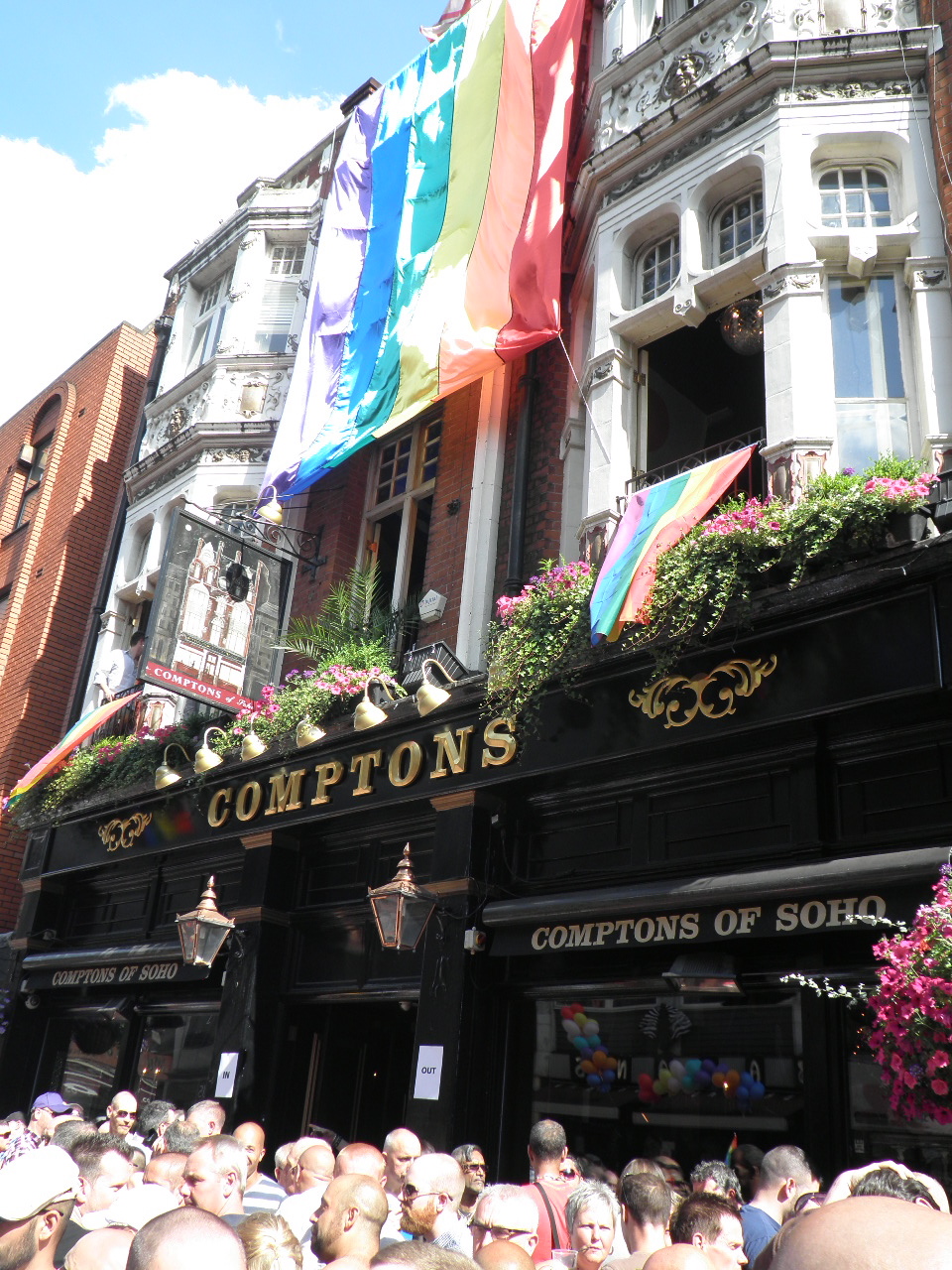
Comptons of Soho, London, UK. Taken during London Pride 2010.

A gay bar is a drinking establishment that caters to an exclusively or predominantly lesbian, gay, bisexual, transgender or queer (LGBTQ+) clientele; the term gay is used as a broadly inclusive concept for LGBTQ+ communities.

Gay bars once served as the centre of gay culture and were one of the few places people with same-sex orientations and gender-variant identities could openly socialize. Other names used to describe these establishments include boy bar, girl bar, gay club, gay pub, queer bar, lesbian bar, drag bar, and dyke bar, depending on the niche communities that they serve.

With the advent of the Internet and an increasing acceptance of LGBTQ+ people across the Western world, the relevance of gay bars in the LGBTQ+ community has somewhat diminished.[1] In areas without a gay bar, certain establishments may hold a gay night instead.

History

[edit]
The Mixei [fi] nightclub in Tammela, Tampere, is the oldest still operating gay bar in Finland, having first opened its doors in 1990.[2]

Gathering places favoured by homosexuals have operated for centuries. Reports from as early as the 17th century record the existence of bars and clubs that catered to, or at least tolerated, openly gay clientele in several major European cities.[3] The White Swan (created by James Cook and Yardley, full name unknown) on Vere Street, in London, England, was raided in 1810 during the so-called Vere Street Coterie. The raid led to the executions of John Hepburn and Thomas White for sodomy.[4] The site was the scene of alleged gay marriages carried out by the Reverend John Church.[5]

It is not clear which place is the first gay bar in the modern sense. In Cannes, France, such a bar had already opened in 1885, and there were many more in Berlin around 1900. In the United Kingdom and the Netherlands gay bars were established throughout the first quarter of the 20th century.

China

[edit]

The oldest gay bar in Beijing is the Half-and-Half, which in 2004 had been open over ten years.[6] The first lesbian bar in China (also in Beijing) was Maple Bar, opened in 2000 by pop singer Qiao Qiao. The On/Off was a popular bar for both gay men and lesbians.[7] The increase in China's gay and lesbian bars in recent years is linked to China's opening up to global capitalism and its consequent economic and social restructuring.[6]

Denmark

[edit]

The bar Centralhjørnet in Copenhagen opened in 1917 and became a gay bar in the 1950s. It now claims to be one of the oldest gay bars in Europe.[8] The main Copenhagen gay district is the Latin Quarter.

France

[edit]

The very first gay bar in Europe and probably in the world was the Zanzibar in Cannes on the French Riviera. The Zanzibar was opened in 1885 and existed for 125 years, before it was closed in December 2010. Among its visitors were many artists, like actor Jean Marais and comedians Thierry Le Luron and Coluche.[9]

Paris became known as a centre for gay culture in the 19th century, making the city a queer capital during the early 20th century, when the Montmartre and Pigalle districts were meeting places of the LGBTQ+ community. Although Amsterdam, Berlin, and London had more meeting places and organizations than Paris, the latter was known for the "flamboyance" of LGBTQ+ quarters and "visibility" of LGBTQ+ celebrities.[10]

Paris retained the LGBTQ+ capital image after the end of World War II, but the center of the meeting place shifted to Saint-Germain-des-Prés. In the 1950s and 1960s the police and authorities tolerated homosexuals as long as the conduct was private and out of view, but gay bar raids occurred and there were occasions when the owners of the bars were involved in facilitating the raids. Lesbians rarely visited gay bars and instead socialized in circles of friends. Lesbians who did go to bars often originated from the working class.[11] Chez Moune, opened in 1936, and New Moon were 20th-century lesbian cabarets located in Place Pigalle, which converted to mixed music clubs in the 21st century.[12][13]

Since the 1980s, the Le Marais district is the center of the gay scene in Paris.

Germany

[edit]
The gay club Eldorado in Berlin, 1932

In Berlin, there was gay and lesbian night life already around 1900, which throughout the 1920s became very open and vibrant, especially when compared to other capitals. Especially in the Schöneberg district around Nollendorfplatz there were many cafes, bars and clubs, which also attracted gay people who had to flee their own country in fear of prosecution, like for example Christopher Isherwood. The gay club Eldorado in the Motzstraße was internationally known for its transvestite shows. There was also a relatively high number of places for lesbians. Within a few weeks after the Nazis took over government in 1933, fourteen of the best known gay establishments were closed. After homosexuality was decriminalized in 1969, many gay bars opened in West Berlin, resulting in a lively gay scene.

In Munich, a number of gay and lesbian bars are documented as early as the Golden Twenties. Since the 1960s, the Rosa Viertel (pink quarter) developed in the Glockenbachviertel and around Gärtnerplatz, which in the 1980s made Munich "one of the four gayest metropolises in the world" along with San Francisco, New York City and Amsterdam.[14] In particular, the area around Müllerstraße and Hans-Sachs-Straße was characterized by numerous gay bars and nightclubs. One of them was the travesty nightclub Old Mrs. Henderson, where Freddie Mercury, who lived in Munich from 1979 to 1985, filmed the music video for the song Living on My Own at his 39th birthday party.[14][15][16] Other gay venues include Pompon Rouge, Mandy's Club, Pimpernel nightclub, the bar Mylord, the Ochsengarten, which was "Germany's first bar for leather men", as well as the gay hotel-pub Deutsche Eiche. Regulars in many of these bars and nightclubs include, for example, Freddie Mercury, Rainer Werner Fassbinder, Walter Sedlmayr (who met his later murderer in the Pimpernel), Inge Meysel and Hildegard Knef.[14][17]

Japan

[edit]

The oldest continuously operating Japanese gay bar, New Sazae, opened in Tokyo in 1966.[18] Most gay bars in Tokyo are located in the Shinjuku Ni-chōme district, which is home to about 300 bars.[19] Each bar may only have room to seat about a dozen people; as a result, many bars are specialized according to interest.[20]

Mexico

[edit]
Amberes street in Mexico City's Zona Rosa is lined with gay bars.

Because of a raid on a Mexico City drag ball in 1901, when 41 men were arrested, the number 41 has come to symbolize male homosexuality in Mexican popular culture, figuring frequently in jokes and in casual teasing.[21][22] The raid on the "Dance of the 41" was followed by a less-publicized raid of a lesbian bar on 4 December 1901 in Santa Maria. Despite the international depression of the 1930s and along with the social revolution overseen by Lázaro Cárdenas (1934–1940), the growth of Mexico City was accompanied by the opening of gay bars and gay bathhouses.[22] During the Second World War, ten to fifteen gay bars operated in Mexico City, with dancing permitted in at least two, El África and El Triunfo. Relative freedom from official harassment continued until 1959 when Mayor Ernesto Uruchurtu closed every gay bar following a triple-murder. But by the late 1960s several Mexican cities had gay bars and, later, U.S.-style dance clubs. These places, however, were sometimes clandestine but tolerated by local authorities, which often meant that they were allowed to exist so long as the owners paid bribes. A fairly visible presence was developed in large cities such as Guadalajara, Acapulco, Veracruz and Mexico City.[23] Today, Mexico City is home to numerous gay bars, many of them located in the Zona Rosa, particularly on Amberes street, while a broad and varied gay nightlife also flourishes in Guadalajara, Acapulco, in Cancun attracting global tourists, Puerto Vallarta which attracts many Americans and Canadians, and Tijuana with its cross-border crowd. However, there are at least several gay bars in most major cities.[24]

Netherlands

[edit]
Café 't Mandje at Zeedijk in Amsterdam

In Amsterdam, there were already a few gay bars in the first quarter of the 20th century. The best known was The Empire [nl], in Nes, which was first mentioned in 1911 and existed until the late 1930s.[25] The oldest that still exists is Café 't Mandje, which was opened in 1927 by lesbian Bet van Beeren.[26] It closed in 1982, but was reopened in 2008.

After World War II, the Amsterdam city government acted rather pragmatic and tolerated the existence of gay bars. In the 1960s their number grew rapidly and they clustered in and around a number of streets, although this was limited to bars, clubs and shops and they never became residential areas for gays, like the gay villages in the US.

Since the late 1950s the main Amsterdam gay street was Kerkstraat, which was succeeded by Reguliersdwarsstraat in the early 1980s, when the first openly gay places opened here, like the famous cafe April in 1981, followed by dancing Havana in 1989.[27] Other streets where there are still concentrations of gay bars are Zeedijk, Amstel and Warmoesstraat, the latter being the center of the Amsterdam leather scene, where the first leather bar already opened around 1955.[26][28] The Queen's Head is a gay bar located at Zeedijk 20 in the centre of Amsterdam.

Russia

[edit]

Because of the high prevalence of homophobia in Russia, patrons of gay bars there often have had to be on the alert for bullying and attacks. In 2013, Moscow's largest gay bar, Central Station, had its walls sprayed with gunfire, had harmful gas released into a crowd of 500 patrons, and had its ceiling nearly brought down by a gang who wanted to crush the people inside. Nonetheless, gay nightlife is increasing in Moscow and St. Petersburg, offering drag shows and Russian music, with some bars also offering discreet gay-only taxi services.[29]

Singapore

[edit]

The first recorded use of the term "gay bar" is in the diaries of homosexual British comedian Kenneth Williams: "16 January 1947. Went round to the gay bar which wasn't in the least gay."[30] At the time Williams was serving in the British Army in Singapore. In the 1970s, straight nightclubs began to open their doors to gay clients on designated nights of the week. In the 1980s, a lesbian bar named Crocodile Rock opened in Far East Plaza, which remains to this day the oldest lesbian bar in Singapore. Today, many gay bars are located on the Neil Road stretch, from Taboo and Tantric, to Backstage Bar, May Wong's Café, DYMK and Play. Mega-clubs like Zouk and Avalon are also a big draw for the gay crowd.[31]

South Africa

[edit]

The history of gay and lesbian bars in South Africa reflects the racial divisions that began in the Apartheid era and continue, to some extent, in the 21st century.[32]

The first white gay bar opened in the Carlton Hotel in downtown Johannesburg in the late 1940s, catering exclusively to men of wealth. In the 1960s, other urban bars began to open that drew more middle and working class white men; lesbians were excluded. The language of Gayle had its roots in the Cape Coloured and Afrikaans-speaking underground gay bar culture. In 1968, when the government threatened to pass repressive anti-gay legislation, queer culture went even further underground, which meant clubs and bars were often the only places to meet. These bars were often the targets of police raids.[33] The decade of the 1970s was when urban gay clubs took root. The most popular gay club of Johannesburg was The Dungeon, which attracted females as well as males, and lasted until the 1990s. The 1979 police assault on the New Mandy's Club, in which patrons fought back, has been referred to as South Africa's Stonewall.[34]

In the 1980s, police raids on white gay clubs lessened as the apartheid government forces found itself dealing with more and more resistance from the black population. In the black townships, some of the shebeens, unlicensed bars established in people's homes and garages, catered to LGBTQ clients. During the struggle against apartheid, some of these shebeens were important meeting places for black gay and lesbian resistance fighters. Lee's, a shebeen in Soweto, for example, was used as a meeting place for black gay men who were part of the Gay Association of South Africa (GASA) but did not feel welcome in the GASA offices.[35]

With the establishment of the post-apartheid 1996 constitution that outlawed discrimination based on sexual orientation as well as race, South Africa's gay night life exploded, though many bars continued to be segregated by race, and fewer blacks than whites go to the urban bars. The 2005 inaugural gay shebeen tour was advertised as a gay pub crawl that would provide an opportunity for South Africans and foreigners to "experience true African gay Shebeen culture".[35][36]

South Korea

[edit]
Lesbos bar in Sinchon, Seoul, South Korea 레스보스

In Seoul, most gay bars were originally congregated near the Itaewon area of Seoul, near the U.S. military base. But in recent years, more clubs have located in the Sinchon area, indicating that "safe spaces" for Korean LGBTQ+ people have extended beyond the foreign zones, which were traditionally more tolerant. One male bar patron said Korean bar culture was not as direct as in the United States, with customers indicating their interest in another customer by ordering him a drink through a waiter. The oldest lesbian bar in Seoul is Lesbos, which started in 1996.[37]

Spain

[edit]

Under the dictatorship of General Francisco Franco from 1939 to 1975, homosexuality was illegal. However, in 1962, Spain's first gay bar, Tony's, opened in Torremolinos and a clandestine gay bar scene also emerged in the 1960s and early 1970s in Barcelona.[38]

Taiwan

[edit]

In Taiwan, Gay bar culture was first brought to Taiwan by the US military stationed in the 1960s.[39] In the 1970s, the first gay bar "Take" appeared in Taipei.[40] At the same time, lesbians often held activities in American military bars and gay bars. It was not until 1985 that the first lesbian bar "Forgettable Valley" appeared.[41] After the mid-1980s, Gay bars and T-bars sprouted up like mushrooms after a rain. In addition to Taipei, they also began to appear in Taichung and Kaohsiung. The style has also become diversified from simply drinking and chatting.[41] For example, Funky in the 1990s divided its business hours into singing hours and dancing hours.

In the early 2000s, the human rights of gays and lesbians in Taiwan improved significantly. The gay nightlife entertainment scene shifted from being a scene opened by gays and only having gay customers. Some non-gay-only nightclubs were considered gay nightclubs because they gathered a large number of gays. Representative stores are TeXound and 2F.[42]

Starting in 2007, gay bars began to move into the Ximen Red House, which was not operating well at that time. Relying on the gay customer base, this place gradually gathered a lot of popularity and became the first openly gay business district in Taiwan.[43] Nowadays, Ximen Red House Bar Street is a must-visit attraction for gays from all over the world when visiting Taiwan.

Currently, the representative gay bars include Abrazo Bistro, Bacio Taipei, Belle's, Commander D, Fairy Taipei, G-Star, Ganymede, Hunt and Locker Room. There are also many small gay bars in Ximen Red House.

United Kingdom

[edit]

In the 18th century, molly houses were clandestine clubs where gay men could meet, drink, dance and have sex with each other. One of the most famous was Mother Clap's Molly House.[44]

The first gay bar in Britain in the modern sense was The Cave of the Golden Calf, established as a night club in London. It opened in an underground location at 9 Heddon Street, just off Regent Street, in 1912 and became a haunt for the wealthy, aristocratic and bohemian.[45] Its creator Frida Strindberg née Uhl set it up as an avant-garde and artistic venture.[46] The club provided a solid model for future nightclubs.

After homosexuality was partially decriminalized in the UK in 1967, gay bar culture became more visible and gradually Soho became the centre of the London LGBTQ+ community, which was "firmly established" by the early 1990s.[47] Gay bars, cafes, restaurants and clubs are centred on Old Compton Street.

Other cities in the UK also have districts or streets with a concentration of gay bars, like for example Stanley Street Quarter in Liverpool, the Merchant City in Glasgow, Canal Street in Manchester and the Birmingham Gay Village.

United States

[edit]
A 2021 Virginia State Senate resolution recognizing Freddie's Beach Bar, Northern Virginia's only gay bar at the time.

There are many institutions in the United States that claim to be the oldest gay bar in the country. Since Prohibition ended in 1933, there are a number of notable gay bars that have opened. In alphabetical order:

  • The Atlantic House in Provincetown, Massachusetts, was constructed in 1798 and was a tavern and stagecoach stop before becoming a de facto gay bar after artists and actors, including Tennessee Williams, began spending summers in Provincetown in the 1920s.[48]
  • The Black Cat Bar, founded in 1906 and operated again after Prohibition was ended in 1933, was located in San Francisco's North Beach neighborhood and was the focus of one of the earliest victories of the homophile movement. In 1951, the California Supreme Court affirmed the right of homosexuals to assemble in a case brought by the heterosexual owner of the bar.
  • The Black Cat Tavern opened in November 1966 and was one of many LGBTQ+ bars to be raided, which happened on New Year's Day in 1967. It is now considered a Los Angeles Historic-Cultural Monument.
Cafe Lafitte in Exile, on Bourbon Street in New Orleans, opened in 1933, has a storied past, replete with celebrities.
  • Cafe Lafitte in Exile in New Orleans, dating back to 1933 and the end of Prohibition, claims to be the oldest continuously operating gay bar in the United States.
  • The Double Header in Seattle's Pioneer Square is claimed to be the oldest gay bar on the North American West Coast, operating since 1933.[49]
  • Esta Noche was the first gay Latino bar in San Francisco; it opened in 1979. It was located on Mission Street and 16th Street. It closed down in 1997 as one of the last gay Latino bars in the Mission District.[50]
  • Eve's Hangout was one of the first lesbian bars,[51] also called Eve Adams Tearoom. It closed after a police raid in 1926. Eva Kotchever, the owner, was deported to Europe and murdered at Auschwitz.[52]
  • Julius Bar, founded by local socialite Matthew Nicol, is the first modern gay bar in New York City. It is where the Mattachine Society staged a "Sip-In" on 21 April 1966 challenging a New York State Liquor Authority rule that prohibited serving alcoholic beverages to gays on the basis that they were considered disorderly. The court ruling in the case that gays could peacefully assemble at bars would lead to the opening of the Stonewall Inn a block southwest in 1967, which in turn led to the 1969 Stonewall Riots. Julius is New York City's oldest continuously operating gay bar.[53]
  • Korner Lounge (1933) of Shreveport, Louisiana is believed to be the second oldest continuously operating gay bar in the country.[54]
  • Maud's Study (961 Cole Street, San Francisco), featured in the film Last Call at Maud's,[55] was a lesbian bar which was founded by Rikki Streicher in 1966 and closed in September 1989. At closing, it claimed to be the oldest continuously operating lesbian bar.[56] It closed during the AIDS crisis when a "clean and sober" mentality drove down a lot of bars.[57]
  • Nob Hill (1101 Kenyon St NW) In Washington D.C was a gay bar dedicated to providing a safe space for queer African-American men. Due to segregation many gay bars in the U.S. were centered around white queer people but from 1957 to 2004 Nob Hill was a space for Black queer people to celebrate.[58] Nobb Hill was run for and by Black queer men and was one of the longest gay nightlife establishments in D.C and the entire country.[59]
  • The White Horse Inn in Oakland, California, operating legally since the end of Prohibition, but also likely illegally during it, claims to be the oldest gay bar in operation in the U.S.[60]

HIV/AIDS impact and response

[edit]

Gay bars have been heavily impacted by the epidemiology of HIV/AIDS with both potential risk and crucial community support and education.

San Francisco had over 100 gay bars when the epidemic first hit in the early 1980s; by 2011 there were only about 30 remaining.[61] During the worst years of the epidemic (before affordable and effective treatment), millions of gay men around the world died; consequently fewer persons owned or patronized gay bars.

Sexually transmitted infections

[edit]

A 2009 study revealed a correlation between gay bar attendance and certain high-risk sexual behaviors. Specifically, the research indicated that individuals who frequented gay bars were more likely to engage in insertive unprotected anal intercourse, including with partners whose HIV status differed from their own.[62]

HIV-affected community

[edit]

Gay bars have always been a place of refuge and support for gay men and the HIV-affected community impacted by the virus.[63][64][65] Cure fundraising, testing, support group, and free condom events have been present at gay bars.[66][67] The National Institute of Health has noted that the gentrification of gay neighborhoods, the movement of more gay people into the suburbs, and decreased overall participation in AIDS and HIV related activism, health care providers are needing to turn to alternate venues to promote sexual wellness among this community. Turning to social media and other online resources, there has been an increase in these digital formats and approaches being used to spread HIV awareness among gay men around the world.[68]

Speculation over declining locations

[edit]

Some commentators have suggested that gay bars are facing decline in the contemporary age due to the pervasiveness of technology. Andrew Sullivan argued in his 2005 essay "The End of Gay Culture" that gay bars are declining because "the Internet dealt them a body blow. If you are merely looking for sex or a date, the Web is now the first stop for most gay men".[69]

June Thomas explained the decline by noting that there is less need for gay-specific venues like bars because gay people are less likely to encounter discrimination or be made unwelcome in wider society.[70] Entrepreneur magazine in 2007 included them on a list of ten types of business that would be extinct by 2017 along with record stores, used bookstores and newspapers.[71]

Some commentators have argued there has been some recent decline in gay-specific venues mainly due to the modern effects of gentrification.[72][73][74][75][76] By building physical spaces to host their community, gay men have introduced gay bars in urban neighborhoods to resist homophobia and ground a sense of belonging in the cities they live in and occupy. Gentrification of inner-cities via gay bars is partially a result of the efforts made by the LGBT community to instill hubs.[77] But despite the decline, gay bars still exist in relatively strong numbers and thrive in most major cities where male homosexuality is not heavily condemned. They also asserted many gay men (especially men new to gay nightlife) still find some value in gay-specific venues and being in the company of other gay men.[78][76][79][80][81] With there being an increase in LGBT acceptance throughout the United States, there appears to be a correlation between a decrease in the number of people within the community seeking out gay bars—as they are able to connect through other spaces and ways. The fate of established gay bars is affected by this transition and change in popularity as they may not be able to continue running due to lessened demand. Regarding gay bars in rural areas, there exists the possibility of LGBTQ+ members being affected by gentrification as people outside of the community move in surrounding spaces.[82]

Unlike gay bars, lesbian bars have become a rarity around the world. Many articles have been published discussing possible reasons as to why lesbian bars struggle to exist despite a growing lesbian population.[83][84][85][86] Reasons for the decline in Lesbian bars and other spaces for queer women include: the popularity of the internet for women to meet and create community, and finances/funding for queer establishments. As queer women have leaned towards social media to meet people, presence at queer-centered spaces has gone down, which has affected the economic stability/standing of Lesbian bars. The more reclusive spending practices and culture of queer women is also a factor that may be connected to the decline of Lesbian bars.[87]

Gentrification

[edit]

Gay bars have historically been connected to the process of gentrification—people in the LGBTQ+ community have been both victims and/or agents. Complexities arise at the assessment of gentrification and the LGBTQ+ community as gay bars along with other queer-led establishments have at times been forms of infrastructure that contribute to driving out previous communities—which are oftentimes lower-class people of color living in urban areas. And as an effect of historic “gayborhoods” remodeling and renovating areas, there have been price increases on rent that in turn make it difficult for LGBTQ+ people to remain. Thus, the presence of the gay community in major cities becomes dispersed, leading to establishments such as gay bars closing or having a lower clientele.[88] As changes in the current population of certain areas across the country can be traced back to institutional and financial forces that drive out residing demographics of certain races and class identities. The matter of gentrification and people of color in the LGBTQ+ community thus becomes complicated and nuanced—as these individuals are then in a divided positioned that places aspects of their identities at a cross.[89][90]

The matter of displacement caused by gentrification in gay neighborhoods is complicated through the experiences of individuals within the greater queer community—with factors such as: race, income, and sexuality. People within the LGBTQ+ community engage with gentrification from different sides as they move to seek refuge in big cities, which may eventually lead to previous tenants being priced out. And as some spaces with a high density of LGBTQ+ clientele continue to grow and gain popularity, people outside of the community might begin to move in which drives out the queer community, thus patronage in gay bars decreases—affecting their profits and stability.[91][92]

In major cities such as San Francisco and Atlanta, there have been documented studies that explore the formation of queer neighborhoods—which often exclude or become a force that leads to the removal of the communities living there previously. A class barrier becomes established, which then also excludes the queer working-class residents of people of color in the area who cannot afford access to the spaces led and dominated by affluent white gay men.[93][94] In an effort to escape verbal and physical violence, the gay community has sought to move to places such as the Castro District in San Francisco to avoid the chances of being targeted. Living in fear of hate crimes, many gayborhoods have a history of being formed out of a desire to form havens for the community. As some people living near or in those neighborhoods begin to notice the increase in queer people moving in, along with being priced out, there are also people who willingly seek to make a profit on selling their home to people who find the area attractive due to the popularity.[95]

Gay bars and pinkwashing

[edit]

The presence of gay bars has been used to make political arguments about the safety and desirability of neighborhoods and communities.[96] In the case of Israel, the presence of established gay bars and the publicized government stance of LGBT acceptance has been used to advertise the country as a safe and progressive location in West Asia for LGBT people.[97] Image of gay bars frequently occur in Israeli marketing campaigns for “pink dollars.” This practice of using gay bar to promote Israel's agenda both internationally and domestically has been termed “pinkwashing.” [98][99] Numerous accounts by queer Palestinians reflect a common sentiment of hostility while in gay bar spaces in Israel. This often begins by them having to go through checkpoints when attempting to access those spaces.[100] When their queerness is acknowledged by police and at border check points, it typically intensifies the abuse rather than mitigating it, serving as a vulnerability rather than a form of protection.[101]

Background

[edit]
The interior of a gay bar in Tel Aviv, Israel, which features a dance floor and music
Hub of men-only gay bars in Cape Town, South Africa

Like most bars and pubs, gay bars range in size from the small, five-seat bars of Tokyo to large, multi-story clubs with several distinct areas and more than one dance floor. A large venue may be referred to as a nightclub, club, or bar, while smaller venues are typically called bars and sometimes pubs. The only defining characteristic of a gay bar is the nature of its clientele. While many gay bars target the gay and/or lesbian communities, some (usually older and firmly established) gay bars have become gay, as it were, through custom, over a long period of time.

The serving of alcohol is the primary business of gay bars and pubs. Like non-gay establishments they serve as a meeting place and LGBTQ+ community focal point, in which conversation, relaxation, and meeting potential romantic and sexual partners is the primary focus of the clientele. Historically and continuing in many communities, gay bars have been valued by patrons as the only place closeted gay men and lesbians can be open and demonstrative about their sexuality without fear of discovery. Gerard Koskovich of the Gay, Lesbian, Bisexual, Transgender Historical Society explains that "[Gay bars] were a public place where gay people could meet and start to have a conversation, where they didn't feel like sexual freaks or somehow not part of the larger social fabric; from that came culture, politics, demands for equal rights."[102]

Gay bars traditionally preferred to remain discreet and virtually unidentifiable outside the gay community, relying exclusively on word of mouth promotion. More recently, gay clubs and events are often advertised by handing out eye-catching flyers on the street, in gay or gay-friendly shops and venues, and at other clubs and events. Similar to flyers for predominantly heterosexual venues, these flyers frequently feature provocative images and theme party announcements.

While traditional gay pub-like bars are nearly identical to bars catering to the general public, gay dance venues often feature elaborate lighting design and video projection, fog machines and raised dancing platforms. Hired dancers (called go-go girls or go-go boys) may also feature in decorative cages or on podiums. Gay sports bars are relatively unusual, but it is not unusual for gay bars to sponsor teams in local sports/game leagues, and many otherwise traditional gay pubs are well known for hosting post-game parties—often filling with local gay athletes and their fans on specific nights or when major professional sporting events are broadcast on TV. Some of the longest established gay bars are unofficial hosts of elaborate local 'Royal Court' drag pageants and drag-related social groups.

Lesbian bar Vivelavie in Amsterdam, 2008
Finnish drag queen Miss B on stage at the DTM club in Helsinki, Finland, in 2019

Gay bars and nightclubs are sometimes segregated by sex. In some establishments, people who are perceived to be of the "wrong" sex (for example, a man attempting to enter a women's club) may be unwelcome or even barred from entry. This may be more common in specialty bars, such as gay male leather fetish or BDSM bars, or bars or clubs which have a strict dress code. It is also common in bars and clubs where sex on the premises is a primary focus of the establishment. On the other hand, gay bars are usually welcoming of transgender and cross-dressed people, and drag shows are a common feature in many gay bars, even men-only spaces. Some gay bars and clubs which have a predominantly male clientele, as well as some gay bathhouses and other sex clubs, may offer occasional women-only nights.

A few gay bars attempt to restrict entry to only gay or lesbian people, but in practice this is difficult to enforce. Most famously, Melbourne's Peel Hotel was granted an exemption from Australia's Equal Opportunities Act by a state tribunal, on the grounds that the exemption was needed to prevent "sexually-based insults and violence" aimed at the pub's patrons. As a result of the decision, the pub is legally able to advertise as a "gay only" establishment, and door staff can ask people whether they are gay before allowing them inside, and can turn away non-gay people.[103]

Vanity Ytinav in front of Esta Noche, a Latino gay bar in San Francisco

Already categorized as gay or lesbian, many gay bars in larger cities/urban areas take this sub-categorization a step further by appealing to distinct subcultures within the gay community. Some of these sub-cultures are defined by costume and performance. These bars often forge a like-minded community in dozens of cities with leather gay bars, line-dancing gay bars, and drag revues. Other subcultures cater to men who fit a certain type, one that is often defined by age, body type, personality, and musical preference. There are some bars and clubs that cater more to a working class/blue collar crowd and some that cater to a more upscale clientele. There are gay bars that cater to "twinks" (young, smooth-bodied pretty boys) and others that cater to bears (older, larger, hairier alternatives to the well-manicured and fey gay stereotype). There are also gay bars that cater to certain races, such as ones for Asian men "and their admirers", Latin men, or black men.[104]

Gay cruise bar

[edit]

A variation of the gay bar is the gay cruise bar. Normally gay bars usually prohibit sexual activity other than kissing or flirting on the premises, however cruise bars allow sex to happen on their property. Cruise bars have a secured entrance door so that only adults can enter, a cloakroom area to allow patrons to change, and seating that allow sexual activity to happen. There is usually an entrance change, however on special occasions it is waived. Mobile phones are banned for privacy reasons.[105] Notable cruise bars include Vault 139 [106] and Bunker Bar[107] in London.

Music

[edit]

Music, either live or, more commonly, mixed by a disc jockey (DJ), is often a prominent feature of gay bars. Typically, the music in gay bars include pop, dance, Electropop, house, trance, and techno. In larger North American cities and in Australia, one or more gay bars with a country music theme and line dancing are also common, as are bars known for retro 1960s pop and "Motown Sound."

List of gay bars

[edit]

This is not a complete list of gay bars around the world.

Argentina

Canada

Colombia

Denmark

Finland

Ireland

Netherlands

Puerto Rico

Thailand

United Kingdom

United States

List of lesbian bars

[edit]

While some gay bars open their doors to all LGBTQ people, other bars cater specifically to lesbians. In recent years many popular lesbian bars have closed down. In 2015, JD Samson made a documentary exploring the very few remaining lesbian bars in the United States.[108] Although the number of established Lesbian bars in the United States has decreased, the spaces that remain serve as core locations for queer women to socialize and be in community. The attendance of queer women in lesbian bars is often higher when they are younger—with older queer women seeking lesbian bars at a lesser rate. The correlation between the stage of self-discovery and desire to attend social spaces such as lesbian bars addresses a shift as people find and connect with the queer community in other ways with time. While queer women feel more comfortable in lesbian bars compared to heterosexual bars, a lack of funds serves as a major reason for dwindling locations.[109]

United States

United Kingdom

See also

[edit]

References

[edit]

Further reading

[edit]
[edit]
Revisions and contributorsEdit on WikipediaRead on Wikipedia
from Grokipedia
A gay bar is a drinking establishment whose primary clientele consists of homosexual men, functioning as a specialized venue for alcohol consumption, social interaction, dancing, and often sexual solicitation within a predominantly same-sex environment. Such bars originated in the early in Western cities, operating under conditions of legal and police harassment due to sodomy laws that criminalized homosexual acts, thereby necessitating discreet locations like basements or private clubs to evade raids and . Prior to widespread and societal tolerance, they served as essential nodes for homosexual networking, , and rudimentary , though frequently marred by exploitation such as inflated prices, mob involvement, and associations with illicit drugs and prostitution. The uprising in 1969, sparked by a on a New York gay bar, marked a pivotal escalation in resistance against such oppression, propelling the organized gay liberation movement. In the post-Stonewall era, gay bars proliferated as symbols of visibility and cultural expression, hosting drag performances, themed events, and community gatherings that reinforced subcultural norms around promiscuity and , even as they faced ongoing challenges like the epidemic, which highlighted risks of anonymous encounters facilitated in these spaces. However, empirical data indicate a marked decline since the , with U.S. gay bar listings dropping by 18.6 percent from 2012 to and overall numbers falling 45 percent since , driven by factors including mainstream assimilation reducing the need for segregated venues, competition from geolocation-based hookup apps like , eroding urban gay enclaves, and economic vulnerabilities exposed by events like closures. This contraction reflects broader shifts in homosexual social patterns toward privatized digital interactions, though surviving bars persist in niche roles amid debates over their relevance in an era of nominal legal equality.

Definition and Characteristics

Core Features and Distinctions from Other Bars

Gay bars are drinking establishments that primarily serve homosexual clients, particularly men, fostering an environment where same-sex romantic and physical interactions are normalized and expected among patrons. This clientele composition distinguishes them from heterosexual-oriented bars, where the majority of visitors engage in opposite-sex pairings, and overt same-sex advances or affections often elicit social disapproval or intervention by staff. In gay bars, the inverse dynamic prevails: heterosexual behaviors may draw curiosity or exclusion, but the space prioritizes homosexual sociality, reducing risks of targeted harassment for gay men compared to mixed or straight venues. Core operational features include marketing and signage directed at homosexual audiences, such as rainbow flags or listings in gay directories, which signal the bar's orientation and attract like-minded visitors while deterring those seeking heterosexual mingling. Interior layouts often emphasize communal areas conducive to conversation and flirtation, with dim lighting and music selections—typically upbeat electronic, pop, or tracks—tailored to facilitate dancing and group energy among predominantly male crowds. Unlike standard bars focused on broad or sports viewing, gay bars rarely center heterosexual-coded activities like pickup lines toward women or competitive drinking games; instead, they accommodate behaviors like casual touching or as standard for interest. Approaches in gay bars, however, are often less direct or frequent than in straight bars, where gendered norms typically prompt men to initiate with women; the absence of such roles in same-sex settings can amplify fears of rejection or signal misinterpretation. The rise of dating apps has further shifted initial screening and initiation online, diminishing the emphasis on in-person pickups, while many gay bars prioritize community bonding, dancing, and relaxation over stranger approaches—though cruising culture persists in certain venues, with dynamics varying by location, age group, and establishment type. Empirical observations from user studies highlight distinctions in safety perceptions: straight women report frequenting bars to evade unwanted male advances prevalent in straight establishments, citing greater inclusivity for non-predatory socializing. For , these venues offer relative refuge from external stigma, though historical records note vulnerabilities to police raids or control, underscoring that "safety" stems from peer norms rather than absolute security. Modern bars maintain this by enforcing informal codes against disruptive straight groups, preserving the homogeneous atmosphere essential to their identity.

Social Functions and Atmosphere

Gay bars function primarily as dedicated social spaces for individuals with same-sex attractions, enabling open interactions that are often restricted in venues due to historical and ongoing . These establishments meet key social and sexual needs by operating like private clubs, where patrons form friendships, pursue romantic or sexual partnerships, and build networks insulated from external judgment. Empirical observations from urban gay districts, which frequently center around such bars, confirm their role in facilitating opportunities and fostering perceptions of relative safety compared to broader city environments. The atmosphere in gay bars emphasizes communal bonding through alcohol consumption, , and , though highlights elevated rates of heavy among patrons, which can enhance social cohesion but also correlates with increased risks like alcohol misuse and associated sexual behaviors. Venues often host themed events, drag performances, and dancing, creating environments that prioritize sexual expression and subcultural , as documented in ethnographic studies of spaces. This lively, expressive ambiance supports , particularly in eras of marginalization, by providing outlets for identity affirmation and mutual support among attendees. Variations exist, with some bars maintaining a more subdued conversational tone while others adopt high-energy, performance-driven vibes to attract diverse crowds, including occasional heterosexual visitors seeking a harassment-free social experience.

Historical Development

Pre-20th Century Origins

Molly houses emerged in early as clandestine taverns, coffeehouses, and private rooms where men engaged in homosexual activities, , and socializing, serving as precursors to modern gay bars. These establishments catered primarily to "mollies," a term denoting effeminate men who sought same-sex relations, often adopting female personas during gatherings that included drinking, dancing, mock weddings, and sexual encounters in . By the , at least three such houses operated in the city, including one run by (known as Mother Clap) at Field Lane in , which functioned as a hub for over 40 men on raided nights. Legal persecution under England's Buggery Act of 1533, which criminalized with penalties up to death, drove these venues underground, yet they persisted amid periodic raids by authorities. The 1726 raid on Mother Clap's house exemplifies enforcement: Clap was convicted of keeping a "sodomitical house" and hanged, while three men faced execution for , with others imprisoned or fined, highlighting the risks despite community resilience. Similar informal meeting spots appeared in other European cities by the late 17th century, such as taverns in and where men discreetly gathered, though documentation remains sparse compared to London's molly houses. These sites differed from contemporary bars by lacking public signage or overt commercial appeal to broader patrons, instead relying on word-of-mouth networks among participants to evade detection. Operations waned by the early due to intensified policing and societal shifts, but they established patterns of dedicated spaces for male same-sex interaction that influenced later establishments. In colonial America, analogous but less formalized backrooms served transient sailor and working-class men for brief encounters, though without the structured of mollies.

Early 20th Century Establishments

![Eldorado bar in Berlin][float-right] In the early 20th century, gay bars proliferated in urban centers with relative social tolerance, particularly during Germany's era. Berlin emerged as a global hub, hosting over 100 establishments catering to homosexual men and women by the 1920s, far exceeding numbers in other cities. These venues, including cabarets and dance halls, offered spaces for drag performances, socializing, and sexual expression amid Paragraph 119 of the German penal code, which criminalized male homosexuality but was unevenly enforced in the liberal atmosphere post-World War I. The Eldorado nightclub, operated by Ludwig Konjetschni, exemplified this scene with its multiple locations featuring taxi dancers and renowned drag shows, drawing international visitors and solidifying 's reputation as a queer capital until Nazi crackdowns in 1933. Elsewhere in , similar establishments appeared amid varying legal constraints. In , Centralhjørnet opened in 1917 as one of the continent's earliest documented gay bars, operating continuously despite sodomy laws. Amsterdam's Café 't Mandje, established in 1927 by Bet van Beeren, became a haven for lesbians and gay men, featuring memorabilia like chalked names of Nazi collaborators post-war, though its early operations focused on discreet patronage during a period of police raids. In the United States, from 1920 to 1933 inadvertently facilitated gay bars as speakeasies in cities like New York and , where and hosted clandestine gatherings. San Francisco's Black Cat Bar, founded in 1906, served as a pioneering venue until its 1921 closure, while New York's Julius' Bar, dating to the 1860s but active in the 1920s, provided a low-profile space for men evading enforcement. These early establishments often operated under duress, with police entrapment and societal stigma limiting visibility outside tolerant enclaves. In , noted a doubling of known gay pubs from six in 1900 to twelve by 1910, reflecting gradual institutional awareness rather than widespread acceptance. American venues, constrained by anti-vice campaigns, emphasized discretion, contributing to subcultural networks that persisted despite closures and relocations. This era's bars laid foundational roles in community formation, predating mid-century expansions.

Post-World War II Expansion

Following the end of in 1945, gay bars experienced significant expansion in the United States, driven by urbanization, population growth in major cities, and the return of military veterans who had formed same-sex networks during service. These establishments proliferated amid a booming economy, providing rare public spaces for social interaction despite ongoing legal prohibitions on in most states. By the late 1940s and 1950s, hundreds of additional gay bars opened across urban centers like New York, , and , often operating under control to navigate police payoffs and raids. This growth continued into the 1960s, with bars serving as central hubs for community formation, though subject to frequent harassment; for instance, the 1967 raid on the in sparked protests that presaged later . By the 1980s, the number of gay bars in the exceeded 1,000, reflecting sustained demand despite persistent sodomy laws and societal stigma. In , bars became key institutions of postwar gay life, fostering visibility in neighborhoods like the Castro. In , similar patterns emerged amid reconstruction and varying legal tolerances. In , the number of queer bars increased from 7 to 13 in and from 5 to 14 in between the early and 1959, as scenes reestablished after wartime suppression. The saw rapid growth in the 1960s, with gay bars doubling in number during the decade and a surge in 1968, particularly in where authorities pragmatically tolerated them post-1945. In the UK, expansion accelerated after partial in 1967, concentrating in London's and enhancing visibility.

Regional Variations in Europe and North America

Gay bars in trace their origins to the 17th century, with early cruising grounds and brothels emerging in cities like amid limited legal tolerance for same-sex activities. By the early 20th century, hosted over 100 such venues during the , including the renowned Eldorado, which catered to a diverse featuring performances and . In the , Amsterdam's gay bar scene from to was predominantly male-oriented, with few exclusively establishments until later decades, reflecting a focus on discreet social networks amid periodic crackdowns. These European bars often integrated into broader nightlife, evolving from historical molly houses to more formalized spaces by the , though Nazi-era closures decimated many in . In , gay bars developed later and more reactively, with the oldest continuously operating venue, the White Horse Inn in , opening in 1933 as a response to urban migration and post-Prohibition opportunities. Post-World War II expansion in U.S. cities like New York and saw bars function as essential refuges for veterans and migrants facing widespread sodomy laws and police raids, contrasting Europe's earlier precedents with a stronger emphasis on and survival. The 1969 raid in catalyzed a shift toward , transforming bars from hidden enclaves to symbols of resistance and , unlike the pre-war cultural vibrancy in European hubs. Canadian scenes paralleled U.S. patterns, with Toronto's Church-Wellesley Village bars emerging in the 1970s amid similar legal pressures, though fewer pre-1930s establishments existed continent-wide due to frontier isolation and Puritan influences. Regional distinctions persist in atmosphere and function: European bars, particularly in Berlin's post-reunification revival, often blend historical nostalgia with techno-influenced cruising, fostering a less insular vibe shaped by earlier in places like the (partial since 1811). North American venues, by contrast, historically prioritized male-dominated "dive" aesthetics for safety, with post-Stonewall diversification into themed events, though both regions now face closures from app-based socializing and since the 2010s. In the U.S., bars like those in San Francisco's Castro district emphasize entertainment and pride events, reflecting liberationist roots, while European counterparts in or maintain a continuum from 18th-century informality to modern inclusivity.

Developments in Asia and Other Regions

In , the district in emerged as a hub for gay bars following , with establishments appearing publicly from the 1950s onward, including mentions of gay tea shops as early as 1948. By 1966, venues like New Sazae had opened, contributing to a specialized scene of bars, clubs, and cruising spots that catered to male patrons amid Japan's conservative social norms. This development paralleled urban post-war reconstruction, providing discreet social spaces despite the absence of legal protections for until later decades. In , Bangkok's gay bar scene gained prominence in the and , with establishments like those in Silom fostering a middle-class gay subculture through magazines such as Mithuna Junior and venues that emphasized homoerotic entertainment. These bars shifted social interactions from informal gatherings to commercialized , reflecting and tourism influences, though they operated under tacit tolerance rather than explicit legal safeguards. China's gay bars developed later, primarily in the , as urban gay populations transitioned from public parks and restrooms to dedicated venues; saw its first such bars around 1995, while Beijing's opened in 1996 amid ongoing state repression of . Hong Kong's , opened in the by an Australian couple, is noted as one of the region's earliest gay bars, predating widespread commercialization but operating in a British colonial context with periodic police scrutiny. In , gay bars remained largely underground into the 1990s due to Section 377's criminalization of until 2018; Mumbai's Slip Disc (also known as Voodoo) emerged in the mid-1990s as a key spot for gatherings in , attracting patrons through discreet word-of-mouth amid societal taboos. Latin America's gay bar history includes City's early venues, where bars required special dancing permits from 1960, enabling clandestine operations tolerated by authorities; by the late 1960s, several cities featured U.S.-style clubs despite periodic raids. In , homosexual organizations like Nuestro Mundo formed in 1967, laying groundwork for bar scenes in that expanded post-dictatorship. In the , Tel Aviv's gay bars proliferated after Israel's founding in 1948, with modern venues like Shpagat establishing the city as a regional outlier amid surrounding hostilities toward . Africa's developments were constrained by colonial-era laws; in , Johannesburg's bar at the Harrison Reef Hotel operated as one of the continent's longest-running gay venues from the 1970s, serving as a clandestine refuge during apartheid when sodomy was illegal until 1994. similarly hosted underground spaces from the 19th century, evolving into bars post-legalization.

Cultural and Social Significance

Role in Community Formation

![Eldorado bar in Berlin, a key venue in the Weimar-era gay scene][float-right] Gay bars have historically functioned as primary venues for the formation of social networks among homosexual individuals, particularly in periods when public expression of same-sex attraction was criminalized or socially stigmatized. Prior to the widespread availability of the and geolocation-based apps in the late 1990s and , these establishments served as essential safe spaces for meeting peers, exchanging information, and building mutual support systems, often in clandestine settings to evade . In urban centers like during the pre-Stonewall era (before 1969), gay bars were central hubs that facilitated the development of infrastructure, including informal activist groups responding to police regulations and raids. Sociological analyses indicate that gay bars consolidated dense interpersonal networks, enhancing visibility and collective identity among non-heterosexual populations by providing consistent locations for repeated interactions. This role was amplified during (1920–1933), when tolerance of illicit activities in speakeasies allowed queer gatherings to expand, establishing economic and cultural patterns that sustained community growth amid broader societal exclusion. Empirical studies of gayborhoods highlight bars as anchors for , enabling , social movement organizing, and access to queer-centric resources, which were critical for resilience in hostile environments. For instance, in mid-20th-century and , bars like Berlin's Eldorado during the (1919–1933) hosted performances and social events that drew diverse patrons, fostering a proto-community atmosphere despite eventual Nazi suppression. While digital platforms have partially supplanted bars for initial connections since the , historical evidence underscores their irreplaceable function in pre-digital eras for forging enduring ties, as oral histories and archival records document bars as sites where individuals formed friendships, romantic partnerships, and advocacy coalitions essential for survival and . This community-forming capacity persisted into the post-World War II period, with expansions in bar numbers correlating to increased localized networks in cities worldwide.

Entertainment, Music, and Events

Gay bars have historically served as primary venues for tailored to same-sex attracted individuals, featuring music, , and live performances that fostered expression in environments where such activities faced external prohibitions. These establishments often hosted disc jockeys spinning records, live bands, and themed events, evolving from clandestine gatherings to more open celebrations post-decriminalization in various jurisdictions. Music genres originating or popularized in gay bars include , which emerged in the as a fusion of , , and Latin rhythms played in New York and other urban gay clubs, enabling uninhibited dancing and social bonding amid rising visibility efforts; these spaces often emphasize community, dancing, and relaxation over primary romantic or sexual pickups, with in-person approaches less direct or frequent than in straight bars—where gendered norms encourage men to initiate with women—due to the rise of dating apps for pre-screening and higher uncertainty in same-sex signal reading. By the , developed in Chicago's gay nightlife scenes, characterized by repetitive four-on-the-floor beats and synthesized elements, providing escapism during the AIDS crisis. , a high-energy variant of with faster tempos, gained traction in San Francisco's gay bars in the early , emphasizing electronic production and vocal hooks. Drag performances, involving men impersonating women through exaggerated attire and mannerisms, became a staple in gay bars from the onward, building on earlier theatrical traditions like the 1930s "" where effeminate acts drew bohemian crowds before crackdowns. By the , drag shows solidified as regular events, often featuring lip-syncing to popular songs, comedy skits, and audience interaction, serving both entertainment and subversive commentary on gender norms. Events in gay bars frequently include themed nights such as leather parties, underwear contests, and go-go dancer appearances, alongside tie-ins to broader pride celebrations where bars host pre- or post-parade gatherings with heightened performances. These activities, while providing outlets for identity affirmation, have occasionally intersected with mainstream incursions, as noted in reports of heterosexual attendance diluting traditional atmospheres in some locales by the late 2010s.

Interactions with Mainstream Society

Gay bars in the historically encountered adversarial interactions with mainstream society through routine police raids, particularly before the late , as authorities enforced anti-sodomy statutes and regulations prohibiting alcohol service in establishments catering to homosexuals. These operations often involved officers entering venues without prior warning to the operators who typically ran such unlicensed bars, leading to arrests for violations like serving without a license or public indecency. In , raids adhered to a standardized protocol where threatened and physically assaulted bar staff and patrons, reflecting broader societal enforcement of moral codes against same-sex gatherings. A pivotal instance occurred on June 28, 1969, when the New York Police Department raided the in , arresting 13 individuals including employees and patrons for offenses tied to unlicensed alcohol and cross-dressing laws; unlike typical compliant responses, this prompted spontaneous riots lasting six days, marking a catalyst for organized resistance against such intrusions. Preceding this, media outlets collaborated with law enforcement by publishing arrestees' names, resulting in public exposure and social repercussions for those identified. Similar patterns prevailed elsewhere, with raids in declining after 1973 amid police corruption exposures that curtailed aggressive tactics against gay venues. Post-1969 activism and legal reforms, including the 2003 Supreme Court decriminalization of private consensual sodomy in Lawrence v. Texas, diminished overt raids, fostering gradual integration where police now participate in parades commemorating sites like Stonewall. Contemporary acceptance manifests in official recognitions, such as the Virginia Senate's 2010 resolution honoring Freddie's Beach Bar for contributions to LGBTQ+ tourism and community events. However, frictions endure over public expressions linked to gay bars, exemplified by 2024 Seattle inspections of spots for lewd conduct violations that incited community protests against perceived overreach. Debates intensify around drag performances, often hosted in gay bars, with multiple U.S. states enacting or attempting restrictions since 2022 to bar minors from events deemed sexually oriented, citing public decency; courts have invalidated several, including in and , on First Amendment protections against viewpoint discrimination. These measures respond to documented instances of explicit content in all-ages shows, highlighting ongoing tensions between cultural autonomy and mainstream standards for family-friendly public spaces. Such interactions underscore a transition from systemic exclusion to negotiated coexistence, where gay bars navigate , licensing, and expressive freedoms amid evolving societal norms.

Types and Subtypes

Male-Oriented Gay Bars

Male-oriented gay bars are drinking establishments that primarily serve homosexual men, functioning as dedicated spaces for , , and casual sexual partnering. These venues typically feature dim lighting, conducive to dancing, and performances such as drag shows or dancers, fostering an atmosphere geared toward male-male interactions. Unlike mixed or female-oriented bars, they often emphasize visual cruising—nonverbal signals for sexual interest—reflecting patterns of higher among , who report median lifetime male partners exceeding 100 in some surveys, compared to far lower figures for lesbians. Historically, such bars trace roots to 17th-century European "molly houses," underground gatherings in where men engaged in , drinking, and sex, predating formalized venues by centuries. By the , they expanded as safe havens amid legal persecution, with establishments like Berlin's Eldorado in the exemplifying cabaret-style male nightlife. In contemporary settings, male-oriented bars dominate LGBTQ+ nightlife numerically; for example, post-2020 data from U.S. listings show bars comprising only about 3.6% of bars, while male-focused or mixed-male venues form the bulk, driven by men's greater propensity for public over private relational norms more common among lesbians. Patronage in these bars skews heavily toward and bisexual men, with empirical studies of bar-goers revealing elevated alcohol consumption and sexual risk-taking, such as unprotected encounters, linked to the venue's role in facilitating . Many include specialized areas like rooms for on-site activity, distinguishing them from mainstream bars, though some enforce dress codes or age restrictions to maintain a targeted clientele. Economic factors contribute to their prevalence, as often possess higher disposable income for , enabling bar ownership and patronage less feasible for female counterparts facing wage disparities.

Lesbian and Mixed-Gender Bars

Lesbian bars emerged as dedicated spaces for women seeking same-sex companionship, distinct from male-oriented gay bars due to differing social dynamics, safety concerns, and patronage patterns. Early prototypes appeared in the , such as Berlin's Damenklub Violetta (1926–1933), one of the first documented lesbian nightclubs, which operated amid Weimar-era tolerance before Nazi suppression. In the , the first known lesbian-owned bar opened in in 1948 at 299 Broadway, marking a shift from underground speakeasies and private parties that had served as precursors since the era. These venues often faced control, police raids, and economic precarity, with operators navigating dress code laws and societal stigma that disproportionately targeted women. Unlike male gay bars, which proliferated through higher alcohol consumption and among patrons, lesbian bars historically numbered far fewer, peaking at over 200 in the U.S. during the and 1990s before declining sharply. This disparity stems from empirical patterns showing women, including , spend less on due to lower average incomes, greater emphasis on non-commercial socializing like house parties, and aversion to male-dominated environments rife with risks. bars thus prioritized community-building over profit-driven entertainment, fostering butch-femme cultures and political discussions, though many closed amid AIDS-era distractions, rising rents, and shifting preferences toward inclusive spaces. By 2020, fewer than two dozen remained in the U.S., though a modest revival added about a dozen new ones by 2023, often rebranded as "sapphic" or -women-focused to attract broader female-identifying crowds. Worldwide, numbers are sparse, with historic examples in (e.g., The Gateways, ) reflecting similar trajectories of marginalization. Mixed-gender bars, catering to both gay men and s or wider LGBTQ+ groups, represent a growing subtype, comprising 65.6% of U.S. gay bars by 2022, up from 44.2% pre-COVID, as venues adapt to inclusive demographics and reduced segregation. These differ from traditional bars by integrating drag shows, dancing, and events appealing to diverse patrons, though lesbians report discomfort in male-heavy settings due to and exclusionary vibes. Economic viability favors mixed models, as they draw larger crowds and mitigate the patronage shortfalls plaguing women-only spaces, where weekend revenue often fails to cover overheads. Contemporary examples emphasize safety protocols and themed nights to balance interests, reflecting broader societal normalization that blurs strict categorizations while preserving niche appeal for women seeking low-pressure environments.

Specialized Venues (e.g., Cruise Bars, Kink-Focused)

Specialized venues within gay bars cater to niche interests, primarily sexual cruising or kink practices, distinguishing them from general social spaces by emphasizing facilitation of anonymous encounters or fetish-oriented activities over casual drinking or conversation. Cruise bars, often dimly lit with minimal furnishings to prioritize physical interaction, emerged as extensions of historical cruising practices in public or semi-public settings, where sought brief sexual partners amid legal prohibitions on . These establishments typically feature dark interiors, glory holes, or back rooms to enable discreet hookups, reflecting adaptations from earlier bathhouses that gained popularity in late 19th-century America when homosexual acts remained criminalized. Kink-focused bars, such as or BDSM-oriented spaces, originated in post-World War II subcultures influenced by clubs and aesthetics, with the first dedicated leather bar, Gold Coast, opening in in 1958 under Chuck Renslow. These venues foster communities around sadomasochistic practices, attire like harnesses and , and events such as leather contests, which trace roots to 1940s gay leather culture responding to societal marginalization. Empirical surveys of non-monogamous gay and bisexual men in New York and indicate that specialized venues like cruising spots or kink bars correlate with higher rates of unprotected anal intercourse compared to mainstream bars, with 886 participants reporting recent partners met in such settings linked to elevated sexual risk behaviors. While cruise bars prioritize immediacy and anonymity—often with patrons entering solely for sex—kink venues emphasize ritualistic elements, including dress codes and hierarchical dynamics, as seen in organizations like the preserving artifacts from these scenes since the . Overlap exists, with some leather bars incorporating cruising areas, but distinctions persist: kink spaces historically served community-building amid stigma, hosting events like founded in the late 1970s in . Data from venue-based studies underscore behavioral patterns, such as increased partner anonymity in cruise-oriented spots contributing to STI transmission risks, though causal links require accounting for self-selection among high-risk individuals rather than venues alone inducing behaviors.

Health, Safety, and Behavioral Patterns

Studies sampling patrons of gay bars have documented elevated seroprevalence of sexually transmitted infections (STIs) among men who have sex with men (MSM), reflecting the venues' role in facilitating sexual networks with high partner turnover. A of cross-sectional surveys across 10 Chinese cities reported median prevalence of 4.41% and prevalence of 11.90% among MSM recruited from gay bars, figures aligned with broader MSM estimates ( 5.39%, 13.91%) but orders of magnitude above general population rates ( <0.1%, <1% in adult males). These levels exceed those in non-MSM populations due to denser mixing and repeated exposures in bar environments, where 18.47% of reported partners were sourced.
Venue TypeMedian HIV Prevalence (%)Median Syphilis Prevalence (%)
Gay Bars4.4111.90
Gay Saunas10.4919.38
Internet6.0615.45
Parks2.1216.25
Overall MSM5.3913.91
Attendance at gay bars and similar venues correlates with amplified risk behaviors, including higher numbers of sexual partners and reduced condom use, which empirically drive STI transmission. Community-based surveys recruiting MSM from bars and clubs in the UK found subgroups with prior syphilis diagnoses exhibited 20.3% crude HIV prevalence and 7.7% undiagnosed HIV, surpassing clinic-attending MSM in undiagnosed cases and linking venue participation to outbreaks of and . Venue-specific norms, such as alcohol-influenced negotiations, further elevate unprotected intercourse rates with met partners. Interventions targeting gay bars underscore causal contributions to STI burdens; a feasibility study in urban settings implemented risk-reduction programs at bars, yielding significant declines in STI incidence (e.g., from baseline rates implying high exposure) over 24 months, alongside reduced unprotected anal intercourse. Such findings indicate that while not the highest-risk venues (e.g., compared to saunas, odds ratio for HIV in bars vs. saunas: 1.65, 95% CI 1.14–2.39), gay bars sustain transmission chains through repeated, affinity-based partnering among already high-prevalence groups. Limitations in sampling—often convenience-based and skewed toward symptomatic or venue-frequenting individuals—may inflate estimates, yet consistent patterns across studies affirm the association.

Drug Use, Alcoholism, and Sobriety Movements

Gay bars, as primary social venues for , have historically facilitated elevated levels of alcohol consumption and use, with empirical studies documenting rates exceeding those in the general . and bisexual men exhibit alcohol and use approximately double that of heterosexual men, often linked to participation including bar attendance. For instance, among young and bisexual men frequenting such venues, 13.6% reported heavy alcohol use and 43% polydrug use, with service industry employment—a common pathway to bar involvement—correlating with higher polydrug patterns. prevalence in gay bar-adjacent scenes includes 58% past-year use, 53% ecstasy, and 40% among screened males. Alcoholism rates among reflect this bar-centric culture, where up to one-third historically reported drinking problems, compared to lower general figures of around 9% for . The National Survey estimated lifetime alcohol and prevalence at 32% for with alcohol use disorder in some cohorts, surpassing heterosexual benchmarks. These patterns persist despite societal shifts, with 21% of young sexual minority men binge drinking monthly, often in bar settings that normalize heavy intake as a social lubricant. In response, sobriety movements within the gay have promoted alcohol- and drug-free alternatives to traditional bars, emphasizing recovery and non-substance-based socializing. Organizations like Gay & Sober, a nonprofit founded to support LGBTQ+ individuals in recovery, host wellness events and advocate for sober queer spaces amid bar declines. The sober-curious trend, gaining traction since the early , has spurred initiatives like Queeret, which organizes cafe-based sober gatherings for introverted LGBTQ+ members, countering the isolation felt in alcohol-dependent venues. Surveys of bar-goers reveal demand for such spaces, with participants attending gay bars for yet expressing needs for sober options to mitigate overconsumption. These efforts, including reduced drinking observations in cities like by 2023, reflect a causal pushback against bar culture's role in perpetuating cycles. Gay bars have long been sites of legal vulnerability due to targeted enforcement of and regulations. In the mid-20th century , authorities frequently raided such venues under state laws prohibiting the sale of alcohol to individuals deemed "disorderly" or engaged in "lewd" behavior, often interpreted to target homosexual gatherings. These operations resulted in mass arrests for offenses like public indecency or , with bars facing revocations for permitting same-sex dancing or serving patrons in attire not matching their perceived . by undercover officers posing as patrons was common, exacerbating risks of prosecution and exposure for attendees. The June 28, 1969, police raid on the in , which led to three days of riots, highlighted the routine nature of such interventions and their role in fostering resistance against discriminatory policing. Post-decriminalization of homosexuality in many jurisdictions by the 2000s, overt raids declined, but residual legal perils persist, including occasional harassment tied to broader vice enforcement or zoning disputes. Reports from 2023 onward note upticks in police scrutiny of LGBTQ venues amid state-level legislative focus on issues, though systematic data on frequency remains limited. Violence targeting gay bars constitutes a persistent threat, often manifesting as hate-motivated assaults on patrons or . statistics show anti-LGBTQ+ hate crimes rising even as overall falls, with 2023 incidents numbering 11,862 nationwide, many involving bias. Victims identifying as LGBT face heightened risks of severe injury from attacks, per victimization surveys. Notable recent cases include an August 22, , group on LGBTQ individuals exiting a bar in , probed as a . On June 28, , a knife-wielding individual vandalized outside a Greenwich Village gay nightclub in . Earlier that month, a , , with enhancements occurred near a bar in . Such incidents underscore vulnerabilities in urban areas with visible gay bar districts. Operators and patrons also encounter legal risks from elevated substance use patterns in these settings, where alcohol and like or GHB correlate with higher charges or facilitated assaults. Surveys reveal growing reports of drink spiking in LGBTQ bars, potentially leading to criminal investigations or civil liabilities. Empirical studies confirm disproportionate involvement among gay bar attendees, amplifying exposure to vice prosecutions despite shifting legal tolerances for certain substances.

Decline and Contributing Factors

Statistical Evidence of Closures

In the United States, business listing data indicate a sustained decline in gay bars over recent decades. Between 2007 and 2019, approximately 36.6% of gay bar listings disappeared, equating to more than one-third of such establishments closing during that period. This trend accelerated in the five-year span from 2012 to 2017, with an 18.6% drop in listings, followed by an additional 14.4% loss from 2017 to 2019. Overall, from 2002 to 2019, gay bar listings fell by 41%, with further erosion to over 50% by 2021 based on comparable business records. These figures derive from aggregated data sources like and , which track establishments but may undercount due to unlisted or rebranded venues; nonetheless, the pattern aligns with direct censuses showing around 803 gay bars nationwide in 2023, up slightly from a pandemic low of 730 in spring 2021 but far below pre-2000 peaks estimated at over 1,400. Subtypes within gay bars exhibited differential declines. Male-oriented gay bars, the most common category, saw listings drop by 37% from 2007 to 2019, while bars declined by 52% and bars serving people of color by nearly 24% between 2019 and 2021 alone. The exacerbated closures, with a 15.9% reduction in LGBTQ+ bars overall, though some rebound occurred post-restrictions as venues adapted or reopened. Internationally, similar patterns emerge. In London, Greater London Authority data record a 60% closure rate for LGBTQ+ venues from 2006 to 2022, shrinking from 125 to 50 establishments. By 2020, 58% of such venues in the city had shuttered, reflecting broader economic and social shifts. These statistics, drawn from municipal records and venue censuses, underscore a global contraction in dedicated gay bar infrastructure, though data gaps persist outside major urban centers.

Impact of Dating Apps and Technology

The proliferation of geolocation-based dating applications, such as launched in 2009, has correlated with a marked decline in gay bar patronage and viability, particularly for male-oriented venues focused on casual encounters. These apps enable users to identify and connect with nearby same-sex partners instantaneously via smartphones, bypassing the need to visit physical spaces like bars for initial meetings or hookups. By the mid-2010s, as 's user base expanded globally—reaching millions of active users—gay bar closures accelerated; in the United States, listings for gay bars fell by 41% between 2002 and 2019, with anecdotal reports from bar owners attributing reduced attendance among younger men to app usage for efficient, private socializing. Empirical observations indicate that apps have shifted behavioral patterns, diminishing bars' role as primary cruising grounds while preserving their value for broader events. This shift includes moving much of the initiating and screening to online platforms, reducing the frequency and directness of in-person approaches at gay bars. A common perception holds that gay men approach others less frequently or directly in gay bars compared to straight contexts, where gendered norms encourage men to initiate with women; however, this is not universal, as approaches do occur, though influenced by higher fear of rejection in same-sex settings without traditional roles, and the efficiency of apps for casual connections. Qualitative interviews with app users reveal that while facilitates rapid sexual connections—often reducing outings to bars for that purpose—many still frequent bars for non-sexual social bonding, live performances, or safety in visible enclaves, with gay bars frequently serving as spaces for dancing, friends, and relaxation rather than primarily for picking up strangers. Dynamics vary by location, age group, and venue type, with some retaining more cruising culture. This complicates claims of outright replacement. However, the efficiency of apps in underserved areas has arguably democratized access to partners, potentially eroding urban gay bars' monopoly on such interactions and contributing to their economic strain, as evidenced by parallel declines in bar density in cities like , where LGBTQ+ venues dropped over 30% in recent years amid app dominance. Technological advancements beyond dating apps, including platforms and virtual queer events, have further fragmented physical attendance. During the , which exacerbated closures, apps sustained connections but did not reverse pre-existing trends; U.S. LGBTQ+ bars, including those oriented toward men of color, saw a 24% drop in such venues between 2019 and 2021, partly as digital alternatives normalized remote interactions. This shift underscores a causal mechanism where apps lower for transient encounters, reducing the sustained foot traffic essential for bar profitability, though bars retain niche appeal for in-person camaraderie amid apps' limitations in fostering deeper ties.

Economic Pressures and Gentrification

Rising commercial rents in urban gayborhoods have exerted significant pressure on gay bars, which often operate on thin profit margins due to niche clientele and regulatory hurdles. In gentrifying areas, property values have surged as higher-income residents and mainstream businesses displace longstanding establishments, leading to widespread closures. A study analyzing U.S. business listings from 1977 to 2019 documented a 36.6% decline in gay bars between 2007 and 2019, attributing part of this trend to economic displacement in traditional enclaves like San Francisco's Castro and New York's . In San Francisco's Castro district, a historic hub of gay culture, escalating rents driven by the tech boom have forced multiple closures. Esta Noche, a prominent Latino gay bar operating for 33 years, shuttered in 2014 after landlords imposed unaffordable rent increases. Similarly, in 2016, a celebrated Castro bar faced closure when its new landlord more than doubled the rent, exemplifying how speculative practices target visible venues for replacement with higher-yield tenants. , another Castro mainstay named after , closed in 2023 after decades of operation amid ongoing economic strains in the neighborhood. New York's has experienced analogous , with rising property costs eroding its commercial landscape. Chi Chiz, one of the last authentic gay bars, closed in 2010 following legal and economic pressures that highlighted the neighborhood's shift toward upscale, heterogeneous development. Research indicates that such resurgent disperses LGBT populations by elevating housing and commercial values, fostering less tolerance for visible spaces as straight influxes prioritize profitability over cultural preservation. By 2025, these dynamics threatened elder residents and remaining bars, diluting the area's historical role as a birthplace of gay rights .

Societal Normalization and Integration

Rising societal acceptance of in Western countries has facilitated the integration of gay individuals into mainstream nightlife, diminishing the necessity for exclusively gay bars as safe havens from discrimination. In the United States, public support for the acceptance of increased from 50% in 2007 to 67% in 2024, correlating with legal advancements such as the 2003 decision in Lawrence v. Texas decriminalizing and the 2015 Obergefell v. Hodges ruling legalizing nationwide. These shifts have enabled gay patrons to frequent heterosexual-dominated venues with reduced risk of harassment, leading to a reported 45% decline in LGBTQ+ bars from 2002 to 2023. Empirical studies indicate that greater tolerance has prompted heterosexual customers to increasingly visit gay bars, altering their demographic composition and cultural role from segregated refuges to more inclusive spaces. Research published in documented this "straight presence" in post-gay bars, where heterosexuals, particularly women, seek environments perceived as free from unwanted advances, thus mainstreaming what were once niche institutions. This integration reflects causal dynamics wherein reduced stigma erodes the demand for identity-specific venues, as evidenced by a 50% closure rate of U.S. gay bars between 2012 and 2021 amid broader societal normalization. In , similar patterns emerge; for instance, in the , evolving social positions of gays and lesbians have impacted LGBTQ by promoting mixed-gender and mainstream integration over specialized gay bars. Official recognitions, such as Virginia's state senate resolution honoring Freddie's Beach Bar in 2010 for its community contributions, exemplify how gay establishments are increasingly viewed as legitimate cultural assets rather than underground necessities. However, this normalization has not uniformly benefited all gay bars, with smaller or rural venues facing amplified challenges from diluted patronage as urban gayborhoods lose their insularity.

Controversies and Criticisms

Internal Community Issues (e.g., , Exclusivity)

Gay bars have faced internal criticisms for fostering , where older patrons, typically those over 40, report feeling marginalized or unwelcome in environments emphasizing , , and high-energy socializing. A study of middle-aged in Manchester's found that participants experienced alienation and ambivalence toward commercial gay venues, attributing exclusion to a pervasive youth-centric that devalues aging bodies and limits intergenerational mixing. Similarly, on gay male aging highlights how ageist attitudes manifest in bar settings through subtle rejections, such as preferential treatment for younger customers by staff or patrons, exacerbating internalized stigma among older . African American older encounter compounded in these spaces, with surveys indicating higher rates of perceived compared to white counterparts, often linked to broader community norms prioritizing vitality over maturity. Racial exclusivity represents another persistent issue, with many bars accused of implicit or explicit preferences for white patrons, leading to the marginalization of men of color. Empirical analyses of gay villages, such as in Birmingham, , reveal patterns of racial consumption where non-white individuals face higher scrutiny at entry points or within venues, including by bouncers and colder social receptions inside. Studies document exclusionary practices against in predominantly white gay bars, including verbal like racial slurs and denial of service, which reinforce segregation and deter attendance. Preferences articulated in —such as "no Asians" or biases against darker skin—mirror broader sexual racism documented in community surveys, where white often express attraction limited to their own race, resulting in exclusivity that fragments the supposed inclusivity of these spaces. In U.S. contexts like West Hollywood, qualitative themes from Latino and respondents highlight repeated sexual and social rejection in mainstream gay bars, prompting parallel ethnic-specific venues as alternatives. Class-based divisions further contribute to exclusivity, as economic barriers like high cover charges, dress codes, and upscale atmospheres alienate working-class or lower-income . on gay community involvement shows that higher correlates with greater participation in commercial bar scenes, while lower-class individuals report discomfort or outright exclusion due to perceived mismatches in presentation or spending capacity. In New York City's West Village bars, historical and contemporary accounts note classism intertwined with , where venue policies favor affluent crowds, sidelining those unable to afford frequent patronage or conforming to polished aesthetics. These dynamics, compounded by within-group biases against or non-masculine expressions, perpetuate a hierarchical where bars serve subsets of the community rather than fostering broad unity, as evidenced by dissertations on ideology driving among .

External Critiques and Perceptions

External critiques of gay bars from religious conservatives frame them as institutional enablers of homosexual activity, which is deemed sinful under interpretations of biblical passages prohibiting same-sex relations. Evangelical outreach efforts, such as street preaching outside or within these venues, portray gay bars as modern equivalents to sites of idolatry and moral corruption, urging patrons toward repentance and celibacy. Societal perceptions among heterosexuals often cast gay bars as seedy environments rife with danger, including risks of , , and predatory behavior, which historically deterred entry by outsiders and reinforced isolation of gay communities. These views stem from documented incidents, such as 1980s shootings at leather bars like New York's , where patrons faced targeted attacks amid perceptions of heightened vulnerability. Public health advocates and moral critics link gay bars to elevated promiscuity, arguing they foster casual sexual encounters that exacerbate STI epidemics, as evidenced by disproportionate HIV rates among men who frequent such spaces despite preventive education. A 1997 analysis noted how bathhouse and bar cultures persisted post-AIDS awareness, prioritizing immediate gratification over long-term health, with average partner counts in gay male networks far exceeding heterosexual norms. This perception fuels broader opposition, as stereotypes of gay promiscuity—rooted in empirical partner data—intensify societal concerns over public health burdens and family structure erosion. Feminist scholars critique gay bar dynamics for embedding , where male patrons objectify women through groping, derogatory language, or exclusionary practices, undermining claims of solidarity. Ethnographic on specific venues, like country-western gay bars, reveals hegemonic at play, with female intrusions met by sexist backlash that reinforces hierarchies even in ostensibly liberating spaces. Such patterns challenge narratives of inclusivity, highlighting how bar culture can perpetuate patriarchal attitudes toward women's bodies.

Pinkwashing and Commercial Exploitation

Pinkwashing refers to where entities promote LGBTQ+ visibility or support superficially to enhance their public image or profitability, often without addressing underlying harms to the . In the of gay bars, this manifests through and sponsorships that leverage queer nightlife for while failing to provide consistent , as seen in backlash against beer companies during events. For instance, in May 2023, multiple Illinois gay bars, including those in , boycotted Anheuser-Busch products like Bud Light after the company distanced itself from a transgender influencer campaign featuring , which critics labeled as opportunistic pinkwashing that prioritized conservative backlash over genuine support. Similar criticisms have targeted broader corporate involvement in -related nightlife, where sponsorships fund bar-hosted events but coincide with donations to politicians opposing LGBTQ+ ; nine major U.S. corporations donated over $1 million each to such politicians in the 2018 election cycle despite public endorsements. Commercial exploitation in gay bars has historical roots in organized crime's control of venues, particularly in mid-20th-century , where the operated many establishments under police payoffs, extracting profits through inflated prices, coerced patronage, and even pimping arrangements while providing rare safe spaces amid legal persecution. In contemporary settings, neoliberal branding has transformed some gay bars into profit-oriented spaces emphasizing "co-sexuality"—welcoming heterosexual crowds, especially women—for revenue, diluting their role as exclusive community refuges and prioritizing high cover charges and themed events over accessibility. This shift, accelerated by post-2010s mainstream acceptance, has drawn internal critiques for fostering exclusivity based on appearance or wealth, such as "Muscle Mary" aesthetics in commodified venues, alienating diverse queer patrons. Geopolitical examples include Israel's promotion of Tel Aviv's gay bar scene as a regional LGBTQ+ haven, with events like Pride drawing international tourists to venues such as those in the city's nightlife districts; critics, including queer Palestinian activists, argue this constitutes pinkwashing to obscure policies like military occupation and restrictions on Palestinian LGBTQ+ individuals seeking asylum. Such narratives, often advanced by advocacy groups like BDS, merit scrutiny for their ideological framing, as they selectively emphasize state promotion while downplaying internal community dynamics or comparable issues elsewhere. Empirical data on bar economics underscores exploitation risks: U.S. gay bar listings declined 41% from 2002 to 2019, partly due to intensified commercialization failing to adapt to community needs amid rising operational costs. Overall, these practices highlight tensions between economic viability and authentic community function, with bars navigating profit imperatives that can undermine their foundational purpose as resistance spaces.

Modern Adaptations and Outlook

Emergence of Pop-Ups and Hybrid Spaces

In response to the closure of numerous traditional gay bars, particularly in urban centers like , where several iconic venues shuttered in recent years, pop-up events have proliferated as flexible alternatives for LGBTQ+ nightlife. These temporary gatherings, often hosted in warehouses, non-specialized clubs, or public spaces, provide short-term safe havens for socializing and performance without the overhead of permanent leases. For instance, in Portland, pop-up parties organized by local promoters have gained traction since around 2023, drawing crowds for themed nights focused on queer joy and resistance amid a landscape of reduced fixed venues. Hybrid spaces represent another adaptation, blending queer nightlife with broader community or commercial functions to enhance viability. These venues operate as multi-purpose facilities—such as daytime cafes transitioning to evening events or community centers incorporating nightlife elements—allowing for diversified revenue streams and wider appeal in an era of economic pressures and societal integration. A notable example is New York City's Queer Nightlife Community Center (QNCC), launched in June 2025 in a 28,000-square-foot warehouse, which combines event hosting, activism spaces, and performances to foster inclusive queer gatherings beyond alcohol-centric models. This model echoes broader trends observed in cities like , where venue closures exceeding 50% between 2006 and 2016 spurred underground hybrids emphasizing inclusivity for diverse queer demographics, including people of color. The rise of these formats, accelerating post-2020 amid disruptions and app-driven socializing, stems from practical imperatives: lower financial risks for organizers, avoidance of gentrification-vulnerable fixed locations, and responsiveness to demands for sober or intersectional options. Empirical data from analyses indicate that such innovations have increased visibility of alternative events, with pop-ups serving as "joyous resistance" nodes in fragmented social fields previously dominated by bars. However, their transitory nature raises questions about sustained community cohesion, as they rely on digital promotion and may exclude less connected individuals.

Recent Openings and Regional Revivals

Following the sharp drop in gay bar numbers during the , a U.S. documented a rebound from 730 establishments in spring to 803 by 2023, reflecting targeted community efforts to sustain dedicated spaces despite persistent economic and social shifts. This uptick, though modest against long-term declines of approximately 50% since the early , signals localized revivals in urban areas where demand for in-person social hubs persists beyond digital alternatives. In the United States, new openings have clustered in East Coast cities. New York City's Loafers Cocktail Bar debuted in May 2025, catering to a mix of locals and visitors with themed events amid the borough's evolving nightlife. Philadelphia saw the launch of Little Gay Pub on May 20, 2025, founded by a trio of operators emphasizing community visibility and queer-specific programming in a neighborhood with historical LGBTQ significance. Complementing these, lesbian bars—a subset historically intertwined with gay bar ecosystems—experienced a documented renaissance, with at least a dozen new venues opening since 2020 across regions from New York to Oklahoma City, driven by queer women entrepreneurs addressing prior near-extinction levels. Examples include The Ruby Fruit in Los Angeles, which opened in February 2023 as a daytime-to-night venue for lesbians and non-binary patrons, and an anticipated lesbian bar in San Francisco's Castro District, announced for early 2025 as the first in decades. European revivals have focused on refurbishments of legacy sites rather than widespread proliferation. In , the City of —billed as the city's oldest LGBTQ+ venue—reopened on July 1, 2025, after a six-figure investment restored its interior for renewed operations in . Such efforts underscore regional pushes to preserve cultural anchors in areas with entrenched gay districts, though overall European gay bar density remains stable without the U.S.-style post-pandemic numerical gains. In , openings remain sporadic due to varying legal and cultural constraints, but Bangkok's Silom district welcomed Rainbow Dragon as a noted addition by mid-2025, praised for its staff-focused management and appeal to the local gay scene. These instances highlight niche revivals in tourist-heavy hubs, contrasting with broader institutional challenges in less permissive regions. Overall, recent developments prioritize hybrid, inclusive models over traditional exclusivity, adapting to demographic shifts like increased participation from women and people of color.

Potential Future Trajectories

The proliferation of dating applications has accelerated the decline of traditional gay bars by supplanting their role in facilitating initial encounters, with over 50% of U.S. gay bar listings disappearing between 2012 and 2021, a trend attributed partly to apps like reducing the necessity for physical venues as intermediaries for casual interactions. This shift suggests a toward further erosion of standalone gay bars in urban areas where online platforms dominate, potentially halving remaining establishments by 2030 if current closure rates persist, as extrapolated from post-2002 data showing a 45% national reduction. However, bars may endure in regions with lower app penetration or stronger community ties, such as rural or conservative areas where physical safe spaces retain value amid ongoing social hostilities. Societal normalization of homosexuality, including same-sex marriage legalization in over 30 countries by 2025, diminishes the demand for exclusively gay-oriented venues, fostering integration into broader nightlife ecosystems where queer patrons mingle without segregation. This could lead to a hybrid model, with traditional gay bars rebranding as "queer" or inclusive spaces appealing to diverse demographics, including Gen Z's preference for low-alcohol or sober environments amid declining youth drinking rates—U.S. alcohol sales dropped 5% among under-30s from 2020 to 2024. Empirical evidence from post-COVID reopenings indicates localized revivals, such as a 10-15% uptick in queer nightlife venues in select U.S. cities like Washington, D.C., driven by demand for in-person community amid digital fatigue. Economic pressures, including and rising operational costs, portend consolidation into pop-up events, themed nights, or multi-use spaces rather than permanent fixtures, with data showing 15% of closures during the 2020-2022 accelerating this pivot. Future viability may hinge on and events, as seen in persistent hotspots like San Francisco's Castro district, but broader trends favor ephemeral formats over fixed locations to mitigate rents averaging $15,000 monthly in major cities. Virtual reality extensions or app-integrated experiences could emerge as supplements, though physical venues' irreplaceable role in fostering serendipitous social bonds—lacking in digital proxies—supports cautious optimism for niche persistence among older cohorts valuing tangible community.

References

Add your contribution
Related Hubs
User Avatar
No comments yet.