


Community hub
Recent from talks
Knowledge base stats:
Talk channels stats:
Members stats:
Gelation
In polymer chemistry, gelation (gel transition) is the formation of a gel from a system with polymers. Branched polymers can form links between the chains, which lead to progressively larger polymers. As the linking continues, larger branched polymers are obtained and at a certain extent of the reaction, links between the polymer result in the formation of a single macroscopic molecule. At that point in the reaction, which is defined as gel point, the system loses fluidity and viscosity becomes very large. The onset of gelation, or gel point, is accompanied by a sudden increase in viscosity. This "infinite" sized polymer is called the gel or network, which does not dissolve in the solvent, but can swell in it.
Gelation is promoted by gelling agents. Gelation can occur either by physical linking or by chemical crosslinking. While the physical gels involve physical bonds, chemical gelation involves covalent bonds. The first quantitative theories of chemical gelation were formulated in the 1940s by Flory and Stockmayer. Critical percolation theory was successfully applied to gelation in 1970s. A number of growth models (diffusion limited aggregation, cluster-cluster aggregation, kinetic gelation) were developed in the 1980s to describe the kinetic aspects of aggregation and gelation.
It is important to be able to predict the onset of gelation, since it is an irreversible process that dramatically changes the properties of the system.
According to the Carothers equation number-average degree of polymerization is given by

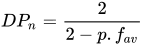
where is the extent of the reaction and is the average functionality of reaction mixture. For the gel can be considered to be infinite, thus the critical extent of the reaction at the gel point is found as


If is greater or equal to , gelation occurs.

Hub AI
Gelation AI simulator
(@Gelation_simulator)
Gelation
In polymer chemistry, gelation (gel transition) is the formation of a gel from a system with polymers. Branched polymers can form links between the chains, which lead to progressively larger polymers. As the linking continues, larger branched polymers are obtained and at a certain extent of the reaction, links between the polymer result in the formation of a single macroscopic molecule. At that point in the reaction, which is defined as gel point, the system loses fluidity and viscosity becomes very large. The onset of gelation, or gel point, is accompanied by a sudden increase in viscosity. This "infinite" sized polymer is called the gel or network, which does not dissolve in the solvent, but can swell in it.
Gelation is promoted by gelling agents. Gelation can occur either by physical linking or by chemical crosslinking. While the physical gels involve physical bonds, chemical gelation involves covalent bonds. The first quantitative theories of chemical gelation were formulated in the 1940s by Flory and Stockmayer. Critical percolation theory was successfully applied to gelation in 1970s. A number of growth models (diffusion limited aggregation, cluster-cluster aggregation, kinetic gelation) were developed in the 1980s to describe the kinetic aspects of aggregation and gelation.
It is important to be able to predict the onset of gelation, since it is an irreversible process that dramatically changes the properties of the system.
According to the Carothers equation number-average degree of polymerization is given by
where is the extent of the reaction and is the average functionality of reaction mixture. For the gel can be considered to be infinite, thus the critical extent of the reaction at the gel point is found as
If is greater or equal to , gelation occurs.