


Community hub
Recent from talks
Knowledge base stats:
Talk channels stats:
Members stats:
Generalized least squares
In statistics, generalized least squares (GLS) is a method used to estimate the unknown parameters in a linear regression model. It is used when there is a non-zero amount of correlation between the residuals in the regression model. GLS is employed to improve statistical efficiency and reduce the risk of drawing erroneous inferences, as compared to conventional least squares and weighted least squares methods. It was first described by Alexander Aitken in 1935.
It requires knowledge of the covariance matrix for the residuals. If this is unknown, estimating the covariance matrix gives the method of feasible generalized least squares (FGLS). However, FGLS provides fewer guarantees of improvement.
In standard linear regression models, one observes data on n statistical units with k − 1 predictor values and one response value each.

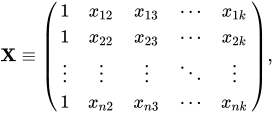
The response values are placed in a vector, and the predictor values are placed in the design matrix, where each row is a vector of the predictor variables (including a constant) for the th data point.



The model assumes that the conditional mean of given to be a linear function of and that the conditional variance of the error term given is a known non-singular covariance matrix, . That is, where is a vector of unknown constants, called "regression coefficients", which are estimated from the data.


![{\displaystyle \mathbf {y} =\mathbf {X} {\boldsymbol {\beta }}+{\boldsymbol {\varepsilon }},\quad \operatorname {E} [{\boldsymbol {\varepsilon }}\mid \mathbf {X} ]=0,\quad \operatorname {Cov} [{\boldsymbol {\varepsilon }}\mid \mathbf {X} ]={\boldsymbol {\Omega }},}](https://wikimedia.org/api/rest_v1/media/math/render/svg/683642aa3b58460b7a5b540950bac4037f946511)

If is a candidate estimate for , then the residual vector for is . The generalized least squares method estimates by minimizing the squared Mahalanobis length of this residual vector:which is equivalent towhich is a quadratic programming problem. The stationary point of the objective function occurs whenso the estimator isThe quantity is known as the precision matrix (or dispersion matrix), a generalization of the diagonal weight matrix.







The GLS estimator is unbiased, consistent, efficient, and asymptotically normal withGLS is equivalent to applying ordinary least squares (OLS) to a linearly transformed version of the data. This can be seen by factoring using a method such as Cholesky decomposition. Left-multiplying both sides of by yields an equivalent linear model: In this model, , where is the identity matrix. Then, can be efficiently estimated by applying OLS to the transformed data, which requires minimizing the objective, This transformation effectively standardizes the scale of and de-correlates the errors. When OLS is used on data with homoscedastic errors, the Gauss–Markov theorem applies, so the GLS estimate is the best linear unbiased estimator for .
![{\displaystyle \operatorname {E} [{\hat {\boldsymbol {\beta }}}\mid \mathbf {X} ]={\boldsymbol {\beta }},\quad {\text{and}}\quad \operatorname {Cov} [{\hat {\boldsymbol {\beta }}}\mid \mathbf {X} ]=(\mathbf {X} ^{\mathrm {T} }{\boldsymbol {\Omega }}^{-1}\mathbf {X} )^{-1}.}](https://wikimedia.org/api/rest_v1/media/math/render/svg/3a8344a9e62819b63868500a361c5676dc827947)



![{\displaystyle \operatorname {Var} [{\boldsymbol {\varepsilon }}^{*}\mid \mathbf {X} ]=\mathbf {C} ^{-1}\mathbf {\Omega } \left(\mathbf {C} ^{-1}\right)^{\mathrm {T} }=\mathbf {I} }](https://wikimedia.org/api/rest_v1/media/math/render/svg/5e6f385468f68d478ee1d59bec298320f79c1fff)


A special case of GLS, called weighted least squares (WLS), occurs when all the off-diagonal entries of Ω are 0. This situation arises when the variances of the observed values are unequal or when heteroscedasticity is present, but no correlations exist among the observed variances. The weight for unit i is proportional to the reciprocal of the variance of the response for unit i.
Hub AI
Generalized least squares AI simulator
(@Generalized least squares_simulator)
Generalized least squares
In statistics, generalized least squares (GLS) is a method used to estimate the unknown parameters in a linear regression model. It is used when there is a non-zero amount of correlation between the residuals in the regression model. GLS is employed to improve statistical efficiency and reduce the risk of drawing erroneous inferences, as compared to conventional least squares and weighted least squares methods. It was first described by Alexander Aitken in 1935.
It requires knowledge of the covariance matrix for the residuals. If this is unknown, estimating the covariance matrix gives the method of feasible generalized least squares (FGLS). However, FGLS provides fewer guarantees of improvement.
In standard linear regression models, one observes data on n statistical units with k − 1 predictor values and one response value each.
The response values are placed in a vector, and the predictor values are placed in the design matrix, where each row is a vector of the predictor variables (including a constant) for the th data point.
The model assumes that the conditional mean of given to be a linear function of and that the conditional variance of the error term given is a known non-singular covariance matrix, . That is, where is a vector of unknown constants, called "regression coefficients", which are estimated from the data.
If is a candidate estimate for , then the residual vector for is . The generalized least squares method estimates by minimizing the squared Mahalanobis length of this residual vector:which is equivalent towhich is a quadratic programming problem. The stationary point of the objective function occurs whenso the estimator isThe quantity is known as the precision matrix (or dispersion matrix), a generalization of the diagonal weight matrix.
The GLS estimator is unbiased, consistent, efficient, and asymptotically normal withGLS is equivalent to applying ordinary least squares (OLS) to a linearly transformed version of the data. This can be seen by factoring using a method such as Cholesky decomposition. Left-multiplying both sides of by yields an equivalent linear model: In this model, , where is the identity matrix. Then, can be efficiently estimated by applying OLS to the transformed data, which requires minimizing the objective, This transformation effectively standardizes the scale of and de-correlates the errors. When OLS is used on data with homoscedastic errors, the Gauss–Markov theorem applies, so the GLS estimate is the best linear unbiased estimator for .
A special case of GLS, called weighted least squares (WLS), occurs when all the off-diagonal entries of Ω are 0. This situation arises when the variances of the observed values are unequal or when heteroscedasticity is present, but no correlations exist among the observed variances. The weight for unit i is proportional to the reciprocal of the variance of the response for unit i.