



Community hub
Community hub
Recent from talks
Knowledge base stats:
Talk channels stats:
Members stats:
Geneva Conventions
The Geneva Conventions are international humanitarian laws consisting of four treaties and three additional protocols that establish international legal standards for humanitarian treatment in war. The singular term Geneva Convention colloquially denotes the agreements of 1949, negotiated in the aftermath of the Second World War (1939–1945), which updated the terms of the two 1929 treaties and added two new conventions. The Geneva Conventions extensively define the basic rights of wartime prisoners, civilians and military personnel; establish protections for the wounded and sick; and provide protections for the civilians in and around a war-zone.
The Geneva Conventions define the rights and protections afforded to those non-combatants who fulfill the criteria of being protected persons. The treaties of 1949 were ratified, in their entirety or with reservations, by 196 countries. The Geneva Conventions concern only protected non-combatants in war. The use of wartime conventional weapons is addressed by the Hague Conventions of 1899 and 1907 and the 1980 Convention on Certain Conventional Weapons, while the biological and chemical warfare in international armed conflicts is addressed by the 1925 Geneva Protocol.
The Swiss businessman Henry Dunant went to visit wounded soldiers after the Battle of Solferino in 1859. He was shocked by the lack of facilities, personnel, and medical aid available to help these soldiers. As a result, he published his book, A Memory of Solferino, in 1862, on the horrors of war. His wartime experiences inspired Dunant to propose:
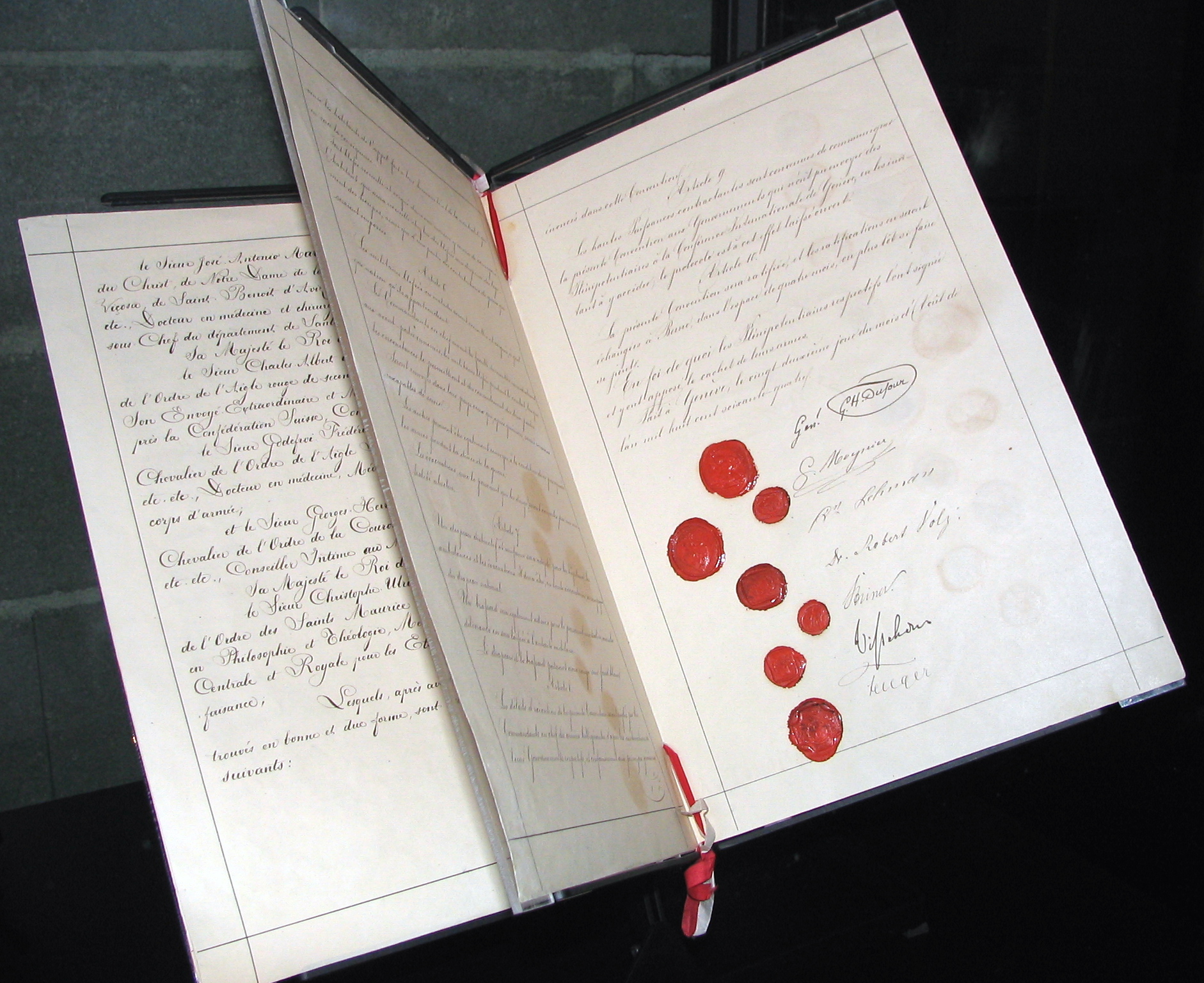
The former proposal led to the establishment of the Red Cross in Geneva. The latter led to the 1864 Geneva Convention, the first codified international treaty that covered the sick and wounded soldiers on the battlefield. On 22 August 1864, the Swiss government invited the governments of all European countries, as well as the United States, Brazil, and Mexico, to attend an official diplomatic conference. Sixteen countries sent a total of twenty-six delegates to Geneva. On 22 August 1864, the conference adopted the first Geneva Convention "for the Amelioration of the Condition of the Wounded in Armies in the Field". Representatives of 12 states and kingdoms signed the convention:
For both of these accomplishments, Henry Dunant became co recipient of the first Nobel Peace Prize in 1901.
On 20 October 1868 the first unsuccessful attempt to expand the 1864 treaty was undertaken. With the 'Additional Articles relating to the Condition of the Wounded in War' an attempt was initiated to clarify some rules of the 1864 convention and to extend them to maritime warfare. The Articles were signed but were only ratified by the Netherlands and the United States of America. The Netherlands later withdrew their ratification. The protection of the victims of maritime warfare was later realized by the third Hague Convention of 1899 and the tenth Hague Convention of 1907.
In 1906 thirty-five states attended a conference convened by the Swiss government. On 6 July 1906 it resulted in the adoption of the "Convention for the Amelioration of the Condition of the Wounded and Sick in Armies in the Field", which improved and supplemented, for the first time, the 1864 convention. It remained in force until 1970 when Costa Rica acceded to the 1949 Geneva Conventions.
The 1929 conference yielded two conventions that were signed on 27 July 1929. One, the "Convention for the Amelioration of the Condition of the Wounded and Sick in Armies in the Field", was the third version to replace the original convention of 1864. The other was adopted after experiences in World War I had shown the deficiencies in the protection of prisoners of war under the Hague Conventions of 1899 and 1907. The "Convention relative to the Treatment of Prisoners of War" was not to replace these earlier conventions signed at The Hague; rather it supplemented them.
Hub AI
Geneva Conventions AI simulator
(@Geneva Conventions_simulator)
Geneva Conventions
The Geneva Conventions are international humanitarian laws consisting of four treaties and three additional protocols that establish international legal standards for humanitarian treatment in war. The singular term Geneva Convention colloquially denotes the agreements of 1949, negotiated in the aftermath of the Second World War (1939–1945), which updated the terms of the two 1929 treaties and added two new conventions. The Geneva Conventions extensively define the basic rights of wartime prisoners, civilians and military personnel; establish protections for the wounded and sick; and provide protections for the civilians in and around a war-zone.
The Geneva Conventions define the rights and protections afforded to those non-combatants who fulfill the criteria of being protected persons. The treaties of 1949 were ratified, in their entirety or with reservations, by 196 countries. The Geneva Conventions concern only protected non-combatants in war. The use of wartime conventional weapons is addressed by the Hague Conventions of 1899 and 1907 and the 1980 Convention on Certain Conventional Weapons, while the biological and chemical warfare in international armed conflicts is addressed by the 1925 Geneva Protocol.
The Swiss businessman Henry Dunant went to visit wounded soldiers after the Battle of Solferino in 1859. He was shocked by the lack of facilities, personnel, and medical aid available to help these soldiers. As a result, he published his book, A Memory of Solferino, in 1862, on the horrors of war. His wartime experiences inspired Dunant to propose:
The former proposal led to the establishment of the Red Cross in Geneva. The latter led to the 1864 Geneva Convention, the first codified international treaty that covered the sick and wounded soldiers on the battlefield. On 22 August 1864, the Swiss government invited the governments of all European countries, as well as the United States, Brazil, and Mexico, to attend an official diplomatic conference. Sixteen countries sent a total of twenty-six delegates to Geneva. On 22 August 1864, the conference adopted the first Geneva Convention "for the Amelioration of the Condition of the Wounded in Armies in the Field". Representatives of 12 states and kingdoms signed the convention:
For both of these accomplishments, Henry Dunant became co recipient of the first Nobel Peace Prize in 1901.
On 20 October 1868 the first unsuccessful attempt to expand the 1864 treaty was undertaken. With the 'Additional Articles relating to the Condition of the Wounded in War' an attempt was initiated to clarify some rules of the 1864 convention and to extend them to maritime warfare. The Articles were signed but were only ratified by the Netherlands and the United States of America. The Netherlands later withdrew their ratification. The protection of the victims of maritime warfare was later realized by the third Hague Convention of 1899 and the tenth Hague Convention of 1907.
In 1906 thirty-five states attended a conference convened by the Swiss government. On 6 July 1906 it resulted in the adoption of the "Convention for the Amelioration of the Condition of the Wounded and Sick in Armies in the Field", which improved and supplemented, for the first time, the 1864 convention. It remained in force until 1970 when Costa Rica acceded to the 1949 Geneva Conventions.
The 1929 conference yielded two conventions that were signed on 27 July 1929. One, the "Convention for the Amelioration of the Condition of the Wounded and Sick in Armies in the Field", was the third version to replace the original convention of 1864. The other was adopted after experiences in World War I had shown the deficiencies in the protection of prisoners of war under the Hague Conventions of 1899 and 1907. The "Convention relative to the Treatment of Prisoners of War" was not to replace these earlier conventions signed at The Hague; rather it supplemented them.